
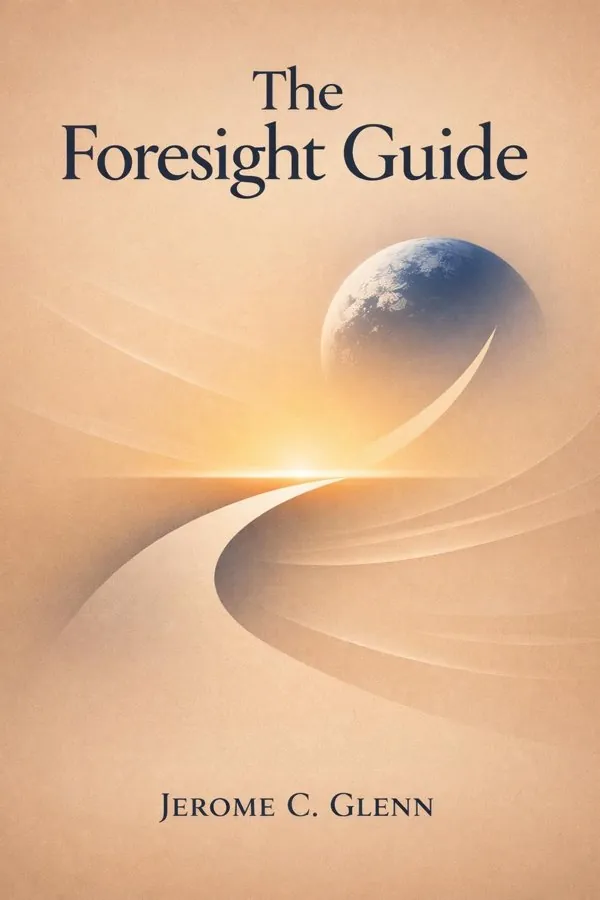
The Foresight Guide: Summary & Key Insights
 10 min5 chaptersAudio available
What Is The Foresight Guide About?
The Foresight Guide by Jerome C. Glenn is a future_trends book spanning 5 pages. The Foresight Guide is a comprehensive manual on futures studies and strategic foresight, written by Jerome C. Glenn, co-founder of The Millennium Project. It provides frameworks, methodologies, and tools for anticipating and shaping the future, covering topics such as scenario planning, trend analysis, and global challenges. The book serves as both a textbook and a practical guide for policymakers, researchers, and futurists.
This FizzRead summary covers all 5 key chapters of The Foresight Guide in approximately 10 minutes, distilling the most important ideas, arguments, and takeaways from Jerome C. Glenn's work. Also available as an audio summary and Key Quotes Podcast.
The Foresight Guide
The Foresight Guide is a comprehensive manual on futures studies and strategic foresight, written by Jerome C. Glenn, co-founder of The Millennium Project. It provides frameworks, methodologies, and tools for anticipating and shaping the future, covering topics such as scenario planning, trend analysis, and global challenges. The book serves as both a textbook and a practical guide for policymakers, researchers, and futurists.
Who Should Read The Foresight Guide?
This book is perfect for anyone interested in future_trends and looking to gain actionable insights in a short read. Whether you're a student, professional, or lifelong learner, the key ideas from The Foresight Guide by Jerome C. Glenn will help you think differently.
- ✓Readers who enjoy future_trends and want practical takeaways
- ✓Professionals looking to apply new ideas to their work and life
- ✓Anyone who wants the core insights of The Foresight Guide in just 10 minutes
Want the full summary?
Get instant access to this book summary and 100K+ more with Fizz Moment.
Get Free SummaryAvailable on App Store • Free to download
Key Chapters
Every field begins with a question. For futures studies, that question was simple but radical: can we improve how humanity prepares for change? The origins of formal foresight emerge in the mid-twentieth century, when rapid technological advances and global tensions demanded more systematic ways of thinking about what lay ahead. In the 1940s and 1950s, institutions like the RAND Corporation pioneered early scenario planning techniques for defense purposes. Figures such as Herman Kahn, often considered one of the founding futurists, introduced the idea of exploring multiple alternative futures rather than seeking a single prediction.
As the decades progressed, futures research expanded beyond its military and corporate beginnings. In the 1960s and 1970s, social and environmental movements brought a new emphasis on long-term global challenges. The Club of Rome’s *Limits to Growth* study in 1972 marked a watershed moment. It framed the world as an interconnected system vulnerable to overconsumption and ecological strain. This era broadened the aims of futures studies from strategic advantage to global sustainability.
By the late twentieth century, a rich tapestry of methodologies had evolved. The work of The Millennium Project, which I co-founded, sought to unify these approaches into a global framework. We aimed to link scenario building with empirical research on global megatrends and emerging issues. Through our *State of the Future* reports, we began to map key challenges confronting humanity—from water scarcity to demographic shifts to the transformative potential of artificial intelligence.
The evolution of futures studies mirrors our growing awareness that no single discipline, nation, or ideology holds a monopoly on the future. Instead, the future arises from the complex interplay of many actors, innovations, and unintended consequences. The role of the futurist, therefore, is not to dictate outcomes, but to help people see patterns, connect insights across domains, and imagine a range of possible worlds.
The cultural shift toward foresight has deepened as well. Universities began offering futures programs; governments established foresight units; corporations integrated scenario thinking into strategic planning. What unites all these efforts is an acknowledgment that the future is too important to be left to chance—or to experts alone. Every individual has a stake in shaping it, and the methods of foresight exist to make that participation informed and effective.
The world isn’t a collection of isolated problems. It’s an intricate ecosystem where every decision ripples outward in ways we rarely predict. Systems thinking invites us to see these interdependencies. It asks us to replace linear cause-and-effect with circular feedback—the kind that governs climate systems, markets, societies, and even our own minds.
When I began teaching systems thinking, I found that many people resist it at first. We are trained to break things down into parts. But the future seldom unfolds linearly. Consider technological innovation: a new tool can trigger economic shifts, alter behaviors, create governance challenges, and then loop back to spur new technologies. Without a systemic lens, these relationships look chaotic. With it, we begin to see structure, leverage points, and opportunities to intervene wisely.
In *The Foresight Guide*, I urge readers to map systems visually. Use models like the *Futures Wheel* to explore how one change cascades into others. This method, developed during my early work with futures research networks, allows teams to chart the secondary and tertiary consequences of emerging issues. The exercise builds not just insight but empathy—because systems thinking teaches us that every stakeholder’s action makes sense within their own feedback loops.
Understanding systems also helps us grasp why foresight matters ethically. When we intervene in one part of a system, we can inadvertently harm another. A policy promoting rapid industrialization may raise incomes but degrade ecosystems. Systems thinking asks us to balance competing outcomes, to design futures that sustain rather than exploit. It cultivates accountability by showing that in complex systems, we are all both cause and effect.
Ultimately, systems thinking is less a technique than a worldview. It teaches humility before complexity and optimism that intelligent design can bend systems toward resilience. Once you internalize this pattern of thought, foresight ceases to be about speculation—it becomes a disciplined exploration of how change actually works.
+ 3 more chapters — available in the FizzRead app
All Chapters in The Foresight Guide
About the Author
Jerome C. Glenn is an American futurist and co-founder of The Millennium Project, an independent think tank focused on global futures research. He has worked extensively in futures studies, science and technology policy, and global strategic planning.
Get This Summary in Your Preferred Format
Read or listen to the The Foresight Guide summary by Jerome C. Glenn anytime, anywhere. FizzRead offers multiple formats so you can learn on your terms — all free.
Available formats: App · Audio · PDF · EPUB — All included free with FizzRead
Download The Foresight Guide PDF and EPUB Summary
Key Quotes from The Foresight Guide
“For futures studies, that question was simple but radical: can we improve how humanity prepares for change?”
“The world isn’t a collection of isolated problems.”
Frequently Asked Questions about The Foresight Guide
The Foresight Guide by Jerome C. Glenn is a future_trends book that explores key ideas across 5 chapters. The Foresight Guide is a comprehensive manual on futures studies and strategic foresight, written by Jerome C. Glenn, co-founder of The Millennium Project. It provides frameworks, methodologies, and tools for anticipating and shaping the future, covering topics such as scenario planning, trend analysis, and global challenges. The book serves as both a textbook and a practical guide for policymakers, researchers, and futurists.
More by Jerome C. Glenn

You Might Also Like
Futureproof: 9 Rules for Humans in the Age of Automation
Kevin Roose
10 min
The Third Wave
Alvin Toffler
10 min
2030: How Today's Biggest Trends Will Collide and Reshape the Future of Everything
Mauro F. Guillén
10 min
A Very Human Future: Enriching Humanity in a Digitized World
Rohit Talwar, Steve Wells, Alexandra Whittington
10 min
AI 2041: Ten Visions for Our Future
Kai-Fu Lee, Chen Qiufan
10 min
Abundance: The Future Is Better Than You Think
Peter H. Diamandis, Steven Kotler
10 minBrowse by Category
Ready to read The Foresight Guide?
Get the full summary and 100K+ more books with Fizz Moment.