
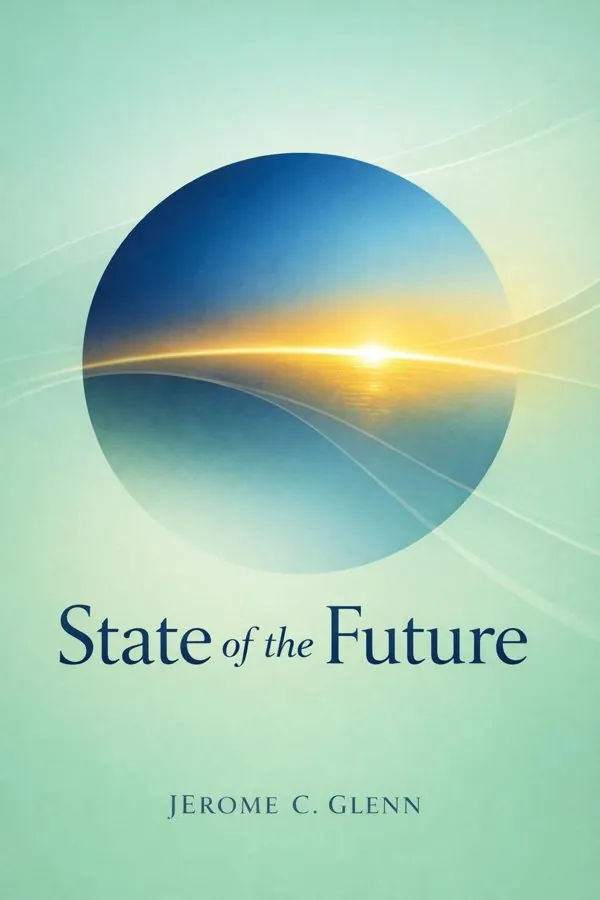
State of the Future: Summary & Key Insights
 10 min9 chaptersAudio available
Key Takeaways from State of the Future
The future rarely breaks down into neat categories, and that is precisely why Jerome C.
Progress that destroys its own foundations is not progress at all.
Every major leap in technology gives humanity new capabilities, but it also increases the consequences of human judgment.
A world of accelerating change cannot be managed with institutions designed for slower eras.
Humanity’s technical abilities are growing faster than its moral coordination, and that gap may be one of the century’s greatest dangers.
What Is State of the Future About?
State of the Future by Jerome C. Glenn is a future_trends book spanning 6 pages. State of the Future is not a conventional book with a single storyline or argument. It is a global intelligence report on the human condition, drawing together data, expert judgment, trend analysis, and scenario thinking to answer one urgent question: where is civilization heading, and what can we still influence? Produced through the Millennium Project and closely associated with futurist Jerome C. Glenn, the work examines the interconnected systems shaping our future, from climate change and energy to governance, ethics, education, health, technology, and security. Its central contribution is to replace fragmented thinking with a whole-systems view of humanity’s prospects. What makes this work especially valuable is its combination of breadth and practicality. Glenn does not merely describe risks; he organizes them into frameworks that help leaders think more clearly, compare priorities, and act with longer time horizons. His authority comes from decades of futures research, international collaboration, and the Millennium Project’s network of experts across disciplines and regions. For policymakers, entrepreneurs, educators, and citizens alike, State of the Future offers something rare: a disciplined way to think about global change before it becomes crisis.
This FizzRead summary covers all 9 key chapters of State of the Future in approximately 10 minutes, distilling the most important ideas, arguments, and takeaways from Jerome C. Glenn's work. Also available as an audio summary and Key Quotes Podcast.
State of the Future
State of the Future is not a conventional book with a single storyline or argument. It is a global intelligence report on the human condition, drawing together data, expert judgment, trend analysis, and scenario thinking to answer one urgent question: where is civilization heading, and what can we still influence? Produced through the Millennium Project and closely associated with futurist Jerome C. Glenn, the work examines the interconnected systems shaping our future, from climate change and energy to governance, ethics, education, health, technology, and security. Its central contribution is to replace fragmented thinking with a whole-systems view of humanity’s prospects.
What makes this work especially valuable is its combination of breadth and practicality. Glenn does not merely describe risks; he organizes them into frameworks that help leaders think more clearly, compare priorities, and act with longer time horizons. His authority comes from decades of futures research, international collaboration, and the Millennium Project’s network of experts across disciplines and regions. For policymakers, entrepreneurs, educators, and citizens alike, State of the Future offers something rare: a disciplined way to think about global change before it becomes crisis.
Who Should Read State of the Future?
This book is perfect for anyone interested in future_trends and looking to gain actionable insights in a short read. Whether you're a student, professional, or lifelong learner, the key ideas from State of the Future by Jerome C. Glenn will help you think differently.
- ✓Readers who enjoy future_trends and want practical takeaways
- ✓Professionals looking to apply new ideas to their work and life
- ✓Anyone who wants the core insights of State of the Future in just 10 minutes
Want the full summary?
Get instant access to this book summary and 100K+ more with Fizz Moment.
Get Free SummaryAvailable on App Store • Free to download
Key Chapters
The future rarely breaks down into neat categories, and that is precisely why Jerome C. Glenn’s framework of the 15 Global Challenges matters so much. One of the report’s deepest insights is that humanity’s biggest problems are not separate issues to be solved one by one. Food security affects migration. Migration influences politics. Politics shapes climate action. Climate disruption affects health, water, and conflict. Once you see these connections, simplistic solutions stop looking credible.
The 15 Global Challenges were developed to help decision-makers understand the world as a system rather than a collection of isolated crises. They include challenges such as sustainable development, clean water, population dynamics, democratization, long-term thinking, information technology, rich-poor gaps, disease, energy, peace and conflict, the status of women, organized crime, and global ethics. Instead of predicting one fixed future, the framework highlights where pressures are building and where coordinated action could generate the greatest leverage.
This way of thinking has practical value far beyond international policy. A city government planning transport, housing, and public safety can use systems thinking to avoid solving one problem while worsening another. A company making long-term investments can examine how climate, regulation, labor trends, and public trust intersect. Even educators can use the framework to teach students how to reason across domains rather than memorize disconnected facts.
The report’s message is clear: intelligent foresight begins with organized complexity. If you want to think more effectively about the future, stop asking, “What is the single biggest problem?” and start asking, “How do the major forces interact?” Actionable takeaway: map one issue you care about by identifying at least five connected challenges around it, then look for interventions that improve more than one area at once.
Progress that destroys its own foundations is not progress at all. One of the central themes of State of the Future is that sustainable development must be understood as stewardship of interconnected natural, economic, and social systems. For too long, societies measured success primarily through growth in production and consumption, often ignoring the ecological costs and long-term fragility created by that model. Glenn’s work argues that the future belongs to societies that can generate prosperity without depleting the environmental and institutional resources on which prosperity depends.
The report treats sustainability not as a niche environmental concern but as a core operating principle for civilization. Water use, biodiversity loss, land degradation, ocean health, urban expansion, and carbon emissions all feed into the same question: can human systems remain viable under rising population expectations and planetary constraints? This requires more than cleaner technology. It requires better accounting, smarter incentives, and decision-making that recognizes delayed consequences.
Practical examples help ground this idea. A government that subsidizes renewable energy while redesigning cities for public transit is not just reducing emissions; it is also improving air quality, public health, and energy security. A company that shifts to circular production, reducing waste and reusing materials, lowers exposure to resource volatility while meeting rising consumer expectations. A farming region that invests in soil restoration and water efficiency improves resilience against drought while protecting long-term productivity.
Sustainability in Glenn’s framing is ultimately about design intelligence: aligning economic systems with ecological reality. That means moving beyond short-term extraction toward regeneration, efficiency, and resilience. Actionable takeaway: evaluate one personal, organizational, or civic goal through a sustainability lens by asking whether it creates value today while preserving the resources and stability needed tomorrow.
Every major leap in technology gives humanity new capabilities, but it also increases the consequences of human judgment. State of the Future treats science and technology as among the most powerful drivers of transformation, not because innovation is automatically beneficial, but because it magnifies both wisdom and error. Artificial intelligence, biotechnology, robotics, advanced materials, sensors, and global information networks can improve health, productivity, education, and sustainability. Yet they can also deepen inequality, erode privacy, destabilize labor markets, and accelerate poorly governed risks.
Glenn’s perspective is neither techno-utopian nor anti-technology. Instead, he asks a more useful question: under what conditions does innovation improve the human future? That depends on governance, ethics, access, and foresight. A breakthrough in gene editing may save lives, but without inclusive standards and international cooperation it may also create moral and geopolitical tensions. AI can improve diagnostics, logistics, and disaster prediction, but without transparency and accountability it can harden bias and shift power toward unaccountable institutions.
The practical implications are immediate. Schools must teach not just digital literacy but judgment, adaptability, and ethical reasoning. Governments must build regulatory frameworks that are agile enough to evolve with innovation instead of lagging by a decade. Businesses must conduct technology assessments that consider downstream social effects, not merely short-term profitability. Individuals also need a healthier relationship with technology, using digital tools intentionally rather than passively accepting whatever captures attention.
The deeper point is that technology does not determine the future on its own. Institutions, values, and incentives shape whether new tools become instruments of liberation or control. Actionable takeaway: whenever evaluating a new technology, ask three questions before embracing it: what problem does it solve, who benefits most, and what unintended consequences might emerge if it scales rapidly?
A world of accelerating change cannot be managed with institutions designed for slower eras. One of the most important insights in State of the Future is that governance capacity is becoming a decisive factor in whether societies can navigate the future successfully. Many of today’s institutions were built to handle local, linear, and relatively predictable problems. But climate change, cyber threats, pandemics, migration, financial contagion, and disinformation are cross-border, nonlinear, and often faster than the policy cycles meant to address them.
Glenn argues that governance must become more anticipatory, collaborative, and evidence-based. This does not simply mean larger government. It means better governance across public institutions, private actors, civil society, and international networks. Effective governance is the ability to detect emerging threats early, coordinate across sectors, maintain legitimacy, and adapt under uncertainty. It also requires ethical foundations, because technical competence without public trust eventually fails.
Examples of stronger governance can already be seen. Cities using open data and participatory planning often make better infrastructure decisions because residents contribute local insight. International disease surveillance networks improve outbreak response by sharing information quickly across borders. Independent ethics boards for emerging technologies can help organizations identify harms before they become scandals. Even at a workplace level, better governance might mean transparent decision rights, feedback mechanisms, and scenario planning rather than improvising under pressure.
The report repeatedly shows that reactive systems pay more later for what they refused to prepare for earlier. Governance, then, is not bureaucracy for its own sake; it is society’s problem-solving architecture. If that architecture is outdated, every future challenge becomes harder. Actionable takeaway: strengthen one decision process in your organization or community by adding a forward-looking review step that asks what risks, stakeholders, and second-order effects are being ignored.
Humanity’s technical abilities are growing faster than its moral coordination, and that gap may be one of the century’s greatest dangers. State of the Future emphasizes that global ethics are not abstract philosophy reserved for scholars; they are practical necessities in an interdependent world. When environmental harms cross borders, when data flows globally, when supply chains link distant labor markets, and when advanced technologies affect all humanity, ethical reasoning can no longer remain narrowly national or purely individual.
Glenn’s work asks us to think about ethics as a form of collective intelligence. What values should guide decisions that affect future generations? How should benefits and risks be shared? What rights should be protected in digital environments? How should power be constrained when tools become more invasive and more scalable? These are not optional questions to address after innovation or growth has already occurred. They are design questions that shape what kind of civilization emerges.
In practical terms, global ethics appears in debates over responsible AI, climate justice, access to vaccines, labor standards in global supply chains, and equitable sharing of technological gains. A company choosing transparent sourcing is making an ethical and strategic decision. A government considering the rights implications of surveillance is doing more than compliance; it is defining the social contract. A university teaching future engineers to examine bias, dignity, and unintended harm is preparing them to build responsibly.
The report suggests that long-term survival depends not only on intelligence and wealth but on moral maturity. Without shared norms, cooperation breaks down precisely when it is most needed. Actionable takeaway: when making a significant decision, explicitly identify who bears the costs, who gains the benefits, and whether people without power or future generations are being treated as invisible stakeholders.
Some of the most urgent threats to the future come bundled together, and few clusters matter more than health, energy, and climate. State of the Future shows that these are not separate policy domains but deeply connected systems. Energy choices affect emissions. Emissions affect climate. Climate affects disease spread, food systems, water stress, displacement, and extreme weather. Public health resilience depends not just on hospitals and medicine, but on infrastructure, air quality, stable power, and functioning ecosystems.
This interconnected view changes how solutions are designed. For example, reducing reliance on fossil fuels is not only a climate strategy. It can also lower respiratory illness, reduce geopolitical dependence, and improve urban quality of life. Strengthening local energy grids with renewables and storage can keep medical services running during disasters. Climate adaptation measures such as cooling centers, flood defenses, and resilient agriculture are also health interventions because they reduce exposure to injury, hunger, and disease.
Glenn’s broader point is that future planning must move from siloed responses to integrated resilience. A nation that invests only in emergency medicine while ignoring pollution, water systems, and heat risk is treating symptoms rather than causes. Likewise, an energy plan that ignores health impacts or climate volatility is incomplete by design. Organizations can apply this principle too: a campus or company can evaluate buildings, transport, food, and energy use as part of one resilience strategy rather than isolated sustainability projects.
The future will reward societies that can connect public health, environmental policy, and energy transition into one coherent agenda. Actionable takeaway: identify one health issue in your community, then trace how it is influenced by environmental conditions and energy systems; use that map to support broader, prevention-focused solutions instead of narrow short-term fixes.
The future cannot be predicted with precision, but it can be explored intelligently. One of the most practical contributions of State of the Future is its emphasis on scenario planning as a tool for better decisions. Glenn does not present foresight as fortune-telling. Instead, he treats it as disciplined imagination: constructing plausible alternative futures so that leaders can test assumptions, identify vulnerabilities, and build flexibility before events force adaptation.
Scenario planning matters because most organizations quietly assume continuity. They budget as if trends will remain stable, as if shocks will stay manageable, and as if institutions will have time to react. But the report makes clear that discontinuities are normal in a complex world. Technological breakthroughs, extreme climate events, geopolitical conflict, demographic shifts, pandemics, and social unrest can rapidly alter the context in which plans were made. Scenario work helps organizations avoid the blindness that comes from relying on one default expectation.
In practice, a business might develop scenarios around supply chain fragmentation, AI-driven competition, or resource scarcity. A city might imagine futures involving rapid migration, severe heat waves, or declining tax bases. A university might test what happens if remote learning, demographic change, and labor market disruption converge. The point is not to guess correctly in every detail. It is to ask better questions now: What signs would indicate a scenario is emerging? Which strategies work across multiple futures? Where are we overexposed?
Foresight turns uncertainty from a source of paralysis into a source of preparation. The more complex the world becomes, the more valuable this mindset is. Actionable takeaway: create three plausible future scenarios for one major decision you face, then choose actions that remain useful across all three rather than betting everything on a single forecast.
A society cannot meet future challenges with people trained only for yesterday’s conditions. Although State of the Future covers many sectors, one of its implied lessons is that education sits underneath them all. Whether the issue is democracy, technology, sustainability, or health, progress depends on human beings who can think critically, collaborate across differences, interpret evidence, and adapt to rapid change. Information alone is no longer enough; what matters is the ability to make sense of complexity and act responsibly within it.
Glenn’s futures perspective pushes education beyond narrow job preparation. Yes, labor markets will change, and people will need new technical skills throughout life. But the deeper challenge is civic and cognitive. Citizens must be able to resist misinformation, weigh long-term consequences, and understand systems. Leaders must become comfortable making decisions under uncertainty. Professionals in every field will need ethical reasoning because technical tools are becoming more powerful and more consequential.
This has practical applications at every level. Schools can teach systems thinking by showing how water, food, energy, and economics interact. Universities can combine technical training with public ethics and scenario analysis. Employers can invest in lifelong learning instead of assuming degrees completed years ago are sufficient. Families and individuals can also cultivate future readiness by encouraging curiosity, media literacy, and the habit of asking second-order questions: what happens next, and for whom?
The report suggests that the quality of future civilization will depend heavily on the quality of future learning. Education is not a background issue; it is a strategic capability. Actionable takeaway: upgrade your learning habits by choosing one future-relevant skill to develop this year, while also practicing one cross-cutting capability such as critical thinking, systems mapping, or ethical analysis.
One of the most refreshing qualities of State of the Future is that it refuses both naive optimism and fatalistic despair. The report acknowledges profound risks, but it also insists that the future remains open to influence. This is a crucial distinction. Hope, in Glenn’s framework, is not wishful thinking that things will somehow improve. It is the disciplined belief that informed, coordinated action can alter trajectories. In that sense, hope is less a mood than a strategy.
This matters because public conversations about the future often swing between extremes. On one side are narratives of inevitable progress driven by technology. On the other are narratives of collapse in which individual and institutional action seems pointless. Glenn offers a more demanding alternative: the future will likely contain both breakthroughs and breakdowns, and our responsibility is to strengthen the conditions that make better outcomes more probable.
Practical examples are everywhere. Local communities can improve resilience with emergency planning, green infrastructure, and inclusive public dialogue. Businesses can embed long-term risk reviews into strategy rather than focusing only on quarterly performance. Philanthropic organizations can support cross-border problem solving on issues like water, education, and public health. Individuals can engage politically, reduce personal blind spots, and support leaders who think beyond the next news cycle.
The underlying lesson is empowering precisely because it is realistic. No one can control the future, but many actors can shape it. Foresight therefore becomes a civic responsibility: seeing farther so we can act sooner. Actionable takeaway: choose one future issue that concerns you, identify one lever you can influence directly, and commit to a recurring action rather than waiting for perfect solutions or global consensus.
All Chapters in State of the Future
About the Author
Jerome C. Glenn is an American futurist, strategist, and co-founder of the Millennium Project, a global participatory think tank dedicated to futures research. Over the course of his career, he has worked on long-range planning, scenario development, policy analysis, and methods for assessing global change. Glenn is especially known for helping develop frameworks that allow governments, institutions, and researchers to think systematically about emerging risks and opportunities. His work often bridges disciplines, combining technology forecasting, governance analysis, sustainability, and ethics into practical tools for decision-making. Through the State of the Future reports and the Millennium Project’s international network, he has become one of the most influential voices in applied foresight, helping shape how leaders around the world approach long-term challenges.
Get This Summary in Your Preferred Format
Read or listen to the State of the Future summary by Jerome C. Glenn anytime, anywhere. FizzRead offers multiple formats so you can learn on your terms — all free.
Available formats: App · Audio · PDF · EPUB — All included free with FizzRead
Download State of the Future PDF and EPUB Summary
Key Quotes from State of the Future
“The future rarely breaks down into neat categories, and that is precisely why Jerome C.”
“Progress that destroys its own foundations is not progress at all.”
“Every major leap in technology gives humanity new capabilities, but it also increases the consequences of human judgment.”
“A world of accelerating change cannot be managed with institutions designed for slower eras.”
“Humanity’s technical abilities are growing faster than its moral coordination, and that gap may be one of the century’s greatest dangers.”
Frequently Asked Questions about State of the Future
State of the Future by Jerome C. Glenn is a future_trends book that explores key ideas across 9 chapters. State of the Future is not a conventional book with a single storyline or argument. It is a global intelligence report on the human condition, drawing together data, expert judgment, trend analysis, and scenario thinking to answer one urgent question: where is civilization heading, and what can we still influence? Produced through the Millennium Project and closely associated with futurist Jerome C. Glenn, the work examines the interconnected systems shaping our future, from climate change and energy to governance, ethics, education, health, technology, and security. Its central contribution is to replace fragmented thinking with a whole-systems view of humanity’s prospects. What makes this work especially valuable is its combination of breadth and practicality. Glenn does not merely describe risks; he organizes them into frameworks that help leaders think more clearly, compare priorities, and act with longer time horizons. His authority comes from decades of futures research, international collaboration, and the Millennium Project’s network of experts across disciplines and regions. For policymakers, entrepreneurs, educators, and citizens alike, State of the Future offers something rare: a disciplined way to think about global change before it becomes crisis.
More by Jerome C. Glenn
You Might Also Like
Futureproof: 9 Rules for Humans in the Age of Automation
Kevin Roose
10 min
The Third Wave
Alvin Toffler
10 min
2030: How Today's Biggest Trends Will Collide and Reshape the Future of Everything
Mauro F. Guillén
10 min
A Very Human Future: Enriching Humanity in a Digitized World
Rohit Talwar, Steve Wells, Alexandra Whittington
10 min
AI 2041: Ten Visions for Our Future
Kai-Fu Lee, Chen Qiufan
10 min
Abundance: The Future Is Better Than You Think
Peter H. Diamandis, Steven Kotler
10 minBrowse by Category
Ready to read State of the Future?
Get the full summary and 100K+ more books with Fizz Moment.