
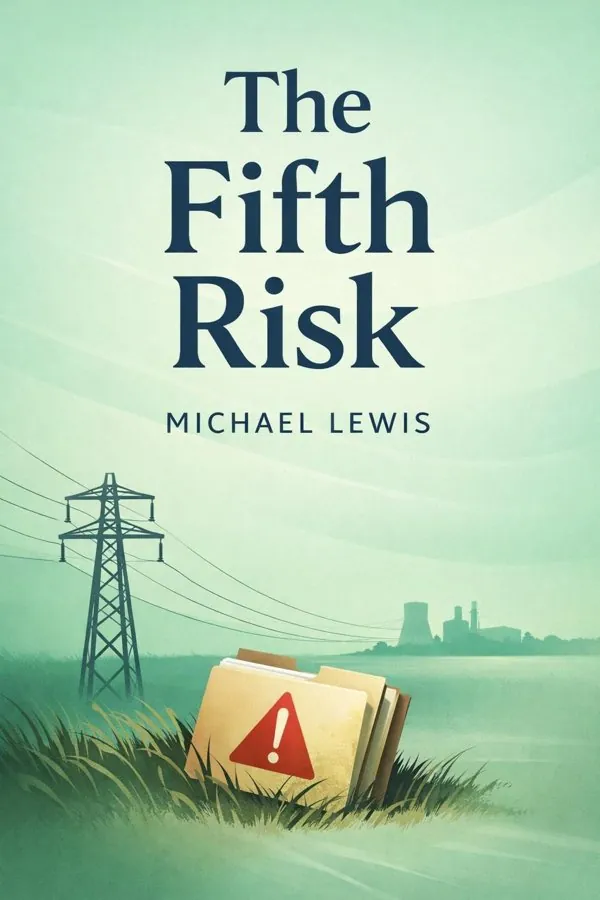
The Fifth Risk: Summary & Key Insights
 10 min9 chaptersAudio available
What Is The Fifth Risk About?
The Fifth Risk by Michael Lewis is a politics book spanning 9 pages. The Fifth Risk explores the hidden dangers that threaten the U.S. government’s ability to function effectively, focusing on the transition between the Obama and Trump administrations. Michael Lewis reveals how critical federal departments—such as Energy, Agriculture, and Commerce—manage essential programs that safeguard the nation, and how neglect or mismanagement of these institutions can lead to catastrophic consequences.
This FizzRead summary covers all 9 key chapters of The Fifth Risk in approximately 10 minutes, distilling the most important ideas, arguments, and takeaways from Michael Lewis's work. Also available as an audio summary and Key Quotes Podcast.
The Fifth Risk
The Fifth Risk explores the hidden dangers that threaten the U.S. government’s ability to function effectively, focusing on the transition between the Obama and Trump administrations. Michael Lewis reveals how critical federal departments—such as Energy, Agriculture, and Commerce—manage essential programs that safeguard the nation, and how neglect or mismanagement of these institutions can lead to catastrophic consequences.
Who Should Read The Fifth Risk?
This book is perfect for anyone interested in politics and looking to gain actionable insights in a short read. Whether you're a student, professional, or lifelong learner, the key ideas from The Fifth Risk by Michael Lewis will help you think differently.
- ✓Readers who enjoy politics and want practical takeaways
- ✓Professionals looking to apply new ideas to their work and life
- ✓Anyone who wants the core insights of The Fifth Risk in just 10 minutes
Want the full summary?
Get instant access to this book summary and 100K+ more with Fizz Moment.
Get Free SummaryAvailable on App Store • Free to download
Key Chapters
The story begins in November 2016, when Donald Trump won the presidency and the federal transition machinery stirred into motion. For decades, presidential transitions had been a matter of civic discipline. The incoming team, regardless of political stripe, would send experts to learn from their predecessors. The outgoing administration, knowing the stakes, would prepare detailed briefings to ensure a seamless exchange of knowledge.
But this time, the process barely happened. When I visited the Department of Energy, I found months’ worth of carefully prepared binders—treatises of operational wisdom—left unopened. Career staff waited expectantly for new appointees who never showed up. It was as if an enormous, intricate ship was sailing unmanned into the next storm. The Trump team’s disinterest was not merely symbolic; it revealed a deeper disdain for the very idea of institutional knowledge. This lack of engagement signified something larger: a refusal to learn what government actually does.
That moment of neglect crystallized the thesis of the book. The danger was not only in who was governing but in the very absence of curiosity about governance itself. Transitions exist to preserve the continuity of essential public functions—those invisible systems that deliver food assistance, maintain nuclear stockpiles, forecast weather, and enforce environmental safeguards. When leadership fails to take responsibility for understanding these systems, the entire population stands at risk. The transfer of power becomes a gamble played with the machinery of national survival.
As I interviewed scientists, administrators, and data analysts across departments, a recurring sentiment emerged: people were terrified not of change, but of ignorance. They did not fear being replaced; they feared that their knowledge, accumulated over decades, would simply vanish into a void of political indifference. This is where the fifth risk begins to germinate—not in malice, but in the entropy that blooms when curiosity dies.
Among all the government departments, none surprised me more than the Department of Energy. To most Americans, it is merely the agency with 'energy' in its name, but in truth, it sits at the heart of America’s nuclear security. It manages the design, safety, and dismantling of the nation’s nuclear arsenal. It safeguards fissile materials, cleans up decades of radioactive waste, and leads the innovation of future energy technologies.
Yet, when I met the career scientists who run it, I found people who spoke not in political language, but in the language of precision and accountability. Their decisions can mean the difference between safety and catastrophe. Managing nuclear weapons is not glamorous; it’s a matter of maintaining continuity, checking redundancies, preserving institutional memory. And yet, in 2017, the new political leadership barely asked what those responsibilities entailed.
Across facilities like Hanford and Oak Ridge, I met engineers overseeing complex cleanup operations that would take a century to complete. Their knowledge is irreplaceable. If neglected, these projects could unleash human and environmental disaster. The Department of Energy is where the fifth risk takes on its most literal meaning—the risk of mismanaging what we cannot afford to misunderstand.
The irony is that these scientists work not for glory, but because they understand the fragility of the systems they protect. Their dedication underscores an essential truth: civilization’s stability depends less on charisma than on stewardship. When a government stops asking, 'What don’t we yet know?', the fifth risk starts to manifest. It is the risk of assuming that competence will maintain itself even as leadership withdraws its attention.
+ 7 more chapters — available in the FizzRead app
All Chapters in The Fifth Risk
About the Author
Michael Lewis is an American author and financial journalist known for his narrative nonfiction works that explore economics, finance, and government. His notable books include Liar’s Poker, Moneyball, The Big Short, and The Undoing Project. Lewis is acclaimed for his ability to make complex subjects accessible and engaging to a broad audience.
Get This Summary in Your Preferred Format
Read or listen to the The Fifth Risk summary by Michael Lewis anytime, anywhere. FizzRead offers multiple formats so you can learn on your terms — all free.
Available formats: App · Audio · PDF · EPUB — All included free with FizzRead
Download The Fifth Risk PDF and EPUB Summary
Key Quotes from The Fifth Risk
“The story begins in November 2016, when Donald Trump won the presidency and the federal transition machinery stirred into motion.”
“Among all the government departments, none surprised me more than the Department of Energy.”
Frequently Asked Questions about The Fifth Risk
The Fifth Risk by Michael Lewis is a politics book that explores key ideas across 9 chapters. The Fifth Risk explores the hidden dangers that threaten the U.S. government’s ability to function effectively, focusing on the transition between the Obama and Trump administrations. Michael Lewis reveals how critical federal departments—such as Energy, Agriculture, and Commerce—manage essential programs that safeguard the nation, and how neglect or mismanagement of these institutions can lead to catastrophic consequences.
More by Michael Lewis


You Might Also Like
Antifa: The Anti-Fascist Handbook
Mark Bray
10 min
Attack from Within: How Disinformation Is Sabotaging America
Barbara McQuade
10 min
Coercion, Capital, and European States, AD 990–1992
Charles Tilly
10 min
Digital Democracy: Concepts, Methodologies, Tools, and Applications
Various Authors
10 min
Fascism
Stanley G. Payne
10 min
Fire And Fury: Inside The Trump White House
Michael Wolff
10 minBrowse by Category
Ready to read The Fifth Risk?
Get the full summary and 100K+ more books with Fizz Moment.