
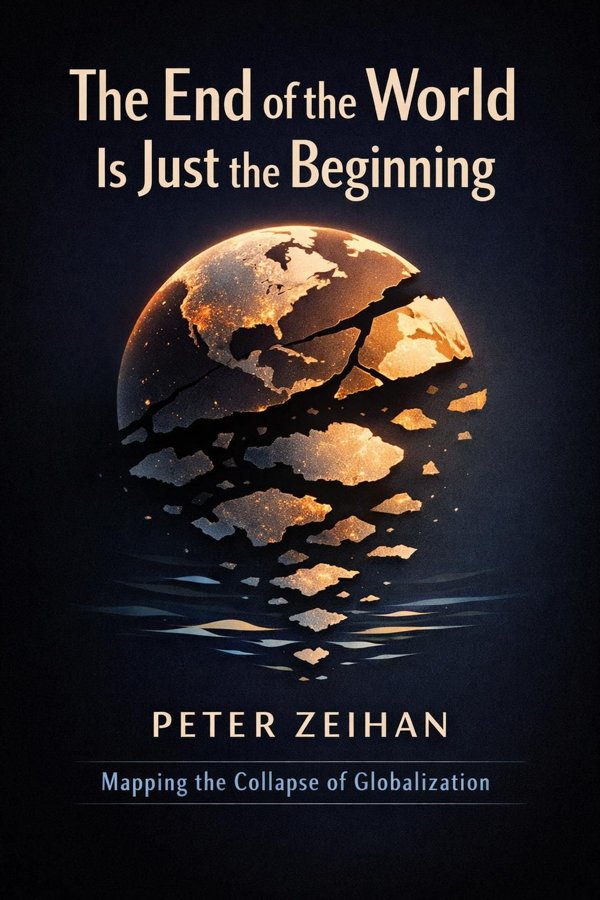
The End of the World Is Just the Beginning: Mapping the Collapse of Globalization: Summary & Key Insights
by Peter Zeihan
 10 min10 chaptersAudio available
Key Takeaways from The End of the World Is Just the Beginning: Mapping the Collapse of Globalization
The easiest way to misunderstand globalization is to think it was created mainly by free markets, technology, or good intentions.
A shrinking and aging population is not just a social issue; it is an economic earthquake.
Modern civilization runs on energy, but not all energy systems create the same kind of strength.
Most consumers experience global trade as something normal, almost invisible.
When globalization recedes, the world does not simply stop trading.
What Is The End of the World Is Just the Beginning: Mapping the Collapse of Globalization About?
The End of the World Is Just the Beginning: Mapping the Collapse of Globalization by Peter Zeihan is a future_trends book spanning 10 pages. What if the modern world economy is not evolving into something more connected, but breaking apart into something smaller, harsher, and more regional? In The End of the World Is Just the Beginning, geopolitical strategist Peter Zeihan argues that the globalized order most people take for granted was never permanent. It was a historical project, built largely under American security guarantees after World War II, and now that project is fading. As the system frays, the consequences will reach far beyond trade: food, manufacturing, energy, finance, shipping, and political stability will all be reshaped. Zeihan’s central claim is that geography, demographics, and energy realities matter more than fashionable economic theories. Countries with favorable terrain, younger populations, secure energy, and protected supply chains may adapt well. Others, especially those dependent on imported food, fuel, components, and maritime security, may face severe disruption. The book matters because it offers a framework for understanding why inflation, shortages, conflict, and supply-chain instability are not random shocks, but signs of a deeper transition. Drawing on decades of geopolitical analysis, Zeihan delivers a provocative, wide-angle map of a world moving beyond globalization and into a far more fragmented future.
This FizzRead summary covers all 10 key chapters of The End of the World Is Just the Beginning: Mapping the Collapse of Globalization in approximately 10 minutes, distilling the most important ideas, arguments, and takeaways from Peter Zeihan's work. Also available as an audio summary and Key Quotes Podcast.
The End of the World Is Just the Beginning: Mapping the Collapse of Globalization
What if the modern world economy is not evolving into something more connected, but breaking apart into something smaller, harsher, and more regional? In The End of the World Is Just the Beginning, geopolitical strategist Peter Zeihan argues that the globalized order most people take for granted was never permanent. It was a historical project, built largely under American security guarantees after World War II, and now that project is fading. As the system frays, the consequences will reach far beyond trade: food, manufacturing, energy, finance, shipping, and political stability will all be reshaped.
Zeihan’s central claim is that geography, demographics, and energy realities matter more than fashionable economic theories. Countries with favorable terrain, younger populations, secure energy, and protected supply chains may adapt well. Others, especially those dependent on imported food, fuel, components, and maritime security, may face severe disruption. The book matters because it offers a framework for understanding why inflation, shortages, conflict, and supply-chain instability are not random shocks, but signs of a deeper transition. Drawing on decades of geopolitical analysis, Zeihan delivers a provocative, wide-angle map of a world moving beyond globalization and into a far more fragmented future.
Who Should Read The End of the World Is Just the Beginning: Mapping the Collapse of Globalization?
This book is perfect for anyone interested in future_trends and looking to gain actionable insights in a short read. Whether you're a student, professional, or lifelong learner, the key ideas from The End of the World Is Just the Beginning: Mapping the Collapse of Globalization by Peter Zeihan will help you think differently.
- ✓Readers who enjoy future_trends and want practical takeaways
- ✓Professionals looking to apply new ideas to their work and life
- ✓Anyone who wants the core insights of The End of the World Is Just the Beginning: Mapping the Collapse of Globalization in just 10 minutes
Want the full summary?
Get instant access to this book summary and 100K+ more with Fizz Moment.
Get Free SummaryAvailable on App Store • Free to download
Key Chapters
The easiest way to misunderstand globalization is to think it was created mainly by free markets, technology, or good intentions. Zeihan’s deeper point is that geography always sets the terms. Mountains, rivers, coastlines, plains, and navigable waterways have shaped where populations gather, how food is produced, which regions can industrialize, and how cheaply goods can move. Globalization succeeded not because geography stopped mattering, but because the United States temporarily overrode many of geography’s traditional limits by protecting sea lanes and underwriting global trade.
That postwar system allowed countries to specialize in ways that would once have been dangerously dependent. Germany could rely on imported energy and export complex manufactures. Japan could import vast quantities of raw materials and food. China could become the world’s factory despite major structural vulnerabilities. This arrangement worked because the oceans were kept relatively safe and shipping remained predictable.
But once that security umbrella weakens, geography reasserts itself. Countries with strong internal river systems, secure coastlines, nearby resources, and defensible borders gain resilience. Those that depend on fragile chokepoints or long-distance imports become exposed. A nation’s map suddenly matters again in everyday economics.
You can apply this insight at any scale. Investors can evaluate countries by transport access and resource security. Business leaders can assess whether suppliers are based in geographically exposed regions. Even individuals can better understand why some places recover from shocks faster than others.
Actionable takeaway: When evaluating a country, company, or supply chain, start with the map. Geography is not background information; it is the foundation of long-term economic strength.
A shrinking and aging population is not just a social issue; it is an economic earthquake. Zeihan argues that one of the biggest hidden drivers of deglobalization is demographic collapse. For decades, many economies expanded because they had large working-age populations, rising consumer demand, and enough younger workers to support retirees. That balance is now deteriorating across much of the developed world and parts of the developing world as well.
Aging societies save differently, spend differently, and innovate differently. They consume more healthcare and fewer housing starts. They take fewer entrepreneurial risks. Most importantly, they lose labor force depth. When there are fewer workers available, manufacturing becomes more expensive, tax systems come under pressure, and pension burdens grow. This is especially damaging for export-driven economies that depend on large workforces and thin profit margins.
Countries such as Japan, South Korea, Germany, Italy, and China face variations of this problem. In some of them, the demographic downturn is so advanced that rebuilding industrial competitiveness becomes much harder. By contrast, countries with younger populations and stronger immigration dynamics may retain more flexibility.
For businesses, demographic analysis helps explain labor shortages, wage pressures, automation demand, and long-term consumer shifts. For policymakers, it raises urgent questions about retirement systems, family support, immigration, and productivity. For individuals, it reframes career planning: sectors serving older populations may grow even as overall economic dynamism slows.
Actionable takeaway: Look beyond GDP and ask a simpler question: who will do the work in ten or twenty years? Demographics often reveal a country’s future more clearly than its current headlines.
Modern civilization runs on energy, but not all energy systems create the same kind of strength. Zeihan shows that in a deglobalizing world, secure access to fuel becomes a primary determinant of national resilience. Countries that can produce their own oil, natural gas, electricity, or industrial inputs enjoy strategic flexibility. Those that depend on long, vulnerable import chains face recurring economic and political stress.
The global era blurred this distinction. Tankers moved hydrocarbons across oceans, refineries processed imported crude, and energy-intensive industries assumed stable access to fuel. But if shipping becomes less reliable, if chokepoints are contested, or if geopolitical blocs harden, import dependence becomes dangerous. An industrial nation without secure energy is not just paying more; it is operating under a structural handicap.
Zeihan pays particular attention to the changing role of the United States, which has become far more energy secure due to shale production. That shift gives America options many allies do not share. Meanwhile, countries heavily dependent on external energy, especially in Europe and East Asia, may face rising costs and strategic vulnerability.
Practical applications are everywhere. Manufacturers should evaluate whether their facilities sit near reliable power and feedstocks. Governments need to think beyond climate targets and ask whether transition plans preserve resilience. Households may see the effects in higher utility costs, transport disruptions, or inflation in goods tied to energy-intensive production.
Actionable takeaway: Treat energy access as a core measure of stability. Whether you are analyzing nations, sectors, or investments, favor systems built on abundant, secure, and locally controllable energy sources.
Most consumers experience global trade as something normal, almost invisible. Zeihan reminds us that cheap transport is not a law of nature. It depends on infrastructure, stable fuel prices, secure shipping lanes, functioning ports, insurance markets, and naval protection. Remove enough of those supports, and the economics of long-distance trade begin to break down.
The modern supply chain was designed for efficiency, not durability. Components cross multiple borders before a final product is assembled. Food travels enormous distances. Industrial goods rely on just-in-time delivery and container shipping schedules that assume disruption will be limited and temporary. This model works beautifully in calm conditions, but it is highly exposed when piracy, war, sanctions, labor shortages, weather shocks, or political fragmentation hit the system.
As transport costs rise or become less predictable, production patterns change. Firms may nearshore manufacturing, reduce product variety, build larger inventories, or regionalize sourcing. Countries with extensive internal transport networks, especially navigable rivers or integrated rail systems, gain a major advantage because they can move goods domestically at lower cost than countries dependent on maritime imports.
This idea has direct relevance for managers and consumers alike. Businesses should expect more volatility in shipping rates and lead times. Retailers may need to reconsider how many far-flung suppliers they can realistically coordinate. Households may notice that low-cost imported goods become less consistently available.
Actionable takeaway: Build plans around transport fragility, not transport perfection. If your business or budget depends on goods arriving cheaply from very far away, start developing alternatives now.
When globalization recedes, the world does not simply stop trading. It reorganizes into tighter, more local systems. Zeihan’s argument is that regionalization will become the dominant pattern of the coming era. Instead of one highly integrated global marketplace, we are likely to see clusters of countries trading more heavily with nearby partners, trusted allies, or politically aligned blocs.
This shift is driven by risk as much as economics. If distant supply lines become uncertain, firms and governments naturally prefer suppliers that are physically closer, strategically friendlier, or easier to protect. Regional trade networks reduce transport exposure, simplify coordination, and make political disruptions somewhat easier to manage. They are not always the cheapest option on paper, but they are often the safer one in a less stable world.
North America is one example Zeihan sees as potentially well positioned due to energy, food production, internal waterways, and geographic insulation. Other regions may try to build similar networks, though not all have the same advantages. Some will struggle because their neighbors are weak, hostile, or equally dependent on imported essentials.
For companies, regionalization can influence plant location, supplier strategy, and inventory design. For workers, it may create new opportunities in domestic manufacturing, logistics, and infrastructure. For governments, it increases the importance of industrial policy, alliance management, and strategic reserves.
Actionable takeaway: Shift your thinking from global optimization to regional resilience. The question is no longer only where something can be made cheapest, but where it can be made reliably under stress.
One of the book’s most provocative themes is that deglobalization will not hurt everyone equally. Zeihan maps a world of winners and losers based on geography, demographics, agriculture, energy, industrial capacity, and strategic position. Countries that can feed themselves, fuel themselves, defend their trade routes, and support production internally stand a much better chance than those built on imported essentials.
This framework helps explain why national outcomes may diverge sharply. A country can be rich today and still be structurally vulnerable tomorrow if its prosperity relies on unstable imports or aging workers. Conversely, a country that appears less globally dominant may be surprisingly resilient if it has secure resources and favorable geography. Zeihan often highlights the United States as unusually advantaged, while warning that many export-driven or import-dependent powers could face severe adjustment.
The practical value of this idea lies in comparative analysis. Investors can use it to test assumptions about emerging markets or industrial powers. Executives can ask whether expansion plans are anchored in countries likely to remain functional under stress. Policymakers can identify which dependencies most urgently need backup options.
Importantly, “winner” does not mean painless success. Even relatively advantaged countries will experience inflation, political tension, supply disruptions, and strategic dilemmas. The point is not that some nations will thrive effortlessly, but that some have a stronger base from which to adapt.
Actionable takeaway: Compare countries by structural resilience, not just current wealth. In an era of disruption, the ability to endure shocks may matter more than headline growth.
Supermarket abundance can create the illusion that food security is automatic. Zeihan argues the opposite: modern agriculture is one of the most globalized and therefore one of the most vulnerable systems on Earth. Food production depends not just on land and weather, but on fertilizers, fuel, machinery parts, financing, shipping, cold storage, and stable trade routes. If any of these links fail, harvests may still happen, but food may not reach the right people at the right price.
Some countries produce large agricultural surpluses and are buffered by strong internal transport networks. Others rely heavily on imported grain, imported fertilizer, or imported energy to run their farms. In a deglobalizing world, those dependencies become dangerous. Even temporary disruptions can trigger price spikes, social unrest, and government instability, especially in lower-income import-dependent states.
The fertilizer issue is particularly important. Industrial agriculture relies on nitrogen, potash, and phosphate systems that are internationally distributed and energy intensive. If trade frictions or fuel shortages hit these inputs, crop yields can fall or costs can surge. This makes food security as much a geopolitical and industrial issue as an agricultural one.
For businesses in food, retail, logistics, and commodities, this means greater volatility is likely. For governments, it underscores the need for reserves, domestic capacity, and diversified suppliers. For households, it suggests that food inflation may be a structural feature rather than a passing anomaly.
Actionable takeaway: Treat food security as a systems issue. Whether at the national, business, or household level, resilience improves when you diversify supply, reduce waste, and understand where key agricultural inputs come from.
It is tempting to believe that innovation will smoothly solve every breakdown in trade, labor, and energy. Zeihan does not reject technology, but he challenges the idea that it can cancel geography or demographics on command. Technology can mitigate shortages, improve efficiency, and enable reshoring, yet it still depends on physical inputs, skilled labor, reliable power, financing, and political stability.
For example, automation may help countries cope with shrinking workforces, but robots require semiconductors, metals, maintenance, and electricity. Renewable energy may reduce dependence on imported hydrocarbons in some contexts, but building those systems demands mining, manufacturing, and transmission infrastructure. Digital platforms can coordinate supply chains more intelligently, but they cannot manufacture missing parts or reopen a blocked sea lane.
This matters because many leaders mistake technological possibility for industrial readiness. A prototype is not a supply chain. A policy target is not a factory network. A software solution does not remove the need for shipping, minerals, or spare capacity. In a fragmented world, countries that can combine innovation with local industrial depth will fare better than those that rely on optimism alone.
For organizations, the practical lesson is to distinguish between useful technological adaptation and magical thinking. Invest in tools that reduce labor intensity, energy waste, and transport dependence, but test whether the supporting ecosystem actually exists. For individuals, this perspective encourages realism about which industries are likely to remain durable.
Actionable takeaway: Favor technology that strengthens resilience in the real world. The best innovations are not the flashiest ones, but the ones that reduce dependence on fragile global systems.
Zeihan’s analysis places the United States in a distinctive position. While many countries were shaped to succeed within a globalized framework, the U.S. possesses underlying advantages that matter even more when globalization recedes: abundant energy, vast arable land, extensive navigable waterways, a large internal market, favorable geography, and relative insulation from many external threats. In his view, these features give America options that few major powers can match.
That does not mean the United States escapes disruption. It still faces inflation, political polarization, labor shortages, industrial bottlenecks, and alliance burdens. But compared with countries dependent on imported fuel, food, or export markets, it has a broader margin for adaptation. It can produce more of what it needs internally and can reorganize supply chains within a continental-scale economy.
This perspective also helps explain why American policy choices matter disproportionately. If the U.S. becomes less willing to police trade routes or support the old global order, countries that built their prosperity on those guarantees may find themselves exposed. At the same time, North American integration, especially with Canada and Mexico, could become more strategically significant.
For businesses and investors, this suggests continued interest in U.S.-centered manufacturing, agriculture, energy, and logistics. For policymakers, it highlights the importance of infrastructure, workforce development, and rebuilding industrial capabilities. For readers, it offers a framework for understanding why America’s role in the next era may be less about managing globalization and more about navigating selective disengagement.
Actionable takeaway: Watch North America closely. In a fragmenting world, the strongest opportunities may emerge where energy, food, industry, and geography align inside a secure regional system.
Periods of economic integration often reduce certain forms of conflict because trade creates interdependence and predictability. Zeihan argues that as globalization unwinds, those stabilizing forces weaken. Scarcer resources, disrupted supply chains, aging populations, and declining trust can turn economic stress into political confrontation. In that environment, regional rivalries, maritime disputes, sanctions, and proxy conflicts become more likely.
The danger is not only classic great-power war, though that risk may rise. It is also a world of chronic instability: countries competing for food imports, energy cargoes, industrial inputs, or strategic territory. Fragile states may crack under price shocks. Alliances may strain when members discover their interests are no longer aligned. Governments facing internal weakness may externalize pressure through nationalism or military brinkmanship.
This final idea ties the entire book together. Geography shapes exposure, demographics reduce flexibility, transport grows costlier, and basic necessities become less secure. The result is a more fractured international system where economics and security can no longer be neatly separated.
The practical implication is not panic, but preparedness. Companies should scenario-plan for sanctions, conflict zones, and abrupt market closures. Governments should revisit strategic reserves, naval capacity, domestic manufacturing, and alliance commitments. Individuals should recognize that “global events” may increasingly affect local prices, employment, and political choices.
Actionable takeaway: Treat geopolitical risk as a permanent feature of the coming decades. Build personal, business, and policy decisions around the assumption that instability will be recurring rather than exceptional.
All Chapters in The End of the World Is Just the Beginning: Mapping the Collapse of Globalization
About the Author
Peter Zeihan is an American geopolitical strategist, author, and public speaker best known for his analysis of globalization, demographics, energy, and national power. He previously served as vice president of analysis at Stratfor, where he developed forecasts on international politics and economic trends, and later founded his own consulting firm, Zeihan on Geopolitics. His work translates large structural forces, such as geography, population aging, agricultural systems, and trade routes, into practical insights for businesses, governments, and general readers. Zeihan has built a reputation for bold, accessible arguments about how the world is changing and which countries are most likely to prosper or struggle. Through books, talks, and commentary, he has become a prominent voice in discussions about deglobalization and the future of the global order.
Get This Summary in Your Preferred Format
Read or listen to the The End of the World Is Just the Beginning: Mapping the Collapse of Globalization summary by Peter Zeihan anytime, anywhere. FizzRead offers multiple formats so you can learn on your terms — all free.
Available formats: App · Audio · PDF · EPUB — All included free with FizzRead
Download The End of the World Is Just the Beginning: Mapping the Collapse of Globalization PDF and EPUB Summary
Key Quotes from The End of the World Is Just the Beginning: Mapping the Collapse of Globalization
“The easiest way to misunderstand globalization is to think it was created mainly by free markets, technology, or good intentions.”
“A shrinking and aging population is not just a social issue; it is an economic earthquake.”
“Modern civilization runs on energy, but not all energy systems create the same kind of strength.”
“Most consumers experience global trade as something normal, almost invisible.”
“When globalization recedes, the world does not simply stop trading.”
Frequently Asked Questions about The End of the World Is Just the Beginning: Mapping the Collapse of Globalization
The End of the World Is Just the Beginning: Mapping the Collapse of Globalization by Peter Zeihan is a future_trends book that explores key ideas across 10 chapters. What if the modern world economy is not evolving into something more connected, but breaking apart into something smaller, harsher, and more regional? In The End of the World Is Just the Beginning, geopolitical strategist Peter Zeihan argues that the globalized order most people take for granted was never permanent. It was a historical project, built largely under American security guarantees after World War II, and now that project is fading. As the system frays, the consequences will reach far beyond trade: food, manufacturing, energy, finance, shipping, and political stability will all be reshaped. Zeihan’s central claim is that geography, demographics, and energy realities matter more than fashionable economic theories. Countries with favorable terrain, younger populations, secure energy, and protected supply chains may adapt well. Others, especially those dependent on imported food, fuel, components, and maritime security, may face severe disruption. The book matters because it offers a framework for understanding why inflation, shortages, conflict, and supply-chain instability are not random shocks, but signs of a deeper transition. Drawing on decades of geopolitical analysis, Zeihan delivers a provocative, wide-angle map of a world moving beyond globalization and into a far more fragmented future.
More by Peter Zeihan
You Might Also Like
Futureproof: 9 Rules for Humans in the Age of Automation
Kevin Roose
10 min
The Third Wave
Alvin Toffler
10 min
2030: How Today's Biggest Trends Will Collide and Reshape the Future of Everything
Mauro F. Guillén
10 min
A Very Human Future: Enriching Humanity in a Digitized World
Rohit Talwar, Steve Wells, Alexandra Whittington
10 min
AI 2041: Ten Visions for Our Future
Kai-Fu Lee, Chen Qiufan
10 min
Abundance: The Future Is Better Than You Think
Peter H. Diamandis, Steven Kotler
10 minBrowse by Category
Ready to read The End of the World Is Just the Beginning: Mapping the Collapse of Globalization?
Get the full summary and 100K+ more books with Fizz Moment.