
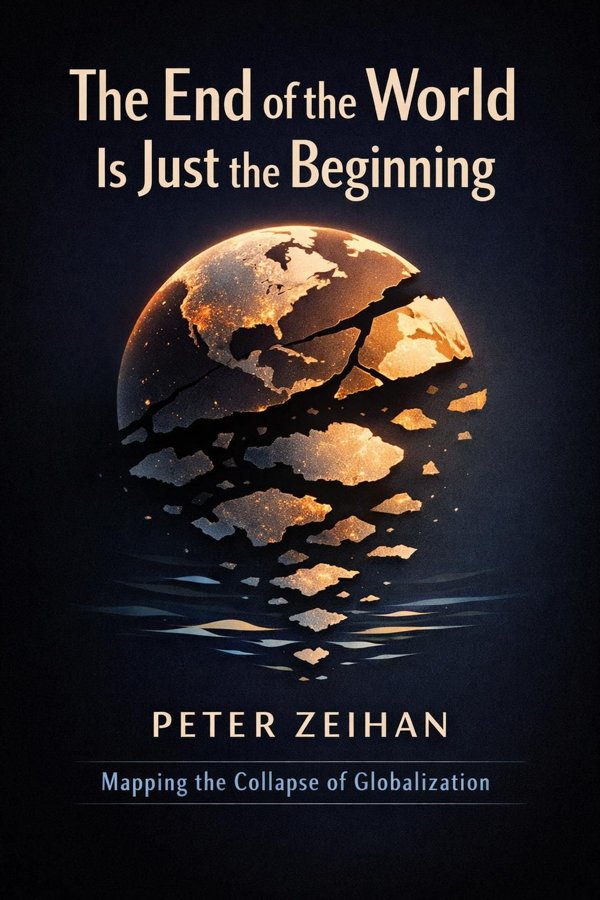
The End of the World Is Just the Beginning: Summary & Key Insights
by Peter Zeihan
 10 min9 chapters
Key Takeaways from The End of the World Is Just the Beginning
The modern global economy feels permanent only because most people were born into it.
In a digital age, it is tempting to think geography matters less than ever.
A country’s future is written not only in its policies but in its population pyramid.
Energy is often discussed as a commodity, but Zeihan treats it as the foundation of modern civilization.
One of Zeihan’s most sobering arguments is that food security in the modern world rests on a chain of assumptions that may not hold.
What Is The End of the World Is Just the Beginning About?
The End of the World Is Just the Beginning by Peter Zeihan is a non-fiction book published in 2001 spanning 5 pages. What happens when the global system we take for granted stops working? In The End of the World Is Just the Beginning, geopolitical strategist Peter Zeihan argues that the age of globalization is not merely changing but actively unraveling. For decades, cheap shipping, secure sea lanes, abundant energy, and open trade made it possible for countries to specialize, outsource, and build deeply interconnected supply chains. Zeihan’s central claim is that this world order was never permanent. It was constructed under unique American strategic leadership after World War II, and as that leadership recedes, the economic and political systems built on it begin to fracture. This matters because globalization is not an abstract idea; it shapes what we can buy, what food reaches our supermarkets, where medicines come from, and how nations project power. Zeihan combines geography, demography, history, energy analysis, and logistics to explain why some countries may adapt while others face severe disruption. Whether or not one agrees with all his conclusions, the book is provocative, wide-ranging, and deeply useful for understanding an unstable century. It is a warning, a framework, and a guide to the turbulent decades ahead.
This FizzRead summary covers all 9 key chapters of The End of the World Is Just the Beginning in approximately 10 minutes, distilling the most important ideas, arguments, and takeaways from Peter Zeihan's work.
The End of the World Is Just the Beginning
What happens when the global system we take for granted stops working? In The End of the World Is Just the Beginning, geopolitical strategist Peter Zeihan argues that the age of globalization is not merely changing but actively unraveling. For decades, cheap shipping, secure sea lanes, abundant energy, and open trade made it possible for countries to specialize, outsource, and build deeply interconnected supply chains. Zeihan’s central claim is that this world order was never permanent. It was constructed under unique American strategic leadership after World War II, and as that leadership recedes, the economic and political systems built on it begin to fracture.
This matters because globalization is not an abstract idea; it shapes what we can buy, what food reaches our supermarkets, where medicines come from, and how nations project power. Zeihan combines geography, demography, history, energy analysis, and logistics to explain why some countries may adapt while others face severe disruption. Whether or not one agrees with all his conclusions, the book is provocative, wide-ranging, and deeply useful for understanding an unstable century. It is a warning, a framework, and a guide to the turbulent decades ahead.
Who Should Read The End of the World Is Just the Beginning?
This book is perfect for anyone interested in non-fiction and looking to gain actionable insights in a short read. Whether you're a student, professional, or lifelong learner, the key ideas from The End of the World Is Just the Beginning by Peter Zeihan will help you think differently.
- ✓Readers who enjoy non-fiction and want practical takeaways
- ✓Professionals looking to apply new ideas to their work and life
- ✓Anyone who wants the core insights of The End of the World Is Just the Beginning in just 10 minutes
Want the full summary?
Get instant access to this book summary and 100K+ more with Fizz Moment.
Get Free SummaryAvailable on App Store • Free to download
Key Chapters
The modern global economy feels permanent only because most people were born into it. Zeihan’s most important insight is that globalization is not the natural endpoint of human progress. It is a political and military construction created under unusual circumstances after World War II. The United States used its naval dominance to secure trade routes, suppress piracy, and guarantee the safe movement of goods across oceans. In return, allies joined an American-led order that helped contain the Soviet Union. Cheap shipping, predictable access to markets, and a stable security umbrella allowed countries to organize their economies around long-distance specialization.
That arrangement transformed the world. Germany could focus on manufacturing, the Gulf states on energy, China on industrial exports, and dozens of countries on pieces of supply chains rather than complete systems. Consumers benefited from lower prices, businesses benefited from scale, and governments became dependent on a level of international stability they did not create themselves. Zeihan argues that many leaders and executives now mistake this framework for a law of nature. It is not. It depends on military protection, diplomatic coordination, and a willingness by the United States to keep underwriting a system from which others often benefit more directly.
A useful way to apply this idea is to reconsider any business or policy plan that assumes global trade will remain frictionless. If a product requires components from six countries and uninterrupted shipping through multiple chokepoints, it is not merely efficient; it is fragile. The same goes for nations that import food, fuel, or industrial inputs while assuming someone else will always keep the routes open.
Actionable takeaway: examine your assumptions and identify where you are treating the current global order as permanent when it may actually be contingent and reversible.
In a digital age, it is tempting to think geography matters less than ever. Zeihan insists the opposite is true. Mountains, rivers, coastlines, arable land, navigable waterways, and access to oceans still shape the rise and resilience of nations. Technology may soften some constraints, but it rarely erases them. Countries with productive farmland, internal river systems, and defendable borders possess enduring advantages. Countries that must import energy, food, and raw materials across vulnerable sea lanes remain exposed, no matter how modern their economies appear.
Zeihan uses geography as a lens for understanding national strength. The United States, for example, benefits from vast agricultural capacity, major navigable rivers, energy resources, and relatively secure neighbors. These are not ideological achievements but structural advantages. By contrast, countries such as Japan or South Korea are technologically sophisticated yet geographically constrained. They depend heavily on imported food, fuel, and industrial inputs. Germany is industrially powerful but lacks many of the natural endowments that would allow it to remain fully self-sufficient in a fractured world.
This perspective explains why some countries can weather disorder better than others. It also helps predict which regions are likely to become more strategically important. Energy corridors, ports, shipping chokepoints, and fertile agricultural zones may matter more in the future, not less. Businesses can use this framework when assessing factory locations, supplier resilience, and market exposure. Investors can use it to understand why political shocks hit some regions harder than others.
Actionable takeaway: whenever you evaluate a country, go beyond GDP and headlines. Ask what its map tells you about food, energy, transport, security, and long-term self-reliance.
A country’s future is written not only in its policies but in its population pyramid. Zeihan argues that demographics are among the clearest predictors of long-term economic and geopolitical outcomes. Nations with aging populations, low birth rates, and shrinking workforces face structural limits that stimulus, slogans, and optimism cannot easily overcome. A healthy economy needs workers, taxpayers, consumers, caregivers, soldiers, and entrepreneurs. When too many people are old and too few are young, every system starts to strain at once.
This is one reason Zeihan is skeptical about the long-term trajectories of many major powers. Europe, East Asia, and especially China face severe demographic decline. Their working-age populations are shrinking while pension burdens and healthcare costs rise. Growth becomes harder to sustain, domestic consumption weakens, and manufacturing competitiveness erodes. Demographic imbalance also affects military readiness and political stability. Older societies often become risk-averse, slower-moving, and less willing to absorb shocks.
By contrast, countries with younger populations may possess a demographic dividend if they can provide jobs, infrastructure, and governance. But youth alone is not enough. A large young population without economic opportunity can also generate instability. Zeihan’s point is not that demographics decide everything, but that they narrow the range of plausible futures. Governments cannot quickly reverse aging, and businesses cannot ignore labor shortages forever.
Practically, this idea affects housing demand, healthcare growth, labor markets, consumption patterns, immigration debates, and where capital should flow. If a country’s age structure is deteriorating sharply, sectors tied to long-term expansion may disappoint, while automation, elder care, and productivity-enhancing technologies may become more important.
Actionable takeaway: look at population age structures before making long-term decisions about markets, labor, or national competitiveness.
Energy is often discussed as a commodity, but Zeihan treats it as the foundation of modern civilization. Without reliable energy, there is no industrial production, no modern agriculture, no global shipping, and no stable political order. The book argues that energy markets are entering a period of turbulence because the systems that once coordinated production, transport, refining, and distribution across borders are becoming less dependable. This is not just about whether oil prices go up or down. It is about whether energy can be delivered in the right form, to the right place, at the right time.
Zeihan pays particular attention to how different countries are positioned within this landscape. Nations that are energy producers or that can secure energy from nearby sources possess a major strategic advantage. Those dependent on distant imports face higher risks, especially if maritime security weakens or if refining and transport networks become disrupted. Energy vulnerability can quickly spill into inflation, food shortages, industrial slowdowns, and political unrest.
The book also emphasizes that transitions are harder than rhetoric suggests. Replacing one energy system with another requires minerals, manufacturing capacity, infrastructure, and time. Renewable energy can be powerful in the right contexts, but it does not automatically solve the geopolitical and logistical challenges of a world becoming less integrated. Every energy system has dependencies, and those dependencies become more visible in periods of disorder.
For companies, energy is not a line item to review once a quarter. It affects site selection, transport costs, production continuity, and strategic resilience. For citizens, it affects everything from heating bills to the price of groceries.
Actionable takeaway: treat energy exposure as a core strategic risk and map where your livelihood, business, or investments rely on uninterrupted fuel and power systems.
One of Zeihan’s most sobering arguments is that food security in the modern world rests on a chain of assumptions that may not hold. Agriculture today depends on fuel, fertilizers, pesticides, machinery, financing, transport networks, and stable trade. Even highly productive farming regions rely on global systems to move inputs in and outputs out. The supermarket shelf looks simple, but behind it stands a vast web of industrial and logistical coordination. If that web frays, food shortages can emerge far from the original disruption.
The book highlights how fertilizers are tied to energy and mineral supply, how many countries depend on imported grains, and how some agricultural exporters are critical to feeding entire regions. Climate shocks, war, sanctions, shipping disruptions, and energy shortages can all reduce yields or prevent distribution. In a deglobalizing world, countries that cannot feed themselves or cannot reliably import food face not merely economic pain but social and political crisis.
This helps explain why agriculture is a strategic issue rather than just a commercial one. Countries with strong domestic farmland, water access, fertilizer production, and transport infrastructure will have a major advantage. Others may need to rethink urbanization patterns, trade policies, and diplomatic priorities. Businesses in food processing, retail, hospitality, and logistics should pay close attention because disruption in agricultural inputs often cascades into pricing and availability shocks across the entire economy.
Individuals can also apply this lesson. While few people can control national food policy, households and local communities can become more aware of supply dependence, food waste, and the value of diversified sourcing.
Actionable takeaway: stop treating food as guaranteed abundance and start viewing agricultural inputs, transport, and local production capacity as essential components of long-term resilience.
For years, efficiency was the supreme virtue of global business. Companies trimmed inventories, outsourced production, sourced from the cheapest location, and relied on just-in-time delivery to maximize returns. Zeihan argues that this model worked because the broader geopolitical system made it workable. Once shipping becomes less secure, relations between major powers worsen, labor pools shrink, and energy prices become unstable, the same supply chains that once looked brilliant begin to look dangerously exposed.
The key insight is that complexity often hides fragility. A product assembled from components made in multiple countries may reduce unit costs, but it also multiplies points of failure. A delay at a single port, a shortage of one chemical, or a diplomatic dispute with one supplier can halt production. Companies discovered this during recent disruptions, but Zeihan believes those episodes were not anomalies. They were previews.
In a less globalized world, redundancy and proximity matter more. This does not mean every country will become fully self-sufficient or every company will reshore everything. It means the decision criteria change. Reliability, political alignment, transport security, and inventory buffers become more valuable relative to pure cost minimization. Nearshoring, friend-shoring, dual sourcing, and strategic stockpiling all make more sense when the wider system is less trustworthy.
This idea applies well beyond manufacturing. Hospitals, food distributors, technology firms, and retailers all depend on timely flows of specialized goods. The same logic also applies to personal life: if your household depends on single-source essentials, you share a smaller version of the same risk.
Actionable takeaway: audit your critical dependencies and redesign around resilience, not just efficiency, by reducing single points of failure wherever possible.
Not all countries will experience the end of globalization in the same way. Zeihan’s analysis is comparative: some nations are deeply dependent on global trade for energy, food, security, and export markets, while others possess enough internal capacity to absorb shocks. The difference between inconvenience and systemic crisis often comes down to structural characteristics that cannot be changed quickly. Geography, demographics, industrial composition, political cohesion, and resource endowment all matter.
This leads Zeihan to make bold assessments about which countries are most vulnerable. Export-driven powers that rely on imported fuel and raw materials may struggle if trade routes become less reliable. Countries with aging populations and limited agricultural capacity may find that they cannot maintain current standards of living without an external system that no longer functions smoothly. Others may be trapped by internal fragmentation, weak institutions, or geographic exposure to hostile neighbors.
At the same time, the book is not uniformly pessimistic. It suggests that some countries are unusually well positioned for a fractured age. States with strong agricultural bases, energy abundance, navigable internal transport, and manageable demographics may emerge relatively stronger. This does not guarantee prosperity, but it gives them room to maneuver while others scramble.
For readers, the practical value lies in comparative thinking. Instead of asking whether the world will be “good” or “bad,” ask which regions are likely to be more resilient than others under stress. This is relevant for hiring, investing, manufacturing, migration, diplomacy, and education. A company expanding abroad should not treat all markets as equally durable. A young professional choosing where to build a career should not either.
Actionable takeaway: rank countries and regions by resilience factors, not just current wealth, and use that framework in strategic decisions.
A hidden assumption of modern life is that someone is always keeping the global system running. Zeihan argues that for roughly seventy-five years, that someone has been the United States. American naval power secured sea lanes. American financial institutions stabilized transactions. American strategic commitments reassured allies and discouraged major disruptions to global trade. But Zeihan contends that this role was never altruistic in a simplistic sense, nor was it meant to last forever. It served specific Cold War and postwar goals, many of which have faded.
As the United States becomes less willing to bear the costs of maintaining a universal global order, the consequences extend far beyond diplomacy. Shipping insurance changes. Trade routes become riskier. Regional powers test boundaries. Allies discover that access to global markets and energy cannot be separated from hard security guarantees. In this sense, American retrenchment is not just a foreign policy shift. It is the mechanism through which deglobalization accelerates.
Zeihan does not argue that the United States is disappearing or becoming weak. In fact, he often sees it as comparatively advantaged. His point is that U.S. strength does not automatically translate into a willingness to keep subsidizing a system for everyone else. That distinction matters. Countries and firms built for an American-policed world may struggle in a world where Washington is more selective.
Readers can apply this by reconsidering geopolitical risk. Political headlines often focus on elections or speeches, but the deeper question is whether the institutions and commitments that kept commerce safe are still dependable. If they are not, then assumptions underlying trade, investment, and security need revision.
Actionable takeaway: incorporate the possibility of a more selective, less interventionist United States into any long-range plan involving trade, security, or overseas expansion.
Predictions of breakdown often paralyze people, but Zeihan’s framework can also be read as a guide to opportunity. If globalization weakens, production does not vanish; it relocates, simplifies, and reorganizes. If long-distance supply chains become riskier, nearby manufacturing hubs gain appeal. If imported energy becomes uncertain, domestic energy development and efficiency technologies become more valuable. If food security rises in importance, agricultural innovation and local processing become strategic sectors.
This means deglobalization is not only a story of loss. It is also a story of reconfiguration. Some regions will attract factories that once would have gone elsewhere. Some industries will gain from redundancy, stockpiling, infrastructure upgrades, and domestic capacity building. Transport networks may become more regional. Corporate strategy may become more geographically disciplined. Governments may rediscover industrial policy, strategic reserves, and the importance of physical infrastructure.
For individuals, opportunity often comes from understanding where the world is moving before institutions fully adjust. Careers linked to logistics, energy systems, agriculture, industrial engineering, cybersecurity, defense, and regional manufacturing may become more important. Local businesses that can serve critical needs reliably may outperform larger but more exposed competitors. Investors who understand resilience may spot value where others see only fear.
The key is to avoid two equal and opposite mistakes: assuming nothing will change, or assuming all change is catastrophic. Systems under stress often produce winners and losers simultaneously. The task is to identify where capacity, demand, and strategic necessity are likely to converge.
Actionable takeaway: look for sectors and regions that become more valuable when reliability, proximity, and self-sufficiency matter more than global scale alone.
All Chapters in The End of the World Is Just the Beginning
About the Author
Peter Zeihan is an American geopolitical strategist, speaker, and bestselling author known for translating complex global trends into clear, provocative arguments. His work focuses on how geography, demographics, energy, agriculture, trade, and security shape the behavior and future of nations. Before becoming an independent analyst, Zeihan worked with Stratfor, where he developed a reputation for long-range forecasting and strategic interpretation. He has since advised corporations, industry groups, policymakers, and public audiences on issues ranging from supply chains to great-power competition. Zeihan is particularly known for challenging conventional assumptions about globalization and for emphasizing the physical and structural realities beneath politics and economics. His books have made him a widely recognized voice in contemporary geopolitical debate.
Get This Summary in Your Preferred Format
Read or listen to the The End of the World Is Just the Beginning summary by Peter Zeihan anytime, anywhere. FizzRead offers multiple formats so you can learn on your terms — all free.
Available formats: App · Audio · PDF · EPUB — All included free with FizzRead
Download The End of the World Is Just the Beginning PDF and EPUB Summary
Key Quotes from The End of the World Is Just the Beginning
“The modern global economy feels permanent only because most people were born into it.”
“In a digital age, it is tempting to think geography matters less than ever.”
“A country’s future is written not only in its policies but in its population pyramid.”
“Energy is often discussed as a commodity, but Zeihan treats it as the foundation of modern civilization.”
“One of Zeihan’s most sobering arguments is that food security in the modern world rests on a chain of assumptions that may not hold.”
Frequently Asked Questions about The End of the World Is Just the Beginning
The End of the World Is Just the Beginning by Peter Zeihan is a non-fiction book that explores key ideas across 9 chapters. What happens when the global system we take for granted stops working? In The End of the World Is Just the Beginning, geopolitical strategist Peter Zeihan argues that the age of globalization is not merely changing but actively unraveling. For decades, cheap shipping, secure sea lanes, abundant energy, and open trade made it possible for countries to specialize, outsource, and build deeply interconnected supply chains. Zeihan’s central claim is that this world order was never permanent. It was constructed under unique American strategic leadership after World War II, and as that leadership recedes, the economic and political systems built on it begin to fracture. This matters because globalization is not an abstract idea; it shapes what we can buy, what food reaches our supermarkets, where medicines come from, and how nations project power. Zeihan combines geography, demography, history, energy analysis, and logistics to explain why some countries may adapt while others face severe disruption. Whether or not one agrees with all his conclusions, the book is provocative, wide-ranging, and deeply useful for understanding an unstable century. It is a warning, a framework, and a guide to the turbulent decades ahead.
More by Peter Zeihan
You Might Also Like



Browse by Category
Ready to read The End of the World Is Just the Beginning?
Get the full summary and 100K+ more books with Fizz Moment.