
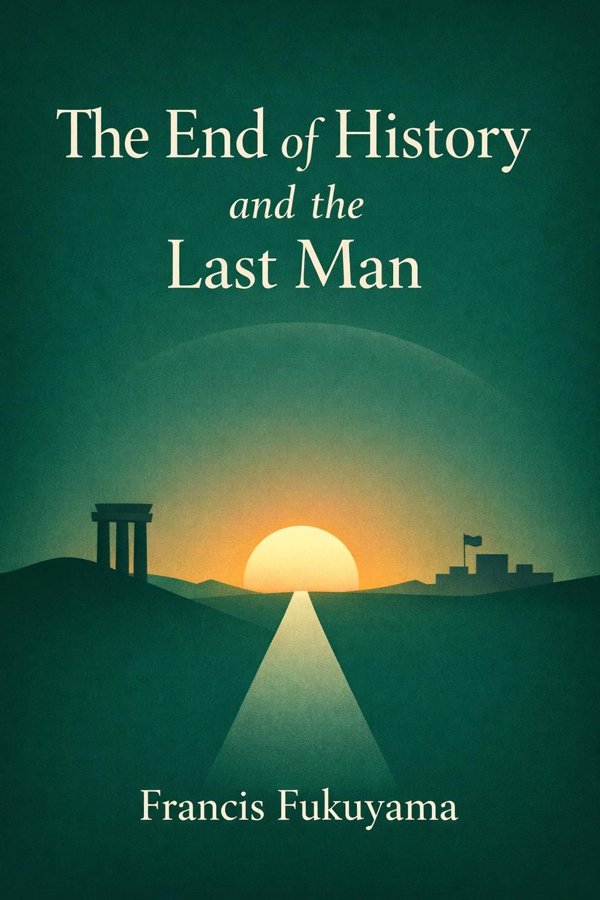
The End of History and the Last Man: Summary & Key Insights
 10 min10 chaptersAudio available
What Is The End of History and the Last Man About?
The End of History and the Last Man by Francis Fukuyama is a politics book spanning 10 pages. In this influential work, Francis Fukuyama argues that the end of the Cold War marked not just the conclusion of a particular historical period but the endpoint of mankind’s ideological evolution. He proposes that liberal democracy may constitute the final form of human government, exploring themes of political philosophy, historical development, and the nature of progress.
This FizzRead summary covers all 10 key chapters of The End of History and the Last Man in approximately 10 minutes, distilling the most important ideas, arguments, and takeaways from Francis Fukuyama's work. Also available as an audio summary and Key Quotes Podcast.
The End of History and the Last Man
In this influential work, Francis Fukuyama argues that the end of the Cold War marked not just the conclusion of a particular historical period but the endpoint of mankind’s ideological evolution. He proposes that liberal democracy may constitute the final form of human government, exploring themes of political philosophy, historical development, and the nature of progress.
Who Should Read The End of History and the Last Man?
This book is perfect for anyone interested in politics and looking to gain actionable insights in a short read. Whether you're a student, professional, or lifelong learner, the key ideas from The End of History and the Last Man by Francis Fukuyama will help you think differently.
- ✓Readers who enjoy politics and want practical takeaways
- ✓Professionals looking to apply new ideas to their work and life
- ✓Anyone who wants the core insights of The End of History and the Last Man in just 10 minutes
Want the full summary?
Get instant access to this book summary and 100K+ more with Fizz Moment.
Get Free SummaryAvailable on App Store • Free to download
Key Chapters
To speak of the end of history, we must first clarify what history itself means. I adopt here a philosophical conception of history, one that reaches beyond chronicles of events into the evolution of human consciousness and political institutions. Hegel offered the foundational insight that history unfolds as a rational process—a dialectic in which contradictions within human society generate new syntheses, leading, step by step, toward greater recognition of freedom.
Marx famously transformed Hegel’s ideal dialectic into one of material struggle, asserting that economic systems and class conflict drive historical progress. Yet even Marx’s materialism concealed a moral essence: the pursuit of justice, equality, and human dignity. Both thinkers shared the conviction that history has direction and meaning—it moves toward the fulfillment of human nature. This belief anchors my own argument: that liberal democracy represents the endpoint of this rational trajectory.
The Cold War era provided the living embodiment of a dialectical clash. Two competing visions—liberal capitalism and communist socialism—faced off as embodiments of freedom versus necessity, individuality versus collective control. When the socialist world crumbled, it was not merely a political defeat; it marked the exhaustion of an ideological alternative. What remained was not the superiority of one state, but the triumph of the principle underlying liberal democracy: the recognition of human autonomy and rights.
In understanding this process, history itself acquires coherence. The rise and fall of systems are not random but part of humanity’s long learning process. We encounter tyranny, we experience oppression, we rebel, and we reconstruct new forms closer to freedom. The endpoint is reached when ideological struggle ceases—when one form embodies the deepest human longing for equality, dignity, and self-government. That form, I argue, is the liberal democratic state.
Still, history as progress remains fragile. Rationality does not automatically guarantee peace. There will be wars, revolts, and regressions—but they will occur within, not beyond, the horizon set by liberal democratic ideals. The rational structure of history remains intact, only now expressed through the refinement, rather than the replacement, of democracy itself.
Over centuries, humanity experimented with divergent ideologies—monarchic divine order, fascist nationalism, communist egalitarianism. Each promised salvation through obedience, discipline, or unity. Each ultimately succumbed to its internal contradictions. The modern world, particularly after 1989, revealed that the age of competing grand ideologies is over. Liberal democracy, combining individual freedom with economic competition, has emerged not by mere circumstance but by the exhaustion of alternatives.
Communism, once heralded as the scientific solution to social inequality, collapsed because its vision of humanity contradicted human nature itself. It denied autonomy, stifled creativity, and subordinated moral choice to bureaucratic control. Fascism, by contrast, exalted the irrational—collective pride, racial purity, spiritual authority—but destroyed itself through its embrace of domination. Liberal democracy survived because it synthesized reason and freedom; it recognized that human beings seek both material well-being and recognition of their individuality.
Importantly, this 'end of evolution' does not mean perfection. Liberal democracy remains vulnerable, yet it stands as the last man’s best institutional expression. It reconciles conflicting human tendencies—our desire for recognition and our need for security—through institutions of law and rights. The struggle now moves from ideology to practice. The task is not to invent new systems but to perfect the existing one.
This historical culmination invites reflection: have we truly transcended ideological conflict? Or are we at risk of returning to older passions in new disguises? Even as liberal democracy spreads globally, impulses toward nationalism and religious absolutism persist. The victory is intellectual and moral, yet history continues as a contest of implementation. Still, the ideological arc bends toward freedom, reinforcing the claim that we have reached the horizon of political possibility.
+ 8 more chapters — available in the FizzRead app
All Chapters in The End of History and the Last Man
About the Author
Francis Fukuyama is an American political scientist, economist, and author known for his work on political order, development, and the theory of liberal democracy. He has taught at Johns Hopkins University and Stanford University and is widely recognized for his contributions to political philosophy and international relations.
Get This Summary in Your Preferred Format
Read or listen to the The End of History and the Last Man summary by Francis Fukuyama anytime, anywhere. FizzRead offers multiple formats so you can learn on your terms — all free.
Available formats: App · Audio · PDF · EPUB — All included free with FizzRead
Download The End of History and the Last Man PDF and EPUB Summary
Key Quotes from The End of History and the Last Man
“To speak of the end of history, we must first clarify what history itself means.”
“Over centuries, humanity experimented with divergent ideologies—monarchic divine order, fascist nationalism, communist egalitarianism.”
Frequently Asked Questions about The End of History and the Last Man
The End of History and the Last Man by Francis Fukuyama is a politics book that explores key ideas across 10 chapters. In this influential work, Francis Fukuyama argues that the end of the Cold War marked not just the conclusion of a particular historical period but the endpoint of mankind’s ideological evolution. He proposes that liberal democracy may constitute the final form of human government, exploring themes of political philosophy, historical development, and the nature of progress.
More by Francis Fukuyama
The Origins of Political Order: From Prehuman Times to the French Revolution
Francis Fukuyama
10 min
Liberalism and Its Discontents
Francis Fukuyama
10 min
Trust: The Social Virtues and the Creation of Prosperity
Francis Fukuyama
10 min
Political Order and Political Decay: From the Industrial Revolution to the Globalization of Democracy
Francis Fukuyama
10 minYou Might Also Like
Antifa: The Anti-Fascist Handbook
Mark Bray
10 min
Attack from Within: How Disinformation Is Sabotaging America
Barbara McQuade
10 min
Coercion, Capital, and European States, AD 990–1992
Charles Tilly
10 min
Digital Democracy: Concepts, Methodologies, Tools, and Applications
Various Authors
10 min
Fascism
Stanley G. Payne
10 min
Fire And Fury: Inside The Trump White House
Michael Wolff
10 minBrowse by Category
Ready to read The End of History and the Last Man?
Get the full summary and 100K+ more books with Fizz Moment.