
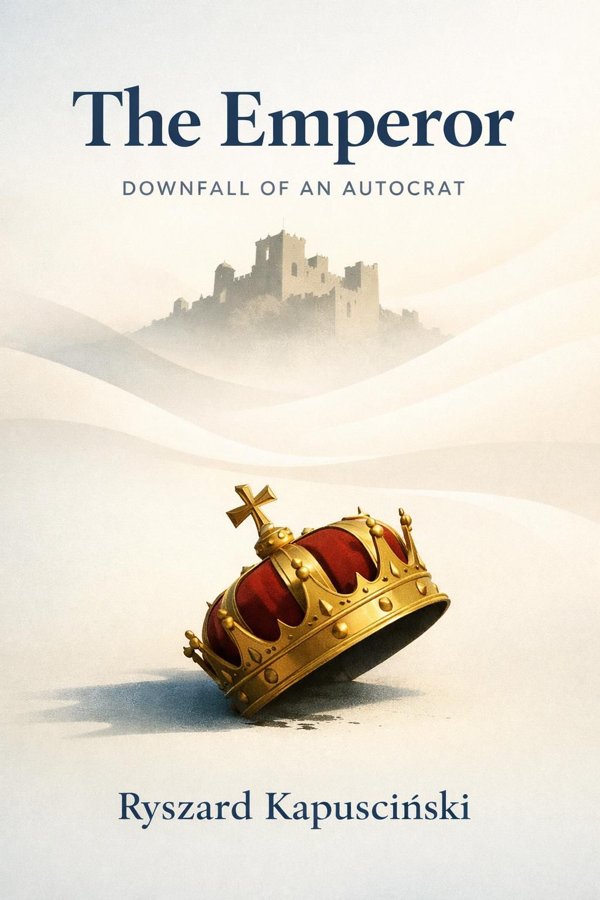
The Emperor: Downfall of an Autocrat: Summary & Key Insights
 10 min9 chaptersAudio available
Key Takeaways from The Emperor: Downfall of an Autocrat
Power often survives not because it is efficient, but because it looks unquestionable.
Autocracy depends on repetition: the daily reenactment of the ruler’s exceptional status.
A bureaucracy can either distribute responsibility or dissolve it.
Corruption is rarely just theft; it is often a method of rule.
The more absolute a ruler becomes, the less he knows.
What Is The Emperor: Downfall of an Autocrat About?
The Emperor: Downfall of an Autocrat by Ryszard Kapuscinski is a world_history book spanning 8 pages. The Emperor: Downfall of an Autocrat is Ryszard Kapuscinski’s haunting study of power at its most theatrical, fragile, and self-deceiving. First published in 1978, the book reconstructs the final years of Ethiopian ruler Haile Selassie I through the voices of former palace insiders: servants, ministers, functionaries, and loyal courtiers who once lived inside the machinery of imperial rule. What emerges is not just a portrait of one monarch, but a penetrating anatomy of autocracy itself. Kapuscinski shows how absolute power survives through ritual, flattery, fear, and carefully managed distance from reality—and how those same forces eventually hasten its collapse. The book matters because it reads far beyond Ethiopia. It is an allegory of every political or organizational system built around a single untouchable figure. Kapuscinski, one of the 20th century’s greatest literary journalists, reported across Africa, Asia, and Latin America and became known for turning political upheaval into sharp moral and psychological inquiry. In The Emperor, he combines reportage with fable-like precision, creating a work that is historically grounded yet timeless. It remains essential reading for anyone who wants to understand how leaders become isolated, institutions become hollow, and regimes fall from within before they collapse in public.
This FizzRead summary covers all 9 key chapters of The Emperor: Downfall of an Autocrat in approximately 10 minutes, distilling the most important ideas, arguments, and takeaways from Ryszard Kapuscinski's work. Also available as an audio summary and Key Quotes Podcast.
The Emperor: Downfall of an Autocrat
The Emperor: Downfall of an Autocrat is Ryszard Kapuscinski’s haunting study of power at its most theatrical, fragile, and self-deceiving. First published in 1978, the book reconstructs the final years of Ethiopian ruler Haile Selassie I through the voices of former palace insiders: servants, ministers, functionaries, and loyal courtiers who once lived inside the machinery of imperial rule. What emerges is not just a portrait of one monarch, but a penetrating anatomy of autocracy itself. Kapuscinski shows how absolute power survives through ritual, flattery, fear, and carefully managed distance from reality—and how those same forces eventually hasten its collapse.
The book matters because it reads far beyond Ethiopia. It is an allegory of every political or organizational system built around a single untouchable figure. Kapuscinski, one of the 20th century’s greatest literary journalists, reported across Africa, Asia, and Latin America and became known for turning political upheaval into sharp moral and psychological inquiry. In The Emperor, he combines reportage with fable-like precision, creating a work that is historically grounded yet timeless. It remains essential reading for anyone who wants to understand how leaders become isolated, institutions become hollow, and regimes fall from within before they collapse in public.
Who Should Read The Emperor: Downfall of an Autocrat?
This book is perfect for anyone interested in world_history and looking to gain actionable insights in a short read. Whether you're a student, professional, or lifelong learner, the key ideas from The Emperor: Downfall of an Autocrat by Ryszard Kapuscinski will help you think differently.
- ✓Readers who enjoy world_history and want practical takeaways
- ✓Professionals looking to apply new ideas to their work and life
- ✓Anyone who wants the core insights of The Emperor: Downfall of an Autocrat in just 10 minutes
Want the full summary?
Get instant access to this book summary and 100K+ more with Fizz Moment.
Get Free SummaryAvailable on App Store • Free to download
Key Chapters
Power often survives not because it is efficient, but because it looks unquestionable. In The Emperor, Kapuscinski presents Haile Selassie’s court as an elaborate stage on which hierarchy, devotion, and order had to be performed daily. Every gesture inside the palace mattered: where one stood, how one bowed, who was permitted to speak, and which trivial duty one was entrusted with. The court was not simply an administrative center. It was a symbolic universe designed to convince everyone—insiders and outsiders alike—that the Emperor’s authority was natural, eternal, and complete.
These rituals served a political purpose. When institutions are weak, appearances become essential. The more fragile the system, the more obsessively it tends to polish symbols of dignity and continuity. Courtiers became guardians of style rather than truth. Their role was to preserve the image of perfection, not to confront the regime’s failures. In such an environment, competence matters less than proximity, ceremony, and the ability to read the ruler’s moods.
This idea applies far beyond monarchy. In corporations, governments, and even nonprofits, leaders can build cultures where optics matter more than outcomes. Endless meetings, formal titles, controlled language, and exaggerated deference can create the illusion of stability while masking dysfunction. Teams begin managing impressions instead of solving problems.
Kapuscinski’s deeper point is that theater can maintain authority for a while, but it cannot substitute for reality forever. A system that devotes its energy to preserving appearances loses the capacity to respond to crisis.
Actionable takeaway: In any organization, ask where ceremony has replaced substance. If people are rewarded more for looking loyal than for telling the truth, the structure may already be in decline.
Autocracy depends on repetition: the daily reenactment of the ruler’s exceptional status. Kapuscinski’s account of the Emperor’s morning routine reveals how even ordinary acts were transformed into sacred performances. Rising, walking, receiving attendants, and moving through palace corridors became choreographed affirmations of imperial grandeur. The old Emperor did not simply begin his day; he was ceremonially unveiled to a system built around his person.
What makes these scenes so important is not their extravagance alone, but their function. Ritual insulated the Emperor from common reality. Every moment reinforced the idea that he was above ordinary constraints—above inconvenience, contradiction, and disorder. The more the court treated him as semi-divine, the harder it became for anyone to approach him as a fallible human leader. Information had to be filtered, language softened, discomfort removed. Ritual thus became a mechanism of ignorance.
In practical terms, this pattern appears whenever leaders surround themselves with routines that prevent friction. An executive who only hears prepared briefings, a politician who appears only in tightly controlled environments, or a founder shielded from customer complaints may unknowingly recreate the same dynamic. Symbolic prestige can become an enemy of situational awareness.
Kapuscinski also suggests that ritual shapes belief. People who repeatedly perform reverence eventually internalize it. The attendants carrying out ceremonial duties were not merely pretending; they were helping build the psychological architecture of autocracy.
Actionable takeaway: Examine the routines around leadership in your own environment. If systems are designed mainly to protect status, simplify reality, or prevent candid contact, redesign them to allow direct feedback and unfiltered information.
A bureaucracy can either distribute responsibility or dissolve it. In The Emperor, the imperial administration appears vast, layered, and busy, yet strangely incapable of solving real problems. Officials managed papers, titles, permissions, ceremonial posts, and endless chains of deference, but this activity did not produce effective governance. Instead, the bureaucracy became a maze in which everyone had a function and almost no one had responsibility.
Kapuscinski shows how autocratic systems prefer bureaucracies that depend on the ruler’s favor rather than on clear rules. Ambiguity serves power. If authority flows personally from the top, subordinates must remain cautious, indirect, and dependent. Decisions are delayed because no one wants to overstep. Bad news is softened because candor is dangerous. Local failures remain local until they become national disasters. The machine grows larger while becoming less capable.
This phenomenon is visible in many institutions today. A company can have multiple reporting lines, dashboards, review committees, and approval chains yet still fail to act decisively because no one feels safe owning the truth. Public agencies can become so focused on process compliance that they neglect outcomes. The result is institutional paralysis disguised as order.
The genius of Kapuscinski’s portrayal is that the absurdity is never merely comic. Beneath the rituals of paperwork and hierarchy lie human costs: ignored grievances, neglected reforms, and a state increasingly detached from the population it governs.
Actionable takeaway: If you lead a team or work inside a large system, identify one recurring problem that “belongs to everyone” and therefore to no one. Assign clear ownership, shorten decision chains, and reward transparent reporting over procedural theater.
Corruption is rarely just theft; it is often a method of rule. Kapuscinski’s account of Haile Selassie’s regime shows a system held together by patronage networks in which favor, access, appointments, and protection mattered more than merit or public service. People did not simply serve the Emperor because they believed in him. Many served because their livelihood, safety, and social standing depended on remaining useful to the palace.
This kind of corruption is especially durable because it is relational. A bribe may be a single transaction, but patronage is a structure of mutual dependence. The ruler rewards loyalty; the loyal become invested in preserving the system; newcomers learn that advancement depends less on competence than on alignment. Over time, corruption stops feeling exceptional and begins to feel normal. It becomes the operating logic of the state.
Kapuscinski makes clear that such systems weaken themselves. Patronage creates short-term loyalty but long-term fragility. It crowds out independent institutions, punishes honesty, and ensures that talented people either conform or leave. Most importantly, it blinds leadership. Those who owe everything to favor are unlikely to deliver unwelcome truths.
Modern readers can recognize similar dynamics whenever access is traded for obedience, whether in politics, business, academia, or local organizations. A manager who promotes only loyalists may enjoy control for a time, but eventually creates a culture where mediocrity is safer than excellence.
Actionable takeaway: Watch for environments where people advance primarily through personal allegiance. To resist patronage culture, insist on transparent criteria for hiring, promotion, and resource allocation—and document decisions so they can be reviewed independently.
The more absolute a ruler becomes, the less he knows. One of Kapuscinski’s most powerful insights is that Haile Selassie’s authority produced his isolation. The Emperor sat at the center of the system, yet gradually lost direct contact with reality. Layers of servants, ministers, and courtiers filtered information before it reached him. They concealed problems, softened crises, and translated suffering into language that would not offend imperial dignity.
This is one of the central paradoxes of autocracy: total control creates informational blindness. Because subordinates fear punishment or exclusion, they bring only what is safe to bring. Because the ruler is treated as infallible, errors cannot be discussed openly. Because loyalty is valued over truth, the leader becomes a prisoner of managed narratives.
Kapuscinski’s depiction remains strikingly modern. Leaders in democratic governments, corporations, or media organizations can also become insulated by staff, data curation, and reputation management. If employees feel they must protect the leader from discomfort, the leader’s confidence may grow at the exact moment situational awareness declines.
The tragedy is that isolation often feels like prestige. The ruler experiences distance as respect, not realizing that every protective layer cuts another line to reality. By the time the truth breaks through, it usually arrives as crisis.
For readers, this idea has personal relevance too. Anyone in a position of authority—manager, teacher, founder, parent—can become harder to correct over time if others start editing themselves in your presence.
Actionable takeaway: Build channels that bypass flattery. Ask for dissent explicitly, seek direct reports from people at the edges of the system, and reward those who raise problems early rather than those who preserve your comfort.
A regime’s true character is revealed when suffering can no longer be hidden. In The Emperor, the 1973 famine becomes the decisive moral and political test that Haile Selassie’s government fails. While people in provinces starved, the imperial system continued to preserve decorum, hierarchy, and the image of control. The problem was not merely administrative incompetence; it was a political culture in which protecting the ruler’s prestige took priority over confronting mass human misery.
Kapuscinski shows how autocracy handles crisis badly because it is structured to suppress embarrassment. Local officials hesitate to report bad news upward. Central authorities delay action to avoid blame. Propaganda and denial replace urgency. Suffering becomes invisible to those who must act because the system has trained everyone to hide disorder rather than address it.
The famine matters in the book not just as an event, but as a revelation. It exposed the gap between imperial mythology and social reality. A ruler celebrated as father of the nation appeared indifferent or unable to respond when the nation most needed him. Once a political order loses moral legitimacy, ceremonial legitimacy rarely survives for long.
This lesson extends to modern institutions during scandals, layoffs, disasters, or public health emergencies. Leaders are judged less by polished messaging than by whether they face pain honestly and act quickly. When image management outruns moral responsibility, trust evaporates.
Actionable takeaway: In any crisis, make reality visible fast. Surface bad news early, prioritize those most affected, and measure leadership not by how calm it appears, but by how directly it responds to human need.
Political collapse usually looks sudden only from a distance. Kapuscinski portrays the fall of Haile Selassie’s regime as the final act of a much longer internal breakdown. The court still functioned, ceremonies still occurred, titles were still distributed, and the imperial image still circulated. Yet beneath the surface, legitimacy was eroding, social grievances were deepening, and the state’s capacity to command obedience was weakening.
This is one of the book’s most enduring contributions: it teaches readers to distinguish between visible stability and actual strength. Systems centered on one ruler often appear durable because dissent is muted and symbols remain intact. But when institutions are hollowed out, problems accumulate silently. Economic strain, military dissatisfaction, public resentment, and elite rivalry may all intensify while the surface remains calm.
Kapuscinski also shows that once fear begins to crack, the structure can unravel quickly. People who seemed loyal yesterday may defect tomorrow if they sense that protection from the center is weakening. Since personal rule relies heavily on belief, the loss of belief has cascading effects.
The same pattern can occur in businesses and organizations. A company may look successful because branding is strong and public messaging is polished, yet internally it may suffer from burnout, talent flight, weak controls, and strategic drift. The external shock does not create the failure; it reveals it.
Actionable takeaway: Do not confuse continuity with health. Look for early indicators of decay—suppressed feedback, talent loss, widening inequality, brittle morale, and dependence on one individual—and treat them as structural warnings, not temporary inconveniences.
Words do not merely describe power; they help preserve it. Throughout The Emperor, Kapuscinski pays close attention to the polished, indirect, deferential language used by former courtiers. Their speech is ceremonious, elliptical, and careful, even when discussing absurdity, cruelty, or collapse. This style is not accidental. It reflects a world in which survival depended on speaking around truth rather than stating it plainly.
Euphemism is one of autocracy’s essential tools. If dismissals become “reassignments,” famine becomes “difficulty,” fear becomes “respect,” and servility becomes “devotion,” the regime can maintain dignity while reality worsens. Language acts as insulation, reducing moral shock and normalizing distortion. People adapt to the vocabulary of power until they can no longer name what is happening clearly.
Kapuscinski’s insight applies strongly to the present. Organizations often use soft language to hide hard realities: “rightsizing” instead of layoffs, “misalignment” instead of negligence, “narrative control” instead of censorship. Such language may sound professional, but it can dull accountability and suppress urgency.
The book invites readers to listen not only to what is said but to how it is said. Excessive formality, passive phrasing, and abstract terminology often signal that a system is protecting itself from honest description. Once language becomes detached from reality, decision-making usually follows.
Actionable takeaway: Audit the vocabulary in your workplace or community. Replace vague, prestige-protecting phrases with direct descriptions of facts, consequences, and responsibilities. Clear language is not just stylistic honesty; it is a practical defense against institutional self-deception.
Despotism is not sustained by one person alone; it reshapes everyone around that person. One of the most unsettling lessons in The Emperor is that autocratic systems corrupt both the ruler and the ruled. Haile Selassie becomes increasingly remote, entitled, and dependent on ceremonial affirmation. But the courtiers, too, are transformed. They learn to flatter, conceal, compete, and submit. Their intelligence is redirected away from solving public problems and toward surviving proximity to power.
Kapuscinski refuses to portray these insiders simply as villains. Many are ridiculous, compromised, or self-serving, yet they are also products of an environment that rewards obedience over integrity. In this sense, the court becomes a moral ecosystem. Everyone adapts. Some do so cynically, others sincerely, but the cumulative effect is the same: a political culture in which honesty becomes hazardous and dignity becomes transactional.
This matters because it challenges the comforting belief that bad systems are caused only by bad leaders. Institutions decay when ordinary people repeatedly make small adjustments to untruth. The assistant edits the report. The manager avoids confrontation. The advisor delays delivering bad news. The result is collective complicity without anyone feeling fully responsible.
For modern readers, the application is direct. In unhealthy workplaces, people often say, “That’s just how things work here.” Kapuscinski warns that such adaptation has ethical costs. We become what our environments repeatedly require.
Actionable takeaway: Notice the small compromises your system asks of you. Protect one zone of non-negotiable integrity—truthful reporting, fair evaluation, documented decisions, or honest speech—so adaptation does not quietly turn into complicity.
All Chapters in The Emperor: Downfall of an Autocrat
About the Author
Ryszard Kapuscinski (1932–2007) was a Polish journalist, essayist, and foreign correspondent widely regarded as one of the most important literary reporters of the 20th century. He spent decades working for the Polish Press Agency, covering revolutions, wars, coups, and political transformations across Africa, Asia, and Latin America. His writing is known for combining firsthand observation with historical reflection, psychological insight, and a highly crafted literary style. Among his best-known books are The Emperor, Shah of Shahs, and The Shadow of the Sun. Kapuscinski’s work often explored how power operates and how ordinary people experience political upheaval. Though debates have surrounded the documentary boundaries of some of his books, his influence on narrative nonfiction and global reportage remains immense.
Get This Summary in Your Preferred Format
Read or listen to the The Emperor: Downfall of an Autocrat summary by Ryszard Kapuscinski anytime, anywhere. FizzRead offers multiple formats so you can learn on your terms — all free.
Available formats: App · Audio · PDF · EPUB — All included free with FizzRead
Download The Emperor: Downfall of an Autocrat PDF and EPUB Summary
Key Quotes from The Emperor: Downfall of an Autocrat
“Power often survives not because it is efficient, but because it looks unquestionable.”
“Autocracy depends on repetition: the daily reenactment of the ruler’s exceptional status.”
“A bureaucracy can either distribute responsibility or dissolve it.”
“Corruption is rarely just theft; it is often a method of rule.”
“The more absolute a ruler becomes, the less he knows.”
Frequently Asked Questions about The Emperor: Downfall of an Autocrat
The Emperor: Downfall of an Autocrat by Ryszard Kapuscinski is a world_history book that explores key ideas across 9 chapters. The Emperor: Downfall of an Autocrat is Ryszard Kapuscinski’s haunting study of power at its most theatrical, fragile, and self-deceiving. First published in 1978, the book reconstructs the final years of Ethiopian ruler Haile Selassie I through the voices of former palace insiders: servants, ministers, functionaries, and loyal courtiers who once lived inside the machinery of imperial rule. What emerges is not just a portrait of one monarch, but a penetrating anatomy of autocracy itself. Kapuscinski shows how absolute power survives through ritual, flattery, fear, and carefully managed distance from reality—and how those same forces eventually hasten its collapse. The book matters because it reads far beyond Ethiopia. It is an allegory of every political or organizational system built around a single untouchable figure. Kapuscinski, one of the 20th century’s greatest literary journalists, reported across Africa, Asia, and Latin America and became known for turning political upheaval into sharp moral and psychological inquiry. In The Emperor, he combines reportage with fable-like precision, creating a work that is historically grounded yet timeless. It remains essential reading for anyone who wants to understand how leaders become isolated, institutions become hollow, and regimes fall from within before they collapse in public.
More by Ryszard Kapuscinski
You Might Also Like
The Age of Capital
Eric Hobsbawm
10 min
The Gulag Archipelago
Aleksandr Solzhenitsyn
10 min
Jerusalem: The Biography
Simon Sebag Montefiore
10 min
The Anglo-Saxons
James Campbell
10 min
The Boer War
Thomas Pakenham
10 min
The Industrial Revolutionaries: The Making of the Modern World 1776–1914
Gavin Weightman
10 minBrowse by Category
Ready to read The Emperor: Downfall of an Autocrat?
Get the full summary and 100K+ more books with Fizz Moment.