
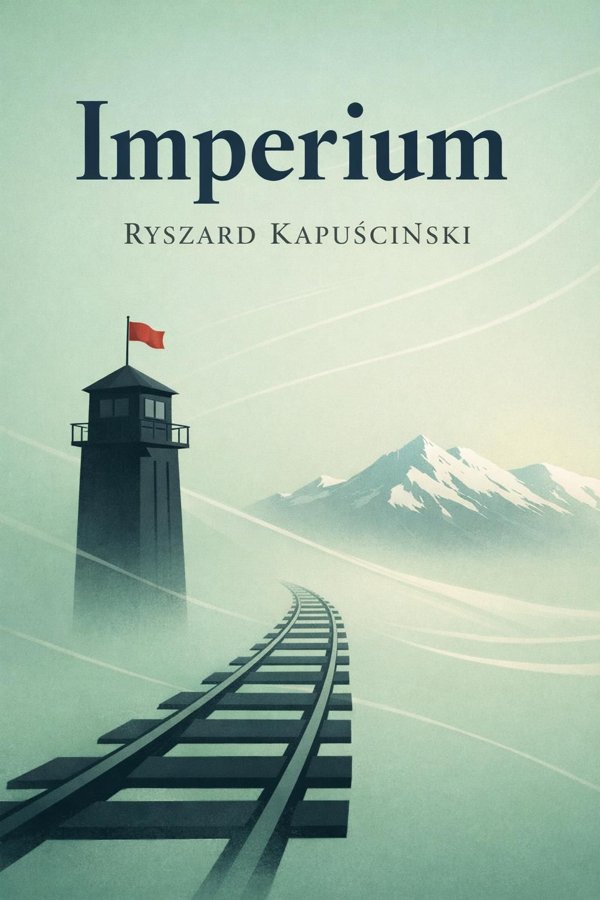
Imperium: Summary & Key Insights
 10 min8 chaptersAudio available
Key Takeaways from Imperium
Empires often introduce themselves not through persuasion, but through fear.
The most lasting effects of empire are often felt not on battlefields, but in kitchens, schools, offices, and train stations.
To understand an empire, look not at its official center but at its neglected edges.
Some landscapes are not merely places; they are political instruments.
Capitals are theaters where power stages its preferred version of reality.
What Is Imperium About?
Imperium by Ryszard Kapuscinski is a world_history book spanning 7 pages. Imperium is Ryszard Kapuscinski’s searching, deeply human account of the Soviet Union as both a political system and a lived reality. Part memoir, part travel writing, part historical reflection, the book follows Kapuscinski from his childhood in eastern Poland during the Soviet invasion of 1939 to his later journeys across the vast territories of the USSR as it approached collapse. What emerges is not a conventional history of communism, but an intimate portrait of empire: how it spreads, how it governs through fear and bureaucracy, how it reshapes landscapes and identities, and how it eventually begins to crack from within. The book matters because it reveals the Soviet world not as an abstraction of ideology or geopolitics, but as a collection of places, memories, silences, and ordinary lives caught inside an enormous system. Kapuscinski is uniquely qualified to tell this story. As one of the twentieth century’s great literary reporters, he combines a witness’s eye for detail with a historian’s sense of pattern and a moralist’s concern for power. Imperium remains essential reading for anyone seeking to understand authoritarianism, imperial rule, and the fragile fate of human freedom.
This FizzRead summary covers all 8 key chapters of Imperium in approximately 10 minutes, distilling the most important ideas, arguments, and takeaways from Ryszard Kapuscinski's work. Also available as an audio summary and Key Quotes Podcast.
Imperium
Imperium is Ryszard Kapuscinski’s searching, deeply human account of the Soviet Union as both a political system and a lived reality. Part memoir, part travel writing, part historical reflection, the book follows Kapuscinski from his childhood in eastern Poland during the Soviet invasion of 1939 to his later journeys across the vast territories of the USSR as it approached collapse. What emerges is not a conventional history of communism, but an intimate portrait of empire: how it spreads, how it governs through fear and bureaucracy, how it reshapes landscapes and identities, and how it eventually begins to crack from within. The book matters because it reveals the Soviet world not as an abstraction of ideology or geopolitics, but as a collection of places, memories, silences, and ordinary lives caught inside an enormous system. Kapuscinski is uniquely qualified to tell this story. As one of the twentieth century’s great literary reporters, he combines a witness’s eye for detail with a historian’s sense of pattern and a moralist’s concern for power. Imperium remains essential reading for anyone seeking to understand authoritarianism, imperial rule, and the fragile fate of human freedom.
Who Should Read Imperium?
This book is perfect for anyone interested in world_history and looking to gain actionable insights in a short read. Whether you're a student, professional, or lifelong learner, the key ideas from Imperium by Ryszard Kapuscinski will help you think differently.
- ✓Readers who enjoy world_history and want practical takeaways
- ✓Professionals looking to apply new ideas to their work and life
- ✓Anyone who wants the core insights of Imperium in just 10 minutes
Want the full summary?
Get instant access to this book summary and 100K+ more with Fizz Moment.
Get Free SummaryAvailable on App Store • Free to download
Key Chapters
Empires often introduce themselves not through persuasion, but through fear. Kapuscinski’s earliest memories of the Soviet Union begin with the 1939 invasion of eastern Poland, when he was still a child. For him, Soviet power did not arrive as a theory about equality or progress. It arrived as tanks, uniforms, orders, portraits of Stalin, and the sudden disappearance of normal life. This opening experience shapes the entire book: the USSR is understood first as a system that colonizes the mind by making people afraid to speak, trust, remember, or even think aloud.
Kapuscinski shows that fear under Stalinism was not simply terror at the level of prisons and executions, though those were real enough. It was also a daily condition. People learned to lower their voices, repeat official slogans, and avoid dangerous honesty. In such a climate, language itself becomes corrupted. Public words no longer express truth; they become instruments of survival. This insight helps explain why totalitarian systems often endure longer than outsiders expect. They do not merely punish dissent. They make self-censorship habitual.
The lesson extends well beyond Soviet history. Any system that encourages people to monitor themselves, avoid uncomfortable facts, and publicly perform loyalty while privately feeling dread is reproducing this imperial logic on a smaller scale. In workplaces, institutions, or political cultures, fear can quietly become a governing tool.
Actionable takeaway: Pay attention to environments where people are careful rather than honest. Fear is often the first sign that power has stopped seeking legitimacy and started demanding submission.
The most lasting effects of empire are often felt not on battlefields, but in kitchens, schools, offices, and train stations. Kapuscinski’s account of postwar Soviet expansion across Eastern Europe highlights how imperial rule embeds itself into ordinary routines. Once the Red Army had advanced and Soviet influence hardened into political control, people encountered empire through rationing, censorship, bureaucratic decrees, educational indoctrination, and a new vocabulary of ideological conformity. Occupation was not only a military fact. It became an administrative habit.
This is one of the book’s most important insights: empires survive by normalizing themselves. The Soviet Imperium did not rely solely on violence, though violence remained in reserve. It also built systems that taught people what could be said, what could be taught, what could be published, and what kinds of memory were officially allowed. Children learned one version of history at school while hearing another version whispered at home. Citizens were forced to navigate a split existence between public obedience and private knowledge.
Kapuscinski helps us see that imperial domination is most effective when it appears mundane. A denied permit, a standardized textbook, a party-approved newspaper, a useless queue, a suspicious neighbor: these become the texture of control. The result is not just political subjugation, but moral exhaustion.
This idea has practical relevance whenever institutions become so centralized that everyday life is shaped by distant power with little accountability. The warning is that domination often advances through paperwork before it advances through overt force.
Actionable takeaway: Study how power operates in the routines of daily life. If control is hidden in procedures, language, and habits, resistance begins with noticing those small mechanisms clearly.
To understand an empire, look not at its official center but at its neglected edges. Kapuscinski’s travels through the Caucasus and Central Asia reveal how the Soviet Union looked far from Moscow’s ideological self-image. In these regions, he encounters landscapes of extraordinary beauty, deep historical memory, ethnic complexity, and simmering resentment. The empire presented itself as a modernizing force bringing unity and progress, yet what Kapuscinski sees are places burdened by underdevelopment, distrust, and wounds left by forced incorporation into a centralized state.
The peripheral republics expose a central contradiction of the Soviet project. Officially, the USSR celebrated the brotherhood of peoples. In practice, it often treated distinct nations and cultures as problems to be managed, displayed, resettled, or disciplined. Local traditions survived, but frequently in distorted or defensive forms. Kapuscinski pays close attention to how these societies carried layered identities: Soviet on paper, national in memory, local in instinct. This unstable arrangement helps explain why the union later unraveled so quickly. What looked from the center like cohesion often masked unresolved historical grievances.
There is also a methodological lesson here. Large systems are easiest to romanticize from afar. The farther one is from the center’s propaganda, the easier it becomes to observe what the system actually produces. In modern terms, if you want to judge a policy, company, or government, examine the communities at the margins that live with its consequences most directly.
Actionable takeaway: To understand any powerful institution, listen to the people on its periphery. The margins often reveal truths that the center works hardest to hide.
Some landscapes are not merely places; they are political instruments. In Imperium, Siberia appears as one of the most powerful symbols of Soviet rule: immense, cold, sparsely populated, and historically tied to exile, forced labor, and disappearance. Kapuscinski’s encounters in Siberia reveal how geography itself can be used by a state to intimidate, isolate, and erase. The vastness of the territory becomes part of the machinery of domination. Distance is transformed into punishment.
Yet Kapuscinski does not reduce Siberia to a metaphor. He also shows it as a lived world populated by workers, settlers, survivors, Indigenous peoples, and those whose biographies were bent by the state’s decisions. The region embodies the Soviet paradox of grand ambition and human waste. It held immense natural wealth and strategic importance, but it was also scarred by the gulag system and by development schemes that treated human beings as expendable resources. In Siberia, the empire’s obsession with scale is laid bare. The state dreamed in colossal terms, but its gigantism often concealed moral emptiness.
This section of the book encourages readers to think about the relationship between space and power. Governments and institutions can use remoteness, complexity, and administrative distance to weaken scrutiny and accountability. When people are pushed out of sight, they are easier to control and easier to forget.
The contemporary relevance is clear in any context where hidden supply chains, remote detention sites, or neglected regions allow abuses to continue without public attention.
Actionable takeaway: Ask what happens in the places furthest from public visibility. Where oversight is weakest and distance is greatest, power is often at its most revealing.
Capitals are theaters where power stages its preferred version of reality. Kapuscinski’s observations in Moscow focus on the contrast between imperial self-confidence and underlying decay. As the Soviet center, Moscow radiated authority, symbolism, and bureaucracy. It was where ideology was produced, rituals were orchestrated, and the empire imagined itself as coherent and historical. But beneath the monumental architecture and official language, Kapuscinski detects fatigue, cynicism, and a system no longer able to believe fully in its own claims.
This is one of his sharpest contributions: authoritarian systems often continue performing strength long after conviction has disappeared. People still repeat formulas, institutions still function on paper, and ceremonies still take place, yet the emotional and moral substance has drained away. In Moscow, Kapuscinski notices queues, inefficiency, evasive speech, and a population trained to live with contradiction. The state remains powerful, but it increasingly governs through inertia rather than belief.
The center therefore becomes a place of distortion. Because so much energy goes into maintaining the image of order, disorder accumulates behind the scenes. The official narrative says history is moving forward; lived experience suggests stagnation. This gap between proclamation and reality is often a sign that a system is approaching crisis.
The broader lesson applies to organizations as much as nations. When leaders invest more in appearances, slogans, and self-protective messaging than in solving obvious problems, decline may already be underway.
Actionable takeaway: Watch for widening gaps between official confidence and everyday experience. When institutions need constant performance to prove their strength, their weakness may already be showing.
Political systems rarely collapse the moment people stop believing in them. Kapuscinski’s treatment of perestroika and the late Soviet years shows a more subtle process: ideology decays first, while the institutions built around it continue staggering forward. By the time reform enters the Soviet vocabulary, many citizens no longer treat communist doctrine as a source of meaning. The slogans still exist, but they feel emptied out, repeated from habit rather than conviction. This is a dangerous moment for any regime, because once belief has vanished, coercion and bureaucracy must carry the whole burden of continuity.
Kapuscinski captures the atmosphere of this transition with particular sensitivity. Perestroika opens space for speech, criticism, and memory, but it also exposes how much of the Soviet world had been held together by fear, silence, and falsification. Once people begin speaking more freely, suppressed grievances pour out: national, economic, historical, and moral. Reform does not simply improve the system; it reveals how unstable it already was. The result is not renewal but acceleration toward fragmentation.
A key insight here is that systems may appear durable while their core story has already failed. This applies beyond politics. A company, movement, or institution can continue operating after its original mission has lost credibility. Metrics may remain, structures may persist, but the animating purpose is gone.
Kapuscinski warns us that reformers inherit a paradox. Opening a closed system may be necessary, but openness can unleash realities that the old order spent decades suppressing.
Actionable takeaway: Do not confuse institutional survival with genuine legitimacy. Ask whether people still believe in the ideas that justify a system, or merely endure its procedures.
When empires weaken, they do not simply disappear; they fracture along the lines they once tried to erase. In the final stages of the Soviet Union’s disintegration, Kapuscinski witnesses the return of buried histories, long-suppressed identities, and unresolved national claims. What had been held together by force, ideology, and central administration begins to come apart with startling speed. Republics seek independence, old flags reappear, local memories surface, and forgotten grievances regain political force.
Kapuscinski is careful not to romanticize this process. Freedom does not arrive as pure celebration. The collapse of imperial order can also produce fear, violence, instability, and confusion. People who have lived for decades inside one official framework must suddenly imagine new states, new loyalties, and new futures. In some places this creates democratic hope; in others, it awakens ethnic conflict or political opportunism. The end of empire is therefore morally complex. It removes one form of domination, but it does not automatically create justice.
This is one of the book’s enduring strengths: it rejects simplistic narratives. The Soviet collapse was neither only a liberation nor only a tragedy. It was a vast historical release, full of possibility and danger. Kapuscinski helps readers understand that when power suppresses diversity for too long, the eventual return of difference may be turbulent.
This insight matters whenever centralized systems insist that unity requires silence. Suppressed tensions do not vanish. They accumulate until crisis gives them expression.
Actionable takeaway: Treat unresolved historical memory seriously. Problems ignored in the name of order often return with greater force when control weakens.
One of Kapuscinski’s quiet arguments is about method: to understand power, you must travel through the lives it touches. Imperium is not written like a textbook or a policy study. It is built from movement, encounter, observation, and memory. Trains, roads, waiting rooms, borderlands, provincial cities, and conversations with ordinary people become his way of dismantling the abstract language of empire. Instead of describing the Soviet Union only through leaders, doctrines, or treaties, he asks what it felt like to inhabit that world.
This approach matters because empires thrive on abstraction. They speak of progress, unity, planning, civilization, and history. Such words can obscure the real experience of shortage, fear, displacement, humiliation, and endurance. Kapuscinski’s literary reportage restores scale to the human level. He notices gestures, weather, silence, architecture, queues, and fatigue. These details are not decorative. They are evidence. They reveal how systems become reality.
The practical value of this method extends to anyone trying to understand complex issues today. Statistics and official statements matter, but they are incomplete without firsthand observation and attention to lived experience. Whether studying migration, economic reform, conflict, or institutional culture, we understand more when we ask how broad structures are absorbed into daily life.
Kapuscinski also models intellectual humility. He does not pretend to explain everything. He travels, listens, reflects, and lets contradictions remain visible.
Actionable takeaway: When confronting big political or social systems, combine analysis with close observation. Seek out lived experience, because abstractions become trustworthy only when tested against human reality.
All Chapters in Imperium
About the Author
Ryszard Kapuscinski (1932–2007) was a Polish journalist, essayist, and author celebrated as one of the leading masters of literary reportage. Born in Pinsk, then part of Poland, he came of age during war, occupation, and the rise of Soviet power, experiences that profoundly shaped his worldview. As a foreign correspondent for the Polish Press Agency, he reported from Africa, Asia, Latin America, and the Soviet sphere, often covering revolutions, coups, and social upheaval. His writing is known for blending firsthand observation, historical insight, and philosophical reflection. Among his most acclaimed books are The Emperor, Shah of Shahs, and Imperium. Kapuscinski remains influential not only for what he witnessed, but for how he transformed journalism into a powerful form of humanistic inquiry.
Get This Summary in Your Preferred Format
Read or listen to the Imperium summary by Ryszard Kapuscinski anytime, anywhere. FizzRead offers multiple formats so you can learn on your terms — all free.
Available formats: App · Audio · PDF · EPUB — All included free with FizzRead
Download Imperium PDF and EPUB Summary
Key Quotes from Imperium
“Empires often introduce themselves not through persuasion, but through fear.”
“The most lasting effects of empire are often felt not on battlefields, but in kitchens, schools, offices, and train stations.”
“To understand an empire, look not at its official center but at its neglected edges.”
“Some landscapes are not merely places; they are political instruments.”
“Capitals are theaters where power stages its preferred version of reality.”
Frequently Asked Questions about Imperium
Imperium by Ryszard Kapuscinski is a world_history book that explores key ideas across 8 chapters. Imperium is Ryszard Kapuscinski’s searching, deeply human account of the Soviet Union as both a political system and a lived reality. Part memoir, part travel writing, part historical reflection, the book follows Kapuscinski from his childhood in eastern Poland during the Soviet invasion of 1939 to his later journeys across the vast territories of the USSR as it approached collapse. What emerges is not a conventional history of communism, but an intimate portrait of empire: how it spreads, how it governs through fear and bureaucracy, how it reshapes landscapes and identities, and how it eventually begins to crack from within. The book matters because it reveals the Soviet world not as an abstraction of ideology or geopolitics, but as a collection of places, memories, silences, and ordinary lives caught inside an enormous system. Kapuscinski is uniquely qualified to tell this story. As one of the twentieth century’s great literary reporters, he combines a witness’s eye for detail with a historian’s sense of pattern and a moralist’s concern for power. Imperium remains essential reading for anyone seeking to understand authoritarianism, imperial rule, and the fragile fate of human freedom.
More by Ryszard Kapuscinski
You Might Also Like
The Age of Capital
Eric Hobsbawm
10 min
The Gulag Archipelago
Aleksandr Solzhenitsyn
10 min
Jerusalem: The Biography
Simon Sebag Montefiore
10 min
The Anglo-Saxons
James Campbell
10 min
The Boer War
Thomas Pakenham
10 min
The Industrial Revolutionaries: The Making of the Modern World 1776–1914
Gavin Weightman
10 minBrowse by Category
Ready to read Imperium?
Get the full summary and 100K+ more books with Fizz Moment.