
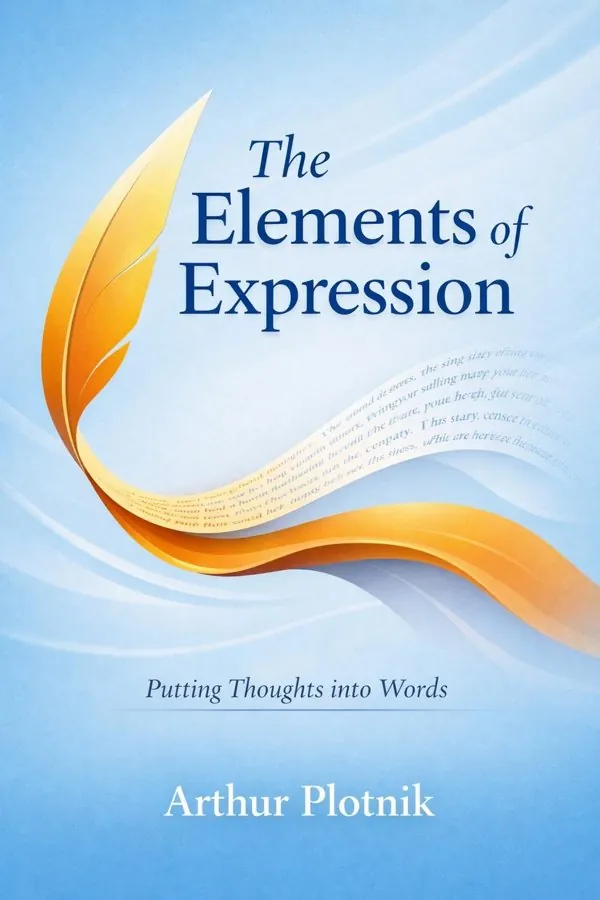
The Elements of Expression: Putting Thoughts into Words: Summary & Key Insights
 10 min9 chaptersAudio available
Key Takeaways from The Elements of Expression: Putting Thoughts into Words
Before language becomes expressive, the writer must first notice life more sharply.
Words do not simply denote; they radiate.
A sentence is not only read with the eye; it is heard with the inner ear.
People remember what they can picture.
Voice is the fingerprint of language.
What Is The Elements of Expression: Putting Thoughts into Words About?
The Elements of Expression: Putting Thoughts into Words by Arthur Plotnik is a writing book spanning 12 pages. What makes one sentence merely correct and another unforgettable? In The Elements of Expression: Putting Thoughts into Words, Arthur Plotnik argues that strong communication depends on far more than grammar or clarity alone. Language comes alive when writers and speakers choose vivid words, shape rhythm, control tone, and develop a distinct voice that carries thought with energy and precision. This book is a practical guide to making prose more memorable, persuasive, and human. Plotnik’s central insight is that expression is not decoration added after the fact. It is the very force that helps ideas land. Whether you are writing essays, speeches, business communication, creative nonfiction, or everyday emails, expressive language can turn flat statements into communication that moves people. Plotnik writes with the authority of an editor, language expert, and publishing professional who spent years helping others sharpen their style. He combines literary sensitivity with practical instruction, showing readers how to improve not by sounding fancier, but by sounding more alive. The result is a book for anyone who wants their words to do more than inform. It is for those who want their words to connect, persuade, and endure.
This FizzRead summary covers all 9 key chapters of The Elements of Expression: Putting Thoughts into Words in approximately 10 minutes, distilling the most important ideas, arguments, and takeaways from Arthur Plotnik's work. Also available as an audio summary and Key Quotes Podcast.
The Elements of Expression: Putting Thoughts into Words
What makes one sentence merely correct and another unforgettable? In The Elements of Expression: Putting Thoughts into Words, Arthur Plotnik argues that strong communication depends on far more than grammar or clarity alone. Language comes alive when writers and speakers choose vivid words, shape rhythm, control tone, and develop a distinct voice that carries thought with energy and precision. This book is a practical guide to making prose more memorable, persuasive, and human.
Plotnik’s central insight is that expression is not decoration added after the fact. It is the very force that helps ideas land. Whether you are writing essays, speeches, business communication, creative nonfiction, or everyday emails, expressive language can turn flat statements into communication that moves people.
Plotnik writes with the authority of an editor, language expert, and publishing professional who spent years helping others sharpen their style. He combines literary sensitivity with practical instruction, showing readers how to improve not by sounding fancier, but by sounding more alive. The result is a book for anyone who wants their words to do more than inform. It is for those who want their words to connect, persuade, and endure.
Who Should Read The Elements of Expression: Putting Thoughts into Words?
This book is perfect for anyone interested in writing and looking to gain actionable insights in a short read. Whether you're a student, professional, or lifelong learner, the key ideas from The Elements of Expression: Putting Thoughts into Words by Arthur Plotnik will help you think differently.
- ✓Readers who enjoy writing and want practical takeaways
- ✓Professionals looking to apply new ideas to their work and life
- ✓Anyone who wants the core insights of The Elements of Expression: Putting Thoughts into Words in just 10 minutes
Want the full summary?
Get instant access to this book summary and 100K+ more with Fizz Moment.
Get Free SummaryAvailable on App Store • Free to download
Key Chapters
Before language becomes expressive, the writer must first notice life more sharply. Plotnik suggests that dull writing often comes not from limited vocabulary but from limited awareness. If you do not hear the cadence of speech, notice emotional nuance, or sense the texture of an experience, your sentences will likely report rather than reveal. Expression begins in perception: the ear, the eye, and the mind working together.
This idea shifts the task of writing. Instead of asking only, “How do I say this?” Plotnik pushes us to ask, “What am I really seeing, feeling, or trying to make someone else feel?” A bland line such as “The room was messy” may be accurate, but it carries little life. A more alert writer might say, “The room looked as if a week of arguments had exploded across the floor.” The second sentence does more than describe. It interprets and evokes.
Plotnik is careful not to equate expression with ornament. The goal is not to pile on adjectives or strain for cleverness. It is to become sensitive to the emotional and sensory charge hidden inside ordinary scenes and ideas. This applies just as much to business or academic writing as to creative work. A project update can sound more energetic if it reflects real priorities and stakes; a classroom essay becomes stronger when it shows the writer actually understands what matters in the topic.
Practical improvement starts with observation. Listen to how people actually speak. Pay attention to words that linger in your mind. Notice which descriptions feel generic and which carry attitude, motion, or atmosphere. Keep a notebook of striking phrases, sensory details, and emotional contrasts.
Actionable takeaway: before revising your next piece, underline every flat sentence and ask what deeper perception or sharper angle could make it more alive.
Words do not simply denote; they radiate. Plotnik treats vocabulary as a toolkit of shades, textures, and temperatures. Two words may share a dictionary meaning while producing entirely different effects on the reader. To call someone “thin,” “lean,” “gaunt,” or “skeletal” is to make not just a descriptive choice but an expressive one. Word choice shapes tone, attitude, precision, and memorability.
Plotnik’s advice is not to chase rare or pretentious words. Expressive diction depends less on obscurity than on fitness. The right common word often beats the wrong elaborate one. “Stomped” is stronger than “walked angrily.” “Glint” may do more work than “shine.” Specific, active, concrete words usually create more impact than abstract, padded phrasing. Compare “The committee made a decision to implement changes” with “The committee approved changes.” The second sentence is tighter, clearer, and more forceful.
At the same time, Plotnik encourages writers to expand their verbal range. A richer vocabulary gives you options, and options give you control. When revising, you can test whether a noun is too broad, a verb too weak, or an adjective too predictable. Freshness often comes from precision. Instead of saying a speaker was “good,” you might say she was “measured,” “magnetic,” “acerbic,” or “plainspoken,” depending on what you mean.
This principle is especially useful in persuasive writing, branding, journalism, and storytelling. The exact word can alter audience trust, emotional tone, and clarity. Strong writers learn to hear the hidden connotations of language and pick words that support their purpose.
Actionable takeaway: when revising, replace at least five vague verbs or generic adjectives with more precise alternatives that match the feeling and meaning you actually intend.
A sentence is not only read with the eye; it is heard with the inner ear. Plotnik emphasizes that rhythm and sound are central to expression because language affects us physically as well as intellectually. The rise and fall of syllables, the length of clauses, the repetition of sounds, and the placement of stress all shape how a sentence lands. Flat prose often lacks not just insight but music.
Writers frequently focus on meaning while ignoring cadence. Yet rhythm can strengthen meaning. Short sentences can create speed, tension, or blunt force. Longer, rolling sentences can suggest thoughtfulness, abundance, or emotional sweep. Consider the difference between “He entered the room. Everyone stopped” and “When he entered the room, conversation thinned, glances tilted, and the air changed.” Both describe an arrival, but the second uses rhythm to dramatize it.
Plotnik invites writers to read their work aloud. Awkward stretches, accidental monotony, and clutter become obvious when heard. Sound devices such as alliteration, assonance, consonance, and repetition can add subtle power when used with restraint. “Cold, clipped replies” has more sting than “short responses.” Likewise, sentence variety matters. A paragraph of similarly sized sentences can feel mechanical. Mixing compact statements with longer constructions creates movement.
This insight applies widely. In speeches, rhythm determines whether lines are memorable. In marketing, a phrase with snap is more repeatable. In essays, varied cadence prevents fatigue. In fiction and memoir, sound helps establish mood and voice.
Expression, then, is partly a compositional art. You are arranging sound as well as sense. You are shaping breath, pause, and momentum.
Actionable takeaway: read one page of your writing aloud and mark every place where the rhythm drags, repeats, or stumbles; then revise for stronger cadence and sentence variety.
People remember what they can picture. Plotnik shows that imagery and figurative language make writing more expressive because they convert abstract thought into felt experience. Rather than merely naming an emotion, a process, or a problem, effective writers embody it. A metaphor, comparison, or sensory detail gives the reader something to grasp.
The key is relevance, not extravagance. Figurative language works when it clarifies or intensifies meaning, not when it exists to show off. Saying “She was nervous” communicates information. Saying “Her thoughts skittered like birds trapped in a hallway” gives the feeling shape and motion. In analytical writing, imagery can make complex concepts accessible. A leader may be described not as “indecisive” but as “keeping one foot on every dock.” The metaphor compresses judgment into a memorable image.
Plotnik also values concrete detail. Specific sensory cues often do more than broad description. Instead of “The neighborhood was old,” imagine “porches sagged under peeling paint, and the mailboxes leaned as if tired of waiting.” Such details build atmosphere while implying history. In nonfiction, the right image can illuminate an argument; in business writing, a carefully chosen analogy can simplify technical material; in teaching, examples anchored in everyday experience improve retention.
Still, Plotnik warns against overloading every paragraph with similes and metaphors. Too much figurative language can feel forced or distracting. Expression is strongest when imagery appears where it can do real work: clarifying a point, sharpening a scene, or revealing attitude.
Actionable takeaway: find one abstract statement in your writing and rewrite it using a concrete image, example, or metaphor that helps the reader see and feel what you mean.
Voice is the fingerprint of language. Plotnik treats it not as a mysterious gift but as the cumulative effect of many decisions: word choice, sentence length, tone, pacing, humor, formality, and point of view. Readers sense voice when they feel a human presence behind the prose, someone with a recognizable way of seeing and saying.
Many writers weaken their voice by trying to sound impressive, neutral, or overly correct. Plotnik argues that effective style comes from authenticity shaped by craft. A strong voice does not mean writing exactly as you speak, nor does it mean adopting quirks for effect. It means developing a manner of expression that feels natural, purposeful, and suited to the material. A columnist may sound sly and conversational; an essayist may sound reflective and measured; a business leader may sound direct and confident. Each voice should fit both writer and context.
Voice also requires control. A lively style can collapse into gimmick if every sentence strains to be noticeable. Plotnik suggests that memorable style often grows from selective distinctiveness: a surprising phrase here, a wry turn there, a steady pattern of clarity and rhythm throughout. Over time, these habits become signature.
For readers trying to improve, imitation can be a useful stage. Study writers you admire and note what makes them recognizable. Do they favor compressed sentences or expansive ones? Do they use irony, concrete detail, or unusual syntax? Borrow techniques temporarily, but use them to discover your own tendencies rather than to become a copy.
Actionable takeaway: choose a paragraph you wrote and revise it to sound more like a real person with a point of view, cutting generic phrases and adding language that reflects your natural stance and intention.
How you arrange words, clauses, and sentences can be as expressive as the words themselves. Plotnik highlights syntax and structure as tools for emphasis, surprise, clarity, and emotional pacing. A sentence can accelerate, hesitate, reveal, conceal, or deliver a punch depending on its architecture.
Writers often think of syntax as merely technical, but Plotnik presents it as artistic. Front-loading a sentence with key information creates immediacy. Delaying the main point can build suspense. Parallel structure adds rhythm and force, as in “She wanted truth, demanded clarity, and refused compromise.” Fragments, when used intentionally, can add drama or intimacy. Inversion, interruption, and repetition can shift stress in revealing ways.
Paragraph structure matters too. An expressive paragraph has movement. It may begin with a bold claim, deepen through example, then land on a resonant final line. Even a simple email can gain strength when ideas are sequenced effectively: first the purpose, then the evidence, then the ask. Poor structure muddies thought; strong structure guides attention.
Plotnik also reminds us that complexity should be purposeful. Long, heavily subordinated sentences can mirror complexity of mind, but they can also suffocate. Short sentences can feel forceful, but too many in a row become choppy. The expressive writer chooses sentence form based on desired effect rather than habit.
This approach is practical across genres. In storytelling, syntax can mimic panic, calm, hesitation, or urgency. In argument, structure helps foreground what matters most. In professional writing, good arrangement increases persuasiveness and saves the reader effort.
Actionable takeaway: revise one paragraph by changing sentence order and length to place your strongest idea at the beginning or end, where readers are most likely to feel its impact.
Every piece of writing carries an attitude, whether the writer intends it or not. Plotnik shows that tone and mood are not cosmetic extras but essential parts of communication. The same facts can sound warm or cold, playful or severe, humble or arrogant, depending on phrasing, rhythm, and framing. Expression succeeds when tone supports both message and audience.
A common mistake is tonal mismatch. Writers may sound too stiff for a personal essay, too casual for a formal proposal, too sarcastic for a sensitive topic, or too grand for a simple point. Plotnik encourages awareness of the relationship between writer, subject, and reader. Ask: What emotional climate should this create? What degree of distance or intimacy is appropriate? What response am I inviting?
Mood grows from cumulative details. A dark mood may come from clipped sentences, harsh sounds, and bleak imagery. A playful tone may rely on nimble phrasing and unexpected comparisons. Even in straightforward professional communication, tone matters. “Please send the files by noon” differs noticeably from “Could you send the files by noon so we can keep the review on schedule?” Both request action, but the second acknowledges collaboration.
Plotnik links this to audience awareness. Expression is not self-display alone; it is relational. Good writers adapt without becoming bland. They preserve distinctiveness while respecting context. Ethical communication also enters here: tone can manipulate, patronize, or obscure. The expressive writer uses style to connect, not to dominate.
Actionable takeaway: before finalizing any piece, name the tone you want in one or two words, such as “confident and warm” or “serious and clear,” then revise any sentence that sends a conflicting signal.
First drafts may contain sparks, but expression is usually refined in revision. Plotnik treats rewriting not as punishment but as the stage where language becomes deliberate. This is where excess gets trimmed, weak spots get strengthened, rhythms get tuned, and authentic voice emerges from rough intention.
Writers sometimes imagine that expressive prose arrives fully formed. Plotnik counters that memorable writing is often the result of repeated attention. Revision allows you to test alternatives: a sharper verb, a cleaner opening, a more resonant closing, a better image, a stronger sequence. It also exposes false notes. A phrase that seemed clever at first may feel inflated on second reading. A paragraph may wander. A metaphor may confuse more than clarify.
This is also where ethics and authenticity matter. Plotnik does not celebrate style for style’s sake. Expressive writing should illuminate thought, not camouflage weak ideas. Revision asks whether your language is honest, appropriate, and genuinely your own. Are you clarifying or exaggerating? Are you energizing your prose or merely decorating it? Are you sounding alive or sounding affected?
Practical revision can happen in layers. One pass for clarity. One for rhythm. One for specificity. One for tone. Reading aloud is invaluable. So is changing the format by printing, enlarging, or viewing on another device. Time away from the draft helps you hear it more objectively.
In the end, revision is how writers honor readers. It shows a willingness to make language work better, not just harder.
Actionable takeaway: use a four-pass revision method on your next draft, checking separately for clarity, precision, rhythm, and tone rather than trying to fix everything at once.
One of Plotnik’s most useful contributions is the reminder that expressive language is not only for novelists, poets, or speechwriters. It has practical applications in everyday communication. Emails, presentations, classroom assignments, cover letters, op-eds, reports, websites, and conversations all benefit when words are chosen with more life and care.
This matters because modern readers are flooded with language. Generic phrasing disappears instantly. Expressive communication, by contrast, earns attention. A teacher who explains a concept with a vivid analogy helps students remember it. A manager who writes with clarity and energy inspires more confidence. A marketer who avoids jargon and speaks concretely reaches customers more effectively. A job applicant with a precise, engaging cover letter stands out.
Plotnik’s broader point is that style is functional. Better expression can improve persuasion, understanding, and trust. It can also help writers think more clearly, since the search for the right phrase often sharpens the idea itself. If you can say something well, you have likely understood it better.
At the same time, application requires judgment. Not every context welcomes flamboyance. In professional settings, the aim is often controlled vividness: concise sentences, active verbs, human tone, and memorable examples without unnecessary flourish. In teaching or public speaking, strategic repetition and rhythm can improve retention. In personal communication, honest specificity can deepen connection.
Plotnik ultimately democratizes style. He suggests that anyone can become more expressive by noticing, choosing carefully, and revising with intent. Expression is not an elite performance. It is a practical advantage.
Actionable takeaway: pick one routine form of communication you use often, such as emails or presentations, and improve it this week by replacing generic phrases with clearer, more concrete, more human language.
All Chapters in The Elements of Expression: Putting Thoughts into Words
About the Author
Arthur Plotnik was an American author, editor, and publishing professional known for his lively approach to language and style. Over the course of his career, he worked extensively in editing and literary communication, including serving as associate editor for the American Library Association. Plotnik became especially respected for books that help readers move beyond grammatical correctness toward more vivid, expressive writing. His work stands out for combining practical instruction with wit, verbal sensitivity, and a deep appreciation for how language sounds and feels. Rather than treating style as decoration, he presented it as an essential part of clear and memorable communication. His books continue to appeal to writers, editors, students, and professionals seeking prose that is not only accurate, but also energetic, distinctive, and human.
Get This Summary in Your Preferred Format
Read or listen to the The Elements of Expression: Putting Thoughts into Words summary by Arthur Plotnik anytime, anywhere. FizzRead offers multiple formats so you can learn on your terms — all free.
Available formats: App · Audio · PDF · EPUB — All included free with FizzRead
Download The Elements of Expression: Putting Thoughts into Words PDF and EPUB Summary
Key Quotes from The Elements of Expression: Putting Thoughts into Words
“Before language becomes expressive, the writer must first notice life more sharply.”
“Words do not simply denote; they radiate.”
“A sentence is not only read with the eye; it is heard with the inner ear.”
“Plotnik shows that imagery and figurative language make writing more expressive because they convert abstract thought into felt experience.”
“Plotnik treats it not as a mysterious gift but as the cumulative effect of many decisions: word choice, sentence length, tone, pacing, humor, formality, and point of view.”
Frequently Asked Questions about The Elements of Expression: Putting Thoughts into Words
The Elements of Expression: Putting Thoughts into Words by Arthur Plotnik is a writing book that explores key ideas across 9 chapters. What makes one sentence merely correct and another unforgettable? In The Elements of Expression: Putting Thoughts into Words, Arthur Plotnik argues that strong communication depends on far more than grammar or clarity alone. Language comes alive when writers and speakers choose vivid words, shape rhythm, control tone, and develop a distinct voice that carries thought with energy and precision. This book is a practical guide to making prose more memorable, persuasive, and human. Plotnik’s central insight is that expression is not decoration added after the fact. It is the very force that helps ideas land. Whether you are writing essays, speeches, business communication, creative nonfiction, or everyday emails, expressive language can turn flat statements into communication that moves people. Plotnik writes with the authority of an editor, language expert, and publishing professional who spent years helping others sharpen their style. He combines literary sensitivity with practical instruction, showing readers how to improve not by sounding fancier, but by sounding more alive. The result is a book for anyone who wants their words to do more than inform. It is for those who want their words to connect, persuade, and endure.
You Might Also Like
The Art of Perspective
Christopher Castellani
10 min
Making a Point: The Persnickety Story of English Punctuation
David Crystal
10 min
The Elements Of Eloquence: How To Turn The Perfect English Phrase
Mark Forsyth
10 min
The Pocket Muse: Ideas and Inspirations for Writing
Monica Wood
10 min
A Little Book on Form: An Exploration into the Formal Imagination of Poetry
Robert Hass
10 min
Adventures In The Screen Trade: A Personal View Of Hollywood And Screenwriting
William Goldman
10 minBrowse by Category
Ready to read The Elements of Expression: Putting Thoughts into Words?
Get the full summary and 100K+ more books with Fizz Moment.