
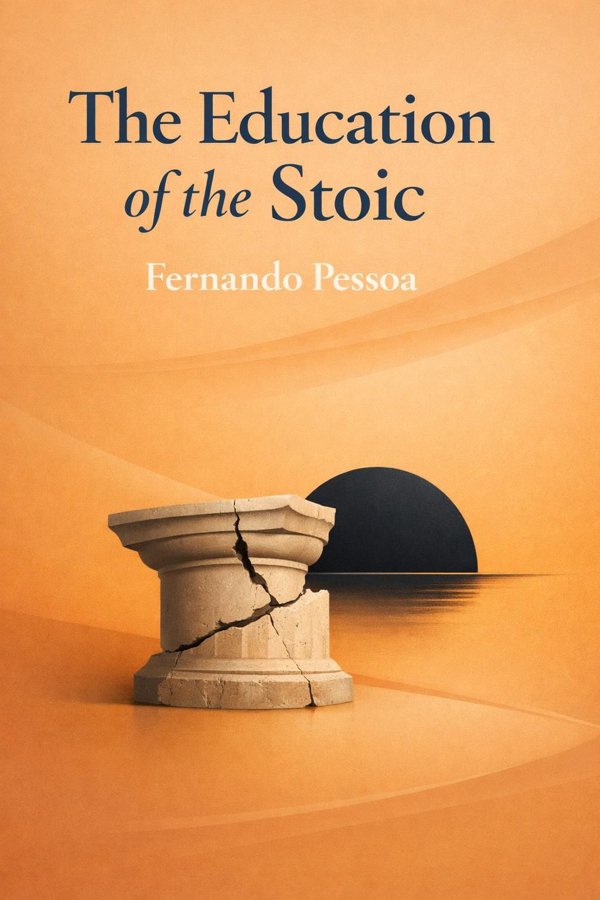
The Education of the Stoic: Summary & Key Insights
 10 min9 chaptersAudio available
Key Takeaways from The Education of the Stoic
A life can be ruined not only by chaos, but by too much order.
What if feeling is not a source of wisdom, but a sabotage of clear thought?
The most punishing moral codes are often those we impose on ourselves.
Art often helps us endure life by transforming pain into meaning.
Reason can illuminate much, but what happens when it examines everything, including its own authority?
What Is The Education of the Stoic About?
The Education of the Stoic by Fernando Pessoa is a western_phil book spanning 8 pages. The Education of the Stoic is one of Fernando Pessoa’s most unsettling and intellectually exacting works: a posthumous confession attributed to his heteronym, the Baron of Teive. Rather than offering Stoicism as a practical path to tranquility, the book presents a mind that pursues rational consistency so relentlessly that life itself becomes impossible. The Baron examines morality, emotion, art, social life, and self-knowledge with pitiless clarity, only to conclude that human existence cannot satisfy the standards of perfect lucidity. The result is a philosophical monologue in which reason becomes both instrument and executioner. What makes this work enduring is its refusal to flatter the reader. Pessoa uses the Baron not to deliver comforting wisdom, but to dramatize the dangers of taking abstraction more seriously than life. The book matters because it exposes a tension many thoughtful people feel: the gap between the ideals we admire and the contradictory beings we actually are. Pessoa, one of the great modernist writers and creators of multiple literary selves, is uniquely suited to this inquiry. Through the Baron of Teive, he gives us not a doctrine to follow, but a consciousness pushed to its absolute limit.
This FizzRead summary covers all 9 key chapters of The Education of the Stoic in approximately 10 minutes, distilling the most important ideas, arguments, and takeaways from Fernando Pessoa's work. Also available as an audio summary and Key Quotes Podcast.
The Education of the Stoic
The Education of the Stoic is one of Fernando Pessoa’s most unsettling and intellectually exacting works: a posthumous confession attributed to his heteronym, the Baron of Teive. Rather than offering Stoicism as a practical path to tranquility, the book presents a mind that pursues rational consistency so relentlessly that life itself becomes impossible. The Baron examines morality, emotion, art, social life, and self-knowledge with pitiless clarity, only to conclude that human existence cannot satisfy the standards of perfect lucidity. The result is a philosophical monologue in which reason becomes both instrument and executioner.
What makes this work enduring is its refusal to flatter the reader. Pessoa uses the Baron not to deliver comforting wisdom, but to dramatize the dangers of taking abstraction more seriously than life. The book matters because it exposes a tension many thoughtful people feel: the gap between the ideals we admire and the contradictory beings we actually are. Pessoa, one of the great modernist writers and creators of multiple literary selves, is uniquely suited to this inquiry. Through the Baron of Teive, he gives us not a doctrine to follow, but a consciousness pushed to its absolute limit.
Who Should Read The Education of the Stoic?
This book is perfect for anyone interested in western_phil and looking to gain actionable insights in a short read. Whether you're a student, professional, or lifelong learner, the key ideas from The Education of the Stoic by Fernando Pessoa will help you think differently.
- ✓Readers who enjoy western_phil and want practical takeaways
- ✓Professionals looking to apply new ideas to their work and life
- ✓Anyone who wants the core insights of The Education of the Stoic in just 10 minutes
Want the full summary?
Get instant access to this book summary and 100K+ more with Fizz Moment.
Get Free SummaryAvailable on App Store • Free to download
Key Chapters
A life can be ruined not only by chaos, but by too much order. That is the Baron of Teive’s starting point. From early on, he becomes devoted to a severe ideal: to think clearly, judge consistently, and live without contradiction. For him, coherence is not merely an intellectual virtue; it is the highest standard by which a person should be measured. Most people accept ambiguity, changing moods, and practical compromise. The Baron sees these as signs of weakness. He wants every belief to align with every action, every principle to be carried through to its conclusion.
This aspiration gives the book its central tension. Coherence sounds admirable, even noble. In everyday life, we respect people who act according to principle. Yet Pessoa shows how the ideal becomes destructive when pushed beyond human limits. Human beings are not systems of logic. We love what we cannot justify, fear what we know is irrational, and change under pressures we barely understand. The Baron cannot forgive this inconsistency in himself or others. His demand for perfect alignment turns self-examination into self-condemnation.
A practical example appears in ordinary moral life. Someone may believe in honesty but still soften the truth to spare a friend’s feelings. Another may value independence but still need affection and reassurance. The Baron would regard such tensions as failures. Pessoa invites us to see them instead as part of being human.
The insight is not that coherence is worthless, but that it must be balanced by humility. Principles help us live, but when they become absolute, they can make life unlivable. Actionable takeaway: examine where your standards guide you well and where they have hardened into impossible demands that leave no room for human complexity.
What if feeling is not a source of wisdom, but a sabotage of clear thought? The Baron of Teive largely believes this. Emotion, in his view, is the force that disturbs judgment, compromises dignity, and drags the mind into dependency. Love, pity, enthusiasm, grief, even ordinary companionship appear to him as forms of inner disorder. To preserve lucidity, he distances himself from emotional attachment and social belonging.
This rejection is not casual misanthropy. It follows from his philosophy. If the good life requires self-mastery and coherence, then emotions are dangerous because they alter our priorities without asking permission. A person in love accepts contradictions. A loyal friend forgives faults. A grieving person can no longer maintain detachment. To the Baron, these states expose the fragility of reason. So he tries to protect himself by refusing the conditions under which he might be moved.
Pessoa reveals the cost of this choice. By treating emotion as contamination, the Baron strips life of warmth, spontaneity, and reciprocity. He avoids the pain of entanglement, but he also loses the forms of meaning that come through vulnerability. In modern terms, this resembles a person who prides themselves on being “rational” while dismissing empathy, intimacy, and emotional honesty as weakness. Such a stance can feel powerful, but it often masks fear of being changed by others.
The book does not suggest surrendering to every emotion. Rather, it asks whether a life purified of feeling is still fully human. Clear thought matters, but so does the capacity to care. Actionable takeaway: instead of treating emotion as an enemy, practice naming feelings without letting them rule you; integration is wiser than suppression.
The most punishing moral codes are often those we impose on ourselves. In The Education of the Stoic, the Baron of Teive measures life against strict moral ideals and finds both the world and himself wanting. He wants integrity, dignity, discipline, and a kind of incorruptible inner nobility. But the more seriously he takes these ideals, the more clearly he sees their collision with ordinary existence. Human beings are vain, impulsive, needy, compromised, and inconsistent. Social life requires tact, selective blindness, and accommodation. Even virtue rarely appears in pure form.
This leads the Baron into a painful contradiction. He cannot stop believing in high ideals, but he also cannot believe that anyone truly embodies them. He sees self-interest hidden inside generosity, pride inside humility, and weakness beneath declarations of principle. Such insight sharpens his intelligence, but it also paralyzes him. If all action is mixed, impure, or compromised, then how can one act without hypocrisy?
This dilemma remains deeply relevant. Consider someone who wants to live ethically in a consumer society. They know their purchases, work, and conveniences implicate them in systems they do not fully endorse. Or think of a leader who values justice but must negotiate with imperfect institutions. The Baron cannot tolerate this impurity. Many readers will recognize the temptation to withdraw when reality fails our standards.
Pessoa’s brilliance lies in showing that moral seriousness can become sterile if it refuses contingency. Ideals should orient life, not abolish it. We do not need perfect purity to act meaningfully; we need honesty about limitation. Actionable takeaway: keep your ideals, but translate them into better choices rather than using them as reasons to reject yourself or the world entirely.
Art often helps us endure life by transforming pain into meaning. The Baron of Teive distrusts that power. For him, art risks becoming a refined falsehood: a beautiful arrangement that consoles us for truths we cannot bear. If poetry, philosophy, or literature merely dress up suffering, then they may soothe us at the expense of lucidity. He refuses consolation because he suspects it is a betrayal of seriousness.
This suspicion gives the book unusual force. Pessoa, himself one of literature’s great artificers, creates a speaker who is wary of art’s seductions. The Baron does not want a noble style to redeem an incoherent life. He rejects sentimentality, symbolic transcendence, and any aesthetic gesture that disguises failure. In doing so, he asks a demanding question: does art reveal reality, or does it make reality easier to tolerate without truly confronting it?
We can see this tension in contemporary culture. People often turn to motivational slogans, beautifully packaged essays, or dramatic personal narratives not because they clarify life, but because they soften it. Even serious art can become self-flattery if we consume it as proof of our depth rather than as a challenge to our self-understanding. The Baron resists all such comfort.
Yet Pessoa also shows the paradox: this very refusal becomes literary. The Baron’s anti-consolation is itself shaped into art. The text therefore becomes a complex meditation on whether honesty can ever appear without form, style, and arrangement. Actionable takeaway: when engaging with art, ask not only whether it moves you, but whether it helps you face reality more clearly or merely gives you a more elegant way to avoid it.
Reason can illuminate much, but what happens when it examines everything, including its own authority? The Baron of Teive pushes rational inquiry to that edge. He believes in analysis, distinction, and the power of the mind to strip away illusion. Yet the deeper he thinks, the more he discovers that reason cannot fully organize existence. It can expose contradictions, but it cannot always tell us how to live with them. It can critique motives, but not generate the emotional energy required for action.
This is one of the book’s most profound insights. We often assume that clearer thinking will solve our deepest problems. Sometimes it does. But there are limits. A person can rationally understand that they should forgive, rest, commit, or begin again, and still remain unable to do so. Life requires momentum, habit, appetite, hope, and tolerance for uncertainty. Pure reason rarely supplies these on its own.
In everyday terms, imagine someone overanalyzing a career decision, a relationship, or a creative project. They list the pros and cons, uncover hidden motives, question every assumption, and end up immobilized. Their reasoning is not wrong; it is insufficient. The Baron represents the extreme version of this condition. He can diagnose life with merciless precision, but diagnosis is not the same as inhabiting life.
Pessoa is not anti-reason. He is exposing the illusion that reason alone can bear the full weight of existence. Wisdom may require accepting that some dimensions of life must be navigated rather than solved. Actionable takeaway: use reason to clarify choices, but set limits on analysis; when further thinking stops producing movement, choose a small concrete action and let experience teach what thought cannot.
Seeing too clearly can become a form of solitude. The Baron of Teive believes that most social life depends on shared illusions, softened judgments, and convenient blindness. To belong, people often overlook contradiction in themselves and others. The Baron cannot do this. His lucidity separates him from ordinary human traffic. He stands apart not because he is superior in any simple sense, but because he cannot participate in the tacit agreements that make community possible.
This isolation is philosophical before it is physical. He is alienated from affection because affection asks for generosity toward imperfection. He is alienated from friendship because friendship thrives on tolerating unresolved complexity. He is alienated even from self-acceptance because self-acceptance requires a mercy he considers intellectually dishonest. In this way, lucidity becomes a burden. The more he perceives, the less he can join.
Many modern readers will recognize a softer version of this experience. Critical intelligence can make one impatient with social performances, simplistic optimism, or borrowed beliefs. A person may feel unable to participate in superficial conversation, group enthusiasm, or reassuring narratives. But Pessoa warns that permanent distance is costly. Detachment can preserve independence, yet it can also harden into sterility and loneliness.
The question the book raises is whether human connection requires a measure of selective blindness. Must we accept illusion to live with others? Not exactly. But we may need to distinguish between dishonesty and kindness, between naivety and tolerance. People are not coherent systems; they are living contradictions. Actionable takeaway: when your clarity isolates you, practice replacing judgment with curiosity; understanding another person’s inconsistency can become a bridge rather than a reason to withdraw.
Stoicism promises freedom through self-command, but in the Baron of Teive it becomes an instrument of negation. He admires restraint, independence, dignity, and the refusal to be ruled by circumstance. These are recognizably Stoic themes. Yet Pessoa presents a crucial distortion: instead of using discipline to live well within limits, the Baron uses it to condemn everything in himself that does not meet an impossible standard. Stoicism, in his hands, ceases to be therapy and becomes tribunal.
This matters because many readers encounter Stoic ideas as practical wisdom: control what you can, accept what you cannot, and cultivate inner steadiness. The Baron shares the desire for mastery, but he lacks the gentler side of genuine Stoicism—the acceptance of human nature, the distinction between aspiration and perfection, the recognition that one can fail and still continue. He turns discipline into purity. Once he does that, any dependency, desire, inconsistency, or emotional movement appears as defeat.
The result is a philosophy that cannot sustain life. A healthy discipline gives structure to action; an absolute discipline leaves no room to act unless one is already flawless. We see versions of this today in productivity culture, moral perfectionism, or rigid self-improvement systems. A person starts with a desire for self-command and ends in self-loathing because every lapse becomes evidence of worthlessness.
Pessoa’s lesson is subtle but essential: ideals become destructive when they are severed from compassion and proportion. Stoicism without humanity turns into cold pride. Actionable takeaway: if you are drawn to self-discipline, pair every standard with a practice of recovery—ask not only how to be strong, but how to begin again after imperfection.
Some minds do not collapse into despair impulsively; they reason their way there. In the Baron of Teive, the decision toward self-destruction is presented not as melodrama, but as the ultimate consequence of a certain type of lucidity. If life cannot satisfy reason, if ideals cannot be embodied, if emotion is contamination, and if consolation is false, then what remains? For the Baron, death appears as the last coherent act available to a consciousness unwilling to compromise.
This is what makes the text so disturbing. It does not romanticize death, nor does it present it as heroic. Instead, Pessoa shows how logic detached from lived mercy can become lethal. The Baron’s conclusion feels internally consistent, but that very consistency reveals the danger in his framework. A philosophy that leaves no room for contradiction eventually leaves no room for survival.
Readers should approach this not as an endorsement, but as a warning about absolutism. In contemporary life, many forms of perfectionism operate in similar ways, though less dramatically. A person may think, “If I cannot do this flawlessly, there is no point in doing it.” Another may believe that one failure invalidates an entire identity. The mind moves from high standards to totalizing conclusions.
Pessoa’s achievement is to make us feel how seductive such conclusions can be to a rigorously self-judging intelligence. But the deeper lesson is that life depends on resisting final verdicts. Meaning often survives in what is partial, broken, and unresolved. Actionable takeaway: when your thinking turns absolute—always, never, pointless, impossible—treat that language as a warning sign and deliberately introduce alternatives, support, and unfinished possibilities.
Not all failure is accidental; sometimes it reveals the structure of a life. The Baron of Teive sees himself as a failed man, but not in the ordinary social sense. He has not simply missed success, status, or pleasure. He has failed to become the kind of being his intelligence demanded. That failure becomes the lens through which he understands everything. Instead of hiding from it, he analyzes it with relentless precision.
This gives the book one of its strangest strengths. Failure here is not only defeat; it is disclosure. By tracing why he cannot live according to his own ideals, the Baron exposes the mismatch between abstract perfection and human existence. In that sense, his confession becomes diagnostic. He is not merely saying, “I could not do it.” He is showing why the project itself may be impossible when taken in absolute terms.
There is practical value in this for readers. Many people interpret failure too narrowly: a job lost, a relationship ended, a goal unmet. Pessoa invites a deeper reading. Our failures often reveal the hidden beliefs we carry about worth, control, identity, and what counts as an acceptable life. A person who burns out pursuing excellence may discover they equated rest with weakness. Someone devastated by rejection may uncover an unexamined need for total approval.
The Baron’s tragedy lies in his inability to transform self-knowledge into gentleness. He understands himself, but only to indict himself. Readers can go further. Failure can become a source of revision rather than a final sentence. Actionable takeaway: when something in your life collapses, ask not only what went wrong, but what impossible ideal was governing you—and what more human standard might replace it.
All Chapters in The Education of the Stoic
About the Author
Fernando Pessoa (1888–1935) was a Portuguese poet, prose writer, critic, and one of the defining figures of European modernism. Born in Lisbon and educated partly in South Africa, he wrote in both Portuguese and English and developed a literary method unlike any other: the creation of heteronyms, alternative authorial selves with distinct biographies, temperaments, and philosophical outlooks. Through figures such as Álvaro de Campos, Ricardo Reis, Alberto Caeiro, and Baron of Teive, Pessoa transformed inner multiplicity into a vast literary universe. Much of his work was unpublished during his lifetime and discovered after his death in a famous trunk of manuscripts. Today he is admired for the depth of his poetry, the originality of his philosophical prose, and his unmatched ability to dramatize consciousness itself.
Get This Summary in Your Preferred Format
Read or listen to the The Education of the Stoic summary by Fernando Pessoa anytime, anywhere. FizzRead offers multiple formats so you can learn on your terms — all free.
Available formats: App · Audio · PDF · EPUB — All included free with FizzRead
Download The Education of the Stoic PDF and EPUB Summary
Key Quotes from The Education of the Stoic
“A life can be ruined not only by chaos, but by too much order.”
“What if feeling is not a source of wisdom, but a sabotage of clear thought?”
“The most punishing moral codes are often those we impose on ourselves.”
“Art often helps us endure life by transforming pain into meaning.”
“Reason can illuminate much, but what happens when it examines everything, including its own authority?”
Frequently Asked Questions about The Education of the Stoic
The Education of the Stoic by Fernando Pessoa is a western_phil book that explores key ideas across 9 chapters. The Education of the Stoic is one of Fernando Pessoa’s most unsettling and intellectually exacting works: a posthumous confession attributed to his heteronym, the Baron of Teive. Rather than offering Stoicism as a practical path to tranquility, the book presents a mind that pursues rational consistency so relentlessly that life itself becomes impossible. The Baron examines morality, emotion, art, social life, and self-knowledge with pitiless clarity, only to conclude that human existence cannot satisfy the standards of perfect lucidity. The result is a philosophical monologue in which reason becomes both instrument and executioner. What makes this work enduring is its refusal to flatter the reader. Pessoa uses the Baron not to deliver comforting wisdom, but to dramatize the dangers of taking abstraction more seriously than life. The book matters because it exposes a tension many thoughtful people feel: the gap between the ideals we admire and the contradictory beings we actually are. Pessoa, one of the great modernist writers and creators of multiple literary selves, is uniquely suited to this inquiry. Through the Baron of Teive, he gives us not a doctrine to follow, but a consciousness pushed to its absolute limit.
More by Fernando Pessoa
You Might Also Like
A Little History of Philosophy
Nigel Warburton
10 min
Areopagitica
John Milton
10 min
How To Think Like A Philosopher: Essential Principles For Clear Thinking
Peter Cave
10 min
Language, Truth and Logic
A. J. Ayer
10 min
The Age of Reason
Thomas Paine
10 min
The Essays
Michel De Montaigne
10 minBrowse by Category
Ready to read The Education of the Stoic?
Get the full summary and 100K+ more books with Fizz Moment.