
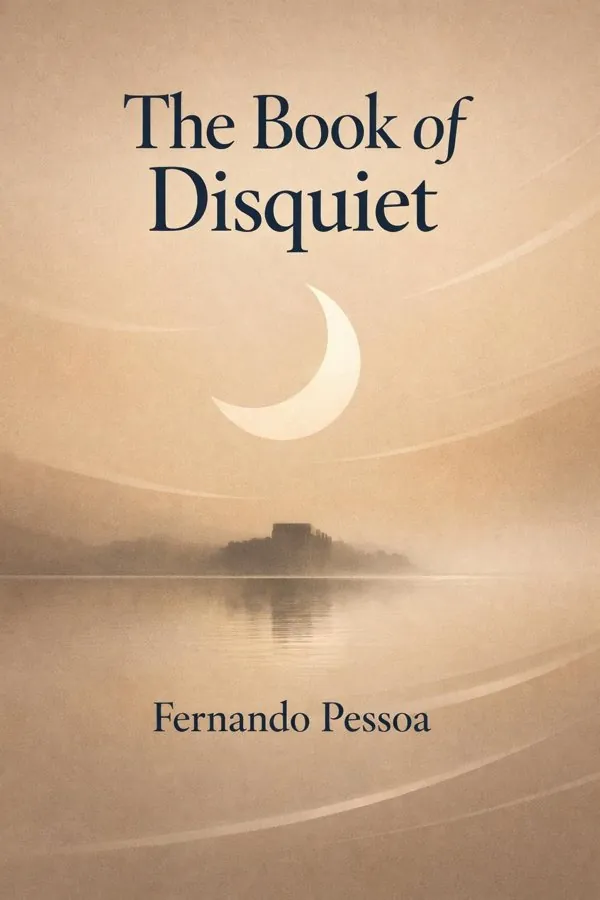
The Book of Disquiet: Summary & Key Insights
 10 min8 chaptersAudio available
Key Takeaways from The Book of Disquiet
Some people suffer solitude; Bernardo Soares almost cultivates it as a way of seeing.
Monotony, Pessoa suggests, is not the opposite of imagination but one of its engines.
When outer life feels limited, the imagination expands to occupy the vacant space.
Few books capture the instability of identity as powerfully as The Book of Disquiet.
Pessoa treats writing not as ornament but as survival.
What Is The Book of Disquiet About?
The Book of Disquiet by Fernando Pessoa is a classics book spanning 7 pages. The Book of Disquiet is one of the strangest and most intimate masterpieces of modern literature: a book made not of plot, but of fragments, meditations, dreams, and moments of inward revelation. Published posthumously from the papers of Portuguese writer Fernando Pessoa and largely attributed to his semi-heteronym Bernardo Soares, it reads like the private notebook of a man who lives outwardly as a modest assistant bookkeeper in Lisbon while inwardly traversing immense emotional and philosophical landscapes. Across its pages, ordinary routines become metaphysical events, boredom becomes a form of perception, and loneliness becomes both wound and refuge. What makes this work enduring is not that it offers answers, but that it gives unforgettable language to states of mind many people feel yet rarely know how to express: estrangement, fatigue, longing, self-division, and the desire to turn life into art. Pessoa is uniquely qualified to write such a book. Few authors explored consciousness with greater subtlety or transformed inner conflict into such haunting prose. The Book of Disquiet matters because it turns private unease into universal literature.
This FizzRead summary covers all 8 key chapters of The Book of Disquiet in approximately 10 minutes, distilling the most important ideas, arguments, and takeaways from Fernando Pessoa's work. Also available as an audio summary and Key Quotes Podcast.
The Book of Disquiet
The Book of Disquiet is one of the strangest and most intimate masterpieces of modern literature: a book made not of plot, but of fragments, meditations, dreams, and moments of inward revelation. Published posthumously from the papers of Portuguese writer Fernando Pessoa and largely attributed to his semi-heteronym Bernardo Soares, it reads like the private notebook of a man who lives outwardly as a modest assistant bookkeeper in Lisbon while inwardly traversing immense emotional and philosophical landscapes. Across its pages, ordinary routines become metaphysical events, boredom becomes a form of perception, and loneliness becomes both wound and refuge.
What makes this work enduring is not that it offers answers, but that it gives unforgettable language to states of mind many people feel yet rarely know how to express: estrangement, fatigue, longing, self-division, and the desire to turn life into art. Pessoa is uniquely qualified to write such a book. Few authors explored consciousness with greater subtlety or transformed inner conflict into such haunting prose. The Book of Disquiet matters because it turns private unease into universal literature.
Who Should Read The Book of Disquiet?
This book is perfect for anyone interested in classics and looking to gain actionable insights in a short read. Whether you're a student, professional, or lifelong learner, the key ideas from The Book of Disquiet by Fernando Pessoa will help you think differently.
- ✓Readers who enjoy classics and want practical takeaways
- ✓Professionals looking to apply new ideas to their work and life
- ✓Anyone who wants the core insights of The Book of Disquiet in just 10 minutes
Want the full summary?
Get instant access to this book summary and 100K+ more with Fizz Moment.
Get Free SummaryAvailable on App Store • Free to download
Key Chapters
Some people suffer solitude; Bernardo Soares almost cultivates it as a way of seeing. One of the central insights of The Book of Disquiet is that alienation is not merely social exclusion but a heightened consciousness of separation from the world. Soares moves through offices, cafés, and Lisbon streets surrounded by people, yet he remains inwardly distant, as though he lives behind glass. This estrangement gives the book its melancholy force, but it also grants him unusual clarity. Because he never fully belongs, he notices everything: gestures, weather, fatigue, passing moods, and the hidden sadness of ordinary life.
Pessoa does not present solitude as romantic freedom. It is often painful, dull, and exhausting. Yet he also suggests that solitude can become a form of truth. In isolation, one is forced to face the instability of identity, the emptiness of routine, and the mind’s relentless need to create meaning. Modern readers may recognize this feeling in remote work, urban anonymity, social media overexposure, or the experience of being constantly connected yet emotionally separate.
Practically, this idea invites us to reconsider our discomfort with aloneness. Solitude can sharpen perception when it is chosen and reflected upon rather than simply endured. Journaling after a long commute, taking a solitary walk without headphones, or sitting quietly after a workday can reveal the emotional textures usually buried under distraction.
Actionable takeaway: set aside fifteen minutes of deliberate solitude this week and write down what you notice about your thoughts, moods, and hidden assumptions when no one else is shaping your attention.
Monotony, Pessoa suggests, is not the opposite of imagination but one of its engines. Bernardo Soares works as an assistant bookkeeper, living among ledgers, invoices, and repetitive tasks. On the surface, this life appears sterile. Yet in The Book of Disquiet, routine becomes the fixed frame against which inner life glows more intensely. The regularity of work does not extinguish dreams; it gives them a backdrop. The office is not only a place of labor but also a theater of metaphysical reflection.
This insight reverses a common assumption that creativity requires dramatic freedom, travel, or constant novelty. Pessoa shows how a disciplined, repetitive environment can generate inward richness. Repetition reveals the structure of our days, and that structure can either numb us or awaken us. Soares transforms clerical life into contemplation by paying exquisite attention to what others dismiss as dull. He turns the ordinary into a mirror.
This is deeply practical for modern life. Many people wait for inspiration to arrive outside their routines: after a career change, a vacation, or some future liberation. Pessoa suggests another possibility. Creative seeing can begin where you already are—in spreadsheets, train rides, errands, and recurring conversations. A teacher may discover emotional patterns in the school day; a nurse may find philosophical depth in repeated acts of care; an accountant may observe how order coexists with existential uncertainty.
Actionable takeaway: choose one recurring task you usually perform mechanically and, for a week, treat it as material for observation. Note what it reveals about your habits, anxieties, desires, and capacity for attention.
When outer life feels limited, the imagination expands to occupy the vacant space. In The Book of Disquiet, dreams are not escapist fantasies in a trivial sense; they are a parallel mode of existence. Bernardo Soares often lives more fully in reverie than in action. He does not merely imagine alternate lives—he inhabits them emotionally, using daydreaming as a creative act that compensates for the narrowness of his circumstances.
Pessoa treats dreaming with seriousness because it reveals a profound truth: human beings do not live only in the world of events. We live equally in possibilities, memories, moods, projections, and invented selves. Reverie becomes both refuge and authorship. Soares creates a life through sensation and thought, even when outwardly nothing significant happens. This helps explain the book’s fragmentary form. The text moves according to the rhythms of inner life, not external plot.
For readers today, this idea can be liberating and cautionary. Imagination can protect the spirit, deepen sensitivity, and generate art. At the same time, unexamined reverie can become avoidance. Many modern forms of scrolling, fantasizing, and perpetual planning function as diluted daydreams that absorb emotion without producing insight. Pessoa shows a more demanding alternative: to turn reverie into observation, language, and self-knowledge.
A practical application is to distinguish between passive escape and active imagination. Instead of letting fantasies blur into distraction, write them down. Ask what they reveal. What do your imagined futures say about your unmet needs? What recurring scene or desire keeps returning?
Actionable takeaway: keep a “reverie notebook” for seven days, recording your daydreams and emotional fantasies, then review them for patterns that point toward hidden values or dissatisfactions.
Few books capture the instability of identity as powerfully as The Book of Disquiet. Pessoa famously wrote through heteronyms, and even this work is attributed to Bernardo Soares, a semi-heteronym whose voice is close to Pessoa yet distinct. This literary strategy reflects one of the book’s deepest claims: the self is not a solid, unified entity but a shifting collection of moods, roles, memories, and perspectives. We are plural, even when we insist on singularity.
Soares often describes himself as divided from himself, both observer and participant, actor and witness. This fragmentation is not presented as a disorder to be cured quickly. It is a condition of consciousness. We contain contradictions: ambition and passivity, intimacy and withdrawal, sincerity and performance. Pessoa’s genius lies in making this feel psychologically precise rather than abstractly philosophical.
This idea resonates strongly today. People present different versions of themselves at work, online, with family, and alone. Many feel fraudulent because these selves do not perfectly align. Pessoa offers a more nuanced view: multiplicity is not necessarily hypocrisy. It may be the natural form of inner life. The challenge is not to reduce ourselves to one rigid identity but to become aware of the voices within us and the circumstances that summon them.
A useful practice is to map your different selves. How do you speak in professional settings versus private ones? What emotional style appears with old friends, strangers, or authority figures? Seeing these shifts clearly can reduce shame and increase intentionality.
Actionable takeaway: write a one-page portrait of three versions of yourself that appear in different contexts, and note what each one protects, fears, and desires.
Pessoa treats writing not as ornament but as survival. In The Book of Disquiet, prose becomes a way to bear consciousness itself. Bernardo Soares writes because he cannot fully inhabit life directly; language allows him to transform sensation into form. The page becomes confession, laboratory, mirror, and shelter all at once. He does not write to persuade a public or teach a system. He writes to articulate what would otherwise remain vague, oppressive, or fleeting.
This is one reason the book feels so intimate. Its fragments often resemble diary entries, yet they are far more crafted than ordinary journaling. Pessoa turns interior states—weariness, yearning, disgust, tenderness, abstraction—into precise literary objects. In doing so, he demonstrates that writing can do more than document life; it can create a relationship to life. To name an emotion is to alter it. To describe confusion with accuracy is already to stand slightly apart from it.
Readers can apply this insight without aspiring to become literary stylists. Reflective writing can clarify emotional complexity, reveal hidden patterns, and convert passive suffering into active attention. Instead of asking, “How do I stop feeling this?” writing asks, “What exactly is this feeling, and what shape does it take in me?” That shift often produces relief.
This is especially useful during periods of uncertainty, burnout, or transition. A few paragraphs written honestly after work, during grief, or in a moment of anxiety can show where the mind is looping and where a deeper truth is waiting.
Actionable takeaway: for the next five days, write ten minutes each evening beginning with the sentence, “Today my inner life felt like…,” and follow the metaphor wherever it leads.
In The Book of Disquiet, Lisbon is not merely a setting; it is an extension of mind. Streets, shop windows, river light, offices, boarding houses, and the muted rhythm of the city all become reflections of Bernardo Soares’s inner condition. Pessoa transforms geography into psychology. The city is observed with such emotional precision that it becomes a metaphysical landscape, a visible form of invisible unrest.
This matters because Pessoa shows that our environments do not simply contain us; they shape the tone of our thoughts. The same street can look oppressive, luminous, empty, or sublime depending on the state of the observer. Soares’s Lisbon is often gray, restrained, and dreamlike, fitting his inward life of hesitation and contemplation. Yet there are also flashes of beauty in ordinary details. The city’s modesty allows subtle perception.
Modern readers can recognize how place influences consciousness. A crowded subway, a fluorescent office, a neighborhood café, or a quiet side street all carry psychological atmospheres. Often we move through them too quickly to register their effect. Pessoa invites us to see our surroundings as collaborators in thought. This can make daily life richer and more legible.
A practical application is to observe your recurring environments not functionally but phenomenologically. What mood does your workspace induce? Which route home restores you? Which room narrows your imagination? By noticing the emotional architecture of place, you can make small changes—lighting, walking routes, pauses, objects on a desk—that support inner steadiness.
Actionable takeaway: take one familiar walk this week with the sole intention of noticing how the environment affects your feelings, then write three sentences connecting place to mood.
The unease that gives this book its title is not a problem to be solved once and for all. Disquiet, in Pessoa’s vision, is the tremor of a mind awake to contradiction, transience, and the insufficiency of simple explanations. Bernardo Soares feels too much, thinks too continuously, and can never rest comfortably inside the ordinary narratives that reassure others. Yet this unrest is also what makes him perceptive. His anxiety becomes a mode of attention.
This is one of the book’s most enduring contributions. It suggests that some forms of discomfort are inseparable from depth. We often seek immediate resolution for ambiguity: a label, a plan, a productivity fix, a positive spin. Pessoa resists this impulse. He lingers with uncertainty and discovers that beauty often appears there—in unfinished thought, passing mood, unresolved longing, and the recognition that life exceeds our categories.
That does not mean glorifying suffering. Persistent despair can be crushing, and Pessoa never hides that. But he distinguishes between mindless distress and reflective disquiet. The latter can sharpen perception, deepen humility, and foster art. In contemporary life, this may mean resisting the pressure to convert every emotion into a quick outcome. Sometimes confusion needs language, not elimination.
A practical approach is to ask better questions during periods of unrest. Instead of “How do I get rid of this feeling right now?” try “What truth might this discomfort be pointing toward?” Such inquiry can uncover misalignment in work, relationships, pace, or values.
Actionable takeaway: the next time you feel vague unease, pause and write down three possible messages that feeling may be carrying before you try to distract yourself from it.
One of the most unsettling dimensions of The Book of Disquiet is its honesty about passivity. Bernardo Soares often prefers imagining life to living it, contemplating action rather than taking it. This can feel frustrating, even tragic, but Pessoa does not conceal it because passivity is part of the human condition. Many people are held back less by lack of desire than by overconsciousness, fear of disappointment, or the wish to preserve possibility by never testing it.
Soares’s inaction reveals a paradox: dreams can protect us from failure, but they can also imprison us. The richer the imagined life, the harder ordinary action may seem. Why begin imperfectly when one can fantasize indefinitely? Pessoa captures this with unusual psychological accuracy. He understands how intelligence and sensitivity can become obstacles when they turn every choice into an abyss of self-analysis.
This insight remains highly relevant. Procrastination, endless planning, identity experimentation without commitment, and “research” that replaces decision-making are modern versions of this problem. The book does not offer motivational slogans, but it does make the cost of passivity visible: life becomes more observed than lived.
The practical lesson is not to reject reflection but to pair it with modest action. Grand existential pressure often paralyzes. Small, concrete steps restore movement. If you dream of writing, write one page. If you imagine changing careers, conduct one informational interview. If you long for connection, send one honest message.
Actionable takeaway: identify one area where you have been living mainly in imagination, then take a single imperfect action within forty-eight hours to move that desire into reality.
All Chapters in The Book of Disquiet
About the Author
Fernando Pessoa (1888–1935) was a Portuguese poet, prose writer, and literary innovator whose work made him one of the defining voices of modernism. Born in Lisbon, he spent part of his youth in South Africa and wrote fluently in both Portuguese and English. Pessoa is best known for his use of heteronyms—distinct authorial identities with separate styles, philosophies, and biographies—which allowed him to explore the instability of self in unprecedented ways. During his lifetime, he worked mainly in commercial offices and as a translator, publishing relatively little in book form. After his death, thousands of unpublished pages were discovered in a trunk, revealing the astonishing breadth of his vision. The Book of Disquiet, attributed to Bernardo Soares, stands among his most influential achievements.
Get This Summary in Your Preferred Format
Read or listen to the The Book of Disquiet summary by Fernando Pessoa anytime, anywhere. FizzRead offers multiple formats so you can learn on your terms — all free.
Available formats: App · Audio · PDF · EPUB — All included free with FizzRead
Download The Book of Disquiet PDF and EPUB Summary
Key Quotes from The Book of Disquiet
“Some people suffer solitude; Bernardo Soares almost cultivates it as a way of seeing.”
“Monotony, Pessoa suggests, is not the opposite of imagination but one of its engines.”
“When outer life feels limited, the imagination expands to occupy the vacant space.”
“Few books capture the instability of identity as powerfully as The Book of Disquiet.”
“Pessoa treats writing not as ornament but as survival.”
Frequently Asked Questions about The Book of Disquiet
The Book of Disquiet by Fernando Pessoa is a classics book that explores key ideas across 8 chapters. The Book of Disquiet is one of the strangest and most intimate masterpieces of modern literature: a book made not of plot, but of fragments, meditations, dreams, and moments of inward revelation. Published posthumously from the papers of Portuguese writer Fernando Pessoa and largely attributed to his semi-heteronym Bernardo Soares, it reads like the private notebook of a man who lives outwardly as a modest assistant bookkeeper in Lisbon while inwardly traversing immense emotional and philosophical landscapes. Across its pages, ordinary routines become metaphysical events, boredom becomes a form of perception, and loneliness becomes both wound and refuge. What makes this work enduring is not that it offers answers, but that it gives unforgettable language to states of mind many people feel yet rarely know how to express: estrangement, fatigue, longing, self-division, and the desire to turn life into art. Pessoa is uniquely qualified to write such a book. Few authors explored consciousness with greater subtlety or transformed inner conflict into such haunting prose. The Book of Disquiet matters because it turns private unease into universal literature.
More by Fernando Pessoa


You Might Also Like






Browse by Category
Ready to read The Book of Disquiet?
Get the full summary and 100K+ more books with Fizz Moment.