
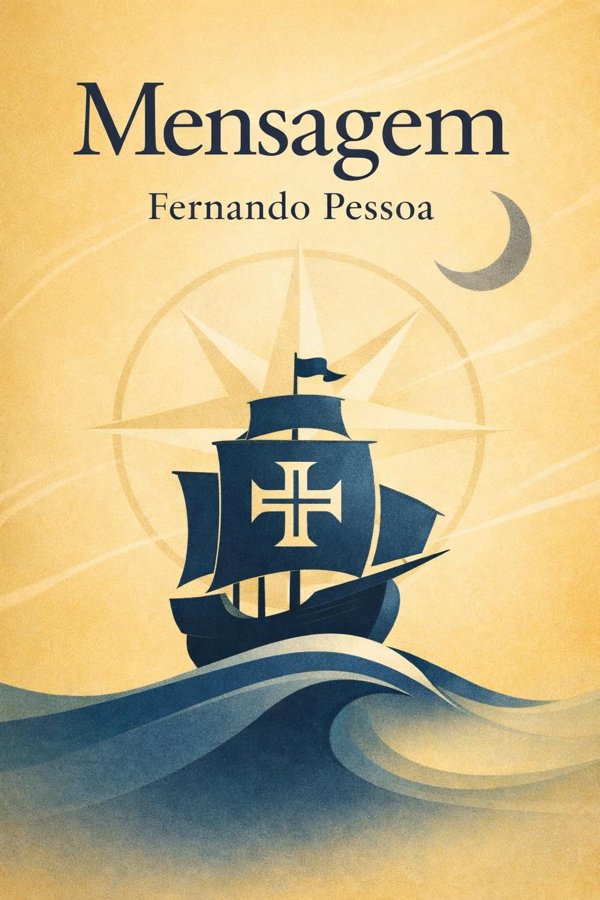
Mensagem: Summary & Key Insights
 10 min9 chaptersAudio available
Key Takeaways from Mensagem
A nation becomes strongest not when it remembers facts, but when it understands the symbols that give those facts meaning.
Great poetry often turns individuals into mirrors in which an entire people can see itself.
Some peoples are shaped by mountains, others by rivers; in Pessoa’s vision, Portugal is shaped by the sea.
Behind every national triumph stands a trail of invisible suffering.
When a nation loses power, it often survives through imagination before it recovers in reality.
What Is Mensagem About?
Mensagem by Fernando Pessoa is a classics book spanning 3 pages. Mensagem is Fernando Pessoa’s visionary poetic meditation on Portugal’s past, present, and imagined destiny. First published in 1934, it was the only book in Portuguese that appeared during Pessoa’s lifetime, which alone gives it a special place in literary history. But the book matters for more than biography. In a sequence of brief, symbol-rich poems, Pessoa transforms kings, navigators, saints, emblems, and legends into parts of a larger spiritual portrait of a nation. Rather than simply praising historical achievements, he asks what remains after empire fades: memory, myth, longing, and the possibility of renewal. The book moves through three broad stages—heraldry, maritime expansion, and prophecy—turning Portuguese history into a meditation on collective identity and cultural purpose. Pessoa was uniquely equipped to write such a work. One of the most inventive poets of the twentieth century, he combined historical knowledge, philosophical intensity, mystical curiosity, and unmatched symbolic imagination. Mensagem endures because it speaks not only to Portugal, but to any reader interested in how nations dream about themselves and how poetry can turn history into destiny.
This FizzRead summary covers all 9 key chapters of Mensagem in approximately 10 minutes, distilling the most important ideas, arguments, and takeaways from Fernando Pessoa's work. Also available as an audio summary and Key Quotes Podcast.
Mensagem
Mensagem is Fernando Pessoa’s visionary poetic meditation on Portugal’s past, present, and imagined destiny. First published in 1934, it was the only book in Portuguese that appeared during Pessoa’s lifetime, which alone gives it a special place in literary history. But the book matters for more than biography. In a sequence of brief, symbol-rich poems, Pessoa transforms kings, navigators, saints, emblems, and legends into parts of a larger spiritual portrait of a nation. Rather than simply praising historical achievements, he asks what remains after empire fades: memory, myth, longing, and the possibility of renewal. The book moves through three broad stages—heraldry, maritime expansion, and prophecy—turning Portuguese history into a meditation on collective identity and cultural purpose. Pessoa was uniquely equipped to write such a work. One of the most inventive poets of the twentieth century, he combined historical knowledge, philosophical intensity, mystical curiosity, and unmatched symbolic imagination. Mensagem endures because it speaks not only to Portugal, but to any reader interested in how nations dream about themselves and how poetry can turn history into destiny.
Who Should Read Mensagem?
This book is perfect for anyone interested in classics and looking to gain actionable insights in a short read. Whether you're a student, professional, or lifelong learner, the key ideas from Mensagem by Fernando Pessoa will help you think differently.
- ✓Readers who enjoy classics and want practical takeaways
- ✓Professionals looking to apply new ideas to their work and life
- ✓Anyone who wants the core insights of Mensagem in just 10 minutes
Want the full summary?
Get instant access to this book summary and 100K+ more with Fizz Moment.
Get Free SummaryAvailable on App Store • Free to download
Key Chapters
A nation becomes strongest not when it remembers facts, but when it understands the symbols that give those facts meaning. In the first section, Brasao, Pessoa does not offer a straightforward historical survey. Instead, he constructs a poetic coat of arms, using heraldic images such as castles, quinas, and the cross to represent inner qualities of Portugal’s historical character. These are not decorative references. They function like compressed moral and spiritual codes. Each emblem stands for sacrifice, struggle, divine mission, endurance, or royal legitimacy, allowing history to be read as a symbolic drama rather than a dry record.
This approach matters because Pessoa suggests that identity is built through interpretation. A shield protects, but it also declares who one is. By transforming the Portuguese coat of arms into poetry, he implies that a people lives not only through institutions and borders, but through the stories and ideals it chooses to preserve. The heroes and founders invoked here are less individual personalities than archetypes. They become embodiments of courage, faith, ambition, and destiny.
A useful modern parallel is how communities, organizations, or even families create meaning through symbols: flags, mottos, rituals, founding stories, and shared images. These are powerful not because they are literally true in every detail, but because they unify memory and aspiration. Pessoa invites readers to ask what symbols shape their own collective identity and whether those symbols still carry living meaning.
Actionable takeaway: Identify one symbol, story, or tradition that defines your community or personal heritage, and ask what deeper values it represents beyond its surface form.
Great poetry often turns individuals into mirrors in which an entire people can see itself. In Mensagem, historical and legendary figures such as Viriato, Count Henry, and Prince Henry the Navigator are not treated merely as subjects of patriotic admiration. Pessoa reshapes them into archetypes, each representing a force within Portugal’s spirit: resistance, foundation, exploration, discipline, sacrifice, or visionary ambition. Their biographies matter less than the qualities they symbolize.
This method allows Pessoa to move beyond conventional nationalism. He is not simply saying that these figures were admirable. He is suggesting that nations are psychic constructions built from repeated ideals embodied by remembered people. Viriato, for example, can be read as the spirit of defiance against domination. Prince Henry becomes not just an organizer of voyages, but a symbol of the will to seek what lies beyond the visible horizon. The heroes are therefore both historical and inward. They exist in the past, but they also represent potential energies in the present.
Readers today can apply this insight by noticing whom their culture celebrates and why. Every society selects certain figures as representative. Entrepreneurs may stand for innovation, activists for moral courage, founders for risk-taking, artists for cultural imagination. These choices reveal what a culture wants to believe about itself. On a personal level, the same is true of mentors and role models. The people we admire often express values we wish to cultivate.
Pessoa’s deeper point is that memory should not be passive. To remember a hero is to inherit a challenge. If these figures are national emblems, then their significance depends on whether later generations embody the virtues they represent.
Actionable takeaway: Choose one historical or personal hero you admire and write down the single quality they symbolize for you, then practice that quality deliberately this week.
Some peoples are shaped by mountains, others by rivers; in Pessoa’s vision, Portugal is shaped by the sea. The second section, Mar Portugues, shifts from heraldic origin to maritime expansion, presenting the ocean as both a physical reality and a metaphysical calling. The sea is not simply where Portuguese ships traveled. It is the testing ground where national identity proved itself. Vast, uncertain, and dangerous, it represents the unknown future toward which courage must move.
Pessoa understands that exploration is never only economic or political. It is existential. To cross the sea is to accept insecurity in exchange for possibility. The maritime voyages that made Portugal globally influential were acts of navigation, but also acts of imagination. They required belief in unseen lands, confidence in incomplete knowledge, and willingness to leave safety behind. That is why the sea in Mensagem carries a meaning far beyond historical expansion. It becomes a symbol of the human need to venture past familiar limits.
The idea remains practical today. Modern readers may not be launching caravels, but they face their own oceans: changing careers, moving countries, building a business, starting a creative project, or entering a difficult conversation without guaranteed outcomes. Pessoa’s sea reminds us that identity often emerges through encounters with uncertainty, not through comfort. What matters is not reckless action, but purposeful risk grounded in a larger vision.
The sea also exposes cost. Exploration demands labor, fear, and loss. Yet without stepping toward the horizon, a culture can become trapped in nostalgia or stagnation. Pessoa admires the sea because it calls a nation to become more than it already is.
Actionable takeaway: Name one important uncertainty in your life and take one concrete step toward it instead of waiting for perfect safety.
Behind every national triumph stands a trail of invisible suffering. One of the most memorable dimensions of Mar Portugues is Pessoa’s insistence that greatness cannot be separated from loss. The maritime age is not glorified in a simplistic way. The sea is magnificent, but it is also a grave. Voyages brought prestige, knowledge, and expansion, yet they also demanded tears, separation, death, and endurance from sailors, families, and entire communities. Pessoa’s nationalist vision is therefore tempered by tragic awareness.
This balance gives the book moral seriousness. Patriotic writing often fails when it celebrates achievements without acknowledging their human cost. Pessoa avoids that weakness by showing that sacrifice is part of the truth of history. Empire and exploration are not abstractions; they are built from hunger, danger, discipline, fear, and mourning. In this sense, Mensagem treats glory as something that must be paid for, not merely admired.
This insight applies beyond national history. In everyday life, visible success usually rests on unseen effort: years of practice behind mastery, private disappointments behind public leadership, emotional strain behind family stability, failed attempts behind innovation. Recognizing sacrifice makes admiration more honest and gratitude more mature. It also prevents us from romanticizing outcomes while ignoring what they required.
Pessoa does not use sacrifice only to make readers sad. He uses it to deepen their understanding of value. What costs nothing rarely transforms anyone. The sea gives Portugal meaning partly because it demanded so much from those who crossed it.
Actionable takeaway: The next time you admire an achievement—your own or someone else’s—pause to identify the hidden sacrifices behind it, and let that awareness guide your gratitude and decision-making.
When a nation loses power, it often survives through imagination before it recovers in reality. Mensagem is built on the conviction that myth is not the opposite of truth, but another way of carrying truth when facts alone feel insufficient. Pessoa draws on legends, prophecies, and symbolic figures not because he is confused about history, but because he believes that collective life depends on more than chronology. Myths preserve emotional and spiritual meaning. They keep a culture’s deepest self-understanding alive.
One of Pessoa’s great strengths is his ability to blur the line between historical memory and visionary interpretation. A king, a saint, or a sailor becomes larger than life because the nation needs more than biography; it needs significance. Myth answers the question, What does this past event mean for who we are now? In that sense, myth is a form of cultural concentration. It distills values into memorable images and stories.
Modern readers sometimes distrust myth because it can be abused for propaganda or nostalgia. Pessoa’s work shows a more nuanced possibility. Myth can inspire without requiring literal belief in every legend. Organizations do something similar when they tell origin stories that embody resilience or innovation. Families do it when they preserve stories that communicate courage, generosity, or endurance across generations.
The danger is not myth itself, but unexamined myth. Healthy myth enlarges responsibility rather than flattering vanity. In Mensagem, myth is useful because it calls Portugal toward a future worthy of its symbols, not toward passive self-congratulation.
Actionable takeaway: Reflect on one story from your culture, family, or institution that still shapes your identity, and ask what value it teaches you to live out today.
Pessoa’s most provocative national idea is that Portugal’s highest future is not a return to territorial empire, but the creation of a spiritual and cultural one. The notion of the Fifth Empire, central to the prophetic atmosphere of Mensagem, draws on older religious and imperial frameworks while radically transforming them. Instead of imagining conquest through armies and possessions, Pessoa envisions influence through language, imagination, culture, and spirit. Portugal’s greatness, in this view, will not come from dominating the world materially, but from illuminating it symbolically.
This distinction is essential. By the time Pessoa wrote, Portugal’s age of geopolitical supremacy had long passed. A purely nostalgic nationalism would have been shallow and unrealistic. The Fifth Empire offers a different answer to decline: transmute lost external power into inner mission. It is an audacious attempt to redefine what national fulfillment means. A small country can still have a world-historical role if its contribution is spiritual, intellectual, artistic, or civilizational.
The idea remains relevant in a global age where soft power often matters more than formal empire. Nations shape the world through language, literature, music, values, technology, and moral vision. On a smaller scale, people and institutions also leave their strongest mark not through control, but through meaning. Teachers, writers, communities, and creators influence others by shaping imagination.
Pessoa’s vision can be used constructively if detached from grandiose self-flattery. The question is not whether one is destined for greatness, but what kind of contribution outlasts force. Mensagem suggests that the highest legacy is one that enlarges consciousness.
Actionable takeaway: Ask yourself whether your goals aim merely at status and possession, or at leaving a deeper cultural, intellectual, or ethical contribution.
A country does not become meaningful simply by celebrating itself; it becomes meaningful when it can imagine its purpose while confronting its decline. One reason Mensagem continues to matter is that it is neither naive patriotic praise nor detached irony. Pessoa writes from a moment when Portugal’s imperial grandeur was already in the past. Instead of ignoring that diminished reality, he responds to it by creating a poetry of re-interpretation. He asks how a nation can remain inwardly significant when outward power has faded.
This makes the book more complex than a simple nationalist anthem. Pessoa certainly exalts Portugal, but his exaltation carries anxiety. The very need for prophecy suggests historical lack. The turn to myth, symbols, and hidden destinies reveals an effort to answer national insufficiency through imagination. In other words, identity here is aspirational rather than secure. Portugal is not presented as fully possessing its mission, but as searching for it.
That dynamic offers a useful lesson for any collective identity today. Healthy belonging requires both pride and critique. Communities decay when they lose confidence, but they also decay when they substitute fantasy for honest self-examination. Pessoa models a third path: recover meaning through cultural depth rather than denial. A nation can honor its past while recognizing that memory alone is not achievement.
The same applies personally. Many people either cling to old success or reject their past entirely. Mensagem suggests another option: reinterpret your history in a way that calls you forward. Identity is strongest when it becomes a task, not just an inheritance.
Actionable takeaway: Revisit one story you tell about your background or past success, and rewrite it as a responsibility for future growth rather than a source of passive pride.
People often assume that poetry reflects reality after the fact, but Mensagem argues that language can actively create a people’s sense of future. Pessoa writes as if poems are not ornaments added to history, but instruments that help form national consciousness. By naming symbols, arranging myths, and invoking prophecy, he attempts to awaken a dormant vision in his readers. The book is therefore an example of poetry functioning as civic imagination.
This idea may sound lofty, yet it has practical force. Political speeches, founding documents, songs, memorials, and slogans all show that language shapes collective emotion and action. Communities rarely move forward through data alone. They need narratives that organize memory and expectation. Pessoa’s poems compress such narratives into striking images and rhythms, making them easier to feel and remember. He is not just describing Portugal; he is trying to re-enchant it.
Readers can take from this a broader respect for the words they live by. The language used in families, schools, companies, and nations influences what people believe is possible. A community repeatedly told that it is broken may become passive. A community reminded of its best principles may become more responsible. On an individual level, the stories we tell ourselves about our identity can either confine us or enlarge us.
Mensagem ultimately shows that literary works can matter far beyond aesthetics. They can preserve memory, challenge despair, and propose new horizons of meaning. Even if one does not share Pessoa’s prophetic nationalism, the book demonstrates the extraordinary power of art to transform collective self-understanding.
Actionable takeaway: Pay attention to the recurring words and stories that shape your environment, and begin using language that calls forth responsibility, courage, and possibility.
All Chapters in Mensagem
About the Author
Fernando Pessoa (1888–1935) was a Portuguese poet, essayist, and critic widely regarded as one of the most important literary figures of the twentieth century. Born in Lisbon, he spent part of his youth in South Africa, where he received an English-language education that deeply shaped his literary range. Pessoa is famous for creating multiple heteronyms, including Alvaro de Campos, Ricardo Reis, and Alberto Caeiro, each with a distinct biography, style, and philosophy. Through these invented authors, he explored radically different poetic voices and ways of seeing the world. His work spans lyric poetry, modernist experimentation, philosophical prose, and literary criticism. Mensagem, published in 1934, was the only Portuguese-language book he released during his lifetime, and it remains one of his most influential and debated works.
Get This Summary in Your Preferred Format
Read or listen to the Mensagem summary by Fernando Pessoa anytime, anywhere. FizzRead offers multiple formats so you can learn on your terms — all free.
Available formats: App · Audio · PDF · EPUB — All included free with FizzRead
Download Mensagem PDF and EPUB Summary
Key Quotes from Mensagem
“A nation becomes strongest not when it remembers facts, but when it understands the symbols that give those facts meaning.”
“Great poetry often turns individuals into mirrors in which an entire people can see itself.”
“Some peoples are shaped by mountains, others by rivers; in Pessoa’s vision, Portugal is shaped by the sea.”
“Behind every national triumph stands a trail of invisible suffering.”
“When a nation loses power, it often survives through imagination before it recovers in reality.”
Frequently Asked Questions about Mensagem
Mensagem by Fernando Pessoa is a classics book that explores key ideas across 9 chapters. Mensagem is Fernando Pessoa’s visionary poetic meditation on Portugal’s past, present, and imagined destiny. First published in 1934, it was the only book in Portuguese that appeared during Pessoa’s lifetime, which alone gives it a special place in literary history. But the book matters for more than biography. In a sequence of brief, symbol-rich poems, Pessoa transforms kings, navigators, saints, emblems, and legends into parts of a larger spiritual portrait of a nation. Rather than simply praising historical achievements, he asks what remains after empire fades: memory, myth, longing, and the possibility of renewal. The book moves through three broad stages—heraldry, maritime expansion, and prophecy—turning Portuguese history into a meditation on collective identity and cultural purpose. Pessoa was uniquely equipped to write such a work. One of the most inventive poets of the twentieth century, he combined historical knowledge, philosophical intensity, mystical curiosity, and unmatched symbolic imagination. Mensagem endures because it speaks not only to Portugal, but to any reader interested in how nations dream about themselves and how poetry can turn history into destiny.
More by Fernando Pessoa
You Might Also Like



Browse by Category
Ready to read Mensagem?
Get the full summary and 100K+ more books with Fizz Moment.