
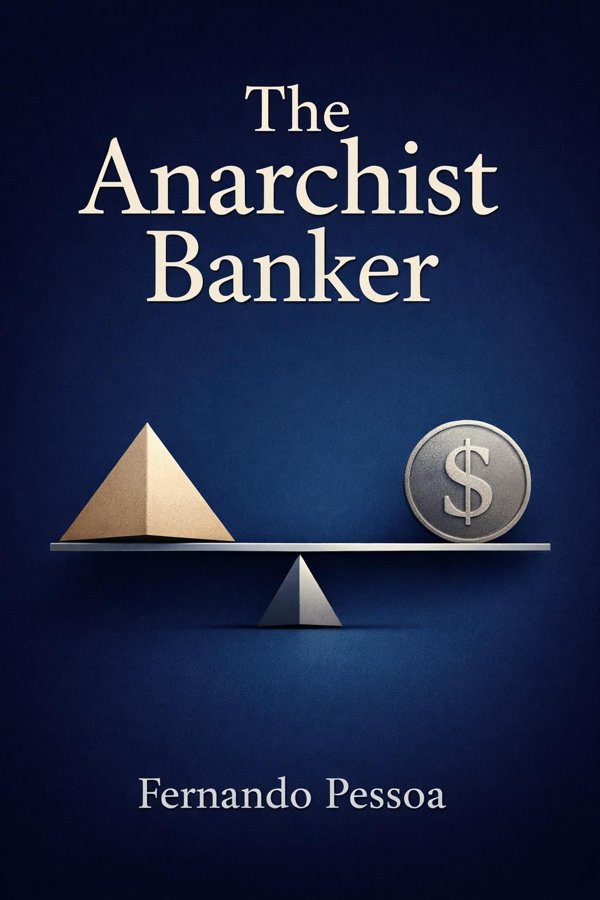
The Anarchist Banker: Summary & Key Insights
 10 min9 chaptersAudio available
Key Takeaways from The Anarchist Banker
Great philosophical shocks often arrive in ordinary settings.
The most dangerous arguments are often the clearest ones.
A paradox becomes persuasive when it follows its own logic without flinching.
Institutions often begin by promising emancipation and end by producing obedience.
Few systems rule more effectively than those we accept as normal.
What Is The Anarchist Banker About?
The Anarchist Banker by Fernando Pessoa is a western_phil book spanning 5 pages. First published in 1922, The Anarchist Banker is one of Fernando Pessoa’s sharpest and most unsettling prose works. Framed as a polite conversation in a café, the story begins with an apparently absurd claim: a wealthy, successful banker calmly insists that he is the only true anarchist. What follows is not a simple joke, but a brilliantly constructed argument in which logic is used to expose the contradictions hidden inside political ideals, social roles, and personal morality. Pessoa turns a quiet dialogue into a philosophical trap, forcing readers to ask whether freedom can exist inside society at all, and whether people who speak most passionately about liberation are often the least free in practice. The book matters because its questions remain modern: How much of our identity is genuine, and how much is performance? Can institutions be resisted from within, or do they inevitably shape us? Pessoa, one of Portugal’s greatest literary minds, was uniquely suited to stage this kind of paradox. Famous for his philosophical depth and his fascination with fractured identity, he created in this short work a lasting meditation on freedom, hypocrisy, and the dangerous elegance of pure reasoning.
This FizzRead summary covers all 9 key chapters of The Anarchist Banker in approximately 10 minutes, distilling the most important ideas, arguments, and takeaways from Fernando Pessoa's work. Also available as an audio summary and Key Quotes Podcast.
The Anarchist Banker
First published in 1922, The Anarchist Banker is one of Fernando Pessoa’s sharpest and most unsettling prose works. Framed as a polite conversation in a café, the story begins with an apparently absurd claim: a wealthy, successful banker calmly insists that he is the only true anarchist. What follows is not a simple joke, but a brilliantly constructed argument in which logic is used to expose the contradictions hidden inside political ideals, social roles, and personal morality. Pessoa turns a quiet dialogue into a philosophical trap, forcing readers to ask whether freedom can exist inside society at all, and whether people who speak most passionately about liberation are often the least free in practice. The book matters because its questions remain modern: How much of our identity is genuine, and how much is performance? Can institutions be resisted from within, or do they inevitably shape us? Pessoa, one of Portugal’s greatest literary minds, was uniquely suited to stage this kind of paradox. Famous for his philosophical depth and his fascination with fractured identity, he created in this short work a lasting meditation on freedom, hypocrisy, and the dangerous elegance of pure reasoning.
Who Should Read The Anarchist Banker?
This book is perfect for anyone interested in western_phil and looking to gain actionable insights in a short read. Whether you're a student, professional, or lifelong learner, the key ideas from The Anarchist Banker by Fernando Pessoa will help you think differently.
- ✓Readers who enjoy western_phil and want practical takeaways
- ✓Professionals looking to apply new ideas to their work and life
- ✓Anyone who wants the core insights of The Anarchist Banker in just 10 minutes
Want the full summary?
Get instant access to this book summary and 100K+ more with Fizz Moment.
Get Free SummaryAvailable on App Store • Free to download
Key Chapters
Great philosophical shocks often arrive in ordinary settings. Pessoa begins The Anarchist Banker not in a revolutionary cell or a parliament, but in a civilized café, where two acquaintances sit down to talk after dinner. This setting matters because it immediately places the discussion inside the polished world of bourgeois comfort: good manners, leisure, social order, and intellectual conversation. Against that backdrop, the banker’s claim that he is an anarchist lands with maximum force. The paradox is not only ideological but theatrical. The reader, like the unnamed interlocutor, expects a contradiction and perhaps a joke. Instead, the banker speaks with composure and precision, as if his wealth and social success were the strongest proof of his anti-social philosophy.
This opening reveals Pessoa’s method. He does not argue through slogans, but through dialogue, irony, and tension between appearance and reasoning. The café becomes a miniature stage on which modern identity is performed. The banker looks like a pillar of the system, yet he claims to have escaped it more completely than self-proclaimed rebels. That contradiction draws the reader into a game where common assumptions begin to collapse.
In practical terms, this opening teaches us to pay attention to context when evaluating ideas. People often present radical beliefs from within highly conventional lives. A corporate executive may speak about freedom and authenticity while remaining deeply dependent on status, hierarchy, and institutional approval. Likewise, activists may denounce systems they still rely on emotionally or materially. Pessoa’s scene reminds us that the credibility of an argument does not come from its packaging.
Actionable takeaway: When you hear a bold ideological claim, look first at the setting, incentives, and social position from which it is being made.
The most dangerous arguments are often the clearest ones. The banker begins by stripping anarchism down to what he claims is its essential principle: the removal of all forms of oppression that prevent an individual from being naturally free. He dismisses the emotional style of political movements and treats anarchism as a strict logical commitment, not a culture, a party, or a mood. In his account, true anarchism is not about public rhetoric, revolutionary fashion, or belonging to a group. It is about eliminating every artificial force that subjugates the individual.
This definition is powerful because it sounds precise and morally attractive. Who would openly defend unnecessary constraints, imposed inequalities, or systems that deform human freedom? Yet Pessoa wants us to notice how quickly a noble principle can become unstable when abstracted from lived reality. The banker’s definition appears rigorous, but it already contains a hidden danger: once freedom becomes a purely individual problem, collective politics starts to look suspicious, even self-defeating.
This tension remains deeply relevant. Many people today say they value independence above all else, but they mean very different things by it. For one person, freedom means political rights; for another, financial security; for another, freedom from social judgment; for another, freedom from institutional control. A startup founder may call autonomy the ability to work without bosses. A gig worker may define it as flexibility. A philosopher may define it as self-mastery. The same word hides multiple realities.
Pessoa’s genius lies in showing that definitions are never innocent. The banker’s entire case depends on controlling the meaning of anarchism from the start. Once he wins the definition, he can begin to twist the conclusion.
Actionable takeaway: Before agreeing or disagreeing with any ideology, ask how its key terms—especially freedom, justice, and equality—are being defined.
A paradox becomes persuasive when it follows its own logic without flinching. After defining anarchism as the destruction of artificial constraints on individual freedom, the banker explains how he came to reject ordinary revolutionary activism. As a younger man, he says, he admired anarchist ideals and associated with those who claimed to fight for them. But over time he concluded that collective anarchist action only reproduced new forms of dependence. Groups required discipline, loyalty, hierarchy, compromise, and emotional conformity. Instead of freeing individuals, they created another social machine.
From there, the banker reaches his astonishing conclusion: if society is structured by artificial powers, then the individual must free himself directly. The most effective way to do that, he argues, is to gain power over the economic conditions that usually enslave people. He therefore pursued wealth, not out of greed, but as a method of liberation. By becoming rich, he claims to have neutralized the coercive force of money in his own life. Since money is one of the main instruments through which society dominates people, mastering it becomes, in his eyes, the most coherent anarchist act.
This is where Pessoa’s irony sharpens. The banker’s reasoning is internally consistent enough to be disturbing. We can recognize a modern version of it everywhere. People justify aggressive ambition by saying they are buying independence. A professional may endure a brutal decade in finance or law in order to become “free” later. An entrepreneur may describe the accumulation of capital as a path to autonomy rather than domination.
Pessoa does not offer an easy rebuttal. Instead, he shows how a rational argument can convert a social ideal into private self-advancement. The reader is left asking whether the banker has exposed the hypocrisy of political radicals—or simply perfected the hypocrisy of selfishness.
Actionable takeaway: When success is justified as liberation, ask whether it reduces domination for everyone or only for the person who gains the advantage.
Institutions often begin by promising emancipation and end by producing obedience. One of the banker’s most provocative claims is that revolutionary groups are not automatically liberating simply because their goals are noble. In his account, anarchist circles are compromised by the same dynamics they condemn: leadership structures, hidden rivalries, dependency on group identity, and pressure to think and act in approved ways. Instead of abolishing power, they merely relocate it.
This is one of the story’s most durable insights. Pessoa understood that the desire to belong can quietly undermine the desire to be free. Even movements built on anti-authoritarian ideals can generate unofficial authorities: charismatic figures, moral gatekeepers, ideological purists, and social enforcers. The language of liberation may coexist with informal coercion. People may stop asking whether an idea is true and start asking whether it is accepted by their side.
The point is not that collective action is useless. Pessoa is not writing a practical guide to politics. He is dramatizing a recurring problem: every organization, even one formed to resist oppression, risks reproducing the structures of control embedded in social life. We can see this in activist groups fractured by status competition, in workplaces that advertise flat hierarchies while concentrating power, or in online communities that preach openness but punish dissent.
For readers today, this idea is especially relevant in digital culture. Communities formed around justice, freedom, or authenticity can quickly become environments of surveillance, performative conformity, and fear of exclusion. The banker uses this instability to justify his retreat into individual strategy.
Actionable takeaway: If you join a movement, evaluate not only its ideals but also its internal habits—who gets influence, how disagreement is handled, and whether freedom exists inside the group itself.
Few systems rule more effectively than those we accept as normal. The banker identifies money as one of the chief mechanisms through which society exerts artificial control over individuals. In everyday life, people depend on income, employers, debt, prices, and property structures in order to survive. Because of that dependence, they must often obey conditions they did not choose. Their choices are shaped not only by law or custom, but by economic necessity. To the banker, this means that poverty and financial insecurity are not merely unfortunate conditions; they are instruments of subjection.
His conclusion is both compelling and suspect. If money dominates social life, then one way to reduce personal domination is to possess enough money not to be ruled by it. Wealth, in this framework, is not luxury but insulation. The rich person can refuse humiliating work, avoid dependence on arbitrary authority, and shield himself from many constraints imposed on others. The banker therefore portrays his fortune as a philosophical achievement: he has escaped the economic machinery that traps ordinary people.
This claim speaks to modern anxieties. Financial independence is widely marketed as the path to freedom. People save aggressively, invest, build side businesses, or seek early retirement because they believe enough money will allow them to reclaim control over their time and dignity. In many cases, that belief contains truth. Economic fragility does narrow freedom.
Yet Pessoa invites us to notice the moral limit of this reasoning. If freedom from domination is bought individually, then the structure of domination remains intact. The banker may be less controlled, but others still carry the burden. His solution is private immunity, not shared emancipation.
Actionable takeaway: Build financial resilience, but do not confuse personal security with the dismantling of the systems that keep others dependent.
An argument can be perfectly structured and still feel deeply wrong. That unsettling experience is central to The Anarchist Banker. As the banker unfolds his case, the reader may repeatedly think, “This makes sense—and yet it cannot be right.” Pessoa uses that discomfort to reveal the limits of logic when detached from moral reality. The banker is not incoherent in the ordinary sense. He proceeds step by step, defines his terms, follows implications, and rejects sentimental exceptions. Precisely because he reasons so cleanly, his conclusion becomes disturbing.
This is one of Pessoa’s greatest achievements in the story. He exposes how formal consistency can become a kind of intellectual seduction. If we follow a principle too rigidly while ignoring context, relation, and human complexity, we may arrive at conclusions that violate the spirit of the very ideal we began with. The banker claims to honor freedom, but his path turns freedom into an individual possession secured through the structures of inequality. Logic has not failed; it has become too narrow.
This happens often in everyday life. A company may defend layoffs as “efficient” and therefore rational, while ignoring loyalty, social cost, and long-term trust. A person may justify emotional detachment as “honesty” while using truth as a cover for indifference. Public debates regularly reward airtight framing over humane understanding.
Pessoa teaches readers to distinguish between validity and wisdom. A chain of reasoning should always be tested against lived consequences, unstated assumptions, and what it leaves out. The banker wins many local points because he controls the level of abstraction. But abstraction itself can become evasive.
Actionable takeaway: Whenever an argument seems flawless, ask what human realities had to be excluded in order to make it so flawless.
People rarely present their self-interest as self-interest. They give it a nobler name. The banker’s monologue can be read as a brilliant critique of ideological hypocrisy, but also as an extraordinary act of personal self-justification. He does not simply say, “I chose wealth.” He says, “I chose wealth because it was the purest form of fidelity to anarchism.” That leap from desire to moral necessity is the mechanism of self-deception Pessoa wants us to recognize.
The story suggests that hypocrisy is not always crude lying. More often, it is the conversion of convenience into principle. We arrange our beliefs so that our actions appear inevitable, virtuous, or philosophically superior. The banker may genuinely believe his own conclusion. That is what makes him so interesting. He is not a cartoon villain but a man who has rationalized his social success so completely that he experiences it as ethical consistency.
This pattern extends far beyond politics. Professionals say they overwork for their families when they may also be serving ambition and ego. Consumers say they “deserve” excess because they work hard. Public figures rebrand self-promotion as service. Entire cultures of productivity, wellness, or leadership often wrap status competition in moral language.
Pessoa’s mirror is uncomfortable because it does not allow readers to remain superior to the banker. We too tell stories that reconcile our ideals with our compromises. The question is not whether we are hypocrites in the dramatic sense, but whether we examine the narratives that make us feel pure.
Actionable takeaway: Regularly ask yourself, “What part of this principle may simply be a flattering explanation for choices that benefit me?”
A freedom that excludes others may secure comfort, but it cannot easily sustain meaning. Beneath the banker’s triumphant logic lies a quieter emptiness. He has solved the problem of domination for himself, at least in theory, by withdrawing from dependence through wealth. But what kind of freedom remains when all collective bonds are treated primarily as threats? If every group risks coercion and every shared project risks corruption, then liberation shrinks into private insulation.
Pessoa does not preach communal politics directly, yet the story hints at what the banker’s worldview cannot provide. Human beings do not live as self-contained atoms. We are shaped by language, affection, labor, institutions, vulnerability, and mutual reliance. Any definition of freedom that tries to erase this social condition risks becoming abstract and sterile. The banker can call himself free because he owes less obedience than others, but his freedom is defensive rather than generative. It protects the self; it does not build a world.
This tension feels modern. Many people pursue autonomy by minimizing dependence: remote work, personal branding, financial independence, selective relationships, retreat from public life. These strategies can be healthy in response to exploitation. But taken as total ideals, they may leave people materially secure and socially hollow. To be free from domination is important; to be free for participation, creation, and mutual flourishing is another matter.
The banker’s version of anarchism strips away solidarity because solidarity is messy. Pessoa suggests that this purification destroys something essential. A society of isolated victors is not liberation.
Actionable takeaway: Define freedom not only as what frees you from control, but also as what enables meaningful, non-coercive connection with others.
The most lasting books do not close debate; they intensify it. The Anarchist Banker ends without an authoritative correction from the narrator, and that restraint is crucial. Pessoa refuses to tell readers exactly how to resolve the banker’s argument. The interlocutor raises doubts, but the banker repeatedly regains momentum, leaving the conversation suspended between admiration, skepticism, and unease. This ambiguity is not a weakness. It is the entire point.
By withholding a final verdict, Pessoa turns the reader into the missing participant in the café. We must decide whether the banker has exposed a hidden truth about ideology, manipulated language to justify greed, or done both at once. The text works because it resists simple classification. It is satire, but not only satire. It is philosophy, but not a system. It is a psychological portrait, but not merely a character study. Its power comes from forcing us to confront how often modern life rewards arguments that are cleverer than they are humane.
This open ending also explains why the story remains so discussable in classrooms, book clubs, and philosophical conversations. Different readers emphasize different lessons: the bankruptcy of ideology, the corruption of capitalism, the seduction of rationalization, or the instability of freedom itself. Pessoa creates not a doctrine but a machine for thought.
In practical life, this final ambiguity is valuable. Not every important text should hand us conclusions. Some should sharpen our habits of interpretation and self-critique. The banker’s last assertion lingers because it cannot be neatly settled.
Actionable takeaway: After reading, summarize the banker’s strongest point and his greatest blind spot in your own words; that exercise reveals what the story is really teaching you.
All Chapters in The Anarchist Banker
About the Author
Fernando Pessoa (1888–1935) was a Portuguese poet, essayist, and prose writer widely considered one of the greatest literary figures of the twentieth century. Born in Lisbon, he spent part of his youth in South Africa, where he received an English-language education that influenced his style and intellectual range. Pessoa is especially famous for writing through multiple heteronyms, including Álvaro de Campos, Ricardo Reis, and Alberto Caeiro, each with a distinct voice and philosophy. His work explores identity, fragmentation, metaphysics, and the instability of the self. Although much of his reputation rests on poetry, his prose also displays remarkable philosophical precision and irony. The Anarchist Banker remains one of his most celebrated prose works, admired for its wit, paradox, and penetrating analysis of freedom and hypocrisy.
Get This Summary in Your Preferred Format
Read or listen to the The Anarchist Banker summary by Fernando Pessoa anytime, anywhere. FizzRead offers multiple formats so you can learn on your terms — all free.
Available formats: App · Audio · PDF · EPUB — All included free with FizzRead
Download The Anarchist Banker PDF and EPUB Summary
Key Quotes from The Anarchist Banker
“Great philosophical shocks often arrive in ordinary settings.”
“The most dangerous arguments are often the clearest ones.”
“A paradox becomes persuasive when it follows its own logic without flinching.”
“Institutions often begin by promising emancipation and end by producing obedience.”
“Few systems rule more effectively than those we accept as normal.”
Frequently Asked Questions about The Anarchist Banker
The Anarchist Banker by Fernando Pessoa is a western_phil book that explores key ideas across 9 chapters. First published in 1922, The Anarchist Banker is one of Fernando Pessoa’s sharpest and most unsettling prose works. Framed as a polite conversation in a café, the story begins with an apparently absurd claim: a wealthy, successful banker calmly insists that he is the only true anarchist. What follows is not a simple joke, but a brilliantly constructed argument in which logic is used to expose the contradictions hidden inside political ideals, social roles, and personal morality. Pessoa turns a quiet dialogue into a philosophical trap, forcing readers to ask whether freedom can exist inside society at all, and whether people who speak most passionately about liberation are often the least free in practice. The book matters because its questions remain modern: How much of our identity is genuine, and how much is performance? Can institutions be resisted from within, or do they inevitably shape us? Pessoa, one of Portugal’s greatest literary minds, was uniquely suited to stage this kind of paradox. Famous for his philosophical depth and his fascination with fractured identity, he created in this short work a lasting meditation on freedom, hypocrisy, and the dangerous elegance of pure reasoning.
More by Fernando Pessoa


You Might Also Like
A Little History of Philosophy
Nigel Warburton
10 min
Areopagitica
John Milton
10 min
How To Think Like A Philosopher: Essential Principles For Clear Thinking
Peter Cave
10 min
Language, Truth and Logic
A. J. Ayer
10 min
The Age of Reason
Thomas Paine
10 min
The Essays
Michel De Montaigne
10 minBrowse by Category
Ready to read The Anarchist Banker?
Get the full summary and 100K+ more books with Fizz Moment.