
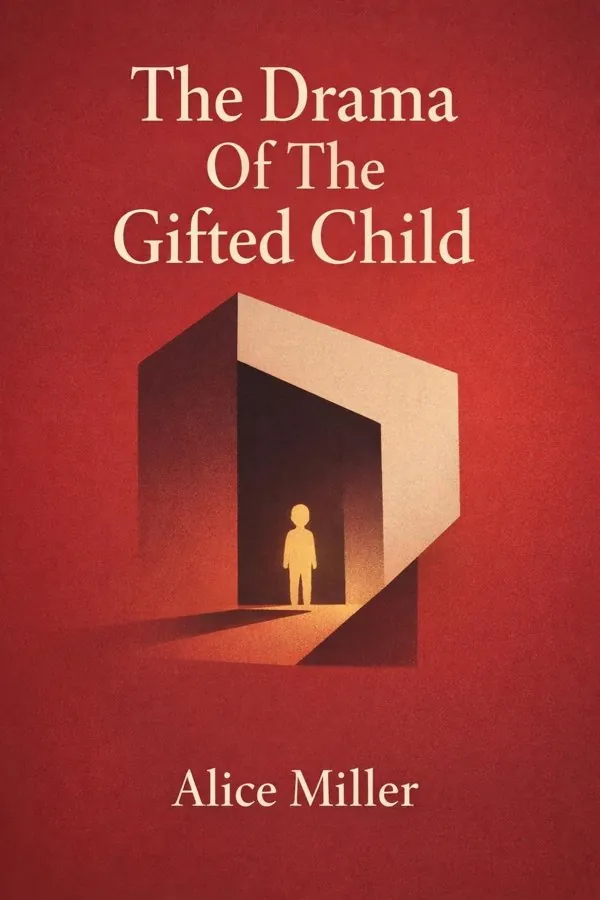
The Drama Of The Gifted Child: The Search For The True Self: Summary & Key Insights
by Alice Miller
 10 min5 chaptersAudio available
What Is The Drama Of The Gifted Child: The Search For The True Self About?
The Drama Of The Gifted Child: The Search For The True Self by Alice Miller is a mental_health book spanning 5 pages. In this groundbreaking work, Alice Miller explores the psychological consequences of childhood trauma and repression. She reveals how gifted children who adapt to their parents' expectations often suffer later in life from a loss of their true self. The book provides deep insight into the dynamics of emotional abuse and the paths toward self-healing.
This FizzRead summary covers all 5 key chapters of The Drama Of The Gifted Child: The Search For The True Self in approximately 10 minutes, distilling the most important ideas, arguments, and takeaways from Alice Miller's work. Also available as an audio summary and Key Quotes Podcast.
The Drama Of The Gifted Child: The Search For The True Self
In this groundbreaking work, Alice Miller explores the psychological consequences of childhood trauma and repression. She reveals how gifted children who adapt to their parents' expectations often suffer later in life from a loss of their true self. The book provides deep insight into the dynamics of emotional abuse and the paths toward self-healing.
Who Should Read The Drama Of The Gifted Child: The Search For The True Self?
This book is perfect for anyone interested in mental_health and looking to gain actionable insights in a short read. Whether you're a student, professional, or lifelong learner, the key ideas from The Drama Of The Gifted Child: The Search For The True Self by Alice Miller will help you think differently.
- ✓Readers who enjoy mental_health and want practical takeaways
- ✓Professionals looking to apply new ideas to their work and life
- ✓Anyone who wants the core insights of The Drama Of The Gifted Child: The Search For The True Self in just 10 minutes
Want the full summary?
Get instant access to this book summary and 100K+ more with Fizz Moment.
Get Free SummaryAvailable on App Store • Free to download
Key Chapters
The drama begins with love itself—or rather, with love distorted through the needs of the parent. From the first moments of life, a child relies absolutely on the caregiver’s benevolence. If the parent is emotionally attuned, the infant learns that her impulses and needs can be safely expressed. But if the parent is emotionally unavailable or narcissistically wounded, the child quickly senses that certain feelings—anger, sadness, defiance—will trigger withdrawal or punishment. To preserve vital contact, the child suppresses those feelings. Here the so-called giftedness emerges: the child learns to intuitively sense what the parent needs and to become that. Sensitive children, in particular, bear this burden, for their heightened perceptiveness makes them expert emotional regulators within the family system.
This adaptation creates what I call the false self—the carefully constructed persona that ensures love at the cost of authenticity. In the outside world, this self appears impressive: competent, empathetic, reliable. Yet its vitality is borrowed; its stability depends entirely on external validation. The true self, meanwhile, retreats into silence, watching as the child’s spontaneity becomes performance. Paradoxically, the greater the child’s success in maintaining parental approval, the deeper the alienation from her own inner life.
When the child’s reality cannot coexist with the parent’s expectations, repression becomes a necessity. Feelings of rage toward a neglectful or manipulative parent are buried because they threaten the child’s fragile dependence. The child cannot both love and hate the parent openly, so hatred—together with grief and pain—is forced underground. What remains visible is a compliant, caring, competent little adult who seems astonishingly responsible for her age. Yet the price of this adaptation is immense: in order to preserve the parent’s love, the child must disown her own emotional truth.
In adulthood, the consequences of this repression reveal themselves through depression, anxiety, compulsive caretaking, and the haunting inability to feel fully alive. Depression, as I describe, is not simply a chemical imbalance; it is the absence of remembered emotion—the price of burying pain that was once too dangerous to acknowledge. The therapeutic challenge, therefore, is not to banish these feelings but to restore them to consciousness. Healing begins when the adult survivor dares to feel what the child could not afford to feel.
+ 3 more chapters — available in the FizzRead app
All Chapters in The Drama Of The Gifted Child: The Search For The True Self
About the Author
Alice Miller (1923–2010) was a Swiss-Polish psychoanalyst and author internationally recognized for her work on childhood trauma, education, and emotional repression. Her books, including 'The Drama of the Gifted Child,' have profoundly influenced psychological discussions on childhood and self-realization.
Get This Summary in Your Preferred Format
Read or listen to the The Drama Of The Gifted Child: The Search For The True Self summary by Alice Miller anytime, anywhere. FizzRead offers multiple formats so you can learn on your terms — all free.
Available formats: App · Audio · PDF · EPUB — All included free with FizzRead
Download The Drama Of The Gifted Child: The Search For The True Self PDF and EPUB Summary
Key Quotes from The Drama Of The Gifted Child: The Search For The True Self
“The drama begins with love itself—or rather, with love distorted through the needs of the parent.”
“When the child’s reality cannot coexist with the parent’s expectations, repression becomes a necessity.”
Frequently Asked Questions about The Drama Of The Gifted Child: The Search For The True Self
The Drama Of The Gifted Child: The Search For The True Self by Alice Miller is a mental_health book that explores key ideas across 5 chapters. In this groundbreaking work, Alice Miller explores the psychological consequences of childhood trauma and repression. She reveals how gifted children who adapt to their parents' expectations often suffer later in life from a loss of their true self. The book provides deep insight into the dynamics of emotional abuse and the paths toward self-healing.
More by Alice Miller

You Might Also Like

Big Feelings: How to Be Okay When Things Are Not Okay
Liz Fosslien, Mollie West Duffy
10 min
Creative Arts Therapies Handbook: Art, Music and Dance Therapy Practices for Wellbeing
Susan I. Buchalter
10 min
Emotional First Aid: Healing Rejection, Guilt, Failure, and Other Everyday Hurts
Guy Winch
10 min
Lost Connections: Why You're Depressed and How to Find Hope
Johann Hari
10 min
No Time to Panic: How to Stop Worrying and Embrace Life
Matt Gutman
10 min
Overcoming Mobbing: A Recovery Guide for Workplace Aggression and Bullying
Maureen Duffy, Len Sperry
10 minBrowse by Category
Ready to read The Drama Of The Gifted Child: The Search For The True Self?
Get the full summary and 100K+ more books with Fizz Moment.