
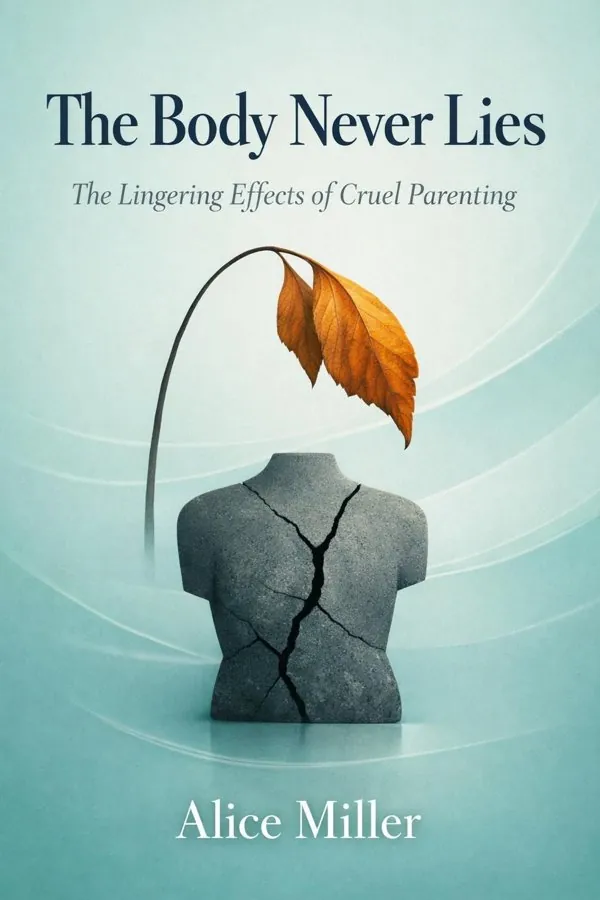
The Body Never Lies: The Lingering Effects of Cruel Parenting: Summary & Key Insights
by Alice Miller
 10 min9 chaptersAudio available
What Is The Body Never Lies: The Lingering Effects of Cruel Parenting About?
The Body Never Lies: The Lingering Effects of Cruel Parenting by Alice Miller is a psychology book spanning 9 pages. In this profound work, Swiss psychoanalyst Alice Miller explores how the body expresses the repressed truths of childhood trauma and emotional neglect. She argues that physical symptoms and psychological suffering often stem from the denial of early pain and the compulsion to idealize abusive parents. Through case studies and reflections, Miller advocates for self-awareness and emotional honesty as paths to healing, emphasizing that the body never lies about the truth of one’s experiences.
This FizzRead summary covers all 9 key chapters of The Body Never Lies: The Lingering Effects of Cruel Parenting in approximately 10 minutes, distilling the most important ideas, arguments, and takeaways from Alice Miller's work. Also available as an audio summary and Key Quotes Podcast.
The Body Never Lies: The Lingering Effects of Cruel Parenting
In this profound work, Swiss psychoanalyst Alice Miller explores how the body expresses the repressed truths of childhood trauma and emotional neglect. She argues that physical symptoms and psychological suffering often stem from the denial of early pain and the compulsion to idealize abusive parents. Through case studies and reflections, Miller advocates for self-awareness and emotional honesty as paths to healing, emphasizing that the body never lies about the truth of one’s experiences.
Who Should Read The Body Never Lies: The Lingering Effects of Cruel Parenting?
This book is perfect for anyone interested in psychology and looking to gain actionable insights in a short read. Whether you're a student, professional, or lifelong learner, the key ideas from The Body Never Lies: The Lingering Effects of Cruel Parenting by Alice Miller will help you think differently.
- ✓Readers who enjoy psychology and want practical takeaways
- ✓Professionals looking to apply new ideas to their work and life
- ✓Anyone who wants the core insights of The Body Never Lies: The Lingering Effects of Cruel Parenting in just 10 minutes
Want the full summary?
Get instant access to this book summary and 100K+ more with Fizz Moment.
Get Free SummaryAvailable on App Store • Free to download
Key Chapters
Every society, in one way or another, teaches children to silence their pain. We are told that the strict hand of discipline is ‘for our own good,’ that a lack of love is simply something to be endured, that obedience is synonymous with virtue. As children, we absorb these values not because they are true but because our survival depends on accepting them. Imagine the impossible position of a child whose parents are abusive or emotionally absent. That child cannot risk recognizing the cruelty in those he or she depends upon. To acknowledge the truth would be to face unbearable fear and loneliness. And so, the child represses awareness, internalizes guilt, and takes responsibility for the parents’ behavior. ‘It must be my fault,’ the child thinks. This lie becomes the foundation upon which many lives are built.
As adults, we may no longer face the same dangers, yet the denial persists. Many come into therapy, as I have seen through years of practice, convinced that their childhoods were happy, even while their bodies are consumed by unexplained pain or illness. The split between body and consciousness is the tragic legacy of our early defenses. To deny childhood suffering may once have been necessary, but in adulthood, it becomes a source of sickness. The contradiction between what we consciously believe (“I had loving parents”) and what the body remembers (“I was terrified and unloved”) inevitably reveals itself, usually in some form of physical expression.
Few emotional illusions are as tenacious as the idealization of parents. I have found again and again that people would rather suffer physical pain than risk acknowledging that their parents caused them harm. This idealization begins as dependency—without parental care, the infant cannot live—and evolves into a deeply moralized belief that to love one’s parents unconditionally, regardless of their actions, is an ethical duty. Cultural and religious traditions often reinforce this illusion, transforming obedience and forgiveness into sacred virtues.
But the idealization of parents is not love—it is fear disguised as virtue. It demands that the child repress any awareness of being wronged. When we convince ourselves that our parents were always right, that their cruelty was a form of love, we continue, as adults, to betray the truth of our experiences. The body, however, refuses this moral distortion. It remembers each humiliation, each cry that went unanswered. In migraines, in ulcers, in depression, the body speaks when the mind cannot. Healing begins only when we stop defending our parents at the expense of our inner child. To idealize them is to silence ourselves once more. To recognize their faults without hatred, and perhaps without forgiveness, is to reclaim the self that was once denied.
+ 7 more chapters — available in the FizzRead app
All Chapters in The Body Never Lies: The Lingering Effects of Cruel Parenting
About the Author
Alice Miller (1923–2010) was a Swiss psychologist and psychoanalyst known for her groundbreaking work on childhood trauma, parental abuse, and the long-term psychological effects of repression. Her influential books, including 'The Drama of the Gifted Child' and 'For Your Own Good,' challenged traditional psychoanalytic views and emphasized the importance of acknowledging and confronting early emotional pain.
Get This Summary in Your Preferred Format
Read or listen to the The Body Never Lies: The Lingering Effects of Cruel Parenting summary by Alice Miller anytime, anywhere. FizzRead offers multiple formats so you can learn on your terms — all free.
Available formats: App · Audio · PDF · EPUB — All included free with FizzRead
Download The Body Never Lies: The Lingering Effects of Cruel Parenting PDF and EPUB Summary
Key Quotes from The Body Never Lies: The Lingering Effects of Cruel Parenting
“Every society, in one way or another, teaches children to silence their pain.”
“Few emotional illusions are as tenacious as the idealization of parents.”
Frequently Asked Questions about The Body Never Lies: The Lingering Effects of Cruel Parenting
The Body Never Lies: The Lingering Effects of Cruel Parenting by Alice Miller is a psychology book that explores key ideas across 9 chapters. In this profound work, Swiss psychoanalyst Alice Miller explores how the body expresses the repressed truths of childhood trauma and emotional neglect. She argues that physical symptoms and psychological suffering often stem from the denial of early pain and the compulsion to idealize abusive parents. Through case studies and reflections, Miller advocates for self-awareness and emotional honesty as paths to healing, emphasizing that the body never lies about the truth of one’s experiences.
More by Alice Miller
You Might Also Like
The Body Keeps the Score
Bessel van der Kolk
10 min
Surrounded by Idiots
Thomas Erikson
10 min
Emotional Intelligence
Daniel Goleman
10 min
Attached
Amir Levine
10 min
Why Does He Do That
Lundy Bancroft
10 min
Women Who Run with the Wolves
Clarissa Pinkola Estés
10 minBrowse by Category
Ready to read The Body Never Lies: The Lingering Effects of Cruel Parenting?
Get the full summary and 100K+ more books with Fizz Moment.