
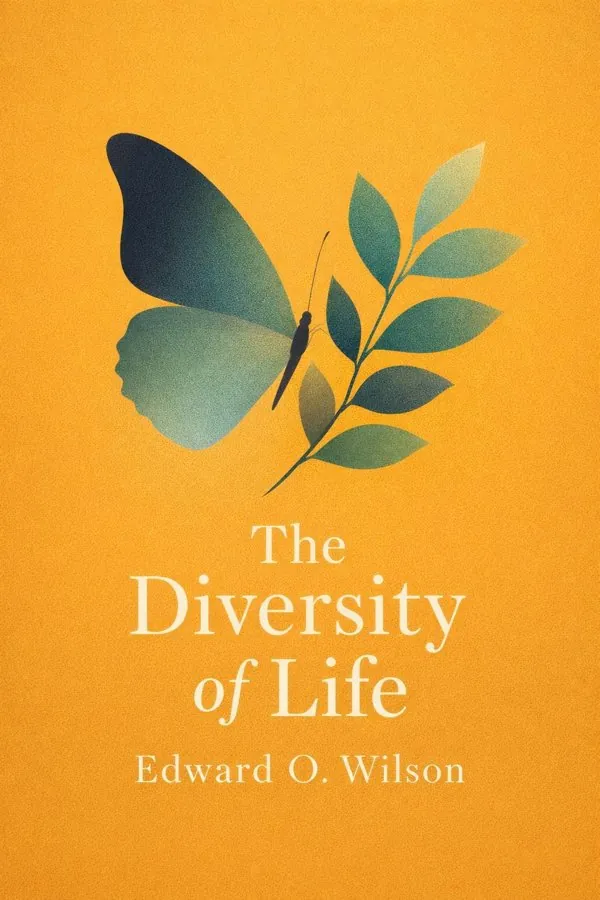
The Diversity of Life: Summary & Key Insights
 10 min9 chaptersAudio available
Key Takeaways from The Diversity of Life
Every species alive today is a survivor of an unimaginably long experiment.
A new species often begins with a separation so small it would be easy to overlook.
The richest parts of the planet are not randomly distributed; they follow ecological rules.
Nature is not built from isolated parts; it is held together by relationships.
A species does not need to be useful to deserve existence, yet many are useful in ways we barely understand.
What Is The Diversity of Life About?
The Diversity of Life by Edward O. Wilson is a life_science book spanning 5 pages. Edward O. Wilson’s The Diversity of Life is both a scientific exploration and a moral appeal. In this landmark book, Wilson examines how Earth became home to millions of species, how those species are connected through ecology and evolution, and why human activity now threatens this extraordinary inheritance at unprecedented speed. He moves from the origins of speciation to the structure of ecosystems, from tropical forests and coral reefs to the silent disappearance of organisms we may never even discover. The result is a work that inspires wonder while confronting readers with urgency. What makes the book especially powerful is Wilson’s authority. Few scientists were better positioned to write it. A pioneering biologist, naturalist, and conservation thinker, Wilson spent decades studying ants, island biogeography, and the principles that shape biodiversity across the planet. He combines rigorous science with elegant prose and a rare ability to make abstract ecological ideas feel immediate and personal. The Diversity of Life matters because it shows that biodiversity is not a decorative feature of the world. It is the living foundation of planetary stability, human prosperity, and our ethical relationship to life itself.
This FizzRead summary covers all 9 key chapters of The Diversity of Life in approximately 10 minutes, distilling the most important ideas, arguments, and takeaways from Edward O. Wilson's work. Also available as an audio summary and Key Quotes Podcast.
The Diversity of Life
Edward O. Wilson’s The Diversity of Life is both a scientific exploration and a moral appeal. In this landmark book, Wilson examines how Earth became home to millions of species, how those species are connected through ecology and evolution, and why human activity now threatens this extraordinary inheritance at unprecedented speed. He moves from the origins of speciation to the structure of ecosystems, from tropical forests and coral reefs to the silent disappearance of organisms we may never even discover. The result is a work that inspires wonder while confronting readers with urgency.
What makes the book especially powerful is Wilson’s authority. Few scientists were better positioned to write it. A pioneering biologist, naturalist, and conservation thinker, Wilson spent decades studying ants, island biogeography, and the principles that shape biodiversity across the planet. He combines rigorous science with elegant prose and a rare ability to make abstract ecological ideas feel immediate and personal. The Diversity of Life matters because it shows that biodiversity is not a decorative feature of the world. It is the living foundation of planetary stability, human prosperity, and our ethical relationship to life itself.
Who Should Read The Diversity of Life?
This book is perfect for anyone interested in life_science and looking to gain actionable insights in a short read. Whether you're a student, professional, or lifelong learner, the key ideas from The Diversity of Life by Edward O. Wilson will help you think differently.
- ✓Readers who enjoy life_science and want practical takeaways
- ✓Professionals looking to apply new ideas to their work and life
- ✓Anyone who wants the core insights of The Diversity of Life in just 10 minutes
Want the full summary?
Get instant access to this book summary and 100K+ more with Fizz Moment.
Get Free SummaryAvailable on App Store • Free to download
Key Chapters
Every species alive today is a survivor of an unimaginably long experiment. When Wilson speaks of the diversity of life, he is inviting us to see nature not as a static catalog of plants and animals, but as the outcome of roughly four billion years of trial, adaptation, extinction, and renewal. The world’s biodiversity is a living archive of evolutionary history, written in genes, body forms, behaviors, and ecological relationships.
This perspective changes how we understand even familiar organisms. A bird’s wing, a flower’s color, a beetle’s shell, or a fungus’s hidden network in the soil are not random traits. They are solutions shaped over deep time by natural selection. Each species reflects a distinctive path through history, molded by competition, climate, geography, chance events, and cooperation with other organisms. Biodiversity, then, is not simply a matter of counting species. It includes the variety of ecosystems, the range of genetic differences within populations, and the intricate evolutionary stories embodied in each form of life.
Wilson emphasizes that the natural world’s richness is greatest where conditions allow evolution to diversify repeatedly, such as in tropical forests or reef systems. These places are not only visually abundant; they represent concentrated evolutionary creativity. Losing them means losing ancient lineages and future possibilities at once.
In practice, this idea matters because it expands conservation beyond protecting charismatic animals. It also means preserving habitats, genetic variation, and lesser-known organisms that maintain ecological resilience. A local wetland, for example, may contain insects, microbes, amphibians, and plants that together reflect millennia of adaptation.
Actionable takeaway: Start seeing biodiversity as history made visible, and support conservation efforts that protect entire habitats, not just a few famous species.
A new species often begins with a separation so small it would be easy to overlook. Wilson builds on Darwinian principles to explain that biodiversity grows through mutation, isolation, and natural selection operating over long spans of time. Populations become distinct when they are divided by mountains, rivers, climate shifts, islands, or ecological niches. Once separated, they accumulate genetic changes and adapt to local conditions until they can no longer interbreed. At that point, speciation has occurred.
This mechanism helps explain why life is so varied even among closely related organisms. A finch population on one island may evolve a beak suited for seeds, while another on a neighboring island develops a shape better for insects. Similar processes unfold across forests, lakes, deserts, and mountain ranges. Small differences, compounded over generations, can eventually produce entirely new branches of life.
Wilson also shows that speciation is not merely an ancient event. It is an ongoing process, though often too slow for human observation in full. Evolution continues wherever populations face different pressures. Yet this also means that when habitats are destroyed or fragmented too abruptly, the process is interrupted. Species vanish faster than new ones can emerge.
A practical application of this idea appears in land management and conservation planning. Protecting migration corridors, maintaining habitat connectivity, and preserving isolated ecological zones all help sustain the evolutionary processes that generate biodiversity. Conservation should not focus only on what exists now; it should also safeguard the conditions under which future diversity can arise.
Actionable takeaway: Support policies and local planning that preserve connected, varied habitats, because protecting evolution’s pathways is as important as protecting its current results.
The richest parts of the planet are not randomly distributed; they follow ecological rules. Wilson explores why tropical regions contain such extraordinary biodiversity compared with temperate zones. Warm climates, long growing seasons, stable environmental conditions, and abundant solar energy create conditions in which life can diversify more extensively. Over long periods, species accumulate rather than being repeatedly erased by glaciation and severe climatic disruption.
This helps explain why rainforests, coral reefs, and equatorial ecosystems are so densely layered with forms of life. A single hectare of tropical forest may contain more tree species than are found across entire countries in colder latitudes. That floral diversity, in turn, supports specialized insects, birds, fungi, mammals, and microorganisms. The result is an ecological architecture of astonishing complexity, where many species occupy narrow niches and depend on subtle interactions.
Wilson’s point is not simply that the tropics are beautiful. They are central reservoirs of the planet’s biological wealth. Because so many species have small ranges and specialized roles, they are also especially vulnerable to disturbance. Logging, mining, conversion to agriculture, and climate disruption can destroy unique life forms before science has even documented them.
This has direct implications for conservation funding and public attention. If resources are limited, then protecting tropical biodiversity hotspots can preserve a disproportionate share of global life. International partnerships, indigenous land rights, sustainable agriculture, and protected-area networks become essential tools.
At a local level, the lesson is broader: diversity flourishes where stability, energy, and ecological opportunity persist. Even in cities, gardens and green corridors designed with native plants can create microhabitats that support pollinators and birds.
Actionable takeaway: Prioritize support for tropical conservation organizations and biodiversity hotspots, where each acre protected may save an exceptional concentration of life.
Nature is not built from isolated parts; it is held together by relationships. Wilson emphasizes that biodiversity matters not only because species exist, but because they interact in food webs, nutrient cycles, pollination systems, predator-prey balances, and symbiotic partnerships. Remove enough strands from this web, and the structure weakens in ways that are difficult to predict.
A forest is more than trees. It includes fungi that help roots absorb nutrients, insects that decompose leaf litter, birds that disperse seeds, predators that regulate herbivores, and microbes that keep soils fertile. Coral reefs, grasslands, wetlands, and estuaries all function through similar interdependence. Species may seem minor in isolation, yet play critical roles in maintaining the system’s resilience and productivity.
Human activity disrupts these relationships at multiple levels. Habitat destruction removes the physical space organisms need. Pollution alters chemistry and reproductive success. Invasive species can crowd out native ones. Overhunting and overfishing collapse food chains. Climate change shifts temperature and rainfall patterns faster than many species can adapt. The most dangerous feature of these impacts is their cumulative effect. Ecosystems rarely fail all at once; they unravel gradually, then suddenly.
Wilson warns that humanity often notices ecological damage only when useful services begin to disappear. A decline in pollinators affects crops. Wetland loss worsens flooding. Deforestation changes rainfall and erodes soil. The web of life is not ornamental; it quietly supports civilization.
Practical responses include restoring degraded habitats, reducing fragmentation, limiting pesticide overuse, and designing development around ecological knowledge. Even household choices, such as avoiding invasive garden plants or reducing meat from destructive supply chains, can scale through collective action.
Actionable takeaway: Treat ecological relationships as infrastructure, and make personal, civic, and business decisions that reduce harm to the systems life depends on.
A species does not need to be useful to deserve existence, yet many are useful in ways we barely understand. Wilson argues that biodiversity carries both ethical and practical value. Ethically, each species is a unique product of evolution, an irreplaceable expression of life’s creativity. To drive it into extinction for trivial or short-term gain is to erase something that can never be remade. Practically, biodiversity underpins agriculture, medicine, climate regulation, soil fertility, water purification, and countless ecosystem services.
Many benefits are obvious. Wild plants contribute genes that improve crops. Forests store carbon and regulate water cycles. Diverse fisheries are more stable than simplified ones. Other benefits are hidden until loss reveals them. A microbial compound may become a future medicine. An obscure insect may control pests naturally. A mangrove system may save coastal communities from storm damage. Biodiversity acts like a vast library of solutions assembled by natural selection, most of which humanity has not yet read.
Wilson resists the false choice between valuing nature for itself and valuing it for human well-being. Both arguments matter. People are more likely to protect what they respect, and society is more likely to invest in protection when the stakes are concrete. Conservation therefore needs scientific evidence, economic reasoning, and moral imagination.
In everyday life, this means expanding our definition of value. A vacant lot with native vegetation may be more ecologically meaningful than a manicured lawn. A protected wetland may generate less immediate profit than development, but far greater long-term public benefit.
Actionable takeaway: When judging land use or policy, ask not only what yields the fastest return, but what preserves long-term ecological, economic, and moral value.
The most alarming fact in Wilson’s argument is simple: natural extinction is being replaced by human-driven extinction at extraordinary speed. Species have always disappeared as part of Earth’s history, but today the rate is vastly amplified by deforestation, habitat fragmentation, pollution, overexploitation, and climate change. This is not ordinary ecological turnover. It is a mass diminishment of life caused by one species expanding beyond sustainable limits.
Wilson stresses that extinction is irreversible. Once a species is gone, its genes, behaviors, ecological role, and evolutionary potential vanish with it. We often imagine extinction as dramatic, involving iconic animals, but much of it is silent. Insects, plants, fungi, freshwater organisms, and countless tropical species disappear without notice. Many are lost before scientists ever name them.
A major driver is habitat loss, especially the shrinking of large continuous ecosystems into small isolated fragments. Small populations are more vulnerable to disease, inbreeding, random disasters, and ecological instability. The species-area relationship, a principle central to conservation biology, shows that reducing habitat tends to reduce the number of species it can support. The mathematics of land loss become the biology of extinction.
This insight has practical force. Conservation is not only about legal protection on paper; it is about maintaining enough space, connectivity, and ecological integrity for populations to survive. Land-use decisions, road placement, fisheries management, and climate policy all become biodiversity policy whether we acknowledge it or not.
Individuals can respond by supporting habitat-focused conservation groups, reducing consumption linked to deforestation, and voting for leaders who understand environmental risk as long-term security risk.
Actionable takeaway: Think of habitat destruction as extinction set in motion, and act early, because prevention is far easier than restoration after collapse.
Good intentions are not enough when ecosystems are at stake. Wilson argues that conservation must be rooted in careful scientific understanding. To protect biodiversity effectively, we need to know where species live, how many remain, what ecological roles they play, how populations respond to disturbance, and which habitats produce the greatest conservation return. Without that knowledge, policy becomes reactive, symbolic, or wasteful.
Wilson champions taxonomy, field biology, biogeography, and ecological monitoring because they provide the map of life on which smart action depends. If species are not identified, counted, and studied, they can vanish invisibly. If ecosystems are not monitored, tipping points may be crossed before anyone recognizes the warning signs. Scientific data can reveal biodiversity hotspots, migration corridors, keystone species, and patterns of decline that should shape protection efforts.
This principle applies beyond research institutions. Governments need biodiversity inventories before approving major development. Businesses should assess ecosystem impact in supply chains. Cities can use ecological data to design parks, stormwater systems, and green corridors that support native life. Schools and citizen science programs can also contribute by collecting local observations that improve conservation planning.
Wilson is especially persuasive in showing that science and policy should not operate as separate worlds. Science clarifies what is happening and what is possible; policy determines whether society acts in time. The gap between knowing and doing is often where biodiversity is lost.
For readers, the practical lesson is to trust evidence-based conservation rather than vague environmental branding. Ask whether a proposed project protects habitat quality, species richness, and long-term ecological function, not just appearances.
Actionable takeaway: Support conservation initiatives that are measurable, data-driven, and transparent, because biodiversity is best protected when decisions follow evidence rather than sentiment alone.
One of Wilson’s most important insights is that the conflict between humanity and nature is, in part, a mistaken framing. Humans are not outside life looking in; we are one branch of the same evolutionary tree. Our minds, cultures, economies, and technologies arose within the biosphere and remain dependent on it. The danger comes when human ambition ignores ecological limits and behaves as if civilization can detach itself from the natural systems that sustain it.
Wilson does not argue for a world without human development. Instead, he asks for a more mature idea of progress, one that recognizes biological reality. Food production depends on soil organisms, pollinators, stable climate, and water cycles. Public health depends on balanced ecosystems as well as medical systems. Economic resilience depends on functioning natural capital even when markets fail to price it accurately.
This perspective also has psychological and cultural implications. People often protect what they feel connected to. Wilson believed that humans possess a deep affinity for life, sometimes called biophilia. Contact with living systems can enrich attention, learning, emotional health, and ethical awareness. Biodiversity is therefore not only a scientific or economic concern; it is part of what makes human life meaningful.
Practical applications include integrating nature into education, urban design, and public life. Cities can preserve native green spaces, schools can teach ecological literacy through local field study, and families can cultivate habits of observation rather than treating nature as distant scenery.
Actionable takeaway: Replace the idea of mastering nature with the practice of living intelligently within it, and build daily habits that strengthen your connection to the living world.
The future of biodiversity will not be decided by knowledge alone, but by whether societies choose to act on what they know. Wilson ends with a clear challenge: conservation is ultimately a political, economic, and cultural decision. The science can identify the crisis and point toward solutions, but governments, institutions, and citizens must decide that preserving life is a priority worth funding, regulating, and defending.
This means confronting uncomfortable trade-offs. Short-term profits from logging, extraction, or poorly planned expansion often come at the expense of long-term ecological stability. Conservation can seem costly in the present, but ecological collapse is far more expensive in the future. The question is not whether society will pay, but whether it will pay early through protection or later through damage, scarcity, and restoration.
Wilson also implies that hope lies in scale. Individual action matters, but systemic change matters more when backed by public will. Protected areas, indigenous stewardship, international agreements, species recovery plans, sustainable agriculture, and climate action all work best when reinforced by informed citizens. Education and public storytelling are therefore part of conservation, not separate from it.
For modern readers, this key idea is especially relevant. Biodiversity loss can feel too vast to influence, yet policy changes, consumer pressure, philanthropy, voting, and community organization all shape outcomes. Even local victories, such as preserving a watershed or restoring an urban habitat, build the social capacity needed for larger success.
Actionable takeaway: Convert concern into commitment by supporting one concrete biodiversity effort, whether through voting, donating, volunteering, or advocating for habitat protection in your own community.
All Chapters in The Diversity of Life
About the Author
Edward Osborne Wilson (1929–2021) was an American biologist, naturalist, and author whose work transformed the study of biodiversity and conservation. Best known for his research on ants, he also made major contributions to island biogeography, sociobiology, and the broader understanding of how species evolve and interact. Wilson spent most of his academic career at Harvard University, where he became one of the world’s leading scientific voices on the richness and fragility of life on Earth. A gifted public intellectual as well as a field scientist, he wrote numerous influential books and won two Pulitzer Prizes. Wilson’s legacy lies not only in his scientific discoveries, but in his passionate effort to convince humanity that protecting biodiversity is essential to both ethics and survival.
Get This Summary in Your Preferred Format
Read or listen to the The Diversity of Life summary by Edward O. Wilson anytime, anywhere. FizzRead offers multiple formats so you can learn on your terms — all free.
Available formats: App · Audio · PDF · EPUB — All included free with FizzRead
Download The Diversity of Life PDF and EPUB Summary
Key Quotes from The Diversity of Life
“Every species alive today is a survivor of an unimaginably long experiment.”
“A new species often begins with a separation so small it would be easy to overlook.”
“The richest parts of the planet are not randomly distributed; they follow ecological rules.”
“Nature is not built from isolated parts; it is held together by relationships.”
“A species does not need to be useful to deserve existence, yet many are useful in ways we barely understand.”
Frequently Asked Questions about The Diversity of Life
The Diversity of Life by Edward O. Wilson is a life_science book that explores key ideas across 9 chapters. Edward O. Wilson’s The Diversity of Life is both a scientific exploration and a moral appeal. In this landmark book, Wilson examines how Earth became home to millions of species, how those species are connected through ecology and evolution, and why human activity now threatens this extraordinary inheritance at unprecedented speed. He moves from the origins of speciation to the structure of ecosystems, from tropical forests and coral reefs to the silent disappearance of organisms we may never even discover. The result is a work that inspires wonder while confronting readers with urgency. What makes the book especially powerful is Wilson’s authority. Few scientists were better positioned to write it. A pioneering biologist, naturalist, and conservation thinker, Wilson spent decades studying ants, island biogeography, and the principles that shape biodiversity across the planet. He combines rigorous science with elegant prose and a rare ability to make abstract ecological ideas feel immediate and personal. The Diversity of Life matters because it shows that biodiversity is not a decorative feature of the world. It is the living foundation of planetary stability, human prosperity, and our ethical relationship to life itself.
More by Edward O. Wilson
You Might Also Like
The Selfish Gene
Richard Dawkins
10 min
Awakenings
Oliver Sacks
10 min
Parasite Rex: Inside the Bizarre World of Nature's Most Dangerous Creatures
Carl Zimmer
10 min
The Atlas of Life on Earth
Various
10 min
The Book of Humans: The Story of How We Became Us
Adam Rutherford
10 min
The Horse
Wendy Williams
10 minBrowse by Category
Ready to read The Diversity of Life?
Get the full summary and 100K+ more books with Fizz Moment.