
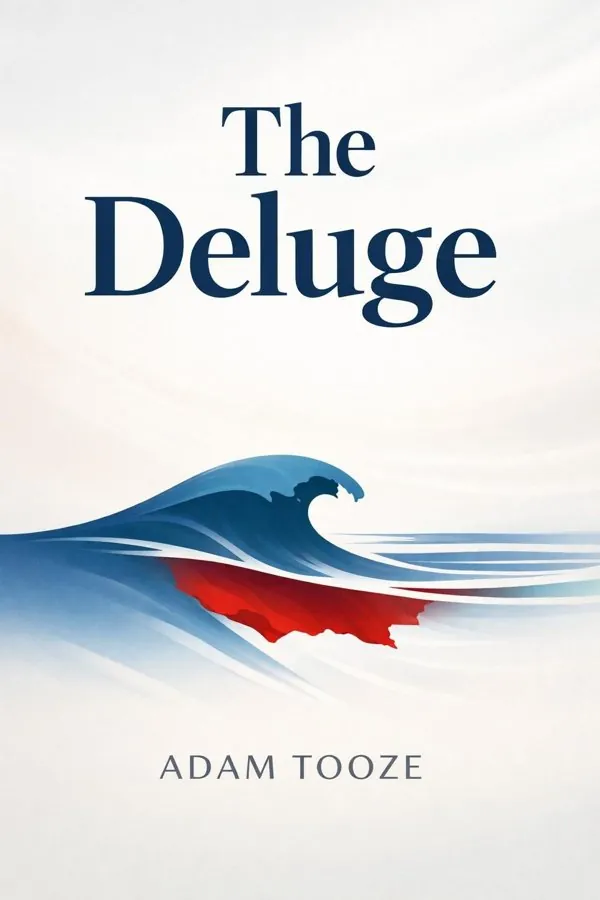
The Deluge: The Great War, America and the Remaking of the Global Order, 1916–1931: Summary & Key Insights
by Adam Tooze
 10 min7 chaptersAudio available
What Is The Deluge: The Great War, America and the Remaking of the Global Order, 1916–1931 About?
The Deluge: The Great War, America and the Remaking of the Global Order, 1916–1931 by Adam Tooze is a world_history book spanning 7 pages. A sweeping history of the aftermath of World War I, 'The Deluge' examines how the United States emerged as a global power and reshaped the international order between 1916 and 1931. Adam Tooze explores the economic, political, and diplomatic transformations that followed the Great War, analyzing how American financial and industrial dominance influenced the reconstruction of Europe and the global balance of power.
This FizzRead summary covers all 7 key chapters of The Deluge: The Great War, America and the Remaking of the Global Order, 1916–1931 in approximately 10 minutes, distilling the most important ideas, arguments, and takeaways from Adam Tooze's work. Also available as an audio summary and Key Quotes Podcast.
The Deluge: The Great War, America and the Remaking of the Global Order, 1916–1931
A sweeping history of the aftermath of World War I, 'The Deluge' examines how the United States emerged as a global power and reshaped the international order between 1916 and 1931. Adam Tooze explores the economic, political, and diplomatic transformations that followed the Great War, analyzing how American financial and industrial dominance influenced the reconstruction of Europe and the global balance of power.
Who Should Read The Deluge: The Great War, America and the Remaking of the Global Order, 1916–1931?
This book is perfect for anyone interested in world_history and looking to gain actionable insights in a short read. Whether you're a student, professional, or lifelong learner, the key ideas from The Deluge: The Great War, America and the Remaking of the Global Order, 1916–1931 by Adam Tooze will help you think differently.
- ✓Readers who enjoy world_history and want practical takeaways
- ✓Professionals looking to apply new ideas to their work and life
- ✓Anyone who wants the core insights of The Deluge: The Great War, America and the Remaking of the Global Order, 1916–1931 in just 10 minutes
Want the full summary?
Get instant access to this book summary and 100K+ more with Fizz Moment.
Get Free SummaryAvailable on App Store • Free to download
Key Chapters
The scale and speed of America’s economic mobilization between 1916 and 1918 were unlike anything history had seen. The European powers were exhausted, their treasuries drained, their industries strained. Into that vacuum stepped the United States—financially ascendant, industrially unbroken. The Allied war effort was effectively refinanced through New York. The dollar supplanted sterling as the world’s reference currency, and American banks—backed by the Federal Reserve—moved from regional actors to global arbiters.
The wartime mobilization was not simply economic but ideological. Wilson’s government framed the U.S. role as a moral crusade for democracy and progress. But beneath that vision lay careful economic engineering: the coordination of war industries, the harnessing of private corporations to public goals, and the fusion of state capacity with market power. This synthesis became the template for twentieth-century American power. It was not empire in the traditional sense but a system of financial and industrial dominance combined with political exceptionalism.
By 1918, the Allied powers were effectively dependent on the United States. France and Britain’s war expenditures were financed by U.S. loans; their reconstruction bills would be as well. When the armistice came, the world faced an extraordinary inversion: European creditors had become debtors, and the U.S., once peripheral, now dictated the flow of global credit. The balance of power had been redrawn, not by conquest, but by accountancy and supply chains.
Woodrow Wilson believed that America’s involvement in the war had a deeper meaning than victory; it was to be the hinge of a new international era. His Fourteen Points articulated an almost revolutionary vision: that the world could be organized on principles of law, democracy, and self-determination. Yet the paradox embedded in this ambition was the tension between moral universalism and the reality of power.
Wilson’s liberal internationalism sought to reconcile national sovereignty with collective security—a world made safe for democracy, but governed by voluntary cooperation. This was, in practice, a fragile combination. The League of Nations was conceived as the instrument of this new order, but it was stillborn when the U.S. Senate rejected the idea of binding American commitments abroad.
This collapse was more than a domestic political failure; it was a structural crisis in global governance. The U.S. had become the indispensable economic power, but it refused to act as a political guarantor. Europe remained bound to American capital but without American leadership. The system that Wilson had imagined to embody moral symmetry became, in reality, asymmetrical: power without responsibility, wealth without collective purpose. The contradictions of 1919 thus marked the true beginning of the twentieth century’s instability.
+ 5 more chapters — available in the FizzRead app
All Chapters in The Deluge: The Great War, America and the Remaking of the Global Order, 1916–1931
About the Author
Adam Tooze is a British historian and professor of history at Columbia University. He is known for his works on economic and global history, including 'The Wages of Destruction' and 'Crashed'. His research often focuses on the intersections of economics, politics, and international relations in the twentieth century.
Get This Summary in Your Preferred Format
Read or listen to the The Deluge: The Great War, America and the Remaking of the Global Order, 1916–1931 summary by Adam Tooze anytime, anywhere. FizzRead offers multiple formats so you can learn on your terms — all free.
Available formats: App · Audio · PDF · EPUB — All included free with FizzRead
Download The Deluge: The Great War, America and the Remaking of the Global Order, 1916–1931 PDF and EPUB Summary
Key Quotes from The Deluge: The Great War, America and the Remaking of the Global Order, 1916–1931
“The scale and speed of America’s economic mobilization between 1916 and 1918 were unlike anything history had seen.”
“Woodrow Wilson believed that America’s involvement in the war had a deeper meaning than victory; it was to be the hinge of a new international era.”
Frequently Asked Questions about The Deluge: The Great War, America and the Remaking of the Global Order, 1916–1931
The Deluge: The Great War, America and the Remaking of the Global Order, 1916–1931 by Adam Tooze is a world_history book that explores key ideas across 7 chapters. A sweeping history of the aftermath of World War I, 'The Deluge' examines how the United States emerged as a global power and reshaped the international order between 1916 and 1931. Adam Tooze explores the economic, political, and diplomatic transformations that followed the Great War, analyzing how American financial and industrial dominance influenced the reconstruction of Europe and the global balance of power.
More by Adam Tooze
The Wages of Destruction: The Making and Breaking of the Nazi Economy
Adam Tooze
10 min
The Deluge: The Great War and the Remaking of Global Order
Adam Tooze
10 min
Crashed: How a Decade of Financial Crises Changed the World
Adam Tooze
10 min
Shutdown: How Covid Shook the World's Economy
Adam Tooze
10 minYou Might Also Like
The Age of Capital
Eric Hobsbawm
10 min
The Gulag Archipelago
Aleksandr Solzhenitsyn
10 min
Jerusalem: The Biography
Simon Sebag Montefiore
10 min
The Anglo-Saxons
James Campbell
10 min
The Boer War
Thomas Pakenham
10 min
The Industrial Revolutionaries: The Making of the Modern World 1776–1914
Gavin Weightman
10 minBrowse by Category
Ready to read The Deluge: The Great War, America and the Remaking of the Global Order, 1916–1931?
Get the full summary and 100K+ more books with Fizz Moment.