
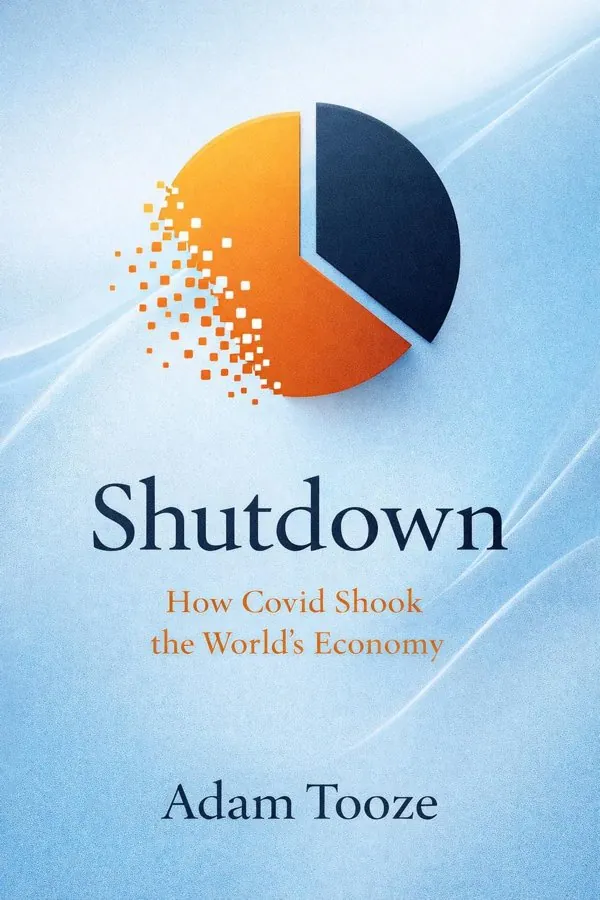
Shutdown: How Covid Shook the World's Economy: Summary & Key Insights
by Adam Tooze
 10 min9 chaptersAudio available
Key Takeaways from Shutdown: How Covid Shook the World's Economy
The most unsettling fact about early 2020 was that the world economy did not merely slow down; it was intentionally switched off.
One of the pandemic’s biggest surprises was how quickly governments abandoned the old idea that markets alone should absorb shocks.
Financial panic can spread faster than any virus, and one of Tooze’s core insights is that central banks prevented the health crisis from becoming a complete financial meltdown.
A striking paradox of the pandemic was that the United States was both deeply dysfunctional and globally indispensable.
The European response to COVID-19 revealed both the fragility of the European project and its capacity for reinvention.
What Is Shutdown: How Covid Shook the World's Economy About?
Shutdown: How Covid Shook the World's Economy by Adam Tooze is a economics book spanning 12 pages. What made the COVID-19 crisis so historically extraordinary was not only the death toll or the speed of contagion, but the way it brought the global economy to a deliberate stop. In Shutdown: How Covid Shook the World's Economy, historian Adam Tooze explains how a public-health emergency quickly became a stress test for finance, politics, supply chains, labor markets, and international power. Rather than treating the pandemic as a simple recession, Tooze shows it as a systemic shock that exposed how deeply interconnected and fragile modern societies had become. The book moves from the first panic of early 2020 to the massive interventions launched by governments and central banks, tracing how policymakers improvised under pressure and how preexisting inequalities shaped who suffered most. It also explores the geopolitical consequences of the crisis, from tensions between the United States and China to the uneven position of Europe and the vulnerability of emerging economies. Tooze writes with the authority of a leading historian of economic crises and global disorder. His talent lies in making complex macroeconomic events readable, urgent, and politically meaningful. This is essential reading for anyone who wants to understand not just what happened during the pandemic, but what it revealed about the world we live in.
This FizzRead summary covers all 9 key chapters of Shutdown: How Covid Shook the World's Economy in approximately 10 minutes, distilling the most important ideas, arguments, and takeaways from Adam Tooze's work. Also available as an audio summary and Key Quotes Podcast.
Shutdown: How Covid Shook the World's Economy
What made the COVID-19 crisis so historically extraordinary was not only the death toll or the speed of contagion, but the way it brought the global economy to a deliberate stop. In Shutdown: How Covid Shook the World's Economy, historian Adam Tooze explains how a public-health emergency quickly became a stress test for finance, politics, supply chains, labor markets, and international power. Rather than treating the pandemic as a simple recession, Tooze shows it as a systemic shock that exposed how deeply interconnected and fragile modern societies had become.
The book moves from the first panic of early 2020 to the massive interventions launched by governments and central banks, tracing how policymakers improvised under pressure and how preexisting inequalities shaped who suffered most. It also explores the geopolitical consequences of the crisis, from tensions between the United States and China to the uneven position of Europe and the vulnerability of emerging economies.
Tooze writes with the authority of a leading historian of economic crises and global disorder. His talent lies in making complex macroeconomic events readable, urgent, and politically meaningful. This is essential reading for anyone who wants to understand not just what happened during the pandemic, but what it revealed about the world we live in.
Who Should Read Shutdown: How Covid Shook the World's Economy?
This book is perfect for anyone interested in economics and looking to gain actionable insights in a short read. Whether you're a student, professional, or lifelong learner, the key ideas from Shutdown: How Covid Shook the World's Economy by Adam Tooze will help you think differently.
- ✓Readers who enjoy economics and want practical takeaways
- ✓Professionals looking to apply new ideas to their work and life
- ✓Anyone who wants the core insights of Shutdown: How Covid Shook the World's Economy in just 10 minutes
Want the full summary?
Get instant access to this book summary and 100K+ more with Fizz Moment.
Get Free SummaryAvailable on App Store • Free to download
Key Chapters
The most unsettling fact about early 2020 was that the world economy did not merely slow down; it was intentionally switched off. Tooze argues that COVID-19 created a crisis unlike a conventional recession because governments and societies chose to halt normal activity in order to preserve life. Factories paused, flights disappeared, schools closed, offices emptied, and consumer demand collapsed all at once. This was not a cyclical downturn driven by falling investment or rising interest rates. It was a coordinated suspension of movement at the heart of an interconnected global system.
That distinction matters because it changes how we interpret both the shock and the response. In a normal downturn, policymakers try to stimulate demand and restore confidence. In the first phase of the pandemic, however, the immediate challenge was to prevent social and economic free fall while daily life remained frozen. The crisis quickly revealed how much modern economies depend on constant circulation: workers commuting, goods crossing borders, patients entering hospitals, credit flowing through financial systems, and households trusting that tomorrow will resemble today.
The shutdown also exposed the illusion that advanced economies are resilient simply because they are wealthy. Rich countries suffered severe shortages of masks, hospital equipment, and basic planning capacity. Businesses built for efficiency rather than redundancy struggled when one part of the system failed. The experience showed that globalization had created prosperity, but also deep dependence on fragile logistical chains.
For readers, the practical lesson is clear: resilience matters as much as efficiency. Whether in business, government, or personal planning, systems designed only for optimization are often weakest when they face real disruption. Build buffers, diversify dependencies, and prepare for interruptions rather than assuming smooth continuity.
One of the pandemic’s biggest surprises was how quickly governments abandoned the old idea that markets alone should absorb shocks. Tooze shows that when collapse loomed, states stepped forward as insurers of last resort, employers of last resort, lenders of last resort, and in many cases direct providers of income. Trillions of dollars were mobilized through wage subsidies, emergency loans, expanded unemployment benefits, stimulus checks, public-health spending, and corporate backstops. The state did not merely regulate the economy; it temporarily became the economy’s central organizing force.
This moment was historically significant because it reversed decades of rhetoric about limited government. When faced with mass layoffs, business failures, and household insecurity, even market-oriented governments accepted that only public power had the scale to stabilize the situation. Programs that would once have seemed politically impossible were implemented within days or weeks. In some countries, governments paid firms to keep workers attached to payrolls. In others, they sent direct cash to households or guaranteed corporate borrowing.
Tooze does not portray these interventions as proof of a new permanent consensus. Rather, he argues that emergencies reveal what states are actually capable of doing when ideology gives way to necessity. The pandemic showed that fiscal constraints are often political before they are technical. It also highlighted the unequal quality of state capacity: some governments delivered support effectively, while others struggled with administrative bottlenecks, partisan conflict, or weak institutions.
The practical application is powerful. When evaluating policy debates, ask not only what leaders say is affordable, but what becomes suddenly possible during crisis. Institutions can move faster and spend more boldly than they usually admit. The actionable takeaway: judge public systems by their emergency capacity and invest in administrative competence before the next shock arrives.
Financial panic can spread faster than any virus, and one of Tooze’s core insights is that central banks prevented the health crisis from becoming a complete financial meltdown. In March 2020, markets for government bonds, corporate debt, and dollar funding seized up with shocking speed. Investors rushed for cash, asset prices tumbled, and even supposedly safe markets showed signs of dysfunction. In response, central banks, especially the U.S. Federal Reserve, intervened on a scale that dwarfed earlier crisis management.
The key issue was liquidity. Businesses, banks, funds, and governments all needed access to financing at the same time, and fear threatened to freeze that access. The Fed cut rates, reopened emergency lending facilities, supported money markets, bought government and corporate securities, and extended dollar swap lines to foreign central banks. Tooze emphasizes that this was not just national crisis management. Because the dollar sits at the core of the global financial system, Fed action stabilized conditions far beyond the United States.
This episode revealed an often-overlooked truth: modern capitalism depends not only on productive firms and consumer spending, but on confidence in the plumbing of finance. When that plumbing breaks, otherwise healthy institutions can collapse from short-term funding stress. During the pandemic, central banks effectively acted as guardians of that hidden infrastructure.
For practical understanding, this means economic crises cannot be judged solely by headlines about jobs or GDP. Watch credit spreads, bond market functioning, and central bank communication, because they often determine whether a shock remains manageable. The takeaway is simple: in any major crisis, follow the liquidity response. If money stops moving, everything else soon follows.
A striking paradox of the pandemic was that the United States was both deeply dysfunctional and globally indispensable. Tooze highlights how America entered the crisis politically polarized, administratively uneven, and badly hit by infection. Yet it still served as the central pillar of economic stabilization. This was true not only because of the size of U.S. fiscal stimulus, but because the Federal Reserve sits at the center of the dollar-based global financial order.
The United States passed enormous relief measures that supported households, firms, and financial markets, helping prevent a deeper domestic collapse. But the global significance went further. International banks, corporations, and governments depend heavily on dollar funding. When stress surged in March 2020, the Fed’s interventions helped calm the world, not just Wall Street. Through swap lines and other facilities, U.S. monetary power acted as a backstop for allied economies and key financial systems.
Tooze uses this to make a broader argument about American hegemony. Even when U.S. politics looks chaotic, the underlying institutional architecture of American power remains decisive. That architecture includes Treasury markets, the Federal Reserve, the dollar’s reserve status, and the political willingness to use fiscal capacity at scale. At the same time, the pandemic exposed the limits of this power. America could stabilize markets globally while failing to protect many of its own citizens effectively.
The lesson for readers is to distinguish between visible political drama and structural power. A country can appear divided and still shape the entire world economy. The actionable takeaway: when assessing global risk, pay attention to institutions, reserve currencies, and financial networks, not just election cycles and headlines.
The European response to COVID-19 revealed both the fragility of the European project and its capacity for reinvention. Tooze shows that Europe entered the pandemic with fresh memories of the eurozone crisis, when debt burdens and fiscal rules had created bitter divisions between member states. In 2020, there was an immediate fear that the same script would return: richer countries protecting themselves while more vulnerable economies, especially in southern Europe, absorbed disproportionate pain.
That fear was not irrational. Italy and Spain were hit hard early, and public debt levels made the politics of support deeply sensitive. Yet the pandemic also pushed the European Union toward a more collective response than many expected. The European Central Bank moved forcefully to calm bond markets, and EU leaders eventually agreed on joint recovery measures that would have seemed unlikely before the crisis. This did not erase internal tensions, but it marked a significant shift toward shared fiscal responsibility.
Tooze’s broader point is that crises test whether political unions are real communities or merely legal frameworks. Europe’s challenge was not only economic but moral and institutional: could it treat a common shock as a shared burden? The answer was partial but important. The pandemic did not solve Europe’s structural problems, but it did encourage new forms of solidarity and demonstrated that integration can deepen under pressure.
For anyone studying institutions, Europe offers a practical case in crisis governance. Complex multinational systems often change only when survival is at stake. The takeaway: durable cooperation requires mechanisms for burden-sharing before panic sets in. If organizations want unity under stress, they must build trust and financial flexibility in advance.
The pandemic made one uncomfortable truth impossible to ignore: the world had become deeply dependent on China for manufacturing, logistics, and industrial continuity. Tooze explains that when the outbreak began in Wuhan and Chinese production slowed, the consequences rippled across continents. Shortages of medical supplies, industrial components, electronics, and basic inputs revealed how concentrated and optimized global supply chains had become.
For years, globalization had rewarded efficiency. Firms outsourced production, minimized inventories, and relied on just-in-time delivery systems to cut costs. But COVID-19 showed the hidden tradeoff. A supply chain that works beautifully in normal times can become a major vulnerability when transport networks fail, borders tighten, or one crucial production hub shuts down. China’s central role in manufacturing meant that disruptions there quickly became disruptions everywhere.
Tooze does not reduce this to a simple anti-globalization argument. China was not merely the source of vulnerability; it was also central to recovery. As Chinese production resumed, it helped supply goods the rest of the world urgently needed. The deeper lesson is that interdependence is neither inherently good nor bad. It creates both strength and fragility. Economies gain from specialization, but they also lose resilience when critical functions are too concentrated.
Businesses and policymakers have since talked about reshoring, friend-shoring, and strategic autonomy. Those ideas reflect the book’s larger message that efficiency must be balanced with security. The practical takeaway is to map your dependencies. Whether you run a company or manage a public institution, identify where single points of failure exist and create backup options before disruption forces your hand.
Crises may feel universal, but they are never experienced equally. Tooze insists that COVID-19 did not hit a level playing field. The pandemic exposed and intensified inequalities across countries, classes, races, and occupations. Professionals with laptops often continued working from home, while service workers, delivery drivers, warehouse employees, nurses, cleaners, and informal laborers faced a harsher choice between income and exposure. The same virus moved through societies structured by unequal protection.
This was especially severe in developing economies, where governments often lacked the fiscal space, healthcare infrastructure, and social insurance systems available in richer countries. Informal workers could not simply pause their livelihoods and wait for support checks. Debt pressures, capital outflows, and limited access to vaccines compounded the crisis. Tooze emphasizes that while advanced economies could borrow cheaply and deploy huge rescue packages, many poorer nations confronted the emergency with fewer tools and greater vulnerability.
Within wealthier countries, too, the divide was stark. Asset owners often recovered quickly as financial markets rebounded, boosted by central bank intervention. Meanwhile, workers in precarious sectors faced unemployment, health risks, and unstable housing. This pattern underscored a disturbing feature of modern crisis management: stabilization of markets does not automatically mean protection for the most exposed people.
The practical implication is that resilience must be measured socially, not just financially. A society is only as secure as the protections available to its most vulnerable members. The actionable takeaway: support policies and institutions that strengthen public health, income protection, housing stability, and labor standards, because inequality is not just a moral issue; it is a crisis amplifier.
One of the false choices exposed by the pandemic was the idea that societies must choose either public health or economic health. Tooze shows that this framing was deeply misleading. The economy does not function independently of human bodies, hospitals, caregiving systems, and public confidence. When disease spreads unchecked, workers fall ill, consumers retreat, schools close, supply chains break, and healthcare systems become overwhelmed. In that sense, protecting health is not the opposite of protecting the economy; it is a precondition for it.
Tooze’s analysis pushes readers to rethink what counts as economic infrastructure. Intensive care capacity, testing systems, vaccine distribution, epidemiological surveillance, and public trust all turned out to have massive macroeconomic consequences. Countries that managed the virus more effectively often found it easier to reopen with greater stability. Those that delayed action in the name of short-term economic activity often suffered both worse health outcomes and prolonged disruption.
This lesson extends beyond pandemics. It suggests that social systems commonly treated as secondary or purely humanitarian are central to economic resilience. Childcare, sick leave, eldercare, sanitation, and local clinics all affect labor supply, productivity, and social stability. Tooze therefore challenges narrow economic thinking that values output while ignoring the conditions that make output possible.
For practical use, this means decision-makers should integrate health planning into economic strategy rather than treating it as a separate domain. Businesses can apply this through sick leave policies, workplace safety, and continuity planning. Governments can apply it through preventative public-health investment. The takeaway: stop thinking of health spending as a cost alone. It is also one of the smartest forms of economic insurance.
The pandemic did not simply interrupt history; it accelerated trends already underway. Tooze argues that COVID-19 compressed years of political and technological change into a short period. Remote work expanded rapidly, digital platforms strengthened their role in commerce and communication, e-commerce surged, and debates about industrial policy, strategic autonomy, and green recovery gained new urgency. What looked at first like a pause became, in many sectors, a catalyst.
But acceleration was uneven and politically contested. The same technologies that enabled continuity also concentrated power in large firms with data, scale, and infrastructure. White-collar flexibility increased for some workers while surveillance, insecurity, and algorithmic management intensified for others. Recovery politics followed a similar pattern. Governments debated whether to return to pre-pandemic norms or use the crisis to reshape economies around public investment, decarbonization, and stronger social protection.
Tooze is especially valuable here because he treats recovery not as a technical phase after emergency, but as a struggle over what kind of world comes next. A crisis opens possibilities, but it does not decide among them. The outcome depends on institutions, coalitions, and political imagination. Will societies rebuild the same vulnerabilities, or will they convert disruption into reform?
Readers can apply this insight by seeing shocks as moments of path dependence. Once habits, technologies, and policies change quickly, they may become entrenched. The actionable takeaway: do not assume recovery means restoration. In times of upheaval, identify which changes are temporary, which are structural, and where deliberate action can steer the future toward greater resilience and fairness.
All Chapters in Shutdown: How Covid Shook the World's Economy
About the Author
Adam Tooze is a British historian, author, and professor at Columbia University, where he focuses on modern history, political economy, and international affairs. He is widely known for explaining major global crises through the combined lenses of economics, politics, and power. Tooze first gained broad recognition for The Wages of Destruction, his acclaimed study of the Nazi economy, and later for Crashed, a sweeping account of the 2008 financial crisis and its aftermath. His work is distinguished by its global scope, intellectual clarity, and ability to make complex systems understandable without oversimplifying them. In Shutdown, he applies that same historical and analytical depth to the COVID-19 pandemic, showing how a health emergency became a defining economic and geopolitical shock.
Get This Summary in Your Preferred Format
Read or listen to the Shutdown: How Covid Shook the World's Economy summary by Adam Tooze anytime, anywhere. FizzRead offers multiple formats so you can learn on your terms — all free.
Available formats: App · Audio · PDF · EPUB — All included free with FizzRead
Download Shutdown: How Covid Shook the World's Economy PDF and EPUB Summary
Key Quotes from Shutdown: How Covid Shook the World's Economy
“The most unsettling fact about early 2020 was that the world economy did not merely slow down; it was intentionally switched off.”
“One of the pandemic’s biggest surprises was how quickly governments abandoned the old idea that markets alone should absorb shocks.”
“Financial panic can spread faster than any virus, and one of Tooze’s core insights is that central banks prevented the health crisis from becoming a complete financial meltdown.”
“A striking paradox of the pandemic was that the United States was both deeply dysfunctional and globally indispensable.”
“The European response to COVID-19 revealed both the fragility of the European project and its capacity for reinvention.”
Frequently Asked Questions about Shutdown: How Covid Shook the World's Economy
Shutdown: How Covid Shook the World's Economy by Adam Tooze is a economics book that explores key ideas across 9 chapters. What made the COVID-19 crisis so historically extraordinary was not only the death toll or the speed of contagion, but the way it brought the global economy to a deliberate stop. In Shutdown: How Covid Shook the World's Economy, historian Adam Tooze explains how a public-health emergency quickly became a stress test for finance, politics, supply chains, labor markets, and international power. Rather than treating the pandemic as a simple recession, Tooze shows it as a systemic shock that exposed how deeply interconnected and fragile modern societies had become. The book moves from the first panic of early 2020 to the massive interventions launched by governments and central banks, tracing how policymakers improvised under pressure and how preexisting inequalities shaped who suffered most. It also explores the geopolitical consequences of the crisis, from tensions between the United States and China to the uneven position of Europe and the vulnerability of emerging economies. Tooze writes with the authority of a leading historian of economic crises and global disorder. His talent lies in making complex macroeconomic events readable, urgent, and politically meaningful. This is essential reading for anyone who wants to understand not just what happened during the pandemic, but what it revealed about the world we live in.
More by Adam Tooze
The Wages of Destruction: The Making and Breaking of the Nazi Economy
Adam Tooze
10 min
The Deluge: The Great War and the Remaking of Global Order
Adam Tooze
10 min
The Deluge: The Great War, America and the Remaking of the Global Order, 1916–1931
Adam Tooze
10 min
Crashed: How a Decade of Financial Crises Changed the World
Adam Tooze
10 minYou Might Also Like
Business Adventures
John Brooks
10 min
Nudge
Richard H. Thaler, Cass R. Sunstein
10 min
The Hitchhiker"s Guide to the Galaxy
Douglas Adams
10 minThe Muqaddimah
Ibn Khaldun
10 minThe Outsiders
William N. Thorndike
10 min
A Little History of Economics
Niall Kishtainy
10 minBrowse by Category
Ready to read Shutdown: How Covid Shook the World's Economy?
Get the full summary and 100K+ more books with Fizz Moment.