
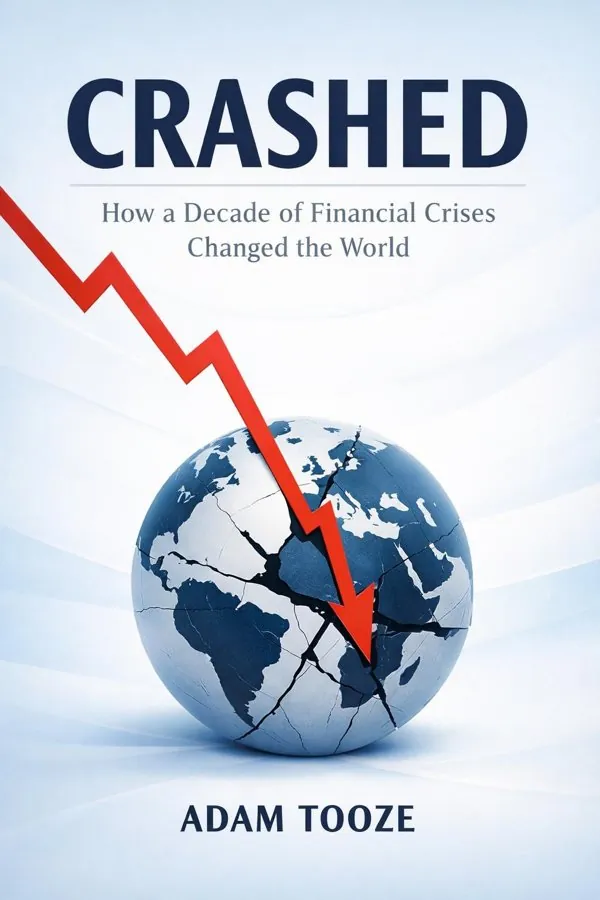
Crashed: How a Decade of Financial Crises Changed the World: Summary & Key Insights
by Adam Tooze
 10 min11 chaptersAudio available
What Is Crashed: How a Decade of Financial Crises Changed the World About?
Crashed: How a Decade of Financial Crises Changed the World by Adam Tooze is a economics book spanning 11 pages. Crashed es un análisis exhaustivo de la crisis financiera global de 2008 y sus consecuencias políticas y económicas. Adam Tooze examina cómo el colapso de los mercados financieros transformó el orden mundial, afectando a Europa, Estados Unidos y las economías emergentes. El libro explora la interconexión entre finanzas, política y poder, mostrando cómo la crisis redefinió la globalización y la geopolítica contemporánea.
This FizzRead summary covers all 11 key chapters of Crashed: How a Decade of Financial Crises Changed the World in approximately 10 minutes, distilling the most important ideas, arguments, and takeaways from Adam Tooze's work. Also available as an audio summary and Key Quotes Podcast.
Crashed: How a Decade of Financial Crises Changed the World
Crashed es un análisis exhaustivo de la crisis financiera global de 2008 y sus consecuencias políticas y económicas. Adam Tooze examina cómo el colapso de los mercados financieros transformó el orden mundial, afectando a Europa, Estados Unidos y las economías emergentes. El libro explora la interconexión entre finanzas, política y poder, mostrando cómo la crisis redefinió la globalización y la geopolítica contemporánea.
Who Should Read Crashed: How a Decade of Financial Crises Changed the World?
This book is perfect for anyone interested in economics and looking to gain actionable insights in a short read. Whether you're a student, professional, or lifelong learner, the key ideas from Crashed: How a Decade of Financial Crises Changed the World by Adam Tooze will help you think differently.
- ✓Readers who enjoy economics and want practical takeaways
- ✓Professionals looking to apply new ideas to their work and life
- ✓Anyone who wants the core insights of Crashed: How a Decade of Financial Crises Changed the World in just 10 minutes
Want the full summary?
Get instant access to this book summary and 100K+ more with Fizz Moment.
Get Free SummaryAvailable on App Store • Free to download
Key Chapters
At the dawn of the twenty-first century, the global economy appeared to have mastered stability. Inflation was low, growth was steady, and globalization seemed unstoppable. But beneath that surface harmony lay profound structural imbalances. The United States was consuming more than it produced, running vast current account deficits financed by foreign capital. Asia, particularly China, was accumulating massive reserves through export surpluses. Europe’s banks, meanwhile, were recycling these dollars through an opaque and leveraged financial system.
The financial system had evolved into something that few understood in full. Innovations such as mortgage-backed securities, collateralized debt obligations, and credit default swaps promised safety through diversification. In truth, they created chains of risk so complex that even those who created them could not track where dangers lay. American homeowners, European bankers, and Chinese reserve managers were bound together through labyrinthine debt structures.
Politically, the mood was one of triumph. Policymakers in Washington and Brussels took this stability as proof of global capitalism’s maturity. Central banks trusted in their ability to fine-tune the business cycle. Economic theory reinforced this complacency, arguing that markets could distribute risk efficiently. Yet, as I show through the archival evidence and data, what they failed to realize was that interdependence magnified fragility. The system’s strength was also its vulnerability.
In September 2008, the unthinkable happened. Lehman Brothers—a Wall Street institution older than many nations—collapsed. Its fall was not merely the bankruptcy of a single firm but a shockwave that revealed the world’s financial arteries were clogged with interbank credit exposures and fragile confidence. Overnight, liquidity dried up. The global banking system, both American and European, faced paralysis.
From inside Lehman and the U.S. Treasury, the story was one of disbelief and improvisation. When I reconstruct those days, I see a world where nobody really knew the magnitude of the contagion. The decision not to rescue Lehman has been debated endlessly, but what matters more is what it exposed: the United States, as the hub of the global financial network, could not contain the fallout within its borders. European banks dependent on dollar funding faced catastrophe. The architecture of global finance had been built on the illusion that national regulators could manage international markets.
The panic after Lehman was a moment when finance, politics, and sovereignty collided. What was unfolding was not merely a U.S. recession but a crisis of globalization itself, a systemic failure of the structures that had defined post-Cold War capitalism.
+ 9 more chapters — available in the FizzRead app
All Chapters in Crashed: How a Decade of Financial Crises Changed the World
About the Author
Adam Tooze es un historiador británico especializado en historia económica y política contemporánea. Profesor en la Universidad de Columbia, es conocido por sus estudios sobre la economía alemana, la Segunda Guerra Mundial y las crisis financieras modernas. Su trabajo combina análisis histórico con una comprensión profunda de la economía global.
Get This Summary in Your Preferred Format
Read or listen to the Crashed: How a Decade of Financial Crises Changed the World summary by Adam Tooze anytime, anywhere. FizzRead offers multiple formats so you can learn on your terms — all free.
Available formats: App · Audio · PDF · EPUB — All included free with FizzRead
Download Crashed: How a Decade of Financial Crises Changed the World PDF and EPUB Summary
Key Quotes from Crashed: How a Decade of Financial Crises Changed the World
“At the dawn of the twenty-first century, the global economy appeared to have mastered stability.”
“In September 2008, the unthinkable happened.”
Frequently Asked Questions about Crashed: How a Decade of Financial Crises Changed the World
Crashed: How a Decade of Financial Crises Changed the World by Adam Tooze is a economics book that explores key ideas across 11 chapters. Crashed es un análisis exhaustivo de la crisis financiera global de 2008 y sus consecuencias políticas y económicas. Adam Tooze examina cómo el colapso de los mercados financieros transformó el orden mundial, afectando a Europa, Estados Unidos y las economías emergentes. El libro explora la interconexión entre finanzas, política y poder, mostrando cómo la crisis redefinió la globalización y la geopolítica contemporánea.
More by Adam Tooze
The Wages of Destruction: The Making and Breaking of the Nazi Economy
Adam Tooze
10 min
The Deluge: The Great War and the Remaking of Global Order
Adam Tooze
10 min
The Deluge: The Great War, America and the Remaking of the Global Order, 1916–1931
Adam Tooze
10 min
Shutdown: How Covid Shook the World's Economy
Adam Tooze
10 minYou Might Also Like
Business Adventures
John Brooks
10 min
Nudge
Richard H. Thaler, Cass R. Sunstein
10 min
The Hitchhiker"s Guide to the Galaxy
Douglas Adams
10 minThe Muqaddimah
Ibn Khaldun
10 minThe Outsiders
William N. Thorndike
10 min
A Little History of Economics
Niall Kishtainy
10 minBrowse by Category
Ready to read Crashed: How a Decade of Financial Crises Changed the World?
Get the full summary and 100K+ more books with Fizz Moment.