
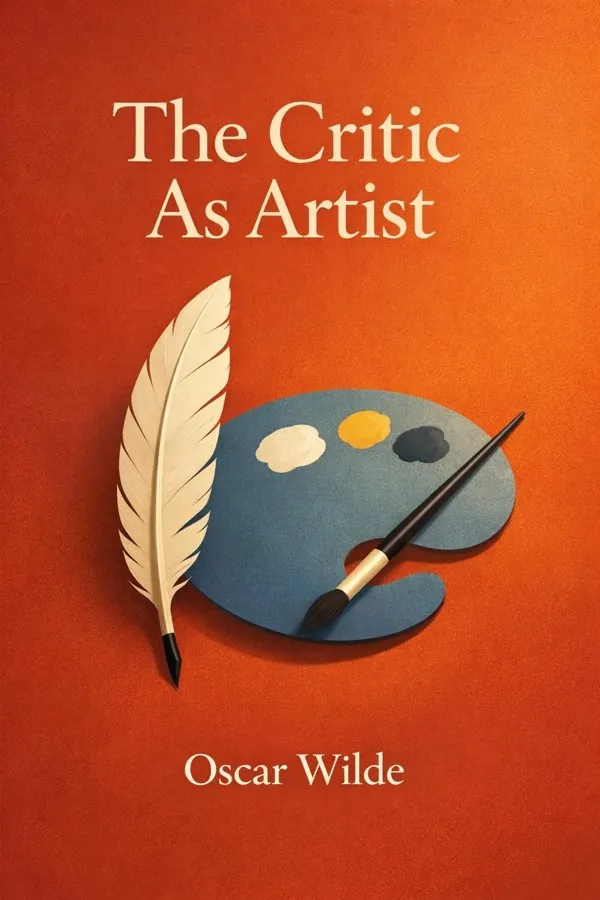
The Critic As Artist: Summary & Key Insights
by Oscar Wilde
 10 min10 chaptersAudio available
What Is The Critic As Artist About?
The Critic As Artist by Oscar Wilde is a western_phil book spanning 10 pages. An essay in dialogue form where Oscar Wilde explores the relationship between art and criticism, arguing that criticism itself is a creative act. Through the voices of Gilbert and Ernest, Wilde presents his aesthetic philosophy, emphasizing the imaginative and interpretive power of the critic as equal to that of the artist.
This FizzRead summary covers all 10 key chapters of The Critic As Artist in approximately 10 minutes, distilling the most important ideas, arguments, and takeaways from Oscar Wilde's work. Also available as an audio summary and Key Quotes Podcast.
The Critic As Artist
An essay in dialogue form where Oscar Wilde explores the relationship between art and criticism, arguing that criticism itself is a creative act. Through the voices of Gilbert and Ernest, Wilde presents his aesthetic philosophy, emphasizing the imaginative and interpretive power of the critic as equal to that of the artist.
Who Should Read The Critic As Artist?
This book is perfect for anyone interested in western_phil and looking to gain actionable insights in a short read. Whether you're a student, professional, or lifelong learner, the key ideas from The Critic As Artist by Oscar Wilde will help you think differently.
- ✓Readers who enjoy western_phil and want practical takeaways
- ✓Professionals looking to apply new ideas to their work and life
- ✓Anyone who wants the core insights of The Critic As Artist in just 10 minutes
Want the full summary?
Get instant access to this book summary and 100K+ more with Fizz Moment.
Get Free SummaryAvailable on App Store • Free to download
Key Chapters
We begin in a setting typical of my dialogues: two cultivated men, Gilbert and Ernest, discussing art late into the evening. Ernest represents what I call the sensible world—those who admire art but think its highest measure is its craftsmanship or emotional power. To him, the critic is secondary, a shadow moving after the artist, illuminating what has already been made. Gilbert interrupts such complacency by suggesting that the critic does not follow but rather *precedes* or *rebirths* art through interpretation.
This opposition between them establishes the essay’s dramatic tension. Ernest holds the comfortable view of the Victorian public: that one must create first, and only then comes judgment; that an artist is an original genius, and a critic merely a recorder. Gilbert—my chosen prophet of aestheticism—turns this hierarchy upside down, asserting that criticism is not derivative but creative, a distinct act of imagination. He argues that before beauty can be known, it must be re-experienced through mind and spirit, and that such re-experience is the essence of criticism.
To read art, Gilbert says, is to write art again. As he speaks, you can sense his conviction that interpretation itself becomes artistry, because every reader or viewer creates anew in his mind what the artist once saw. The critic thus becomes a companion creator, not a servant, and art becomes an endless circle of imaginative acts rather than a static masterpiece fixed in marble or paint.
Gilbert’s argument deepens as he brings imagination into the heart of criticism. He reminds Ernest—and by extension the reader—that the highest faculty of the soul is imagination, for imagination allows us to see not merely what is before us, but what might be. Just as the painter uses color to make the invisible visible, the critic uses thought to make emotion intelligible. Both serve beauty in different languages.
To him, criticism transforms perception into art, because to interpret a painting, a poem, or a symphony demands that one recreate it with one’s own inner fire. A perfect critic does not describe art; he *recreates* it mentally until it sings differently within him. The original artist shaped form and color; the critic shapes understanding and insight. Both are responsible for creation.
Wilde draws from his broader philosophy of aestheticism here: the act of feeling beauty is itself an act of being. The critic, through his imaginative sympathy, becomes even more original than the artist, for he interprets not one reality but many. He brings meanings across epochs and styles, merging the world of art into a wider consciousness. It is, in Gilbert’s words, the critic who teaches the public to live aesthetically—to turn perception into revelation. Thus, criticism attains a status not of judgment but of new creation.
+ 8 more chapters — available in the FizzRead app
All Chapters in The Critic As Artist
About the Author
Oscar Wilde (1854–1900) was an Irish poet, playwright, and novelist known for his wit, flamboyant style, and sharp social commentary. His major works include 'The Picture of Dorian Gray' and 'The Importance of Being Earnest'. Wilde was a leading figure of the Aesthetic Movement, advocating 'art for art’s sake'.
Get This Summary in Your Preferred Format
Read or listen to the The Critic As Artist summary by Oscar Wilde anytime, anywhere. FizzRead offers multiple formats so you can learn on your terms — all free.
Available formats: App · Audio · PDF · EPUB — All included free with FizzRead
Download The Critic As Artist PDF and EPUB Summary
Key Quotes from The Critic As Artist
“We begin in a setting typical of my dialogues: two cultivated men, Gilbert and Ernest, discussing art late into the evening.”
“Gilbert’s argument deepens as he brings imagination into the heart of criticism.”
Frequently Asked Questions about The Critic As Artist
The Critic As Artist by Oscar Wilde is a western_phil book that explores key ideas across 10 chapters. An essay in dialogue form where Oscar Wilde explores the relationship between art and criticism, arguing that criticism itself is a creative act. Through the voices of Gilbert and Ernest, Wilde presents his aesthetic philosophy, emphasizing the imaginative and interpretive power of the critic as equal to that of the artist.
More by Oscar Wilde
You Might Also Like
A Little History of Philosophy
Nigel Warburton
10 min
Areopagitica
John Milton
10 min
How To Think Like A Philosopher: Essential Principles For Clear Thinking
Peter Cave
10 min
Language, Truth and Logic
A. J. Ayer
10 min
The Age of Reason
Thomas Paine
10 min
The Essays
Michel De Montaigne
10 minBrowse by Category
Ready to read The Critic As Artist?
Get the full summary and 100K+ more books with Fizz Moment.