
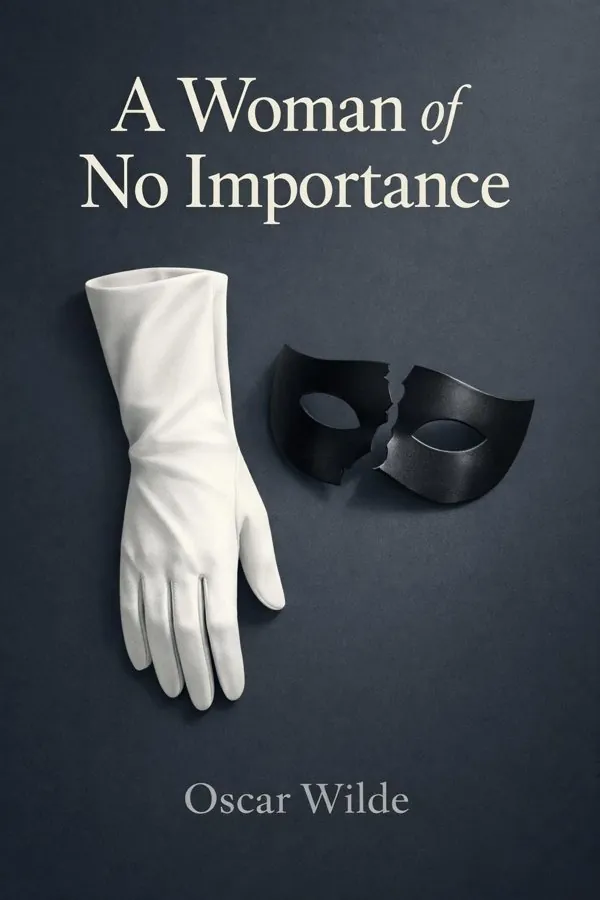
A Woman of No Importance: Summary & Key Insights
by Oscar Wilde
 10 min5 chaptersAudio available
What Is A Woman of No Importance About?
A Woman of No Importance by Oscar Wilde is a classics book spanning 5 pages. A Woman of No Importance is a play written by Oscar Wilde in 1893. The work explores moral hypocrisy and the social conventions of Victorian high society, focusing on themes of gender, reputation, and double standards. With his characteristic wit and social critique, Wilde portrays the tension between appearance and truth in human relationships.
This FizzRead summary covers all 5 key chapters of A Woman of No Importance in approximately 10 minutes, distilling the most important ideas, arguments, and takeaways from Oscar Wilde's work. Also available as an audio summary and Key Quotes Podcast.
A Woman of No Importance
A Woman of No Importance is a play written by Oscar Wilde in 1893. The work explores moral hypocrisy and the social conventions of Victorian high society, focusing on themes of gender, reputation, and double standards. With his characteristic wit and social critique, Wilde portrays the tension between appearance and truth in human relationships.
Who Should Read A Woman of No Importance?
This book is perfect for anyone interested in classics and looking to gain actionable insights in a short read. Whether you're a student, professional, or lifelong learner, the key ideas from A Woman of No Importance by Oscar Wilde will help you think differently.
- ✓Readers who enjoy classics and want practical takeaways
- ✓Professionals looking to apply new ideas to their work and life
- ✓Anyone who wants the core insights of A Woman of No Importance in just 10 minutes
Want the full summary?
Get instant access to this book summary and 100K+ more with Fizz Moment.
Get Free SummaryAvailable on App Store • Free to download
Key Chapters
It begins with laughter, as all respectable comedies should. At Lady Hunstanton’s country house, the guests gather — a collection of titled ladies and witty gentlemen, all comfortably wrapped in self-satisfaction. Their conversation sparkles on the surface, but it flickers with undertones of moral blindness. I wanted to portray this idle chatter as the music of hypocrisy — cheerful, rhythmical, and utterly hollow.
These scenes of banter give us a glimpse into a world where reputation is everything and real feeling is merely inconvenient. The guests indulge in polite moralizing while quietly defending the very wrongs they condemn. Wildean comedy always loves paradox, and here the paradox is moral: the people who speak most of virtue are those least capable of living it. It is through their words that the stage becomes a mirror of society — reflecting how the privileged classes disguise moral emptiness with charm.
Lady Hunstanton herself is kind-hearted, but conventional; her world demands no depth, only conformity. Conversations about charity, politics, and the position of women masquerade as intellect, while true compassion stays absent. I wanted this setting to be deliberately artificial, a light façade concealing deeper moral tension about to erupt with the arrival of young Gerald Arbuthnot. The polite laughter of society will soon turn into a test of conscience.
Gerald Arbuthnot enters this world with youth’s radiant hope. To him, the aristocracy promises opportunity and glamour. His manners are simple, his dreams sincere. When Lord Illingworth — the charming and influential nobleman — offers to make him his secretary, Gerald believes fortune has smiled upon him. Yet, in this moment, ambition becomes the play’s moral fork in the road.
I created Gerald to be the emblem of idealism, the young man who thinks success comes from association with power. He has been raised solely by his mother, Mrs. Arbuthnot — a woman of moral conviction and quiet suffering. She taught him integrity, but she cannot shield him from the seductions of worldly success. His acceptance of Lord Illingworth’s patronage symbolizes the innocence that society exploits: the belief that advancement comes without compromise.
This chapter of the story unveils the contrast between youth’s purity and maturity’s corruption. Lord Illingworth embodies cynicism disguised as charm — a man who has mastered the art of making vice respectable. He does not view mentorship as service, but as conquest. His fascination with Gerald lies in the cruel irony that the boy he chooses to elevate is, unknowingly, his own son. In that irony rests the play’s moral engine: the collision of high society’s games with deep human consequences.
Through Gerald’s ambition, I wanted to explore the allure of worldly success. The glittering promise of patronage blinds him to moral warning, and his admiration for Lord Illingworth foreshadows the painful revelation to come. Youth’s trust, when placed in a corrupt world, leads inevitably to disillusionment.
+ 3 more chapters — available in the FizzRead app
All Chapters in A Woman of No Importance
About the Author
Oscar Wilde (1854–1900) was an Irish writer, poet, and playwright known for his wit, aesthetic style, and critique of Victorian society. His most notable works include The Picture of Dorian Gray and The Importance of Being Earnest.
Get This Summary in Your Preferred Format
Read or listen to the A Woman of No Importance summary by Oscar Wilde anytime, anywhere. FizzRead offers multiple formats so you can learn on your terms — all free.
Available formats: App · Audio · PDF · EPUB — All included free with FizzRead
Download A Woman of No Importance PDF and EPUB Summary
Key Quotes from A Woman of No Importance
“It begins with laughter, as all respectable comedies should.”
“Gerald Arbuthnot enters this world with youth’s radiant hope.”
Frequently Asked Questions about A Woman of No Importance
A Woman of No Importance by Oscar Wilde is a classics book that explores key ideas across 5 chapters. A Woman of No Importance is a play written by Oscar Wilde in 1893. The work explores moral hypocrisy and the social conventions of Victorian high society, focusing on themes of gender, reputation, and double standards. With his characteristic wit and social critique, Wilde portrays the tension between appearance and truth in human relationships.
More by Oscar Wilde
You Might Also Like



Browse by Category
Ready to read A Woman of No Importance?
Get the full summary and 100K+ more books with Fizz Moment.