
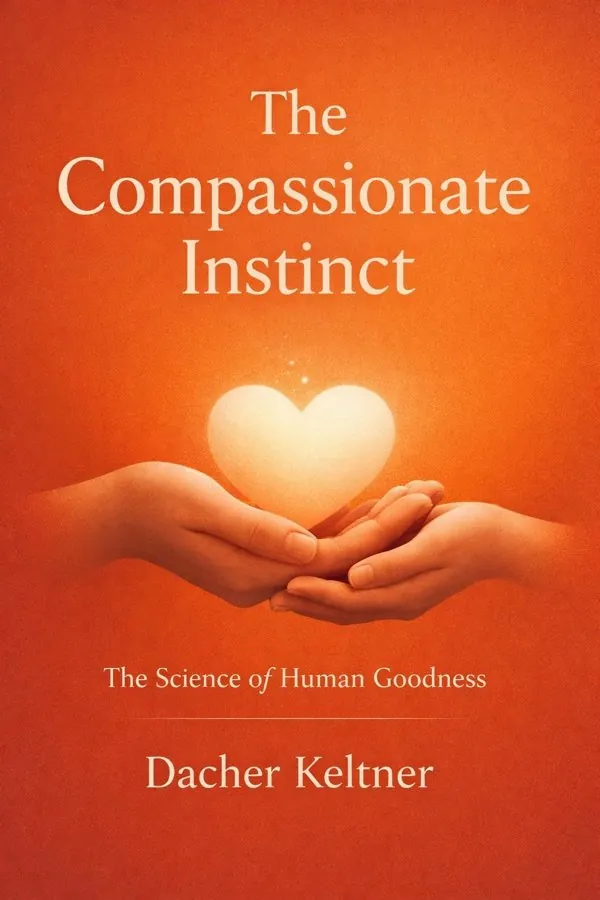
The Compassionate Instinct: The Science of Human Goodness: Summary & Key Insights
 10 min5 chaptersAudio available
What Is The Compassionate Instinct: The Science of Human Goodness About?
The Compassionate Instinct: The Science of Human Goodness by Dacher Keltner is a positive_psych book spanning 5 pages. This book explores the biological and psychological foundations of compassion, kindness, and altruism. Edited by Dacher Keltner, Jason Marsh, and Jeremy Adam Smith, it gathers essays from leading scientists and thinkers who reveal how empathy and cooperation are deeply rooted in human nature. The work challenges the notion that humans are primarily selfish, presenting evidence from neuroscience, evolutionary biology, and social psychology that compassion is essential to our survival and well-being.
This FizzRead summary covers all 5 key chapters of The Compassionate Instinct: The Science of Human Goodness in approximately 10 minutes, distilling the most important ideas, arguments, and takeaways from Dacher Keltner's work. Also available as an audio summary and Key Quotes Podcast.
The Compassionate Instinct: The Science of Human Goodness
This book explores the biological and psychological foundations of compassion, kindness, and altruism. Edited by Dacher Keltner, Jason Marsh, and Jeremy Adam Smith, it gathers essays from leading scientists and thinkers who reveal how empathy and cooperation are deeply rooted in human nature. The work challenges the notion that humans are primarily selfish, presenting evidence from neuroscience, evolutionary biology, and social psychology that compassion is essential to our survival and well-being.
Who Should Read The Compassionate Instinct: The Science of Human Goodness?
This book is perfect for anyone interested in positive_psych and looking to gain actionable insights in a short read. Whether you're a student, professional, or lifelong learner, the key ideas from The Compassionate Instinct: The Science of Human Goodness by Dacher Keltner will help you think differently.
- ✓Readers who enjoy positive_psych and want practical takeaways
- ✓Professionals looking to apply new ideas to their work and life
- ✓Anyone who wants the core insights of The Compassionate Instinct: The Science of Human Goodness in just 10 minutes
Want the full summary?
Get instant access to this book summary and 100K+ more with Fizz Moment.
Get Free SummaryAvailable on App Store • Free to download
Key Chapters
For much of history, human beings were viewed through the lens of competition. From Hobbes’s vision of life as 'nasty, brutish, and short' to Darwin’s early interpreters who glorified 'survival of the fittest,' our collective imagination has been haunted by the myth of ruthless struggle. Every kindness was seen as suspect—a veneer masking the cold calculus of self-interest. But contemporary research paints a brighter picture.
Anthropologists and evolutionary theorists now suggest that our ancestors thrived not by domination but by cooperation. The capacity to share food, care for children, and protect one another gave rise to stable groups, which in turn increased reproductive success. Even Darwin himself, late in life, wrote of sympathy and moral sensibility as evolutionary advantages. This reinterpretation, which I and many of my colleagues in psychology support, reframes humanity’s story from one of aggression to one of affiliation.
In this section, I present how modern science overturned the doctrine of selfishness. Decades of data—from primate behavior to human development—show that empathy and fairness are not eccentric traits; they are deeply rooted behaviors found across species. Capuchin monkeys reject unequal pay. Elephants mourn their dead. Infants cry when another baby cries. Each of these findings disrupts the narrative that compassion is artificial. Instead, they demonstrate that prosocial behavior evolved because it made survival possible.
This shift in perspective has practical consequences. When we view others as competitors, our societies organize around exclusion, punishment, and fear. When we accept compassion as innate, policies and institutions can be designed to harness cooperation—through restorative justice, community engagement, and altruistic leadership. In writing this, I invite you to see humanity anew: not as a battlefield of individual agendas but as a living network of shared intentions. The history of our species is a history of helping.
In evolutionary terms, compassion offers profound advantages. Groups that care for one another are more resilient, more productive, and more innovative. Our ancestors who cooperated had greater chances to survive harsh climates, raise offspring successfully, and protect resources. As a result, natural selection favored emotional systems that promote empathy and trust.
From the perspective of evolutionary science, compassion can be seen as an adaptation rooted in caregiving. The parental bond between mother and child is the template. The neurochemical oxytocin regulates birth, lactation, and attachment—functions essential for reproductive success. Yet its effects extend far beyond family ties: research shows oxytocin increases generosity, reduces social anxiety, and enhances the ability to read emotions in others. In other words, nature equipped us not only to raise young but to build community.
Other physiological mechanisms reinforce this system. Mirror neurons, discovered in primate studies, allow us to sense the actions and feelings of another person as if they were our own. Vagal nerve activity, associated with relaxation and social engagement, correlates with compassion and prosocial motivation. Together, these biological instruments orchestrate the symphony of empathy.
I like to think of compassion as evolution’s masterpiece—a mechanism by which individual survival became linked to collective flourishing. Without it, human life would fragment. With it, we thrive together. The adaptive power of compassion transcends genetics; culture amplifies it. Rituals of sharing, communal care, and moral teaching all stem from this basic biological foundation.
When we reconnect with this truth, competition loses its allure. We remember that to help others is not merely to do good—it is to continue the very process that made us human.
+ 3 more chapters — available in the FizzRead app
All Chapters in The Compassionate Instinct: The Science of Human Goodness
About the Author
Dacher Keltner is a professor of psychology at the University of California, Berkeley, and the founding director of the Greater Good Science Center. His research focuses on the biological and evolutionary origins of emotion, compassion, and social connection. He is known for his work on the science of happiness and human goodness.
Get This Summary in Your Preferred Format
Read or listen to the The Compassionate Instinct: The Science of Human Goodness summary by Dacher Keltner anytime, anywhere. FizzRead offers multiple formats so you can learn on your terms — all free.
Available formats: App · Audio · PDF · EPUB — All included free with FizzRead
Download The Compassionate Instinct: The Science of Human Goodness PDF and EPUB Summary
Key Quotes from The Compassionate Instinct: The Science of Human Goodness
“For much of history, human beings were viewed through the lens of competition.”
“In evolutionary terms, compassion offers profound advantages.”
Frequently Asked Questions about The Compassionate Instinct: The Science of Human Goodness
The Compassionate Instinct: The Science of Human Goodness by Dacher Keltner is a positive_psych book that explores key ideas across 5 chapters. This book explores the biological and psychological foundations of compassion, kindness, and altruism. Edited by Dacher Keltner, Jason Marsh, and Jeremy Adam Smith, it gathers essays from leading scientists and thinkers who reveal how empathy and cooperation are deeply rooted in human nature. The work challenges the notion that humans are primarily selfish, presenting evidence from neuroscience, evolutionary biology, and social psychology that compassion is essential to our survival and well-being.
More by Dacher Keltner


You Might Also Like

Don't Sweat the Small Stuff... and It's All Small Stuff
Richard Carlson
10 min
Option B
Sheryl Sandberg & Adam Grant
10 min
Hallelujah Anyway: Rediscovering Mercy
Anne Lamott
10 min
I Can Do It: How to Use Affirmations to Change Your Life
Louise Hay
10 min
The Coffee Bean: A Simple Lesson to Create Positive Change
Jon Gordon, Damon West
10 min
The Happiness Hypothesis: Finding Modern Truth in Ancient Wisdom
Jonathan Haidt
10 minBrowse by Category
Ready to read The Compassionate Instinct: The Science of Human Goodness?
Get the full summary and 100K+ more books with Fizz Moment.