
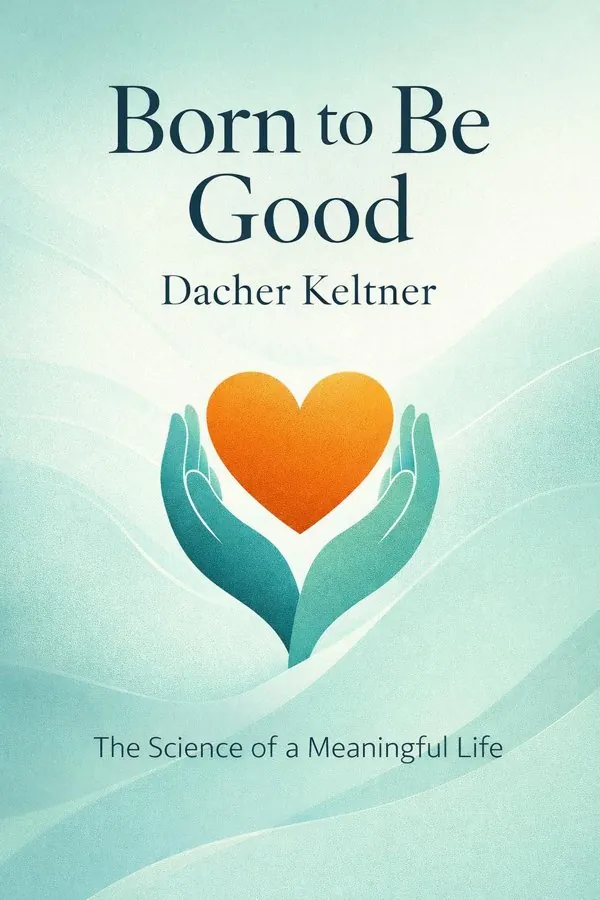
Born to Be Good: The Science of a Meaningful Life: Summary & Key Insights
 10 min10 chaptersAudio available
What Is Born to Be Good: The Science of a Meaningful Life About?
Born to Be Good: The Science of a Meaningful Life by Dacher Keltner is a positive_psych book spanning 10 pages. In this book, psychologist Dacher Keltner explores the evolutionary and emotional foundations of human goodness. Drawing on research in social psychology, neuroscience, and evolutionary biology, he argues that emotions such as compassion, gratitude, and awe are central to our moral lives and social connections. Through scientific insights and real-world examples, Keltner shows how these emotions shape our relationships and contribute to a meaningful life.
This FizzRead summary covers all 10 key chapters of Born to Be Good: The Science of a Meaningful Life in approximately 10 minutes, distilling the most important ideas, arguments, and takeaways from Dacher Keltner's work. Also available as an audio summary and Key Quotes Podcast.
Born to Be Good: The Science of a Meaningful Life
In this book, psychologist Dacher Keltner explores the evolutionary and emotional foundations of human goodness. Drawing on research in social psychology, neuroscience, and evolutionary biology, he argues that emotions such as compassion, gratitude, and awe are central to our moral lives and social connections. Through scientific insights and real-world examples, Keltner shows how these emotions shape our relationships and contribute to a meaningful life.
Who Should Read Born to Be Good: The Science of a Meaningful Life?
This book is perfect for anyone interested in positive_psych and looking to gain actionable insights in a short read. Whether you're a student, professional, or lifelong learner, the key ideas from Born to Be Good: The Science of a Meaningful Life by Dacher Keltner will help you think differently.
- ✓Readers who enjoy positive_psych and want practical takeaways
- ✓Professionals looking to apply new ideas to their work and life
- ✓Anyone who wants the core insights of Born to Be Good: The Science of a Meaningful Life in just 10 minutes
Want the full summary?
Get instant access to this book summary and 100K+ more with Fizz Moment.
Get Free SummaryAvailable on App Store • Free to download
Key Chapters
One of the most profound discoveries in recent decades is that human emotions evolved not merely for individual survival but for social connection. For centuries, Darwin’s notion of the ‘survival of the fittest’ was interpreted as a justification for self-serving behavior. Yet in *The Descent of Man*, Darwin wrote something largely ignored: sympathy—the capacity to feel with others—was one of the strongest instincts in human evolution. In that passage, I saw the seed of what I now call the science of goodness.
Through evolutionary psychology, we can trace emotions like compassion and gratitude to early communal life. Small bands of our ancestors survived because they helped each other. Sharing food, caring for offspring that weren’t one’s own, comforting the injured—these acts built trust, and trust enhanced survival. Groups that cultivated kindness persisted; those dominated by selfishness fractured. Neurological and genetic evidence now validates what ancient moral traditions intuited: goodness is adaptive.
My colleagues and I at UC Berkeley and elsewhere have studied infants and primates to see these roots in action. Even before they can speak, babies show distress when others cry and delight when caregivers comfort. Chimpanzees who lose fights are comforted by companions through gentle touch—remarkably similar to human compassion. These behaviors are not cultural affectations; they are biological signatures of a species wired for connection.
If we look closely at our own daily interactions—the soothing word to a friend, the automatic reach to comfort a crying child—we’re witnessing evolutionary history in motion. Goodness is not a fragile overlay on human aggression; it’s the emotional glue that made society itself possible.
Compassion is where the science of goodness most vividly comes alive. For years, I have been fascinated by the small, often invisible gestures that express care—an arm around a shoulder, a soft tone in a moment of crisis, the willingness to see another’s suffering. Modern physiology shows that compassion is not weakness; it is strength encoded in our biology.
In the lab, when people witness suffering and respond compassionately, their vagus nerve—the pathway linking the brain to the heart—activates, slowing the heartbeat and promoting calm engagement rather than fear or panic. This physiological signature, a marker of safety and connection, has been central in our research. Compassion literally regulates our bodies toward harmony, enabling us to approach rather than withdraw.
We also discovered that compassion correlates with oxytocin release, reinforcing trust and affiliation. This dovetails beautifully with the evolutionary story: to survive in social groups, we had to master the art of care. Compassion opens us to others’ pain, directing our attention outward, dissolving the illusion of separation. When I lecture about these findings, I often remind audiences: to be compassionate is not to deny our own needs, but to realize that our well-being is inseparable from others’. Compassion connects physiology, emotion, and morality in one elegant system.
+ 8 more chapters — available in the FizzRead app
All Chapters in Born to Be Good: The Science of a Meaningful Life
About the Author
Dacher Keltner is a professor of psychology at the University of California, Berkeley, and a leading researcher in the field of emotion and social behavior. He is the founding director of the Greater Good Science Center and has published extensively on compassion, awe, and the science of happiness.
Get This Summary in Your Preferred Format
Read or listen to the Born to Be Good: The Science of a Meaningful Life summary by Dacher Keltner anytime, anywhere. FizzRead offers multiple formats so you can learn on your terms — all free.
Available formats: App · Audio · PDF · EPUB — All included free with FizzRead
Download Born to Be Good: The Science of a Meaningful Life PDF and EPUB Summary
Key Quotes from Born to Be Good: The Science of a Meaningful Life
“One of the most profound discoveries in recent decades is that human emotions evolved not merely for individual survival but for social connection.”
“Compassion is where the science of goodness most vividly comes alive.”
Frequently Asked Questions about Born to Be Good: The Science of a Meaningful Life
Born to Be Good: The Science of a Meaningful Life by Dacher Keltner is a positive_psych book that explores key ideas across 10 chapters. In this book, psychologist Dacher Keltner explores the evolutionary and emotional foundations of human goodness. Drawing on research in social psychology, neuroscience, and evolutionary biology, he argues that emotions such as compassion, gratitude, and awe are central to our moral lives and social connections. Through scientific insights and real-world examples, Keltner shows how these emotions shape our relationships and contribute to a meaningful life.
More by Dacher Keltner


You Might Also Like

Don't Sweat the Small Stuff... and It's All Small Stuff
Richard Carlson
10 min
Option B
Sheryl Sandberg & Adam Grant
10 min
Hallelujah Anyway: Rediscovering Mercy
Anne Lamott
10 min
I Can Do It: How to Use Affirmations to Change Your Life
Louise Hay
10 min
The Coffee Bean: A Simple Lesson to Create Positive Change
Jon Gordon, Damon West
10 min
The Happiness Hypothesis: Finding Modern Truth in Ancient Wisdom
Jonathan Haidt
10 minBrowse by Category
Ready to read Born to Be Good: The Science of a Meaningful Life?
Get the full summary and 100K+ more books with Fizz Moment.