
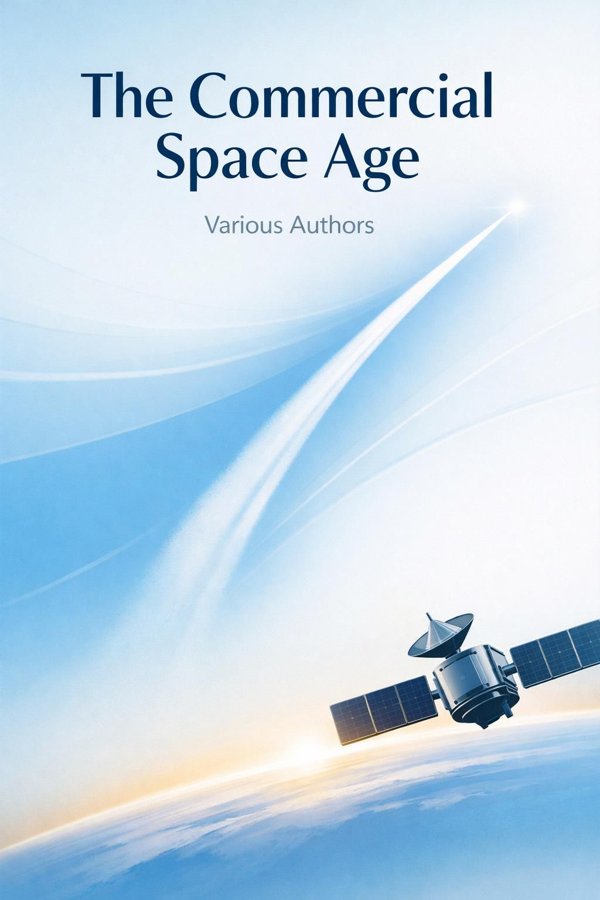
The Commercial Space Age: Summary & Key Insights
 10 min5 chaptersAudio available
What Is The Commercial Space Age About?
The Commercial Space Age by Various Authors is a space_physics book spanning 5 pages. This book explores the emergence and evolution of the commercial space industry, examining how private enterprises have transformed space exploration from a government-led endeavor into a global business sector. It discusses the technological, economic, and policy developments that have enabled commercial spaceflight, satellite services, and new ventures such as space tourism and asteroid mining.
This FizzRead summary covers all 5 key chapters of The Commercial Space Age in approximately 10 minutes, distilling the most important ideas, arguments, and takeaways from Various Authors's work. Also available as an audio summary and Key Quotes Podcast.
The Commercial Space Age
This book explores the emergence and evolution of the commercial space industry, examining how private enterprises have transformed space exploration from a government-led endeavor into a global business sector. It discusses the technological, economic, and policy developments that have enabled commercial spaceflight, satellite services, and new ventures such as space tourism and asteroid mining.
Who Should Read The Commercial Space Age?
This book is perfect for anyone interested in space_physics and looking to gain actionable insights in a short read. Whether you're a student, professional, or lifelong learner, the key ideas from The Commercial Space Age by Various Authors will help you think differently.
- ✓Readers who enjoy space_physics and want practical takeaways
- ✓Professionals looking to apply new ideas to their work and life
- ✓Anyone who wants the core insights of The Commercial Space Age in just 10 minutes
Want the full summary?
Get instant access to this book summary and 100K+ more with Fizz Moment.
Get Free SummaryAvailable on App Store • Free to download
Key Chapters
When considering the origins of the space age, I always return to the iconic missions of the Cold War. Space exploration began as a government-led endeavor: it was about prestige, power, and technological mastery. From Sputnik and Apollo to the Space Shuttle, every milestone stemmed from national ambition. Yet, as the decades passed and funding wavered, new actors quietly began reshaping the paradigm. Private firms started building satellites, developing launch services, and even negotiating contracts directly with customers worldwide. This shift marked the dawn of the commercial era.
Throughout the late 20th century, nations such as the United States opened the door to private participation. The 1984 Commercial Space Launch Act in the U.S. was pivotal — it legitimized companies such as SpaceX decades later. I remember conversations with engineers who described how this law transformed their vision from a dream into a framework. It allowed entrepreneurs to explore orbital possibilities the way industrialists once explored oceanic trade routes. The transformation was cultural as much as technological. Government agencies began viewing private partners not as competitors, but collaborators. NASA’s contracts with SpaceX and Orbital Sciences illustrate that cooperation beautifully.
From my perspective as a chronicler of this evolution, what strikes me most is how innovation thrives under risk and freedom. Once the private sector got involved, timelines shortened, technologies diversified, and efficiency soared. Companies introduced modular satellite systems, rapid manufacturing, and cost-cutting design principles drawn from computer engineering. The resulting ecosystem became self-feeding: as launch costs dropped, demand for space services exploded. Industries like telecommunications and Earth observation could suddenly afford to expand their fleets. What started as an alternative became the driving engine of space activity.
This chapter is ultimately a reminder that history itself is entrepreneurial. The birth of every new industry depends on a shift from centralized control to distributed creativity. Space is proving to be no exception, and standing at this crossroads, I see humanity embracing a new era — one where the horizon is defined not by political boundaries, but by economic imagination.
When I look at the technology powering this revolution, I see something wondrous — the rebirth of the rocket itself. Reusability, once dismissed as impractical, has become the cornerstone of commercial spaceflight. SpaceX’s Falcon series and Blue Origin’s suborbital systems have shown that landings can be routine, not miraculous. This changed everything. A launch that once cost hundreds of millions can now be executed at a fraction of that cost. Reusable rockets are not simply machines; they are economic equalizers, allowing both small startups and nations with modest budgets to reach orbit.
Satellite technology underwent a similar metamorphosis. Miniaturization — through the development of CubeSats and nanosatellites — transformed research and business models alike. No longer did an entity need vast capital or massive infrastructure to deploy a constellation. Universities, emerging economies, and tech startups began launching their own missions. In my analysis, this subtle but profound shift is what finally made space accessible, not just to the powerful, but to the creative.
I often remind readers that technology is never value-neutral. It carries intentions. Every innovation reflects human priorities — efficiency, exploration, sustainability. The drive for reusability came not only from economics, but from an environmental awakening. Engineers began questioning the wastefulness of traditional rocketry and sought circular solutions. The same logic now applies to orbital habitats, lunar bases, and asteroid mining technology. These ambitions rest on one truth: sustainability in space directly affects sustainability on Earth. The more we learn to recycle engines and repurpose satellites, the better we understand stewardship of our home planet.
As we move through this chapter, I want you to see technology as a bridge — not just between Earth and orbit, but between imagination and reality. The engineers building these systems are writing the operational script for the next century. They are proving that dreamers armed with physics and persistence can reshape destiny. Technology, in this age, is not an accessory to ambition; it is the language of progress itself.
+ 3 more chapters — available in the FizzRead app
All Chapters in The Commercial Space Age
About the Author
The contributors include aerospace engineers, economists, and policy experts who have studied or participated in the development of commercial space activities. Their collective expertise provides a multidisciplinary perspective on the challenges and opportunities of the space economy.
Get This Summary in Your Preferred Format
Read or listen to the The Commercial Space Age summary by Various Authors anytime, anywhere. FizzRead offers multiple formats so you can learn on your terms — all free.
Available formats: App · Audio · PDF · EPUB — All included free with FizzRead
Download The Commercial Space Age PDF and EPUB Summary
Key Quotes from The Commercial Space Age
“When considering the origins of the space age, I always return to the iconic missions of the Cold War.”
“When I look at the technology powering this revolution, I see something wondrous — the rebirth of the rocket itself.”
Frequently Asked Questions about The Commercial Space Age
The Commercial Space Age by Various Authors is a space_physics book that explores key ideas across 5 chapters. This book explores the emergence and evolution of the commercial space industry, examining how private enterprises have transformed space exploration from a government-led endeavor into a global business sector. It discusses the technological, economic, and policy developments that have enabled commercial spaceflight, satellite services, and new ventures such as space tourism and asteroid mining.
More by Various Authors



You Might Also Like

The Means Of Prediction
Mark P. Silverman
10 min
AstroTech
Various Authors
10 min
Black Holes and Time Warps: Einstein’s Outrageous Legacy
Kip S. Thorne
10 min
Dark Matter and the Dinosaurs: The Astounding Interconnectedness of the Universe
Lisa Randall
10 min
Helgoland
Carlo Rovelli
10 min
Hyperspace: A Scientific Odyssey Through Parallel Universes, Time Warps, and the 10th Dimension
Michio Kaku
10 minBrowse by Category
Ready to read The Commercial Space Age?
Get the full summary and 100K+ more books with Fizz Moment.