
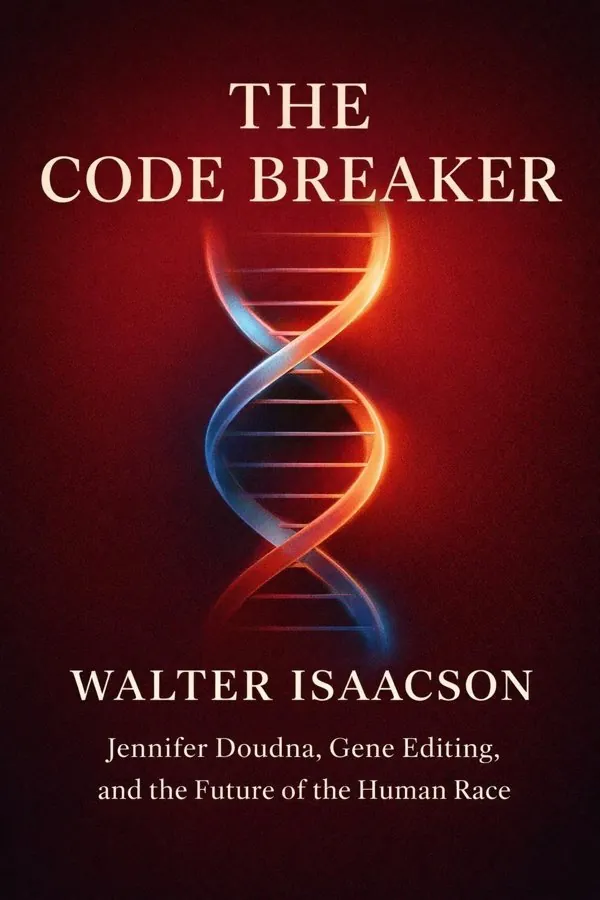
The Code Breaker: Jennifer Doudna, Gene Editing, and the Future of the Human Race: Summary & Key Insights
 10 min5 chaptersAudio available
What Is The Code Breaker: Jennifer Doudna, Gene Editing, and the Future of the Human Race About?
The Code Breaker: Jennifer Doudna, Gene Editing, and the Future of the Human Race by Walter Isaacson is a biographies book spanning 5 pages. The Code Breaker tells the story of Jennifer Doudna and the development of CRISPR gene-editing technology. Walter Isaacson explores how Doudna’s scientific breakthroughs revolutionized biology, medicine, and ethics, offering insight into the power and responsibility of editing the code of life.
This FizzRead summary covers all 5 key chapters of The Code Breaker: Jennifer Doudna, Gene Editing, and the Future of the Human Race in approximately 10 minutes, distilling the most important ideas, arguments, and takeaways from Walter Isaacson's work. Also available as an audio summary and Key Quotes Podcast.
The Code Breaker: Jennifer Doudna, Gene Editing, and the Future of the Human Race
The Code Breaker tells the story of Jennifer Doudna and the development of CRISPR gene-editing technology. Walter Isaacson explores how Doudna’s scientific breakthroughs revolutionized biology, medicine, and ethics, offering insight into the power and responsibility of editing the code of life.
Who Should Read The Code Breaker: Jennifer Doudna, Gene Editing, and the Future of the Human Race?
This book is perfect for anyone interested in biographies and looking to gain actionable insights in a short read. Whether you're a student, professional, or lifelong learner, the key ideas from The Code Breaker: Jennifer Doudna, Gene Editing, and the Future of the Human Race by Walter Isaacson will help you think differently.
- ✓Readers who enjoy biographies and want practical takeaways
- ✓Professionals looking to apply new ideas to their work and life
- ✓Anyone who wants the core insights of The Code Breaker: Jennifer Doudna, Gene Editing, and the Future of the Human Race in just 10 minutes
Want the full summary?
Get instant access to this book summary and 100K+ more with Fizz Moment.
Get Free SummaryAvailable on App Store • Free to download
Key Chapters
Jennifer Doudna’s journey begins in the small, lush environment of Hilo, Hawaii—an unlikely birthplace for one of science’s great revolutions. Her father, a literature professor, fostered her love of reading and inquiry, while the natural world around her sparked an abiding fascination with the mechanisms of life. As a teenager, she found a copy of James Watson’s *The Double Helix*, a book that made the process of scientific discovery feel vivid and accessible, if not sometimes petty and political. It ignited her imagination. Doudna wanted to see for herself how scientists uncovered nature’s secrets.
In college, she entered the realm of chemistry and molecular biology, guided by mentors who recognized her sharp intuition. At Harvard she worked under Jack Szostak, one of the pioneering minds exploring the properties of RNA—a molecule that seemed, more and more, to hold the key to understanding how life evolved. That period shaped her as both a thinker and a leader. It taught her that science was less about memorizing facts and more about asking questions that no one yet knew how to answer.
Isaacson captures Doudna’s early drive not as ambition but as wonder. The reader sees her struggle against the subtle barriers that women often face in laboratory culture, her determination to master the language of molecular structures, and her growing sense that RNA, far from being a mere intermediary messenger between DNA and proteins, might itself perform complex and essential functions. These formative experiences reveal a scientist who embodies curiosity without vanity—a rare humility paired with intellectual confidence.
From these roots came her later belief that knowledge brings duty. Doudna’s upbringing in a natural paradise and her education surrounded by pioneering researchers prepared her for a life where scientific exploration must always be tempered by responsibility.
Before CRISPR, RNA was largely overshadowed by the glamour of DNA. But scholars like Doudna helped launch what Isaacson calls the RNA Revolution. Doudna’s fascination with RNA led her to study its shapes and folds, its mysterious ability to form intricate, self-regulating structures. She learned to visualize these molecules using crystallography, uncovering how RNA could not only carry information but catalyze chemical reactions, behaving in many ways like proteins.
In the 1990s, the scientific world began to appreciate that RNA might have been the original molecule of life—both code and catalyst. Doudna, through her work at Yale and later at the University of California, Berkeley, mapped out these small molecular machines and revealed how their forms governed their functions. Her discoveries were technically complex but conceptually elegant: life itself was flexible and innovative, capable of repurposing parts of its molecular toolkit for creative solutions.
Isaacson portrays this period as the intellectual crucible that prepared Doudna for CRISPR. It taught her patience in unraveling nature’s subtleties. It grounded her understanding of molecular precision, allowing her to see beauty in complexity. Just as Leonardo da Vinci found art in anatomy, Doudna found design in biology. Her growing knowledge of RNA’s dual nature—as both message and mechanism—would later allow her to comprehend how bacteria defend themselves using RNA-guided systems, the very foundation of CRISPR-Cas9.
The theme in this section is discovery without foresight—how the most transformative innovations begin as studies of curiosity. Doudna did not set out to alter genes; she wanted to understand RNA’s personality. In doing so, she unknowingly stepped onto the path that would allow humanity to perform precise edits on the fabric of life.
+ 3 more chapters — available in the FizzRead app
All Chapters in The Code Breaker: Jennifer Doudna, Gene Editing, and the Future of the Human Race
About the Author
Walter Isaacson is an American writer, journalist, and professor known for his biographies of influential figures such as Steve Jobs, Leonardo da Vinci, and Albert Einstein. He served as CEO of the Aspen Institute and editor of Time magazine.
Get This Summary in Your Preferred Format
Read or listen to the The Code Breaker: Jennifer Doudna, Gene Editing, and the Future of the Human Race summary by Walter Isaacson anytime, anywhere. FizzRead offers multiple formats so you can learn on your terms — all free.
Available formats: App · Audio · PDF · EPUB — All included free with FizzRead
Download The Code Breaker: Jennifer Doudna, Gene Editing, and the Future of the Human Race PDF and EPUB Summary
Key Quotes from The Code Breaker: Jennifer Doudna, Gene Editing, and the Future of the Human Race
“Jennifer Doudna’s journey begins in the small, lush environment of Hilo, Hawaii—an unlikely birthplace for one of science’s great revolutions.”
“Before CRISPR, RNA was largely overshadowed by the glamour of DNA.”
Frequently Asked Questions about The Code Breaker: Jennifer Doudna, Gene Editing, and the Future of the Human Race
The Code Breaker: Jennifer Doudna, Gene Editing, and the Future of the Human Race by Walter Isaacson is a biographies book that explores key ideas across 5 chapters. The Code Breaker tells the story of Jennifer Doudna and the development of CRISPR gene-editing technology. Walter Isaacson explores how Doudna’s scientific breakthroughs revolutionized biology, medicine, and ethics, offering insight into the power and responsibility of editing the code of life.
More by Walter Isaacson
You Might Also Like
An American Marriage
Tayari Jones
10 min
Benjamin Franklin: An American Life
Walter Isaacson
10 min
I Know Why The Caged Bird Sings
Maya Angelou
10 min
Long Walk to Freedom
Nelson Mandela
10 min
Persepolis
Marjane Satrapi
10 min
Surely You're Joking, Mr. Feynman!
Richard P. Feynman
10 minBrowse by Category
Ready to read The Code Breaker: Jennifer Doudna, Gene Editing, and the Future of the Human Race?
Get the full summary and 100K+ more books with Fizz Moment.