
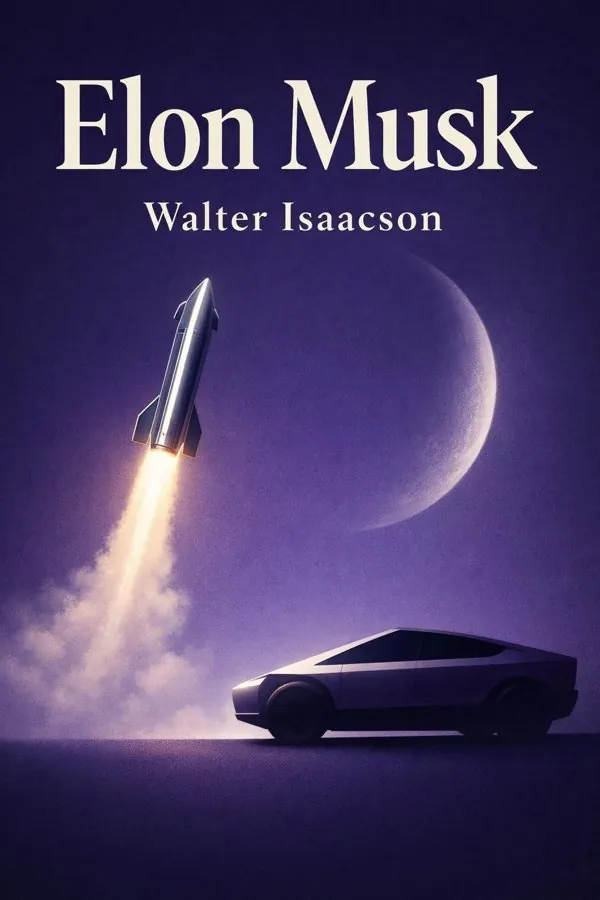
Elon Musk: Summary & Key Insights
 10 min9 chaptersAudio available
Key Takeaways from Elon Musk
Some of the people who change the world are first shaped by worlds that felt unsafe to them.
Progress often stalls when people confuse inherited assumptions with reality.
Companies often fail not because they lack talent, but because they move too slowly for the scale of their ambition.
People can work hard for compensation, but they endure extraordinary hardship for meaning.
In many organizations, leaders manage from summaries while specialists carry the real technical burden.
What Is Elon Musk About?
Elon Musk by Walter Isaacson is a biographies book. Walter Isaacson’s Elon Musk is an intimate, fast-paced portrait of one of the most consequential and polarizing figures of the twenty-first century. Built from extensive access to Musk’s life, family, companies, crises, and decision-making, the book traces his path from a difficult childhood in South Africa to leadership roles at Tesla, SpaceX, X, Neuralink, and other ventures. But this is not simply a celebration of wealth or innovation. It is a study of the engine behind Musk’s ambition: a mind driven by risk, urgency, emotional volatility, and a relentless desire to bend reality toward his vision. The book matters because Musk’s choices influence industries that shape modern life, from electric vehicles and private spaceflight to artificial intelligence, internet infrastructure, and social media. Isaacson is uniquely qualified to tell this story. Known for acclaimed biographies of Steve Jobs, Leonardo da Vinci, Albert Einstein, and Benjamin Franklin, he combines narrative skill with a journalist’s discipline and a historian’s eye for character. The result is a nuanced biography that captures both Musk’s genius and the human costs of his methods, inviting readers to ask a larger question: what does it take to remake the future, and what price does it demand?
This FizzRead summary covers all 9 key chapters of Elon Musk in approximately 10 minutes, distilling the most important ideas, arguments, and takeaways from Walter Isaacson's work. Also available as an audio summary and Key Quotes Podcast.
Elon Musk
Walter Isaacson’s Elon Musk is an intimate, fast-paced portrait of one of the most consequential and polarizing figures of the twenty-first century. Built from extensive access to Musk’s life, family, companies, crises, and decision-making, the book traces his path from a difficult childhood in South Africa to leadership roles at Tesla, SpaceX, X, Neuralink, and other ventures. But this is not simply a celebration of wealth or innovation. It is a study of the engine behind Musk’s ambition: a mind driven by risk, urgency, emotional volatility, and a relentless desire to bend reality toward his vision.
The book matters because Musk’s choices influence industries that shape modern life, from electric vehicles and private spaceflight to artificial intelligence, internet infrastructure, and social media. Isaacson is uniquely qualified to tell this story. Known for acclaimed biographies of Steve Jobs, Leonardo da Vinci, Albert Einstein, and Benjamin Franklin, he combines narrative skill with a journalist’s discipline and a historian’s eye for character. The result is a nuanced biography that captures both Musk’s genius and the human costs of his methods, inviting readers to ask a larger question: what does it take to remake the future, and what price does it demand?
Who Should Read Elon Musk?
This book is perfect for anyone interested in biographies and looking to gain actionable insights in a short read. Whether you're a student, professional, or lifelong learner, the key ideas from Elon Musk by Walter Isaacson will help you think differently.
- ✓Readers who enjoy biographies and want practical takeaways
- ✓Professionals looking to apply new ideas to their work and life
- ✓Anyone who wants the core insights of Elon Musk in just 10 minutes
Want the full summary?
Get instant access to this book summary and 100K+ more with Fizz Moment.
Get Free SummaryAvailable on App Store • Free to download
Key Chapters
Some of the people who change the world are first shaped by worlds that felt unsafe to them. One of the central ideas in Elon Musk is that Musk’s later appetite for extreme risk cannot be understood without looking at his early life. Isaacson shows how a difficult childhood in South Africa, marked by emotional pain, social isolation, bullying, and a turbulent family environment, helped create a person who learned to retreat into imagination, technical thinking, and endurance. Musk did not merely survive discomfort; he became unusually tolerant of it.
This matters because many of his later decisions seem irrational unless viewed through that lens. Most executives try to reduce uncertainty. Musk repeatedly runs toward it. He is willing to endure public criticism, financial instability, and near-collapse if he believes the mission is important enough. In business, that translated into betting his fortune on Tesla and SpaceX when both were close to failure. In management, it created a culture where impossible deadlines and intense pressure were normal rather than exceptional.
Isaacson does not present adversity as automatically beneficial. The same traits that gave Musk resilience also contributed to emotional detachment, sudden mood shifts, and an abrasive style that often hurt colleagues and family members. Readers can take a balanced lesson from this. Hard experiences may build toughness, but unexamined toughness can become destructive.
In practical terms, this idea applies to leadership and personal growth. Your painful experiences may contain hidden strengths: tolerance for uncertainty, independence, and persistence. But those strengths need conscious direction. The actionable takeaway is to identify one hardship that shaped you and write down both the strength it gave you and the blind spot it may have created. Use one while actively managing the other.
Progress often stalls when people confuse inherited assumptions with reality. A defining trait Isaacson highlights is Musk’s commitment to first-principles thinking: breaking a problem down to its physical, engineering, or economic fundamentals instead of accepting industry norms. Rather than asking what something usually costs, how long it usually takes, or how competitors do it, Musk asks what the raw materials, scientific limits, and core constraints actually are.
This approach appears repeatedly throughout the book. At SpaceX, instead of accepting the astronomical cost structure of the aerospace industry, Musk challenged the assumption that rockets had to be disposable and prohibitively expensive. At Tesla, he pushed against conventional beliefs about electric vehicles being niche products with weak performance. His method was not magic. It was disciplined simplification: strip the problem to its essentials, rebuild from the ground up, then test aggressively.
Isaacson also shows the downside. First-principles thinking can become dismissive if it ignores institutional knowledge, regulatory complexity, or human factors. Not every convention is foolish. Some exist because previous failures taught hard lessons. Musk’s breakthroughs came not merely from questioning assumptions, but from pairing that questioning with deep technical engagement and teams capable of executing.
For readers, this is one of the book’s most practical lessons. In business, career planning, and product design, many “facts” are really habits. If a project seems impossible, ask: what are the true constraints, and which ones are self-imposed? A practical example: instead of assuming a launch, software rollout, or hiring plan must follow standard timelines, separate legal requirements from organizational routines.
The actionable takeaway is to pick one problem you face and list three assumptions you have accepted without testing. Then ask what would happen if each one were removed.
Companies often fail not because they lack talent, but because they move too slowly for the scale of their ambition. Isaacson presents Musk as a leader obsessed with urgency. He believes delay is a hidden form of surrender, especially in industries where technical progress compounds and competitors hesitate. This “hardcore” tempo shaped Tesla factory turnarounds, SpaceX launch schedules, and countless product crises where Musk would descend into the details and demand immediate action.
The power of urgency is clear in the biography. When Tesla faced production bottlenecks, Musk treated manufacturing itself as the product and worked relentlessly to remove obstacles. When SpaceX confronted rocket failures, the pace of learning mattered as much as the technical insights. Fast iteration allowed failure to become data rather than defeat. In that sense, urgency was not just intensity for its own sake; it was a system for compressing learning cycles.
Yet Isaacson is careful to reveal the cost. A permanent state of emergency can exhaust teams, degrade morale, and normalize poor communication. Some employees were inspired by the mission and energized by the challenge. Others burned out under pressure or suffered from Musk’s unpredictable demands. Urgency, when unmanaged, can turn into chaos.
Applied well, however, this idea is valuable far beyond Musk’s companies. Many projects linger because teams seek comfort before momentum. A faster feedback loop often beats a perfect initial plan. In a startup, that might mean releasing a simplified version early. In a large organization, it might mean running a small pilot instead of waiting for universal alignment.
The actionable takeaway is to identify one important project and cut its decision cycle in half for the next two weeks. Replace abstract planning with shorter experiments, clearer deadlines, and visible accountability.
People can work hard for compensation, but they endure extraordinary hardship for meaning. One of the most revealing themes in Elon Musk is that Musk’s greatest organizational advantage is not merely capital or intelligence, but his ability to recruit people into missions that feel historically significant. SpaceX was not just building rockets; it was making humanity multiplanetary. Tesla was not just selling cars; it was accelerating the transition to sustainable energy. That sense of purpose made top engineers willing to accept lower comfort, higher stress, and greater uncertainty than they might tolerate elsewhere.
Isaacson shows how mission can create extraordinary cohesion. In environments where the technical challenges are immense and the odds of failure are real, a strong narrative helps teams persist through setbacks. Employees at Musk’s companies often describe being pushed harder than anywhere else, yet many also describe the work as the most meaningful of their lives. Mission turns sacrifice into identity.
Still, the biography also exposes a warning: purpose can be used to justify unhealthy demands. When leaders frame every deadline as existential and every objection as disloyalty to the mission, ideals become tools of pressure. A compelling vision must be paired with respect, fairness, and sustainable systems if it is to remain ethical.
For managers, entrepreneurs, and creators, the lesson is powerful. Talented people want to know why their work matters. A clear mission can improve hiring, retention, and resilience far more than slogans or perks. But it has to be concrete. “Changing the world” is weak unless linked to a specific problem and a believable strategy.
The actionable takeaway is to rewrite your team’s mission in one sentence that answers three questions: what are we building, for whom, and why does it matter now?
In many organizations, leaders manage from summaries while specialists carry the real technical burden. Isaacson argues that one reason Musk has been able to alter multiple industries is his willingness to dive deeply into engineering, manufacturing, design, and physics. He does not lead only through vision statements. He interrogates tolerances, materials, algorithms, production line layouts, and software behavior. This technical immersion allows him to challenge weak assumptions and make decisions others might delegate.
The advantage is obvious. Leaders who understand the substance of the work can better identify bottlenecks, distinguish excuses from genuine constraints, and ask more ambitious questions. Musk’s involvement in product design at Tesla or launch systems at SpaceX gave him leverage that many financial or purely operational CEOs lack. It also helped create cultures where technical excellence was central, not ornamental.
But Isaacson also portrays the shadow side. Deep involvement can drift into micromanagement, especially when a leader’s standards are extreme and their patience is limited. Experts may feel overruled, demoralized, or unable to communicate nuance. Technical fluency does not automatically equal emotional intelligence or good organizational design.
For readers, the broader point is that authority is stronger when it is grounded in understanding. Whether you lead a sales team, a product group, a classroom, or a nonprofit, you should know the core mechanics of the work well enough to ask intelligent questions and earn trust. This does not mean doing everyone’s job. It means respecting the craft enough to engage with it seriously.
A practical example: if you manage software, sit in on debugging sessions. If you run a clinic, understand patient flow. If you lead marketing, learn how analytics are actually generated.
The actionable takeaway is to spend one hour this week learning the most technical or operational part of your team’s work, and ask one frontline person to teach you how the process truly functions.
If failure is treated as shame, innovation becomes theater. One of the most important lessons in Elon Musk is that breakthrough organizations learn by failing in public, quickly, and repeatedly. SpaceX is perhaps the clearest example. Early rockets exploded. Tests went wrong. Timelines slipped. Yet each failure became a source of insight because the company had built a culture centered on iteration rather than image protection. Musk pushed teams to treat mistakes as data, provided they led to rapid improvement.
Isaacson shows how this philosophy differs from traditional corporate behavior. In legacy organizations, avoiding embarrassment can become more important than learning. Teams become cautious, presentations become polished, and risk migrates from product development to internal politics. Musk’s companies instead often accept visible failure to accelerate progress. That mindset made reusable rockets, electric vehicle scaling, and ambitious hardware development more feasible than many outsiders believed.
However, the book is careful not to romanticize failure. Not all failures are useful. Repeated errors without learning are wasteful. In regulated or safety-critical environments, experimentation must be disciplined. The point is not recklessness. It is designing systems where small and frequent failures prevent larger and more catastrophic ones.
Readers can apply this in practical ways. A product team can run prototypes before full deployment. A writer can publish drafts to trusted readers. A manager can test a new workflow with one department before scaling it. The key is shortening the distance between experiment and feedback while keeping the consequences manageable.
The actionable takeaway is to choose one initiative you have delayed out of fear of getting it wrong. Turn it into a small-scale test with a clear hypothesis, a limited downside, and a deadline for review.
A society fascinated by genius often asks what a visionary achieved before asking whom they hurt along the way. Isaacson’s biography is strongest when it refuses to flatten Musk into either hero or villain. Yes, he has helped force dramatic change in transportation, aerospace, and industrial ambition. But the book also shows that the same traits behind his accomplishments can inflict real damage: emotional harshness, impulsive judgments, unstable relationships, and expectations that others absorb the consequences of his intensity.
This tension is central to understanding the book. Musk’s effectiveness is tied to a mode Isaacson sometimes describes as demon mode: a state of focused, often ruthless urgency activated during crises. In business, that mode can produce astonishing execution. In personal life and organizational culture, it can create fear, unpredictability, and pain. The biography repeatedly asks whether the machinery of transformation must always be so bruising.
That question extends beyond Musk. Many workplaces still reward results while ignoring how those results are produced. But sustainable excellence depends on more than output. It requires trust, psychological safety, and relationships that do not collapse under pressure. Isaacson does not deny the power of hard-driving leadership; he invites readers to examine its trade-offs honestly.
For professionals, this means resisting the temptation to imitate only the visible parts of Musk’s style: intensity, boldness, and demands. Those traits can inspire action, but without emotional discipline they corrode teams. Ambition should sharpen standards, not strip away humanity.
The actionable takeaway is to evaluate your own leadership or work style using two metrics, not one: what results did you create, and what condition did you leave people in? Improve whichever side is weaker.
Charismatic founders can start movements, but only systems can sustain them. Although Elon Musk is filled with dramatic scenes centered on Musk’s personality, Isaacson makes clear that enduring impact comes from building mechanisms that scale: manufacturing systems, supply chains, launch processes, design feedback loops, talent pipelines, and capital structures. Musk’s ambitions became historically significant not because he made bold statements, but because his companies repeatedly converted ideas into repeatable operations.
Tesla’s rise was not just a branding victory for electric vehicles. It involved rethinking battery supply, factory design, software integration, charging infrastructure, and cost curves. SpaceX’s achievements depended not only on rocket design but on testing cadence, reusable systems, and vertical integration. These are systems-level accomplishments. They show that transformative leadership is less about isolated brilliance than about creating organizations capable of reproducing excellence under pressure.
This is a crucial lesson for readers who admire visionary figures. Inspiration is easy to overvalue because it is visible and memorable. Systems are less glamorous but more decisive. A team with average excitement and strong processes will often outperform a highly inspired team with weak execution. Musk’s genius, at his best, was not just seeing the future. It was insisting on architectures that could make that future real.
In practical terms, anyone building something should ask: where does success currently depend too much on individual effort? That is usually where a system is missing. Examples include undocumented workflows, ad hoc hiring, unclear approval paths, or customer support that relies on one heroic person.
The actionable takeaway is to identify one recurring problem in your work and replace improvisation with a simple system: a checklist, dashboard, process map, or review rhythm that makes good performance easier to repeat.
Many people talk about the future as if it is something that arrives. Isaacson’s portrait of Musk insists on a different idea: the future is built by people willing to make concrete things under extreme uncertainty. Across electric vehicles, rockets, satellites, AI-adjacent technologies, and infrastructure, Musk is portrayed not primarily as a commentator on what might happen, but as a builder obsessed with bending timelines. That builder mentality is one of the book’s deepest messages.
What distinguishes builders is not just intelligence or imagination. It is the willingness to engage reality at the level of prototypes, factories, components, teams, financing, and repeated setbacks. Musk’s ambitions are huge, but his impact comes from operationalizing them. He does not stop at saying humanity should become multiplanetary; he builds launch vehicles. He does not just argue for sustainability; he scales manufacturing. Isaacson suggests that this marriage of grand narrative and practical execution is what gives Musk unusual force.
There is also a civic lesson here. Societies increasingly reward commentary, branding, and abstraction, yet material progress still depends on people who make difficult, physical, technical systems work. Whether in energy, transportation, medicine, or software, builders shape the conditions others live in.
For readers, this idea can be applied at any scale. You may not launch rockets, but you can shift from consuming ideas to producing outcomes. Instead of endlessly researching, start the prototype. Instead of debating, test. Instead of waiting for confidence, begin building competence through action.
The actionable takeaway is to choose one future-oriented idea you care about and convert it into a build step you can complete this week: a mock-up, a budget, a pilot, a call, or a working first version.
All Chapters in Elon Musk
About the Author
Walter Isaacson is an American author, journalist, and historian celebrated for his bestselling biographies of major innovators, thinkers, and statesmen. He has written widely praised books on Steve Jobs, Leonardo da Vinci, Albert Einstein, Benjamin Franklin, and Henry Kissinger, earning a reputation for blending rigorous research with vivid storytelling. Isaacson has served as editor of Time magazine, chairman and CEO of CNN, and president and CEO of the Aspen Institute. His work often focuses on the intersection of personality, creativity, leadership, and historical change. In Elon Musk, he brings that same biographical depth to one of the most consequential and controversial entrepreneurs of the modern era, offering readers a balanced portrait of brilliance, intensity, and contradiction.
Get This Summary in Your Preferred Format
Read or listen to the Elon Musk summary by Walter Isaacson anytime, anywhere. FizzRead offers multiple formats so you can learn on your terms — all free.
Available formats: App · Audio · PDF · EPUB — All included free with FizzRead
Download Elon Musk PDF and EPUB Summary
Key Quotes from Elon Musk
“Some of the people who change the world are first shaped by worlds that felt unsafe to them.”
“Progress often stalls when people confuse inherited assumptions with reality.”
“Companies often fail not because they lack talent, but because they move too slowly for the scale of their ambition.”
“People can work hard for compensation, but they endure extraordinary hardship for meaning.”
“In many organizations, leaders manage from summaries while specialists carry the real technical burden.”
Frequently Asked Questions about Elon Musk
Elon Musk by Walter Isaacson is a biographies book that explores key ideas across 9 chapters. Walter Isaacson’s Elon Musk is an intimate, fast-paced portrait of one of the most consequential and polarizing figures of the twenty-first century. Built from extensive access to Musk’s life, family, companies, crises, and decision-making, the book traces his path from a difficult childhood in South Africa to leadership roles at Tesla, SpaceX, X, Neuralink, and other ventures. But this is not simply a celebration of wealth or innovation. It is a study of the engine behind Musk’s ambition: a mind driven by risk, urgency, emotional volatility, and a relentless desire to bend reality toward his vision. The book matters because Musk’s choices influence industries that shape modern life, from electric vehicles and private spaceflight to artificial intelligence, internet infrastructure, and social media. Isaacson is uniquely qualified to tell this story. Known for acclaimed biographies of Steve Jobs, Leonardo da Vinci, Albert Einstein, and Benjamin Franklin, he combines narrative skill with a journalist’s discipline and a historian’s eye for character. The result is a nuanced biography that captures both Musk’s genius and the human costs of his methods, inviting readers to ask a larger question: what does it take to remake the future, and what price does it demand?
More by Walter Isaacson
You Might Also Like

An American Marriage
Tayari Jones
10 min
Benjamin Franklin: An American Life
Walter Isaacson
10 min
I Know Why The Caged Bird Sings
Maya Angelou
10 min
Long Walk to Freedom
Nelson Mandela
10 min
Persepolis
Marjane Satrapi
10 min
Surely You're Joking, Mr. Feynman!
Richard P. Feynman
10 minBrowse by Category
Ready to read Elon Musk?
Get the full summary and 100K+ more books with Fizz Moment.