
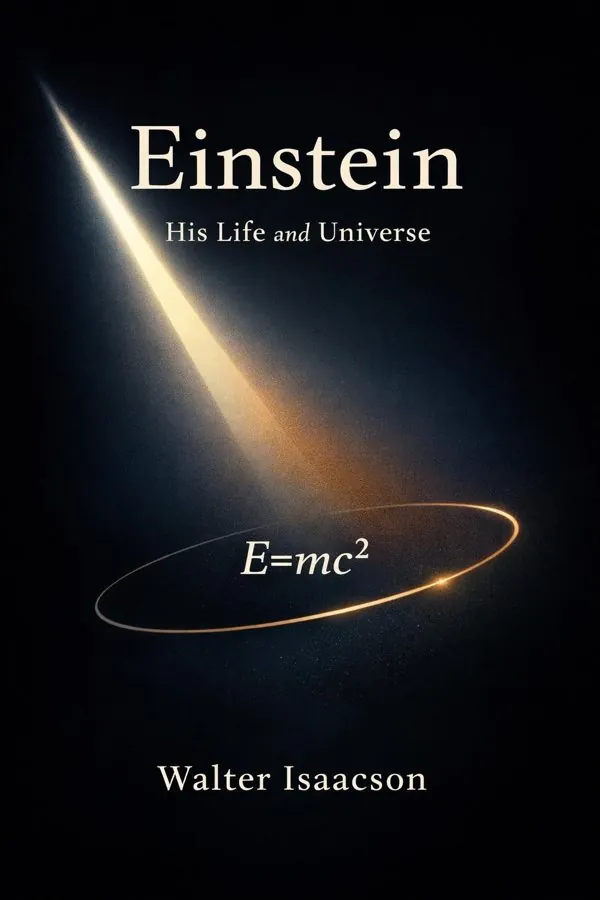
Einstein: His Life and Universe: Summary & Key Insights
 10 min9 chaptersAudio available
What Is Einstein: His Life and Universe About?
Einstein: His Life and Universe by Walter Isaacson is a biographies book spanning 9 pages. This biography explores the life, mind, and scientific achievements of Albert Einstein, tracing his journey from a curious child in Germany to one of the most influential physicists in history. Walter Isaacson draws on newly released personal letters and archival materials to portray Einstein’s intellectual development, his moral and political beliefs, and his complex personal relationships. The book provides insight into how Einstein’s creativity and rebellious spirit shaped both his scientific breakthroughs and his worldview.
This FizzRead summary covers all 9 key chapters of Einstein: His Life and Universe in approximately 10 minutes, distilling the most important ideas, arguments, and takeaways from Walter Isaacson's work. Also available as an audio summary and Key Quotes Podcast.
Einstein: His Life and Universe
This biography explores the life, mind, and scientific achievements of Albert Einstein, tracing his journey from a curious child in Germany to one of the most influential physicists in history. Walter Isaacson draws on newly released personal letters and archival materials to portray Einstein’s intellectual development, his moral and political beliefs, and his complex personal relationships. The book provides insight into how Einstein’s creativity and rebellious spirit shaped both his scientific breakthroughs and his worldview.
Who Should Read Einstein: His Life and Universe?
This book is perfect for anyone interested in biographies and looking to gain actionable insights in a short read. Whether you're a student, professional, or lifelong learner, the key ideas from Einstein: His Life and Universe by Walter Isaacson will help you think differently.
- ✓Readers who enjoy biographies and want practical takeaways
- ✓Professionals looking to apply new ideas to their work and life
- ✓Anyone who wants the core insights of Einstein: His Life and Universe in just 10 minutes
Want the full summary?
Get instant access to this book summary and 100K+ more with Fizz Moment.
Get Free SummaryAvailable on App Store • Free to download
Key Chapters
Einstein’s journey began in Ulm and Munich, where his early years already hinted at his lifelong tension between conformity and curiosity. The young Albert resisted the militaristic discipline of German schools, which rewarded obedience over imagination. He preferred wandering alone, pondering the nature of light or playing his violin—a solace that would accompany him for life. His fascination with invisible forces began when his father showed him a simple compass, its needle trembling toward the north. That moment, as he would later recall, made him sense that something deeply hidden must be behind things.
His family was middle-class, Jewish, and constantly testing the balance between assimilation and identity. When the family business faltered, young Einstein was uprooted repeatedly, absorbing lessons about uncertainty and independence. The rigid schooling he despised only deepened his conviction that thinking freely mattered more than following rules. These formative years shaped his intellectual temperament: resistant to authority, quietly introspective, and yearning for conceptual beauty rather than rote achievement.
Einstein’s education at the Swiss Federal Polytechnic in Zurich liberated him from the authoritarianism of German culture. Here he encountered fellow thinkers who blended art, science, and philosophy, igniting his spirit of inquiry. Yet even in this freer environment, he rebelled against prescribed study plans and skipped classes to pursue ideas on his own. His professors were often skeptical of his attitude, but his peers recognized the originality behind it.
While his grades rarely impressed the faculty, Einstein’s mind was alive with contradictions—rigorous in physics, speculative in metaphysics, grounded yet imaginative. He spent more time in cafés discussing Maxwell’s electromagnetic theory and the works of Hume and Mach than attending formal lectures. It was during these years that he first met Mileva Marić, a fellow student and his intellectual partner for some of his early scientific ideas. The Zurich years taught him that creativity blooms best when guided by personal conviction rather than institutional approval, and it was this conviction that sustained him through years of obscurity ahead.
+ 7 more chapters — available in the FizzRead app
All Chapters in Einstein: His Life and Universe
About the Author
Walter Isaacson is an American author, journalist, and professor known for his biographies of influential figures such as Steve Jobs, Leonardo da Vinci, and Benjamin Franklin. A former editor of Time magazine and CEO of the Aspen Institute, Isaacson is recognized for his ability to weave historical context with personal narrative, illuminating the human side of genius.
Get This Summary in Your Preferred Format
Read or listen to the Einstein: His Life and Universe summary by Walter Isaacson anytime, anywhere. FizzRead offers multiple formats so you can learn on your terms — all free.
Available formats: App · Audio · PDF · EPUB — All included free with FizzRead
Download Einstein: His Life and Universe PDF and EPUB Summary
Key Quotes from Einstein: His Life and Universe
“Einstein’s journey began in Ulm and Munich, where his early years already hinted at his lifelong tension between conformity and curiosity.”
“Einstein’s education at the Swiss Federal Polytechnic in Zurich liberated him from the authoritarianism of German culture.”
Frequently Asked Questions about Einstein: His Life and Universe
Einstein: His Life and Universe by Walter Isaacson is a biographies book that explores key ideas across 9 chapters. This biography explores the life, mind, and scientific achievements of Albert Einstein, tracing his journey from a curious child in Germany to one of the most influential physicists in history. Walter Isaacson draws on newly released personal letters and archival materials to portray Einstein’s intellectual development, his moral and political beliefs, and his complex personal relationships. The book provides insight into how Einstein’s creativity and rebellious spirit shaped both his scientific breakthroughs and his worldview.
More by Walter Isaacson



You Might Also Like

An American Marriage
Tayari Jones
10 min
Benjamin Franklin: An American Life
Walter Isaacson
10 min
I Know Why The Caged Bird Sings
Maya Angelou
10 min
Long Walk to Freedom
Nelson Mandela
10 min
Persepolis
Marjane Satrapi
10 min
Surely You're Joking, Mr. Feynman!
Richard P. Feynman
10 minBrowse by Category
Ready to read Einstein: His Life and Universe?
Get the full summary and 100K+ more books with Fizz Moment.