
Meditations vs The Burnout Society: Which Should You Read?
A detailed comparison of Meditations by Marcus Aurelius and The Burnout Society by Byung-Chul Han. Discover the key differences, strengths, and which book is right for you.

Meditations
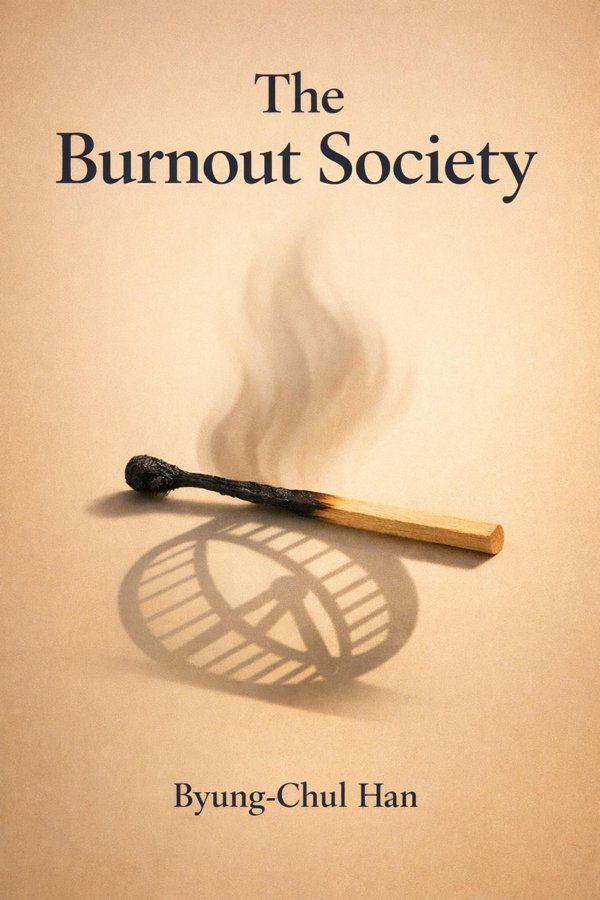
The Burnout Society
In-Depth Analysis
Marcus Aurelius’s Meditations and Byung-Chul Han’s The Burnout Society are both books about pressure, but they explain pressure from opposite directions. Marcus asks how a person can remain inwardly ordered amid chaos, insult, fatigue, and mortality. Han asks what kind of society produces subjects who exhaust themselves in the name of freedom, positivity, and achievement. One is a manual of self-command written from inside the conscience of an emperor; the other is a philosophical diagnosis of late modern capitalism written from outside, at the level of culture and social form. Read together, they create a striking dialogue between ancient ethics and contemporary critique.
Meditations is grounded in Stoic first principles: distinguish what is in your control from what is not, act according to reason, accept the order of nature, and treat others as fellow participants in a common rational world. This is clear in Book II, where Marcus begins the day by anticipating “interfering, ungrateful, arrogant, dishonest, jealous, and surly people.” The point is not cynical withdrawal. Rather, he trains himself not to be shocked by human bad behavior and not to let others deform his own character. In Book V, he addresses laziness and reluctance directly: when you wake up, remember that you are made for the work of a human being, just as plants and animals fulfill their functions. Again and again, Marcus turns philosophy into practice through mental rehearsal.
Han, by contrast, is not trying to help the reader endure a universal human condition so much as identify a historically specific pathology. His most famous distinction is between disciplinary society and performance society. In the former, power works through prohibition, command, and external limits—the language of “must not.” In the latter, power works through positivity, possibility, and self-activation—the language of “you can.” The result is the “achievement subject,” who believes himself free precisely when he is most deeply enlisted in self-exploitation. Depression, burnout, and exhaustion become not just private medical issues but symptoms of a civilization that has converted life into an endless project of optimization.
That contrast reveals the deepest difference between the books: Meditations treats suffering primarily as a problem of judgment and character, while The Burnout Society treats exhaustion primarily as a problem of social organization and psychic economy. Marcus would tell a reader not to resent difficult circumstances, to return to the present task, and to refuse enslavement to reputation or comfort. Han would ask why the present task has become limitless, why rest has been colonized by productivity logic, and why freedom now appears as internalized coercion. Marcus strengthens the self; Han destabilizes the very ideal of the endlessly productive self.
Yet the books are not simple opposites. In fact, Han can help modern readers see how Stoic discipline might be misunderstood in a performance culture. Marcus’s exhortations to rise, work, and endure can sound uncannily compatible with contemporary hustle ideology if stripped of their ethical framework. But in Meditations, work is not self-branding, optimization, or competitive achievement. It is duty in the moral sense: doing the just, rational, and social thing without vanity. Marcus repeatedly warns against fame, ego, and theatricality. Book III’s reflections on mortality and the triviality of praise are anti-performative in a way that resists the logic Han critiques. Marcus does not say “maximize yourself”; he says “master yourself so that you may serve the common good.”
Similarly, Han’s critique does not render Marcus obsolete. If anything, it clarifies which parts of Stoicism remain vital. In a world of metrics, personal branding, and constant exposure, Marcus’s reminders that external recognition is fleeting and that one should not scatter the mind become newly urgent. His cosmic perspective in Book IV—everything changes, everything is interconnected, you are a small part of a larger whole—can counteract the narcissistic intensity of achievement culture. Where Han shows why people are exhausted, Marcus offers a discipline for not letting exhaustion become spiritual disintegration.
The books also differ in voice and readerly experience. Meditations feels personal, vulnerable, and iterative. Because it was not written for publication, its repetitions are features, not flaws: Marcus is drilling himself in habits of perception. The intimacy matters. A Roman emperor admitting irritation, fatigue, and temptation gives the book unusual credibility. Han’s voice is cooler, sharper, and more diagnostic. He writes in compact conceptual oppositions—negativity versus positivity, discipline versus performance, otherness versus sameness. This gives his work intellectual force, but it can also make it feel more abstract and less companionable than Marcus’s journal.
In practical terms, Meditations is the more usable daily text. A reader can take a single passage—about responding to insult, accepting death, or doing today’s work—and apply it immediately. The Burnout Society is more useful as a reframing device. It helps readers reinterpret their anxiety and exhaustion not as isolated weakness but as participation in a broader social pattern. That is a profound gift, but it does not by itself tell one what to do at 7 a.m. when dread and obligations return.
Ultimately, these books answer different needs. Meditations asks, “How shall I live well regardless of circumstances?” The Burnout Society asks, “What sort of circumstances are producing this damaged form of life?” Marcus offers ethical stamina; Han offers cultural lucidity. The richest reading does not force a choice between them. Han prevents Stoicism from becoming naive adaptation to unhealthy systems, while Marcus prevents critique from collapsing into paralysis or ressentiment. Together they teach that one must both examine the soul and diagnose the world that acts upon it.
Side-by-Side Comparison
| Aspect | Meditations | The Burnout Society |
|---|---|---|
| Core Philosophy | Meditations is a Stoic work of self-governance centered on reason, virtue, mortality, and alignment with nature. Marcus Aurelius repeatedly reminds himself that external events are not fully under his control, but his judgments and actions are. | The Burnout Society diagnoses a modern regime of self-exploitation in which individuals internalize pressure and become both master and laborer to themselves. Han’s philosophy is less about personal virtue than about exposing the structural logic of neoliberal performance culture. |
| Writing Style | Meditations is fragmentary, intimate, and aphoristic because it was written as a private notebook rather than a formal treatise. Its short entries feel like urgent moral exercises: reminders to rise, endure insults, and remember death. | The Burnout Society is compressed, theoretical, and essayistic, drawing on continental philosophy and social critique. Han writes in sharp formulations, often favoring conceptual contrast over narrative development. |
| Practical Application | Marcus offers immediately usable practices: morning preparation for difficult people, reframing adversity, and returning attention to present duty. The book lends itself to daily rereading and personal reflection. | Han helps readers reinterpret their exhaustion as socially produced rather than merely private failure. Its application is diagnostic and critical, encouraging resistance to constant optimization, but it offers fewer step-by-step habits. |
| Target Audience | Meditations suits readers interested in moral self-discipline, spiritual resilience, and classical philosophy, including newcomers who can tolerate a non-linear text. It especially appeals to those seeking personal steadiness under stress. | The Burnout Society is better suited to readers interested in contemporary theory, cultural criticism, and the politics of work, especially those reflecting on burnout, productivity, and digital life. It may resonate most with academics, knowledge workers, and readers of critical theory. |
| Scientific Rigor | Meditations is not a scientific text and does not aim to offer empirical evidence; its authority comes from philosophical coherence and lived introspection. Its claims are ethical and existential rather than research-driven. | The Burnout Society also operates primarily as philosophical diagnosis rather than empirical social science. Although its observations often feel acute, Han tends to generalize broadly and argues through concepts more than data. |
| Emotional Impact | Meditations often consoles by shrinking ego and enlarging perspective: fame fades, death comes, and one should still act justly. Its emotional force comes from hearing a ruler struggle privately with the same fear, irritation, and fatigue as any reader. | The Burnout Society can feel bracing, even unsettling, because it names a hidden violence in the language of freedom and achievement. Readers often experience recognition rather than consolation: the book makes ordinary busyness appear pathological. |
| Actionability | Marcus is highly actionable because he translates philosophy into recurring disciplines of attention, speech, and conduct. Many entries can be turned directly into journaling prompts or behavioral rules. | Han is moderately actionable at best; he changes how readers interpret their lives, but rarely specifies a concrete program for reform. The book is powerful as a lens, less powerful as a handbook. |
| Depth of Analysis | Meditations goes deep into the microphysics of the self: anger, vanity, procrastination, and fear of death are analyzed from within. Its depth is moral and psychological rather than sociological. | The Burnout Society is deep in a different register, tracing how social systems reshape subjectivity so that coercion becomes internal. Han’s analysis is structural, historical, and conceptual rather than introspective. |
| Readability | Meditations is readable in short bursts, though some passages can feel repetitive or abstract depending on translation. Its accessibility comes from memorable maxims and concrete moral situations. | The Burnout Society is short but denser and more allusive, especially for readers unfamiliar with continental philosophy. Its brevity can be deceptive because nearly every page compresses multiple theoretical claims. |
| Long-term Value | Meditations rewards lifelong return because its concerns—ego, mortality, duty, distraction, and character—never become obsolete. Different life stages reveal new meanings in the same passages. | The Burnout Society has strong long-term value as a diagnosis of 21st-century work culture, digital overstimulation, and self-optimization. Its relevance may even grow as performance metrics and psychic exhaustion become more pervasive. |
Key Differences
Inner Ethics vs Social Diagnosis
Meditations is concerned with how an individual should think and act under any circumstances, focusing on anger, death, duty, and judgment. The Burnout Society is concerned with how a historical system produces exhausted subjects; for example, Han’s achievement subject is not merely weak but socially formed by performance imperatives.
Stoic Acceptance vs Critical Suspicion
Marcus trains acceptance of what lies beyond one’s control, including difficult people, loss, and bodily decline. Han is suspicious of the demand to adapt too smoothly, especially when adaptation conceals systemic violence such as self-exploitation disguised as freedom.
Daily Practice vs Conceptual Framework
Meditations offers usable exercises: morning preparation, attention to the present, reframing insult, and remembering mortality. The Burnout Society offers a conceptual lens—disciplinary society, positivity, achievement, fatigue—through which readers reinterpret modern experience rather than enact a fixed routine.
Personal Notebook vs Philosophical Essay
Marcus writes in fragments to himself, which is why the book feels confessional and repetitive in a productive way. Han writes a polished, compact argument intended for publication, and his style is correspondingly denser, sharper, and less intimate.
Universal Human Problems vs Historically Specific Pathology
Meditations addresses enduring problems that recur in any era: ego, mortality, laziness, anger, and social conflict. The Burnout Society addresses a distinctly modern condition shaped by neoliberal productivity, where one is compelled not by overt prohibition but by internalized pressure to achieve.
Duty as Service vs Achievement as Self-Exploitation
In Marcus, work is justified as fulfilling one’s role in nature and society; Book V’s insistence on rising to one’s task is moral, not careerist. In Han, modern work becomes endless because the subject identifies with performance itself, turning effort into a trap that feels voluntary.
Consolation vs Unmasking
Meditations often steadies the reader by enlarging perspective: fame is fleeting, life is short, and virtue matters most. The Burnout Society is less consoling and more unmasking, exposing how the rhetoric of positivity and freedom can conceal new forms of domination.
Who Should Read Which?
The stressed professional seeking calm and moral clarity
→ Meditations
Marcus Aurelius offers practical techniques for managing frustration, ego, fatigue, and the pressure of responsibility. Readers who need a daily stabilizing text rather than a social theory of work will get more immediate value from his Stoic reflections.
The academic, critic, or reader questioning modern productivity culture
→ The Burnout Society
Han provides a sharp vocabulary for understanding burnout, self-optimization, and the paradox of freedom under neoliberal performance demands. Readers interested in structural critique and contemporary theory will likely find it more intellectually provocative.
The reflective reader who wants both self-mastery and cultural analysis
→ Meditations
Start with Meditations because it gives you a durable foundation in personal ethics and resilience. Then add The Burnout Society as a second step to understand how modern systems shape the very self Marcus is trying to discipline.
Which Should You Read First?
Read Meditations first if you want an immediate philosophical practice, then follow with The Burnout Society to understand the social environment in which that practice now operates. Marcus Aurelius gives you a vocabulary of self-command—control of judgment, acceptance of fate, resistance to fame, and devotion to present duty. Those lessons create a stable inner baseline, which is helpful before approaching Han’s more abstract critique. Reading Han second is especially fruitful because The Burnout Society complicates simplistic uses of Stoicism. After absorbing Marcus’s emphasis on discipline and duty, Han helps you ask whether modern demands for productivity have corrupted those virtues into self-exploitation. In other words, Marcus teaches you how not to be ruled by circumstances; Han teaches you to recognize that some circumstances are designed to colonize the self from within. If you are already immersed in critical theory or your main concern is workplace exhaustion, reversing the order can also work. But for most readers, Meditations first and Han second provides the best combination of practical grounding and contemporary insight.
Want the full summary?
Get instant access to this book summary and 100K+ more with Fizz Moment.
Get Free SummaryAvailable on App Store • Free to download
Frequently Asked Questions
Is Meditations better than The Burnout Society for beginners?
For most beginners, Meditations is the easier entry point, though it comes with one challenge: it is non-linear and repetitive because it is a private journal. Still, its central ideas are immediately recognizable—control your judgments, accept difficulty, do your duty, remember mortality. The Burnout Society is much shorter, but often harder for beginners because Han writes in compressed theoretical language and assumes comfort with abstract social critique. If you are new to philosophy and want practical wisdom first, Meditations is usually the better starting point. If you are specifically interested in burnout, neoliberalism, and modern work culture, Han may feel more urgent despite being denser.
Which book is more useful for dealing with burnout and work stress: Meditations or The Burnout Society?
They help in different ways. Meditations is more useful for the inner experience of stress: irritation, dread, loss of perspective, and resistance to daily duty. Marcus gives concrete mental practices, like expecting difficult people, focusing on the present task, and refusing to let externals control your peace. The Burnout Society is more useful for understanding why burnout feels so pervasive today. Han shows how self-optimization and performance culture make people complicit in their own exhaustion. If you need coping tools now, choose Meditations. If you need a diagnosis of why modern work feels psychologically violent even when it appears “free,” choose The Burnout Society.
How does Marcus Aurelius compare to Byung-Chul Han on freedom and self-discipline?
Marcus Aurelius sees freedom primarily as inner sovereignty: the ability to govern one’s judgments, desires, and actions according to reason rather than impulse. Self-discipline is liberating because it protects the soul from being ruled by anger, fear, pleasure, or public opinion. Byung-Chul Han is suspicious of modern versions of self-discipline because they often mask coercion. In The Burnout Society, the achievement subject believes it is choosing freely, but is actually obeying diffuse pressures to perform, optimize, and produce. So Marcus treats discipline as ethical formation, while Han warns that contemporary culture can weaponize discipline by making exploitation feel voluntary.
Is The Burnout Society more relevant than Meditations in the age of social media and hustle culture?
In terms of social diagnosis, yes: The Burnout Society feels remarkably tuned to the age of constant visibility, productivity metrics, and self-branding. Han’s account of positivity, achievement, and self-exploitation maps well onto influencer culture, digital labor, and the endless imperative to improve oneself. But relevance is not only about diagnosis. Meditations remains deeply relevant because social media intensifies exactly the temptations Marcus warns against—vanity, distraction, approval-seeking, and emotional reactivity. Han explains the system; Marcus trains the person trying to live sanely within it. If you want to understand hustle culture, Han is sharper. If you want to resist its effects in daily life, Marcus is often more helpful.
What are the main philosophical differences between Meditations and The Burnout Society?
The largest difference is scale. Meditations analyzes the ethical self from the inside: how to think, act, and remain upright in a transient world. Its assumptions are Stoic—nature is ordered, virtue is the good, externals are secondary, and peace depends on disciplined judgment. The Burnout Society analyzes society from the outside: how power mutates in modernity so that coercion becomes internalized as self-motivation. Han is less concerned with virtue than with how subjectivity is shaped by neoliberal performance demands. Marcus says, in effect, “govern yourself well.” Han asks, “what has made the self into a site of relentless production in the first place?”
Should I read Meditations or The Burnout Society first if I want practical philosophy for modern life?
If your priority is practical philosophy you can use immediately, start with Meditations. You can open almost any page and find a thought to test that day: do not be disturbed by others’ behavior, remember how brief life is, and do the work proper to a human being. Then read The Burnout Society to complicate and deepen that practice. Han will help you see that some forms of “self-improvement” are not liberating at all, but extensions of a performance regime. This sequence works well because Marcus gives you an inner method, while Han gives you a critical account of the environment in which that method is now being practiced.
The Verdict
If you want a book that can change your daily conduct almost immediately, Meditations is the stronger recommendation. Marcus Aurelius offers a durable discipline of attention: accept what you cannot control, act justly, resist vanity, and return to the present task. Its wisdom is portable, rereadable, and surprisingly intimate. For readers dealing with irritation, fear, distraction, grief, or the feeling of being morally scattered, it remains one of the most useful books ever written. If, however, your central concern is not simply how to cope but how to understand the conditions producing modern exhaustion, The Burnout Society is the more incisive choice. Han gives a powerful vocabulary for contemporary life: positivity, achievement, self-exploitation, burnout. He is especially valuable for readers who sense that their fatigue is not just personal weakness but the product of a culture that turns freedom into compulsion. The best verdict is not either-or. These books are strongest together because they correct each other’s blind spots. Meditations can, in the wrong hands, be reduced to private resilience detached from social critique. The Burnout Society can, in the wrong hands, become lucid diagnosis without a discipline of living. Read Marcus for strength of soul and Han for clarity about the world that drains it. If forced to choose one, pick Meditations for practical life guidance and The Burnout Society for contemporary cultural understanding.
Want to read both books?
Get AI-powered summaries of both Meditations and The Burnout Society in just 20 minutes total.