
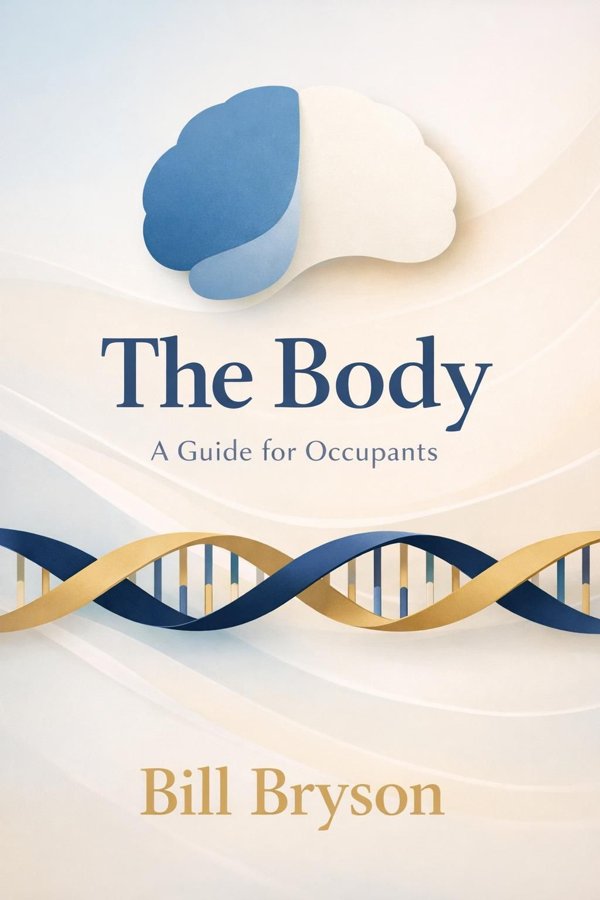
The Body: A Guide for Occupants: Summary & Key Insights
by Bill Bryson
 10 min12 chaptersAudio available
What Is The Body: A Guide for Occupants About?
The Body: A Guide for Occupants by Bill Bryson is a popular_sci book spanning 12 pages. A witty and deeply informative exploration of the human body, explaining how it functions, how it heals, and how it can fail. Bill Bryson takes readers on a journey through the body’s organs, systems, and mysteries, blending scientific insight with humor and storytelling to make complex biology accessible and engaging.
This FizzRead summary covers all 12 key chapters of The Body: A Guide for Occupants in approximately 10 minutes, distilling the most important ideas, arguments, and takeaways from Bill Bryson's work. Also available as an audio summary and Key Quotes Podcast.
The Body: A Guide for Occupants
A witty and deeply informative exploration of the human body, explaining how it functions, how it heals, and how it can fail. Bill Bryson takes readers on a journey through the body’s organs, systems, and mysteries, blending scientific insight with humor and storytelling to make complex biology accessible and engaging.
Who Should Read The Body: A Guide for Occupants?
This book is perfect for anyone interested in popular_sci and looking to gain actionable insights in a short read. Whether you're a student, professional, or lifelong learner, the key ideas from The Body: A Guide for Occupants by Bill Bryson will help you think differently.
- ✓Readers who enjoy popular_sci and want practical takeaways
- ✓Professionals looking to apply new ideas to their work and life
- ✓Anyone who wants the core insights of The Body: A Guide for Occupants in just 10 minutes
Want the full summary?
Get instant access to this book summary and 100K+ more with Fizz Moment.
Get Free SummaryAvailable on App Store • Free to download
Key Chapters
Let’s begin at the surface—the skin, your body’s largest organ. It’s easy to think of skin as a mere covering, but it’s a dynamic, intelligent barrier that is constantly renewing, sensing, and protecting. The human skin contains millions of receptors that help us perceive temperature, pressure, and pain, functioning as our first interface with the outside world. It’s also a chemical laboratory, producing melanin to filter ultraviolet light and sebum to keep the surface supple and resistant.
In studying the skin, I was struck by its sheer resourcefulness. Consider how it heals: the moment you nick it, disaster response begins. Platelets clot the wound, immune cells rush to repel invaders, and new tissue knits itself from the bottom up. It never sleeps. It’s so efficient that even when we age, shedding layers slower and retaining scars longer, it still works ceaselessly. Hair, too, tells a story—it’s dead matter on the outside but vital underneath. From the comfort of insulation to the social signals of style, hair reflects both biology and culture. If there’s one revelation here, it’s that everything you see in the mirror is an active frontier between you and the environment—your personal space suit crafted by evolution itself.
Within your skull sits the most astounding object in the known universe: the brain. Weighing just about three pounds, it consumes roughly twenty percent of the body’s energy. It is a landscape of billions of neurons, each connecting to thousands of others, forming networks of unimaginable complexity. What fascinates me is how these cells generate mind, memory, and emotion from pure physical process.
When I wrote about the brain, I tried to capture the paradox of self-awareness—that the organ investigating itself can never quite grasp its own depth. Neuroscience can chart its signals, but consciousness remains elusive. The brain interprets everything—from light waves it perceives as color to vibrations it understands as speech—building a world within. Historically, it was misunderstood as a source of humors or mystical force, but today we see it as the epicenter of identity. Yet for all science’s progress, there’s humility in admitting we know only a fragment of how it does what it does.
Every thought, every movement originates here. Whether you’re reading a poem or falling in love, what’s happening is electricity jumping synapses in an intricate pattern. And still, something ineffable—the 'you' within—emerges. Writing about the brain, I wanted readers to sense both the majesty and the vulnerability of their own minds.
+ 10 more chapters — available in the FizzRead app
All Chapters in The Body: A Guide for Occupants
About the Author
Bill Bryson is a British-American author known for his humorous and informative books on travel, science, and language. His works include 'A Short History of Nearly Everything' and 'Notes from a Small Island'. Bryson’s writing is celebrated for its clarity, wit, and ability to make complex subjects enjoyable for general readers.
Get This Summary in Your Preferred Format
Read or listen to the The Body: A Guide for Occupants summary by Bill Bryson anytime, anywhere. FizzRead offers multiple formats so you can learn on your terms — all free.
Available formats: App · Audio · PDF · EPUB — All included free with FizzRead
Download The Body: A Guide for Occupants PDF and EPUB Summary
Key Quotes from The Body: A Guide for Occupants
“Let’s begin at the surface—the skin, your body’s largest organ.”
“Within your skull sits the most astounding object in the known universe: the brain.”
Frequently Asked Questions about The Body: A Guide for Occupants
The Body: A Guide for Occupants by Bill Bryson is a popular_sci book that explores key ideas across 12 chapters. A witty and deeply informative exploration of the human body, explaining how it functions, how it heals, and how it can fail. Bill Bryson takes readers on a journey through the body’s organs, systems, and mysteries, blending scientific insight with humor and storytelling to make complex biology accessible and engaging.
More by Bill Bryson



You Might Also Like

Structures: Or Why Things Don"t Fall Down
J.E. Gordon
10 min
The Road to Wigan Pier
George Orwell
10 min
Bonk: The Curious Coupling of Science and Sex
Mary Roach
10 min
First Bite: How We Learn to Eat
Bee Wilson
10 min
In Pursuit Of The Unknown: 17 Equations That Changed The World
Ian Stewart
10 min
Napoleon's Buttons: 17 Molecules That Changed History
Penny Le Couteur and Jay Burreson
10 minBrowse by Category
Ready to read The Body: A Guide for Occupants?
Get the full summary and 100K+ more books with Fizz Moment.