
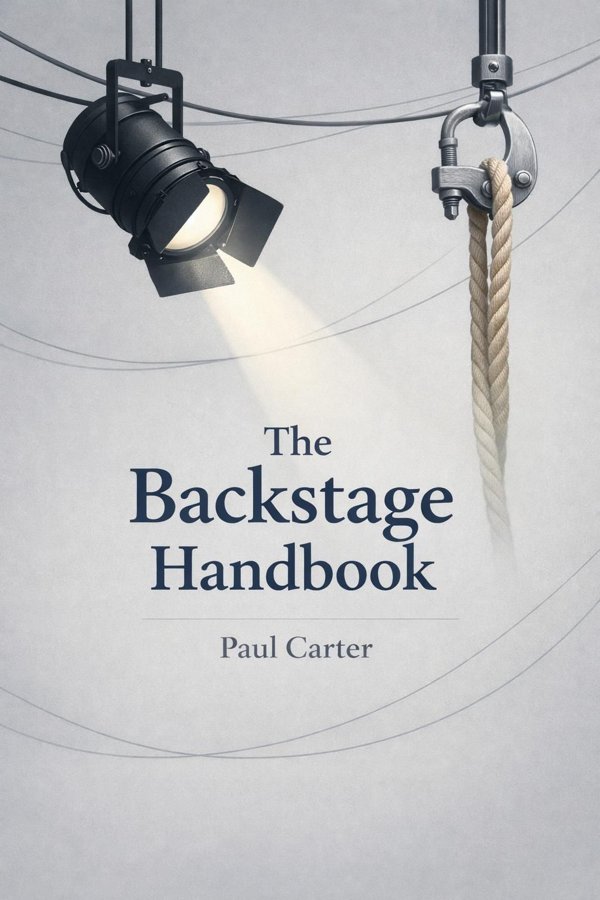
The Backstage Handbook: An Illustrated Almanac of Technical Information: Summary & Key Insights
by Paul Carter
 10 min9 chaptersAudio available
Key Takeaways from The Backstage Handbook: An Illustrated Almanac of Technical Information
A production rarely fails because of a lack of creativity; it fails when creative ideas cannot be executed accurately, efficiently, and on time.
Every scenic illusion begins as a decision about material behavior.
The magic of stage movement depends on mechanics that are anything but magical.
Few backstage disciplines punish guesswork more quickly than rigging.
Good stage lighting feels emotional, but it begins with numbers, angles, circuitry, and optics.
What Is The Backstage Handbook: An Illustrated Almanac of Technical Information About?
The Backstage Handbook: An Illustrated Almanac of Technical Information by Paul Carter is a performing_arts book spanning 12 pages. Some books teach artistic vision; this one teaches how to make that vision stand up, hang safely, light correctly, and survive opening night. The Backstage Handbook: An Illustrated Almanac of Technical Information by Paul Carter is one of the most practical reference works ever created for technical theater. Rather than offering abstract theory, it gathers the measurements, formulas, drafting symbols, hardware diagrams, rigging conventions, material specifications, and backstage standards that working professionals rely on every day. It is the kind of book people keep within arm’s reach in a scene shop, lighting booth, prop room, or production office because it answers the questions that stop a build, delay a cue, or create risk. What makes the book matter is its extraordinary usefulness. Theater production depends on precision hidden beneath illusion: platform heights, lumber dimensions, cable data, counterweight calculations, stage geometry, electrical information, and safe working practices. Carter, a respected technician and designer, understood that backstage work runs on accumulated craft knowledge that is rarely organized in one place. His handbook turns that scattered expertise into a portable technical memory. For students, it is an education in professional standards. For experienced crews, it is a fast, trusted problem-solving tool. For anyone behind the scenes, it is less a book than an indispensable working companion.
This FizzRead summary covers all 9 key chapters of The Backstage Handbook: An Illustrated Almanac of Technical Information in approximately 10 minutes, distilling the most important ideas, arguments, and takeaways from Paul Carter's work. Also available as an audio summary and Key Quotes Podcast.
The Backstage Handbook: An Illustrated Almanac of Technical Information
Some books teach artistic vision; this one teaches how to make that vision stand up, hang safely, light correctly, and survive opening night. The Backstage Handbook: An Illustrated Almanac of Technical Information by Paul Carter is one of the most practical reference works ever created for technical theater. Rather than offering abstract theory, it gathers the measurements, formulas, drafting symbols, hardware diagrams, rigging conventions, material specifications, and backstage standards that working professionals rely on every day. It is the kind of book people keep within arm’s reach in a scene shop, lighting booth, prop room, or production office because it answers the questions that stop a build, delay a cue, or create risk.
What makes the book matter is its extraordinary usefulness. Theater production depends on precision hidden beneath illusion: platform heights, lumber dimensions, cable data, counterweight calculations, stage geometry, electrical information, and safe working practices. Carter, a respected technician and designer, understood that backstage work runs on accumulated craft knowledge that is rarely organized in one place. His handbook turns that scattered expertise into a portable technical memory. For students, it is an education in professional standards. For experienced crews, it is a fast, trusted problem-solving tool. For anyone behind the scenes, it is less a book than an indispensable working companion.
Who Should Read The Backstage Handbook: An Illustrated Almanac of Technical Information?
This book is perfect for anyone interested in performing_arts and looking to gain actionable insights in a short read. Whether you're a student, professional, or lifelong learner, the key ideas from The Backstage Handbook: An Illustrated Almanac of Technical Information by Paul Carter will help you think differently.
- ✓Readers who enjoy performing_arts and want practical takeaways
- ✓Professionals looking to apply new ideas to their work and life
- ✓Anyone who wants the core insights of The Backstage Handbook: An Illustrated Almanac of Technical Information in just 10 minutes
Want the full summary?
Get instant access to this book summary and 100K+ more with Fizz Moment.
Get Free SummaryAvailable on App Store • Free to download
Key Chapters
A production rarely fails because of a lack of creativity; it fails when creative ideas cannot be executed accurately, efficiently, and on time. That is why The Backstage Handbook begins, in spirit, with tools. For Paul Carter, tools are not accessories to stagecraft but the basic vocabulary of technical work. Hammers, screwdrivers, wrenches, saws, clamps, measuring tapes, levels, utility knives, and specialty devices each support a different type of task, and understanding them is part of professional competence.
The book helps readers recognize that backstage labor depends on matching the right tool to the right job. A framing square is not interchangeable with a tape measure when accuracy matters. A C-clamp, spring clamp, or bar clamp may look similar to a beginner, but each behaves differently under pressure. Even simple hand tools carry implications for speed, finish quality, and safety. In a scene shop, the wrong screwdriver can strip hardware; on electrics calls, improper pliers can slow cable management; in props, precision cutting tools affect both aesthetics and durability.
Carter’s practical approach also reinforces a deeper lesson: tools require habits. Keeping blades sharp, measuring twice, labeling cases, and returning gear to designated places are small disciplines that save productions from chaos. A technician who knows tool function but lacks tool discipline creates inconsistency. One who combines both becomes reliable.
In real productions, this knowledge shows up everywhere: assembling rehearsal furniture quickly, repairing a platform before half-hour, adjusting masking hardware in dim light, or troubleshooting a loose fastener during a touring load-in. Technical excellence often looks like quiet preparedness.
Actionable takeaway: build a core kit of essential backstage tools, learn the exact purpose of each one, and practice maintenance and organization so your tools increase precision instead of adding friction.
Every scenic illusion begins as a decision about material behavior. The audience may see a Victorian staircase, a brick alley, or a futuristic control room, but backstage professionals see plywood thickness, framing stock, fasteners, hinges, casters, and load limits. One of the handbook’s greatest strengths is its systematic treatment of materials and hardware, because it teaches technicians to think structurally rather than cosmetically.
Carter compares woods, metals, sheet goods, and construction components in a way that reveals their practical consequences. Softwoods may be affordable and easy to work with, but they differ in strength and finish. Hardwood may be necessary for durability in platforms or trim pieces. Plywood, lauan, tempered hardboard, steel stock, bolts, screws, lag fasteners, and specialty connectors all serve distinct functions. The choice between a carriage bolt and a wood screw is not trivial; it determines whether a unit can be safely assembled, disassembled, toured, or reused.
The book also highlights a central truth of technical theater: hardware is often the hidden architecture of reliability. Hinges affect moving scenery, casters alter tracking and stability, turnbuckles support tensioning, and eye bolts can become critical points in a rigged system. A beautiful unit built with poor hardware choices becomes a maintenance problem by previews.
Practical application is immediate. When building a platform, a technician must choose framing lumber, top skin thickness, leg attachment methods, and bracing hardware based on span, weight, and repeated use. When hanging masking, selecting the right grommeting or pipe support prevents mid-run wear and tear. Carter equips readers to ask not just “Will this work?” but “Will this survive?”
Actionable takeaway: before building any scenic element, identify the loads, movement, assembly needs, and lifespan of the piece, then choose materials and hardware based on function first and appearance second.
The magic of stage movement depends on mechanics that are anything but magical. Sliding wagons, turntables, hinges, pivots, jacks, brakes, tracks, pulleys, and leverage systems all create motion, but only when their physical principles are understood. The Backstage Handbook treats mechanical systems as practical engineering for theater, showing that dynamic scenery is safest and most effective when its movement is planned rather than improvised.
Carter’s emphasis helps readers see that moving scenery is not merely a design feature; it is a coordinated system of force, friction, balance, and control. A wagon that binds on its track may be suffering from alignment issues, incorrect caster choice, or uneven load distribution. A pivoting wall may require reinforcement at stress points. A trap, lift, or fold-down unit may look elegant on paper but fail in operation if clearances and mechanical tolerances are ignored.
This section matters because many productions ask scenery to transform quickly and repeatedly under pressure. In a musical, a rolling staircase may need to move silently and lock precisely into place. In a drama, a practical door must survive dozens of slams without loosening. In touring productions, units must be engineered for assembly speed and transport resilience. Carter’s tables, sketches, and reference data support exactly these decisions.
The larger lesson is that backstage mechanics are about repeatability. The best system is not the most clever one; it is the one crews can operate consistently in low light, under time constraints, and with minimal risk. Good mechanical design reduces operator strain and performance variability.
Actionable takeaway: when designing any moving scenic element, map the path of motion, points of force, likely wear areas, and reset process before construction begins, and prioritize simple, repeatable mechanics over theatrical gimmicks.
Few backstage disciplines punish guesswork more quickly than rigging. Whenever scenery, curtains, lighting equipment, or effects are suspended overhead, the stakes rise dramatically. The Backstage Handbook is especially valued for its rigging and stage machinery information because it translates a high-risk area of production into a structured reference framework grounded in hardware knowledge, system logic, and safety-minded calculation.
Carter outlines the components and concepts that underpin theatrical rigging: rope, cable, blocks, battens, sheaves, shackles, thimbles, clamps, counterweight systems, arbor arrangements, and mechanical supports. The power of this material lies in its clarity. It teaches that each piece of hardware has a specific use case and that load path matters. A rigging point is only as strong as its weakest component, and professionals must understand both individual parts and the complete system.
The practical implications are significant. Hanging a scenic banner, flying a portal, balancing a batten, or installing a temporary point for an effect all require careful assessment. Even routine calls, such as adding instruments to an electrics pipe, involve weight awareness and secure attachment methods. In larger venues, rigging also intersects with motorized machinery, winches, and structural engineering considerations.
Perhaps the most important message is cultural: rigging requires humility. Experience is useful, but familiarity can breed dangerous shortcuts. Carter’s handbook functions as a corrective, reminding technicians to verify capacities, inspect components, and follow accepted practice instead of relying on memory or tradition alone.
Actionable takeaway: never rig from habit alone; confirm hardware suitability, trace the full load path, inspect every component, and when uncertainty exists, stop and consult a qualified rigger or engineer before proceeding.
Good stage lighting feels emotional, but it begins with numbers, angles, circuitry, and optics. The Backstage Handbook grounds lighting practice in the technical fundamentals that make artistic choices possible. Rather than treating light as a purely creative medium, Carter shows it as a controlled system involving instruments, beam spread, focus, power distribution, color media, hanging positions, and photometric logic.
This matters because even the most inspired design must work within the realities of a venue. A designer may want a sculptural sidelight look, but boom positions, shutter cuts, wattage limits, and cable runs determine what can actually be achieved. A technician hanging instruments must understand connector types, clamp orientation, safety cables, circuiting, patching, and lamp behavior. The handbook’s tables and diagrams provide the practical language for these tasks.
Lighting fundamentals also include draftsmanship and communication. Standard symbols, plot notation, and paperwork conventions ensure that designers, electricians, and board programmers interpret the same plan correctly. A lighting plot is not merely a picture; it is a technical instruction set for installation and operation.
In practice, Carter’s reference helps with everyday decisions: calculating dimmer loads, choosing the right instrument for a throw distance, identifying connector standards, spacing electrics, or interpreting beam angles for coverage across a cyc or acting area. It also helps teams avoid common failures such as overloaded circuits, poor focus access, or sloppy cable management.
The deeper insight is that lighting artistry depends on technical fluency. Precision in hang, circuiting, paperwork, and maintenance frees the design to become expressive.
Actionable takeaway: treat every lighting choice as both an artistic and technical decision by checking instrument function, beam needs, power capacity, and paperwork accuracy before the first hang begins.
Audiences notice sound most when it fails. A mic cuts out, a speaker hums, a cue distorts, or spoken text disappears into the room. Carter’s handbook recognizes that sound is not separate from the physical environment or the electrical infrastructure that supports it. The sections on sound, acoustics, and electrical power together offer a practical way of thinking about how audio systems succeed backstage.
At the core is a simple truth: sound quality depends on both equipment and space. A well-chosen microphone can still perform poorly in a reflective room. A speaker system may be powerful but unintelligible if coverage is uneven. Cable runs, connectors, grounding, and power distribution all affect reliability. The handbook helps readers navigate this complexity by giving them technical reference information rather than vague advice.
For theater practitioners, this is invaluable. A small black-box production may need to balance body mics with live instruments while controlling feedback. A school auditorium may suffer from acoustic dead spots and noisy electrical systems. A touring event may require fast integration with unfamiliar house power and patching conventions. In each case, technical understanding saves time and prevents embarrassment.
Carter’s inclusion of power systems reinforces another crucial lesson: audio problems are often system problems. Buzz, interference, overloads, or inconsistent performance may stem from electrical issues as much as sonic ones. Backstage professionals benefit when they understand voltage, connectors, distribution methods, and safe electrical practice alongside mixer and speaker basics.
Actionable takeaway: when troubleshooting sound, examine the full chain, including room acoustics, microphone choice, speakers, cables, connectors, and power sources, instead of assuming the problem lies in a single device.
Behind every seamless scene change is a hidden geometry of platforms, masking, sightlines, clearances, and traffic patterns. The Backstage Handbook excels at turning stage layout and construction into a readable system. Carter helps readers understand not just individual structures, but the spatial logic that allows sets, performers, and crews to coexist safely and efficiently.
This includes practical reference material on stage dimensions, platform construction, stair geometry, rake considerations, soft goods placement, backstage access, and common structural arrangements. What makes this especially useful is the connection between construction and operation. A platform is not merely a raised surface; it affects sightlines, actor safety, storage beneath, scene-shift routes, and load-bearing demands. A masking leg is not just fabric; it shapes audience perception and determines whether operators can move unseen.
In application, this knowledge guides countless decisions. A designer planning a multi-level set must account for railings, stair rise and run, crossover routes, and backstage storage. A technical director laying out a wagon path must maintain wing clearance and avoid pinch points. A stage manager assessing preset traffic must understand how set placement affects performers moving in blackout. Carter’s handbook brings these concerns into one practical frame.
The deeper message is that successful stagecraft is relational. Construction choices interact with lighting angles, fly cues, actor movement, orchestra placement, and emergency egress. Good stage layout anticipates not only how scenery looks, but how a whole production lives in the space over time.
Actionable takeaway: when planning scenic construction, evaluate every unit in relation to sightlines, traffic flow, backstage access, storage, and emergency movement, not just its visual impact from the house.
The most important backstage effect is the one the audience never sees: risk prevented. Throughout The Backstage Handbook, safety is not isolated as a moral footnote; it is embedded in every technical decision. Carter’s reference material on equipment, rigging, electricity, construction, and operations collectively reinforces a core principle of professional theater: no deadline, design idea, or budget pressure justifies unsafe practice.
This philosophy matters because theater often operates under conditions that invite shortcuts. Crews work quickly, spaces are dim, scenery is temporary, and many teams include volunteers or students with uneven experience. In that environment, reliable standards become essential. Safe ladder use, load awareness, proper fastening, cable management, personal protective equipment, inspection routines, and clear backstage communication all reduce the chance of injury and equipment failure.
The handbook’s glossary, reference tables, and appendices strengthen safety by making technical information accessible at the moment of need. Instead of relying on memory, users can verify dimensions, ratings, terminology, and accepted methods. That is especially important in areas where mistakes compound, such as electrical work, suspended loads, moving scenery, or temporary structures.
Safety also has an artistic payoff. Productions run more smoothly when crews trust equipment, understand procedures, and work within clear systems. Fewer accidents mean fewer delays, less panic, and more attention available for performance quality. Professionalism is not only visible in polished outcomes; it is visible in the absence of preventable chaos.
Actionable takeaway: build a habit of checking technical choices against safety standards every time you work, and normalize stopping a process whenever something seems uncertain, unstable, or improperly installed.
All Chapters in The Backstage Handbook: An Illustrated Almanac of Technical Information
About the Author
Paul Carter is a stage technician and designer whose enduring reputation rests on his ability to organize the practical knowledge of technical theater into a clear, usable form. Best known as the compiler of The Backstage Handbook, Carter drew on real backstage experience to assemble a portable reference covering tools, materials, rigging, lighting, construction, drafting, power systems, and safety. His work is especially important in a field where crucial knowledge is often learned informally through apprenticeships, production work, and shop practice. By gathering technical data, diagrams, formulas, and standards into a single illustrated handbook, he created a resource that has served generations of students and professionals. Carter is remembered not only as a practitioner of stagecraft, but as a major contributor to technical theater education.
Get This Summary in Your Preferred Format
Read or listen to the The Backstage Handbook: An Illustrated Almanac of Technical Information summary by Paul Carter anytime, anywhere. FizzRead offers multiple formats so you can learn on your terms — all free.
Available formats: App · Audio · PDF · EPUB — All included free with FizzRead
Download The Backstage Handbook: An Illustrated Almanac of Technical Information PDF and EPUB Summary
Key Quotes from The Backstage Handbook: An Illustrated Almanac of Technical Information
“A production rarely fails because of a lack of creativity; it fails when creative ideas cannot be executed accurately, efficiently, and on time.”
“Every scenic illusion begins as a decision about material behavior.”
“The magic of stage movement depends on mechanics that are anything but magical.”
“Few backstage disciplines punish guesswork more quickly than rigging.”
“Good stage lighting feels emotional, but it begins with numbers, angles, circuitry, and optics.”
Frequently Asked Questions about The Backstage Handbook: An Illustrated Almanac of Technical Information
The Backstage Handbook: An Illustrated Almanac of Technical Information by Paul Carter is a performing_arts book that explores key ideas across 9 chapters. Some books teach artistic vision; this one teaches how to make that vision stand up, hang safely, light correctly, and survive opening night. The Backstage Handbook: An Illustrated Almanac of Technical Information by Paul Carter is one of the most practical reference works ever created for technical theater. Rather than offering abstract theory, it gathers the measurements, formulas, drafting symbols, hardware diagrams, rigging conventions, material specifications, and backstage standards that working professionals rely on every day. It is the kind of book people keep within arm’s reach in a scene shop, lighting booth, prop room, or production office because it answers the questions that stop a build, delay a cue, or create risk. What makes the book matter is its extraordinary usefulness. Theater production depends on precision hidden beneath illusion: platform heights, lumber dimensions, cable data, counterweight calculations, stage geometry, electrical information, and safe working practices. Carter, a respected technician and designer, understood that backstage work runs on accumulated craft knowledge that is rarely organized in one place. His handbook turns that scattered expertise into a portable technical memory. For students, it is an education in professional standards. For experienced crews, it is a fast, trusted problem-solving tool. For anyone behind the scenes, it is less a book than an indispensable working companion.
You Might Also Like

Harriet Tubman: Live in Concert
Bob the Drag Queen
10 min
The Art of Stagecraft
Robert Edmond Jones
10 min
The Art of Stop-Motion Animation
Ken A. Priebe
10 min
Thunderstorm
Cao Yu
10 min
Acting In Film: An Actor's Take on Movie Making
Michael Caine
10 min
Character Animation Crash Course!
Eric Goldberg
10 minBrowse by Category
Ready to read The Backstage Handbook: An Illustrated Almanac of Technical Information?
Get the full summary and 100K+ more books with Fizz Moment.