
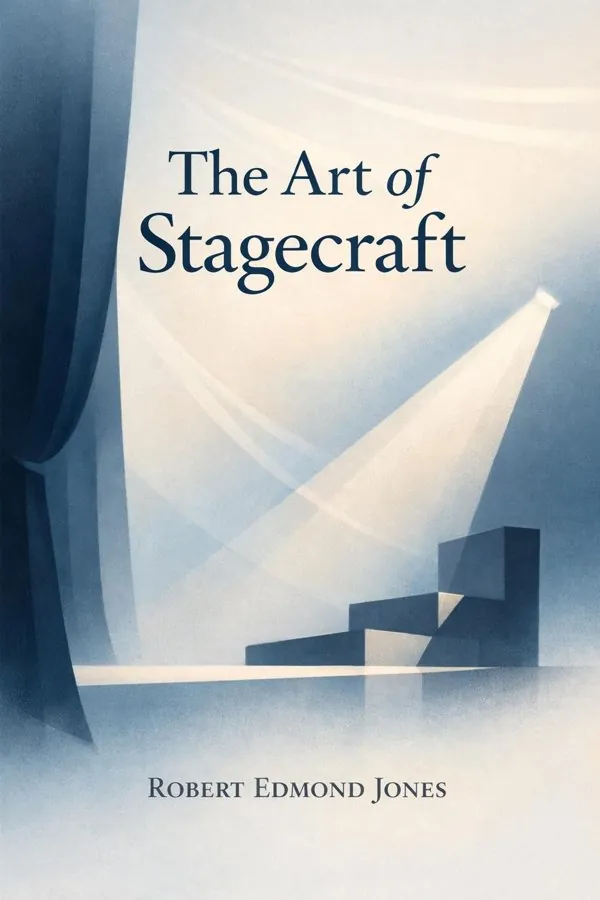
The Art of Stagecraft: Summary & Key Insights
 10 min9 chaptersAudio available
Key Takeaways from The Art of Stagecraft
A stage picture becomes memorable only when it expresses the soul of the play rather than merely reproducing a location.
What audiences imagine can be more powerful than what they are shown in exhaustive detail.
Light does more than make performers visible; it shapes the emotional and spiritual atmosphere of the stage.
Theatre becomes art when it transforms ordinary materials into a world charged with feeling and meaning.
A production becomes compelling when all its parts appear to belong to the same imaginative vision.
What Is The Art of Stagecraft About?
The Art of Stagecraft by Robert Edmond Jones is a performing_arts book. The Art of Stagecraft is a foundational meditation on what makes theatre visually powerful, emotionally persuasive, and spiritually alive. In this influential work, Robert Edmond Jones argues that stage design is not decoration added after the fact, but an essential expressive force at the heart of dramatic storytelling. He invites readers to see the stage not as a place for literal imitation of reality, but as a poetic space where light, shape, movement, and atmosphere reveal inner truth. That idea changed modern theatre. Rather than treating scenery as a painted backdrop or technical necessity, Jones presents stagecraft as an art of selection, suggestion, and imaginative transformation. His thinking helped redefine scenic design in the twentieth century and continues to shape directors, designers, actors, and students today. Jones writes with the authority of a pioneering American stage designer whose work brought visual unity and emotional depth to the theatre. This book matters because it teaches readers to think beyond mechanics and ask a deeper question: how can every element on stage serve the life of the play? For anyone interested in theatre, performance, or visual storytelling, it remains both a practical guide and an artistic manifesto.
This FizzRead summary covers all 9 key chapters of The Art of Stagecraft in approximately 10 minutes, distilling the most important ideas, arguments, and takeaways from Robert Edmond Jones's work. Also available as an audio summary and Key Quotes Podcast.
The Art of Stagecraft
The Art of Stagecraft is a foundational meditation on what makes theatre visually powerful, emotionally persuasive, and spiritually alive. In this influential work, Robert Edmond Jones argues that stage design is not decoration added after the fact, but an essential expressive force at the heart of dramatic storytelling. He invites readers to see the stage not as a place for literal imitation of reality, but as a poetic space where light, shape, movement, and atmosphere reveal inner truth. That idea changed modern theatre. Rather than treating scenery as a painted backdrop or technical necessity, Jones presents stagecraft as an art of selection, suggestion, and imaginative transformation. His thinking helped redefine scenic design in the twentieth century and continues to shape directors, designers, actors, and students today. Jones writes with the authority of a pioneering American stage designer whose work brought visual unity and emotional depth to the theatre. This book matters because it teaches readers to think beyond mechanics and ask a deeper question: how can every element on stage serve the life of the play? For anyone interested in theatre, performance, or visual storytelling, it remains both a practical guide and an artistic manifesto.
Who Should Read The Art of Stagecraft?
This book is perfect for anyone interested in performing_arts and looking to gain actionable insights in a short read. Whether you're a student, professional, or lifelong learner, the key ideas from The Art of Stagecraft by Robert Edmond Jones will help you think differently.
- ✓Readers who enjoy performing_arts and want practical takeaways
- ✓Professionals looking to apply new ideas to their work and life
- ✓Anyone who wants the core insights of The Art of Stagecraft in just 10 minutes
Want the full summary?
Get instant access to this book summary and 100K+ more with Fizz Moment.
Get Free SummaryAvailable on App Store • Free to download
Key Chapters
A stage picture becomes memorable only when it expresses the soul of the play rather than merely reproducing a location. One of Robert Edmond Jones’s central arguments is that stagecraft exists to serve drama, not to show off craftsmanship, wealth, or realism for its own sake. A set that looks impressive but fails to deepen the emotional action is, in his view, misguided. Theatre is not architecture, furniture display, or historical exhibition. It is a living art that depends on concentration, suggestion, and meaning.
Jones challenges the assumption that the best scenery is the most detailed or accurate. Instead, he urges the designer to ask what the audience needs to feel and understand in each moment. A room on stage does not need every wall fixture if the real purpose of the scene is to reveal loneliness, conflict, desire, or dread. If a stripped-down environment communicates those truths more powerfully, then it is better stagecraft than a fully furnished replica. In this sense, design is interpretive. It is not neutral support. It shapes perception.
This idea has practical relevance far beyond professional theatre. A school production, for example, can become stronger by focusing on a few essential elements that support tone and action rather than trying to imitate a film set. Directors and designers can choose color, texture, scale, and empty space to guide attention and intensify meaning. Even actors benefit from this principle because they perform more clearly in environments built around dramatic intention.
Actionable takeaway: before designing any set, write a one-sentence statement of what each scene must emotionally communicate, and let every visual choice support that purpose.
What audiences imagine can be more powerful than what they are shown in exhaustive detail. Jones believes that the stage should not compete with everyday reality by trying to copy it exactly. Theatre works through concentration and symbolic force. A few carefully chosen visual elements can awaken the imagination more deeply than a painstakingly realistic scene. In his view, literal realism often deadens theatrical energy because it leaves nothing for the audience to complete inwardly.
This does not mean vagueness or carelessness. Suggestion requires precision. The designer must select the right forms, colors, and spatial relationships to evoke a world rather than duplicate it. A towering staircase, a shaft of cold light, or a single distorted doorway may tell us more about a character’s psychological state than a perfectly realistic interior. Jones sees theatre as an art of imaginative economy, where omission is as meaningful as inclusion.
This principle can be applied in many production contexts. A director staging Macbeth might avoid building a heavy stone castle and instead use stark platforms, shadows, and banners to suggest ambition, violence, and instability. A contemporary drama set in an apartment might use only a table, a window frame, and confined lighting to express emotional claustrophobia. The audience accepts theatrical shorthand when it is coherent and purposeful.
Jones’s insight also speaks to budgets. Smaller companies often assume that limited resources are a disadvantage, but imaginative suggestion can produce stronger theatre than expensive literalism. When design choices are distilled to essentials, the production often gains clarity and style.
Actionable takeaway: in planning a set, remove every element that explains too much and keep only what sparks the audience’s imagination and supports the emotional truth.
Light does more than make performers visible; it shapes the emotional and spiritual atmosphere of the stage. Jones treats lighting as one of the most expressive tools in theatre, not as a secondary technical system to be added after scenery is built. Through light, the stage can breathe, transform, conceal, reveal, isolate, or exalt. In many ways, light is the designer’s most poetic medium because it changes how all other elements are perceived.
Jones helped expand the idea that lighting should interpret dramatic action. Brightness, shadow, color, direction, and rhythm all communicate meaning. A scene of intimacy may require soft containment, while a moment of moral exposure may call for harsh illumination. A figure standing in silhouette can appear mythic, threatened, or alone depending on the surrounding visual context. By controlling light, the designer guides the audience’s attention and feeling without explicit explanation.
In practical terms, this means lighting should be part of the production concept from the beginning. For example, a play about memory may use pools of light surrounded by darkness to suggest the fragmentary nature of recollection. A comedy may rely on openness and visual buoyancy, while a tragedy may use depth and shadow to create foreboding. Even simple productions can benefit from intentional lighting choices. A modest black-box theatre can create extraordinary worlds through focused illumination and strategic darkness.
Actors also gain from expressive lighting because it supports storytelling beats. When a design team understands where emotional shifts occur, lighting can participate in those transitions instead of merely covering the stage evenly.
Actionable takeaway: treat lighting as part of the script analysis process, and identify where changes in light can mark emotional, thematic, or psychological turning points.
Theatre becomes art when it transforms ordinary materials into a world charged with feeling and meaning. For Jones, the stage is not simply a platform where events happen; it is a poetic space where reality is heightened, distilled, and reimagined. This poetic quality distinguishes stagecraft from mere utility. A production succeeds visually when the stage environment allows the audience to enter a world that feels inevitable, unified, and alive.
Jones resists the idea that poetry belongs only to language. Scenic form, costume, movement, and light can all be poetic when they reveal an inner essence. A poetic stage image does not need to be ornate. It may be stark and minimal. What matters is that it expresses the invisible dimensions of the play: mood, destiny, tension, innocence, decay, transcendence. Through style and atmosphere, stagecraft gives shape to what cannot be spoken directly.
This concept is especially useful for directors and designers deciding on a production’s visual vocabulary. Instead of asking only what period objects belong on stage, they can ask what kind of world the play wants to become. A production of The Cherry Orchard might emphasize fading elegance through pale space and fragile lines rather than literal domestic detail. A modern devised piece might use recurring visual metaphors, such as suspended cloth or shifting frames, to create an emotional landscape.
The poetic world of the stage also requires consistency. If every design choice comes from a shared sensibility, the production feels whole. If styles clash without purpose, the spell breaks.
Actionable takeaway: define the central image or atmosphere of the play in visual terms, and use it as a guiding metaphor for all major design decisions.
A production becomes compelling when all its parts appear to belong to the same imaginative vision. Jones emphasizes unity as one of the highest aims of stagecraft. Scenery, costumes, lighting, movement, acting style, and direction should not operate as separate departments pursuing unrelated goals. When they converge around a clear interpretation, the audience experiences the play as a single artistic event rather than a collection of disconnected effects.
This idea was transformative because it challenged older theatre practices in which sets might be chosen conventionally, costumes rented independently, and lighting treated as a purely functional afterthought. Jones saw that visual incoherence weakens drama. If the acting is intimate and psychological but the set is grandiose and distracting, the production sends mixed signals. If costumes suggest stylization while scenery insists on literal realism, the world of the play becomes unstable.
In practice, unity begins with conversation and shared intention. A design team should discuss not just logistics but interpretation. What is the play really about? What tone should dominate? What visual rules govern this world? For instance, a production centered on repression might use strict lines, controlled color, and choreographed movement to reinforce the same emotional pattern across all elements. In a more expressionistic play, distortion and fluidity may shape scenery, costume silhouette, and lighting transitions alike.
Unity does not mean sameness or monotony. Contrast still matters. But contrasts should feel designed, not accidental. A sudden burst of color or realism becomes more effective when it emerges from an otherwise coherent system.
Actionable takeaway: create a short production manifesto before rehearsals begin, outlining the visual and emotional principles that every department will use to maintain artistic unity.
A scenic designer is not merely a supplier of backgrounds but a reader of the play and a maker of meaning. Jones insists that the designer’s role is fundamentally artistic and interpretive. This was a radical claim in a theatrical culture that often treated scenery as craft, trade, or decoration. For Jones, the designer must understand structure, rhythm, character, and theme just as deeply as a director or actor does. Only then can visual choices become dramatically necessary.
This elevates stage design from execution to authorship within collaboration. The designer asks: what is the hidden architecture of the play? What image best expresses its central conflict? What should the audience sense before a character even speaks? Through composition, scale, and atmosphere, the designer provides answers that shape the audience’s experience from the first glance.
A practical implication is that designers must read scripts analytically, not just extract scene locations. A play set in multiple rooms may actually demand one flexible environment if its emotional logic is continuous. Conversely, a simple one-room drama may need subtle visual transformation over time to reflect changing relationships. Designers who think interpretively also collaborate better because they can explain why a choice matters dramatically, not just aesthetically.
This perspective benefits students and emerging artists. It encourages them to develop literary sensitivity, historical awareness, and visual imagination together. Instead of asking, “What did this place look like?” they can ask, “What should this feel like, and why?” That shift leads to stronger, more meaningful work.
Actionable takeaway: when reading a script, identify three emotional or thematic images before sketching scenery, and let those images guide your design rather than surface realism alone.
The simplest stage image is often the hardest to create because it requires confidence, discipline, and clarity of intention. Jones repeatedly values simplicity, not because he rejects richness, but because he understands how easily theatre becomes cluttered. Excess detail can obscure action, weaken focus, and burden the audience with irrelevant information. Simplicity, by contrast, makes room for dramatic force.
But simplicity is not the same as emptiness. It is achieved through careful selection. Every object, line, and visual emphasis must justify its presence. This can be difficult because artists and producers may fear that audiences will equate simplicity with lack of effort or budgetary compromise. Jones argues the opposite: true simplicity reflects mastery. It reveals that the production team knows what matters most.
Consider a scene of grief. Filling the stage with realistic furniture may create context, but a single chair in a wide, dim space may better communicate loss and desolation. In a fast-moving comedy, clean design can support pace by reducing scene changes and visual confusion. In experimental work, simplicity can help abstract ideas land more clearly because spectators are not distracted by unnecessary representation.
Simplicity also improves collaboration. Actors move more freely, lighting can sculpt space more effectively, and directors can compose stronger stage pictures when the environment is not overcrowded. For low-budget theatre, this principle is especially liberating. The question becomes not how much can be built, but what minimum form can produce maximum resonance.
Actionable takeaway: after completing a design concept, remove or revise at least one major element and ask whether the production becomes clearer, stronger, or more focused without it.
The magic of theatre does not come from machinery alone; it arises from a shared act of imagination between artists and audience. Jones sees stagecraft as an invitation to participation. When theatre leaves space for imagination, spectators become active collaborators, completing the world of the play in their minds and emotions. This is one reason he resists over-explaining through design. The stage should stimulate the imaginative faculty, not replace it.
This insight changes how one thinks about every production choice. A doorframe may be enough to imply an entire house. A shift in color may suggest a new country. A raised platform and altered posture may create a throne room. These conventions work because audiences accept the theatrical contract when the production presents its signs clearly and confidently. The result is not less believable theatre, but more alive theatre.
For performers, this principle is equally important. Actors do not merely inhabit finished spaces; they animate and define them through behavior. A sparse environment can feel vast, dangerous, intimate, or sacred depending on how performers move within it. Directors can therefore use rehearsal to discover how space is imagined physically, not only how it is designed visually.
This idea is especially valuable in education and community theatre, where limited means can become creative strengths. A production that trusts imagination often feels more inventive than one that strains to mimic film realism. Audiences frequently remember the sense of wonder generated by theatrical transformation, not the number of objects on stage.
Actionable takeaway: design each scene with one intentional gap for the audience’s imagination to fill, and trust performance, light, and context to complete the illusion.
The deepest aim of modern stagecraft, as Jones presents it, is not external accuracy but inner truth. He belongs to a theatrical movement that sought to move beyond conventional prettiness and photographic imitation toward design that reveals psychological, emotional, and spiritual realities. This is the larger philosophical thread that ties his arguments together. Scenic art matters because it can make visible what lies beneath the surface of events.
Inner truth may mean the atmosphere of a character’s mind, the moral pressure of a social world, or the mythic scale of a dramatic conflict. A design can communicate these dimensions through compression, exaggeration, abstraction, and rhythm. A slanted wall may express instability. Monumental scale may evoke oppressive authority. Repeating patterns may suggest entrapment. Jones values these choices because they help the audience experience the play more deeply than literal realism alone can allow.
This approach remains highly relevant in contemporary performance. Psychological drama, opera, dance theatre, and devised work all benefit from design that interprets rather than merely illustrates. Even realistic plays often become stronger when their visual world subtly reflects inner conditions. A family dining room can be arranged to emphasize distance, hierarchy, or imbalance. A workplace can feel spiritually vacant through proportion and light.
Jones’s modernism is therefore not about fashion but about honesty. He asks theatre artists to search for the most truthful stage expression, even if it departs from ordinary appearances. That search gives stagecraft its artistic dignity.
Actionable takeaway: for each production, identify the hidden inner truth of the play and choose one visual strategy that makes that invisible reality legible on stage.
All Chapters in The Art of Stagecraft
About the Author
Robert Edmond Jones was one of the most important American stage designers of the twentieth century. Born in 1887, he became a leading figure in the movement that transformed scenic design from decorative realism into a more expressive, unified art. His work emphasized atmosphere, symbolism, and the emotional power of light and space, helping redefine how modern theatre looked and felt. Jones designed for major productions and collaborated with influential theatre artists, earning a reputation for both visual imagination and artistic seriousness. He was also a gifted writer and teacher whose ideas shaped generations of directors and designers. Through The Art of Stagecraft, he articulated a lasting vision of theatre as a poetic medium in which every visual element should serve the deeper truth of the play.
Get This Summary in Your Preferred Format
Read or listen to the The Art of Stagecraft summary by Robert Edmond Jones anytime, anywhere. FizzRead offers multiple formats so you can learn on your terms — all free.
Available formats: App · Audio · PDF · EPUB — All included free with FizzRead
Download The Art of Stagecraft PDF and EPUB Summary
Key Quotes from The Art of Stagecraft
“A stage picture becomes memorable only when it expresses the soul of the play rather than merely reproducing a location.”
“What audiences imagine can be more powerful than what they are shown in exhaustive detail.”
“Light does more than make performers visible; it shapes the emotional and spiritual atmosphere of the stage.”
“Theatre becomes art when it transforms ordinary materials into a world charged with feeling and meaning.”
“A production becomes compelling when all its parts appear to belong to the same imaginative vision.”
Frequently Asked Questions about The Art of Stagecraft
The Art of Stagecraft by Robert Edmond Jones is a performing_arts book that explores key ideas across 9 chapters. The Art of Stagecraft is a foundational meditation on what makes theatre visually powerful, emotionally persuasive, and spiritually alive. In this influential work, Robert Edmond Jones argues that stage design is not decoration added after the fact, but an essential expressive force at the heart of dramatic storytelling. He invites readers to see the stage not as a place for literal imitation of reality, but as a poetic space where light, shape, movement, and atmosphere reveal inner truth. That idea changed modern theatre. Rather than treating scenery as a painted backdrop or technical necessity, Jones presents stagecraft as an art of selection, suggestion, and imaginative transformation. His thinking helped redefine scenic design in the twentieth century and continues to shape directors, designers, actors, and students today. Jones writes with the authority of a pioneering American stage designer whose work brought visual unity and emotional depth to the theatre. This book matters because it teaches readers to think beyond mechanics and ask a deeper question: how can every element on stage serve the life of the play? For anyone interested in theatre, performance, or visual storytelling, it remains both a practical guide and an artistic manifesto.
You Might Also Like

Harriet Tubman: Live in Concert
Bob the Drag Queen
10 min
The Art of Stop-Motion Animation
Ken A. Priebe
10 min
Thunderstorm
Cao Yu
10 min
Acting In Film: An Actor's Take on Movie Making
Michael Caine
10 min
Character Animation Crash Course!
Eric Goldberg
10 min
Dance as Medicine: The Story of Healing Dance
Anna Halprin
10 minBrowse by Category
Ready to read The Art of Stagecraft?
Get the full summary and 100K+ more books with Fizz Moment.