
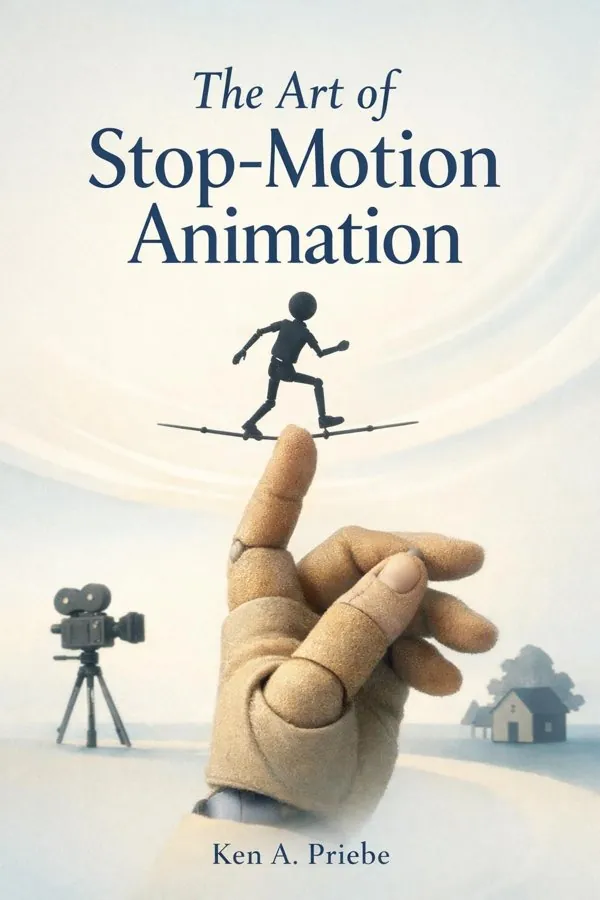
The Art of Stop-Motion Animation: Summary & Key Insights
 10 min9 chaptersAudio available
Key Takeaways from The Art of Stop-Motion Animation
The most surprising truth about stop-motion is that it is not really about movement; it is about creating the illusion of life through stillness.
A puppet is not just a character design brought into three dimensions; it is a machine built for performance.
Audiences do not connect to movement alone; they connect to intention.
In stop-motion, improvisation is expensive.
Stop-motion is often discussed as an animation craft, but Priebe reminds readers that it is equally a cinematographic art.
What Is The Art of Stop-Motion Animation About?
The Art of Stop-Motion Animation by Ken A. Priebe is a performing_arts book. The Art of Stop-Motion Animation by Ken A. Priebe is a practical and inspiring guide to one of the most tactile forms of filmmaking. At its core, the book explains how artists create the illusion of life by moving puppets, objects, or clay figures one frame at a time. But it goes far beyond basic technique. Priebe explores the full creative process behind stop-motion, from concept design and character construction to lighting, camera work, performance, and post-production. The result is both a technical manual and a celebration of an art form that rewards patience, craftsmanship, and imagination. What makes this book valuable is its balance of accessibility and depth. Beginners can use it to understand foundational principles, while more experienced animators can refine their workflow and artistic judgment. Priebe writes with clear affection for the medium and with the credibility of someone who understands both its history and its hands-on realities. In an age dominated by digital tools, this book reminds readers why stop-motion remains uniquely powerful: every frame contains evidence of human touch, deliberate choice, and creative problem-solving.
This FizzRead summary covers all 9 key chapters of The Art of Stop-Motion Animation in approximately 10 minutes, distilling the most important ideas, arguments, and takeaways from Ken A. Priebe's work. Also available as an audio summary and Key Quotes Podcast.
The Art of Stop-Motion Animation
The Art of Stop-Motion Animation by Ken A. Priebe is a practical and inspiring guide to one of the most tactile forms of filmmaking. At its core, the book explains how artists create the illusion of life by moving puppets, objects, or clay figures one frame at a time. But it goes far beyond basic technique. Priebe explores the full creative process behind stop-motion, from concept design and character construction to lighting, camera work, performance, and post-production. The result is both a technical manual and a celebration of an art form that rewards patience, craftsmanship, and imagination.
What makes this book valuable is its balance of accessibility and depth. Beginners can use it to understand foundational principles, while more experienced animators can refine their workflow and artistic judgment. Priebe writes with clear affection for the medium and with the credibility of someone who understands both its history and its hands-on realities. In an age dominated by digital tools, this book reminds readers why stop-motion remains uniquely powerful: every frame contains evidence of human touch, deliberate choice, and creative problem-solving.
Who Should Read The Art of Stop-Motion Animation?
This book is perfect for anyone interested in performing_arts and looking to gain actionable insights in a short read. Whether you're a student, professional, or lifelong learner, the key ideas from The Art of Stop-Motion Animation by Ken A. Priebe will help you think differently.
- ✓Readers who enjoy performing_arts and want practical takeaways
- ✓Professionals looking to apply new ideas to their work and life
- ✓Anyone who wants the core insights of The Art of Stop-Motion Animation in just 10 minutes
Want the full summary?
Get instant access to this book summary and 100K+ more with Fizz Moment.
Get Free SummaryAvailable on App Store • Free to download
Key Chapters
The most surprising truth about stop-motion is that it is not really about movement; it is about creating the illusion of life through stillness. Each frame is a photograph of a tiny adjustment, and when those photographs are played in sequence, viewers perceive intention, emotion, and action. Ken A. Priebe emphasizes that stop-motion is both mechanical and magical: mechanical because it requires precise incremental changes, and magical because those changes can convince an audience that a puppet is thinking, reacting, and feeling.
This idea matters because many beginners focus too quickly on equipment or software and overlook the medium’s deeper principle. Stop-motion works when the animator understands rhythm, timing, spacing, and performance. A character leaning forward by a fraction, hesitating before a gesture, or holding still for an extra frame can communicate far more than exaggerated motion alone. The illusion of life comes from deliberate choices, not from complex technology.
Priebe also shows that stop-motion’s tactile nature gives it a special expressive power. Unlike purely digital animation, every object has material presence. Fabric wrinkles, clay fingerprints, and subtle shifts in texture can add authenticity rather than detract from it. These qualities help the audience feel the artist’s hand behind the work.
In practice, this means animators should begin by studying movement itself. Observe how people blink before speaking, how weight shifts when standing up, or how an object falls differently depending on its material. Then translate those observations into controlled frame-by-frame decisions. A simple ball bounce or head turn can teach the foundations of believable animation better than an ambitious complex scene.
Actionable takeaway: Before attempting a major film, create a short exercise using a basic object and focus entirely on timing, spacing, and intent in each frame.
A puppet is not just a character design brought into three dimensions; it is a machine built for performance. One of Priebe’s key insights is that successful stop-motion begins long before animation starts. The design phase determines what the animator will be able to achieve later. If a character cannot hold poses, maintain balance, or express emotion clearly, no amount of frame-by-frame effort will fully solve those weaknesses.
Priebe explains how puppet construction combines sculpture, engineering, and acting requirements. Armatures must be durable yet flexible. Facial features need to support expression. Costumes have to look natural without restricting motion. Scale affects everything from texture to movement to how light interacts with materials. A beautifully designed puppet that is difficult to animate becomes a liability; a thoughtfully designed puppet becomes a creative partner.
This applies to sets and props as well. A set is not only a background but an environment for action. Doors must open reliably, surfaces must support foot placement, and objects that need to move must do so consistently. Even seemingly minor details, such as how a sleeve bunches or whether hair stays in place between frames, can affect continuity and performance.
For example, a simple walking scene demands that feet grip the set, knees bend smoothly, and the body maintain balance. If the armature is weak or the costume too stiff, the scene becomes frustrating and time-consuming. By contrast, well-planned fabrication saves hours of correction and allows the animator to focus on storytelling.
Actionable takeaway: When designing a puppet or set, test every important action in advance—standing, walking, reaching, turning, and expressing emotion—before committing to final fabrication.
Audiences do not connect to movement alone; they connect to intention. A stop-motion character becomes memorable not because it moves smoothly, but because it appears to think and feel. Priebe stresses that animation is performance, and the animator is effectively both actor and director. Every gesture, pause, glance, and shift in posture tells the audience what is happening inside the character.
This is a vital distinction. Beginners often chase technical smoothness, assuming that more frames or more motion automatically create better animation. But lifeless movement remains lifeless no matter how polished it is. A character that pauses before answering, recoils slightly from a surprise, or hesitates before stepping forward feels alive because those actions imply thought. The illusion of thinking is often more powerful than the action itself.
Priebe encourages animators to study acting principles: motivation, subtext, body language, and emotional clarity. A scene should not merely show what a character does; it should reveal why. For instance, two characters can perform the same action—picking up a cup—but one may do it cautiously, another impatiently. The difference lies in timing, spacing, and physical attitude.
Practical applications include shooting video reference, acting out scenes yourself, and planning emotional beats before animating. Even for nonhuman characters, performance is essential. A monster, robot, or clay creature still needs readable intent. The most successful stop-motion often comes from simplifying gestures to their clearest emotional core.
Actionable takeaway: Before animating any scene, write down the character’s emotional objective in one sentence and let that motivation guide every pose, pause, and transition.
In stop-motion, improvisation is expensive. Because each second of footage may require many minutes or hours of labor, Priebe emphasizes the importance of planning. Storyboards, exposure sheets, animatics, shot lists, and rehearsal are not bureaucratic extras; they are tools that protect creativity from chaos. The better the preparation, the more mental energy the animator can devote to nuance and problem-solving during production.
This does not mean creativity becomes rigid. Rather, structure creates freedom. A storyboard clarifies composition and action. An animatic reveals pacing issues before shooting begins. Exposure sheets help coordinate dialogue, effects, and timing. Shot planning ensures that the crew knows what must be built, lit, and animated for each setup. Without these steps, productions can waste precious time redoing scenes, rebuilding sets, or discovering continuity problems too late.
Priebe shows that pre-production is especially important in stop-motion because changes are harder to make once animation starts. If a puppet is missing needed articulation, if a set wall blocks camera movement, or if lip-sync timing has not been mapped out, fixing the issue on the stage can be disruptive and costly. Planning also reduces the emotional strain of a medium that already demands patience and concentration.
A practical example is dialogue animation. Instead of guessing mouth shapes and timing frame by frame, an animator can break the soundtrack into phonetic beats, test expressions, and create a performance roadmap. The resulting animation is usually more confident and consistent.
Actionable takeaway: Before shooting, create a simple production packet for every scene containing storyboard frames, timing notes, key poses, and any technical concerns you need to solve in advance.
Stop-motion is often discussed as an animation craft, but Priebe reminds readers that it is equally a cinematographic art. The puppet may perform the action, yet the camera decides how the audience experiences it. Lens choice, framing, depth of field, lighting contrast, and camera movement all affect mood, scale, and dramatic clarity. A great animation performance can be weakened by flat visual storytelling, while thoughtful cinematography can elevate a simple action into something compelling.
Lighting is particularly important because stop-motion sets are miniature worlds that must feel believable on screen. Poorly controlled lighting can reveal scale in the wrong way, creating an artificial toy-like appearance. Strategic lighting, by contrast, can enhance texture, define space, and support emotional tone. Warm soft light can create intimacy; hard directional light can create tension or mystery. Consistency matters too, since accidental flicker between frames can distract the viewer and break immersion.
Priebe also addresses technical discipline. Locked camera setups, stable exposure, and controlled white balance are essential for clean footage. At the same time, filmmakers should think artistically. A low angle can make a puppet feel powerful. A close-up can reveal subtle performance. A slow camera move, carefully executed, can make the miniature world feel more cinematic and alive.
For example, a character walking across a set may seem ordinary when shot wide and flatly lit. The same action, framed with shadows and a slight push-in, can feel suspenseful or emotional. Cinematography is not decoration; it is storytelling.
Actionable takeaway: For each scene, decide on one visual intention—such as intimacy, tension, wonder, or comedy—and choose your framing and lighting to reinforce that feeling consistently.
One of the most honest lessons in Priebe’s book is that stop-motion is a medium of constant obstacles. Puppets loosen, sets break, lights shift, software glitches, and continuity errors appear when least convenient. Rather than treating these problems as signs of failure, Priebe presents them as a normal part of the craft. Stop-motion artists succeed not because everything goes smoothly, but because they learn to adapt with patience and ingenuity.
This mindset is crucial. The medium demands persistence because its process is inherently slow and detail-sensitive. A tiny technical issue can interrupt hours of animation. But many of stop-motion’s creative breakthroughs come from practical solutions. Animators develop rigging methods to support jumps and flights, replacement parts for facial expressions, tie-down systems for stable footing, and compositing strategies to remove supports later. Every challenge becomes an opportunity to improve workflow and design.
Priebe also highlights the importance of documentation and consistency. Keeping notes on lighting setups, camera settings, puppet conditions, and scene progress helps prevent small issues from becoming major setbacks. Organized troubleshooting is more effective than improvising under stress. The animator who labels parts, photographs setups, and tracks frame counts is better equipped to recover when something goes wrong.
A useful example is handling a puppet that starts drifting out of balance during a shot. Instead of forcing the scene forward and hoping for the best, a disciplined animator pauses, checks tie-downs, reviews the armature, and corrects the issue before continuing. That moment of caution can save a sequence.
Actionable takeaway: Build a habit of keeping a production log for every shoot day, noting technical settings, problems encountered, and solutions that can be reused on future projects.
Modern tools have transformed stop-motion production, but Priebe makes clear that software is only as effective as the artist using it. Digital cameras, frame-grabbing programs, compositing tools, and editing systems have made the process more efficient and accessible. Animators can preview movement instantly, check continuity, correct exposure, and integrate visual effects with far more control than in earlier eras. Yet these advantages do not eliminate the need for strong fundamentals.
This point matters because technology can create false confidence. Onion-skin previews, motion-control systems, and post-production cleanup can help refine work, but they cannot substitute for understanding timing, character, design, and visual storytelling. An animator who relies too heavily on software correction may end up with technically neat but emotionally weak results. Tools should reduce friction, not replace intention.
Priebe’s balanced perspective is especially useful for independent creators. You do not need the most expensive setup to make meaningful stop-motion. A modest camera, simple lighting, accessible software, and handmade materials can produce excellent work when guided by clear artistic choices. Technology becomes empowering when it is chosen to solve specific problems: stabilizing footage, planning animation, removing rigs, or improving editing flow.
For example, frame-capture software can help an animator compare the current pose to the previous one and avoid accidental bumps. But deciding how far a hand should move, when a character should pause, or how emotion should build still depends on judgment and observation. The technology assists execution; it does not invent the performance.
Actionable takeaway: Choose tools based on the creative or technical problem you need to solve, and spend at least as much time practicing animation principles as learning software features.
Stop-motion becomes richer when artists understand that they are joining a long tradition rather than inventing the form from scratch. Priebe places contemporary practice within the history of stop-motion, connecting early pioneers, studio innovations, independent experimenters, and modern feature filmmakers. This historical context matters because it reveals how the medium has continuously evolved while preserving its handmade core.
Studying the lineage of stop-motion helps animators see that many current techniques emerged through decades of experimentation. Filmmakers solved problems of articulation, replacement animation, effects integration, and puppet fabrication long before today’s digital conveniences existed. Their solutions can still teach modern creators about discipline, ingenuity, and visual storytelling. History also broadens artistic possibility. Stop-motion is not limited to one style; it includes surreal object animation, clay performance, puppet dramas, monster effects, and highly polished commercial productions.
Priebe’s historical perspective encourages respect for craft while also inviting innovation. Artists who know the past can borrow methods intelligently, avoid repeating mistakes, and identify where their own voice fits within the medium. A filmmaker inspired by Ray Harryhausen, Jan Švankmajer, or contemporary studios may discover very different approaches to motion, texture, tone, and narrative.
Practically, this means watching stop-motion analytically rather than passively. Notice how older films handled weight, staging, and camera limitations. Study how different eras approached facial animation or compositing. Such observation builds visual literacy and confidence.
Actionable takeaway: Create a personal study list of stop-motion films from different periods and styles, then analyze one scene from each to identify techniques you can adapt in your own work.
Perhaps the deepest lesson in The Art of Stop-Motion Animation is that this medium rewards endurance. Stop-motion is labor-intensive, repetitive, and often slow to reveal results. Yet this very slowness can become a source of artistic strength. Priebe presents the process as one of sustained attention, where careful incremental effort accumulates into a finished performance and, eventually, a complete film. The animator learns to trust progress that is almost invisible in the moment.
This is why stop-motion attracts creators who value craftsmanship. Every second on screen represents many decisions made with patience: adjusting a finger, correcting a shadow, checking a frame, rebalancing a puppet, refining a pose. That discipline shapes the artist as much as the artwork. It teaches observation, resilience, and commitment to detail. In a culture that often rewards speed, stop-motion stands as a reminder that some forms of expression become more meaningful precisely because they take time.
Priebe does not romanticize the effort; he acknowledges the frustrations. But he also shows that persistence is what transforms ambition into skill. Short exercises lead to more control. Small completed projects build confidence. Over time, the animator develops both technical fluency and a personal style. The handmade quality of stop-motion becomes the visible record of that perseverance.
A practical application is to think in milestones rather than masterpieces. Completing a ten-second test, then a one-minute scene, is often more valuable than starting an elaborate project that never finishes. Momentum matters.
Actionable takeaway: Set a realistic stop-motion project you can complete within a defined timeframe, and prioritize finishing it fully so you gain the experience of carrying a film from idea to final render.
All Chapters in The Art of Stop-Motion Animation
About the Author
Ken A. Priebe is an animation artist, writer, and educator best known for his work in explaining and promoting the craft of stop-motion animation. He has built a reputation for making a highly specialized medium understandable to students, filmmakers, and enthusiasts without losing its technical richness. His expertise spans animation principles, production workflow, puppet performance, and the history of stop-motion as an evolving art form. Priebe’s teaching-oriented approach is especially valued because he combines practical instruction with genuine enthusiasm for handmade filmmaking. Through The Art of Stop-Motion Animation, he has helped readers appreciate both the discipline and the creative joy behind frame-by-frame filmmaking, establishing himself as a trusted guide for anyone interested in how stop-motion comes to life.
Get This Summary in Your Preferred Format
Read or listen to the The Art of Stop-Motion Animation summary by Ken A. Priebe anytime, anywhere. FizzRead offers multiple formats so you can learn on your terms — all free.
Available formats: App · Audio · PDF · EPUB — All included free with FizzRead
Download The Art of Stop-Motion Animation PDF and EPUB Summary
Key Quotes from The Art of Stop-Motion Animation
“The most surprising truth about stop-motion is that it is not really about movement; it is about creating the illusion of life through stillness.”
“A puppet is not just a character design brought into three dimensions; it is a machine built for performance.”
“Audiences do not connect to movement alone; they connect to intention.”
“In stop-motion, improvisation is expensive.”
“Stop-motion is often discussed as an animation craft, but Priebe reminds readers that it is equally a cinematographic art.”
Frequently Asked Questions about The Art of Stop-Motion Animation
The Art of Stop-Motion Animation by Ken A. Priebe is a performing_arts book that explores key ideas across 9 chapters. The Art of Stop-Motion Animation by Ken A. Priebe is a practical and inspiring guide to one of the most tactile forms of filmmaking. At its core, the book explains how artists create the illusion of life by moving puppets, objects, or clay figures one frame at a time. But it goes far beyond basic technique. Priebe explores the full creative process behind stop-motion, from concept design and character construction to lighting, camera work, performance, and post-production. The result is both a technical manual and a celebration of an art form that rewards patience, craftsmanship, and imagination. What makes this book valuable is its balance of accessibility and depth. Beginners can use it to understand foundational principles, while more experienced animators can refine their workflow and artistic judgment. Priebe writes with clear affection for the medium and with the credibility of someone who understands both its history and its hands-on realities. In an age dominated by digital tools, this book reminds readers why stop-motion remains uniquely powerful: every frame contains evidence of human touch, deliberate choice, and creative problem-solving.
You Might Also Like

Harriet Tubman: Live in Concert
Bob the Drag Queen
10 min
The Art of Stagecraft
Robert Edmond Jones
10 min
Thunderstorm
Cao Yu
10 min
Acting In Film: An Actor's Take on Movie Making
Michael Caine
10 min
Character Animation Crash Course!
Eric Goldberg
10 min
Dance as Medicine: The Story of Healing Dance
Anna Halprin
10 minBrowse by Category
Ready to read The Art of Stop-Motion Animation?
Get the full summary and 100K+ more books with Fizz Moment.