
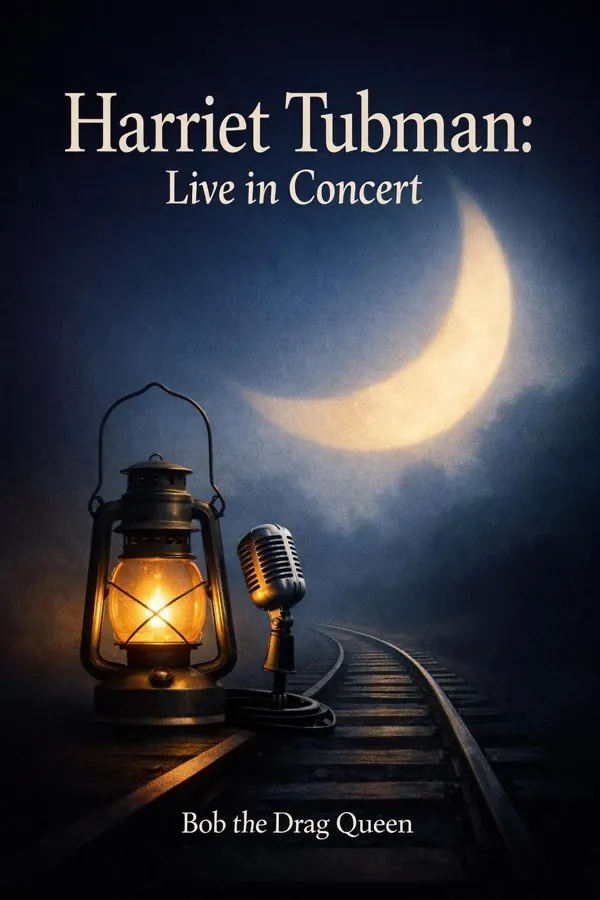
Harriet Tubman: Live in Concert: Summary & Key Insights
 10 min9 chaptersAudio available
Key Takeaways from Harriet Tubman: Live in Concert
Sometimes the fastest way to expose a cultural lie is to exaggerate it until everyone can see the absurdity.
Heroes become easier to admire when they are no longer allowed to surprise us.
History does not reach most people in raw form; it arrives staged, edited, narrated, and performed.
Many people assume that if something is funny, it cannot also be serious.
Who gets celebrated in a culture tells you what that culture rewards.
What Is Harriet Tubman: Live in Concert About?
Harriet Tubman: Live in Concert by Bob the Drag Queen is a performing_arts book. What if one of the most revered figures in American history returned not as a statue or chapter heading, but as a modern recording artist ready to drop an album? That audacious premise powers Harriet Tubman: Live in Concert, Bob the Drag Queen’s inventive, genre-bending work of satire, performance, and cultural criticism. Framed around the idea that Harriet Tubman is preparing a music project for today’s audiences, the book uses comedy to ask serious questions about memory, celebrity, race, activism, and the ways America packages Black heroes for consumption while often ignoring the fullness of their humanity. The result is funny, sharp, and unexpectedly moving. Bob the Drag Queen brings unusual authority to this material: as an acclaimed performer, writer, comedian, and cultural commentator, he understands both the mechanics of entertainment and the politics of representation. That dual perspective allows him to turn humor into a tool for historical reflection. This is not a conventional biography of Tubman. It is a bold reimagining that invites readers to laugh, think harder, and reconsider how public figures are transformed into symbols, brands, and myths.
This FizzRead summary covers all 9 key chapters of Harriet Tubman: Live in Concert in approximately 10 minutes, distilling the most important ideas, arguments, and takeaways from Bob the Drag Queen's work. Also available as an audio summary and Key Quotes Podcast.
Harriet Tubman: Live in Concert
What if one of the most revered figures in American history returned not as a statue or chapter heading, but as a modern recording artist ready to drop an album? That audacious premise powers Harriet Tubman: Live in Concert, Bob the Drag Queen’s inventive, genre-bending work of satire, performance, and cultural criticism. Framed around the idea that Harriet Tubman is preparing a music project for today’s audiences, the book uses comedy to ask serious questions about memory, celebrity, race, activism, and the ways America packages Black heroes for consumption while often ignoring the fullness of their humanity. The result is funny, sharp, and unexpectedly moving. Bob the Drag Queen brings unusual authority to this material: as an acclaimed performer, writer, comedian, and cultural commentator, he understands both the mechanics of entertainment and the politics of representation. That dual perspective allows him to turn humor into a tool for historical reflection. This is not a conventional biography of Tubman. It is a bold reimagining that invites readers to laugh, think harder, and reconsider how public figures are transformed into symbols, brands, and myths.
Who Should Read Harriet Tubman: Live in Concert?
This book is perfect for anyone interested in performing_arts and looking to gain actionable insights in a short read. Whether you're a student, professional, or lifelong learner, the key ideas from Harriet Tubman: Live in Concert by Bob the Drag Queen will help you think differently.
- ✓Readers who enjoy performing_arts and want practical takeaways
- ✓Professionals looking to apply new ideas to their work and life
- ✓Anyone who wants the core insights of Harriet Tubman: Live in Concert in just 10 minutes
Want the full summary?
Get instant access to this book summary and 100K+ more with Fizz Moment.
Get Free SummaryAvailable on App Store • Free to download
Key Chapters
Sometimes the fastest way to expose a cultural lie is to exaggerate it until everyone can see the absurdity. Harriet Tubman: Live in Concert begins with a deliberately outrageous premise: Harriet Tubman, abolitionist hero and Underground Railroad conductor, is now a contemporary music artist preparing to release a live album. On the surface, the setup is comic nonsense. Underneath, it becomes a razor-sharp commentary on how modern culture repackages historical figures into marketable products. Bob the Drag Queen uses satire not to trivialize Tubman, but to reveal how American society often prefers safe, simplified icons over complicated human beings.
The book’s humor works because it targets familiar habits. We turn revolutionaries into inspirational quotes, political struggles into museum gift-shop language, and radical lives into digestible brand identities. By imagining Tubman navigating entertainment culture, publicity, and performance expectations, Bob highlights the strange distance between what Tubman actually did and how she is commonly remembered. The joke lands because it is uncomfortably plausible: in a media ecosystem driven by spectacle, even liberation history can be treated like content.
This idea has practical implications beyond literature. Satire can help readers question sanitized narratives in schools, social media, and public institutions. When a company uses civil rights imagery to sell products, or when a holiday speech flattens historical struggle into generic inspiration, the book gives us a framework for seeing that distortion more clearly.
Actionable takeaway: The next time you encounter a polished, inspirational version of a historical figure, ask what complexity has been removed to make that version easy to consume.
Heroes become easier to admire when they are no longer allowed to surprise us. One of the book’s strongest achievements is its refusal to leave Harriet Tubman frozen in the role of distant saint. Instead of presenting her as a fixed monument, Bob the Drag Queen imagines her as a living presence with taste, opinions, timing, attitude, and agency. That creative move matters because public memory often transforms extraordinary people into static symbols. They become important, but not alive.
By placing Tubman in an obviously modern and theatrical setting, the book restores a sense of unpredictability to her image. Readers are pushed to consider not just what Tubman represents, but who she might be if allowed full personhood in the present tense. This is especially important for Black historical figures, who are often honored in ways that strip away wit, contradiction, ambition, anger, and individuality. Reverence can become its own kind of erasure.
Seeing Tubman as more than a symbol encourages better engagement with history. In classrooms, for example, a person-centered approach invites students to think about motives, risks, and decisions rather than memorizing names and dates. In public culture, it reminds us that real courage is not abstract. It is enacted by people who improvise under pressure, make mistakes, and persist anyway.
The book suggests that honoring someone properly means resisting simplification. Tubman was not powerful because she fit neatly into a moral lesson. She was powerful because she changed the world through bold, dangerous action.
Actionable takeaway: When learning about any celebrated figure, look for sources that restore their personality, conflict, and complexity instead of repeating only their most polished legend.
History does not reach most people in raw form; it arrives staged, edited, narrated, and performed. Harriet Tubman: Live in Concert understands that public memory is built as much through performance as through documentation. The concert framing is not merely a comic gimmick. It is the book’s central method for exploring how societies decide who gets remembered, how they get remembered, and what emotional register their memory must occupy.
A concert is carefully constructed. There is branding, lighting, sequencing, audience expectation, image management, and emotional payoff. By imagining Tubman in that format, Bob the Drag Queen draws attention to the performative layers already surrounding historical remembrance. Think of school assemblies, national holidays, museum exhibitions, biopics, and social media posts. All of them shape memory through choices about tone, emphasis, and spectacle. They tell us whether to feel reverence, guilt, pride, or distance.
The book asks readers to notice that these choices are never neutral. If a radical abolitionist is remembered only as an inspirational symbol of perseverance, her political edge may be dulled. If her life is framed as uplifting rather than disruptive, audiences can admire her without confronting the systems she fought. Performance can preserve history, but it can also tame it.
This insight is useful for artists, educators, and readers alike. Anyone presenting history should ask not only, “Is this accurate?” but also, “What kind of experience am I creating, and what does it encourage people to forget?” The format of a story can quietly reshape its meaning.
Actionable takeaway: Pay attention to how historical stories are presented, not just what facts they contain, because presentation often determines the lesson people actually absorb.
Many people assume that if something is funny, it cannot also be serious. This book proves the opposite. Harriet Tubman: Live in Concert uses comedy not to diminish a historical icon, but to engage her with more energy, urgency, and honesty than solemn treatment sometimes allows. Bob the Drag Queen recognizes that reverence without imagination can become lifeless. Humor, when used intelligently, can open audiences to reflection that a purely earnest tone might never reach.
The book’s comedic voice works because it understands the difference between laughing at Harriet Tubman and using laughter to critique the culture around her. The real target is the machinery of modern fame, historical simplification, and the performative ways institutions celebrate Black excellence. Comedy creates enough distance for readers to recognize absurd patterns they may otherwise accept as normal. Once they laugh, they are more prepared to see the critique underneath.
This balance is especially valuable in conversations about race and history, where fear of saying the wrong thing can make discussion stiff or superficial. Humor can lower defensiveness while preserving moral seriousness. A teacher, performer, or writer can use wit to ask difficult questions about appropriation, hero worship, or selective memory without making audiences shut down.
The lesson extends beyond this book. Not every meaningful engagement with history must look like a lecture or memorial. Art can be playful and respectful at once. In fact, playfulness can be the very thing that keeps historical memory alive rather than embalmed.
Actionable takeaway: Do not dismiss a work because it is funny; ask instead what the humor is doing, whom it protects, and what truths it allows people to confront.
Who gets celebrated in a culture tells you what that culture rewards. By placing Harriet Tubman inside the machinery of contemporary entertainment, the book shines a bright light on modern celebrity itself. The absurdity of imagining Tubman as a music star reveals how public attention today is often organized around visibility, branding, virality, and image maintenance rather than sacrifice, moral courage, or political impact. The contrast is funny, but it is also damning.
Tubman’s historical significance came from risking her life repeatedly to lead enslaved people to freedom and support abolitionist struggle. In a celebrity framework, however, public value is measured through audience metrics, marketability, and personal narrative packaging. Bob the Drag Queen uses this mismatch to expose a deeper problem: society often admires transformative people only after they can be made legible in familiar entertainment terms. We want heroes, but we want them mediated through forms we already know how to consume.
This critique applies widely. Activists are often expected to become charismatic brands. Social causes get distilled into slogans. Public figures are asked to be inspirational, relatable, and monetizable all at once. In the process, substance can be replaced by optics. The book challenges readers to consider how many of their own judgments are shaped by publicity logic rather than ethical substance.
In everyday life, this means becoming more intentional about whom we amplify and why. Do we reward polish over principle? Visibility over service? Emotional performance over material action? The questions are uncomfortable, which is precisely why the satire matters.
Actionable takeaway: Reevaluate the people and causes you celebrate by asking whether your attention is being guided by genuine impact or by the seductions of branding and fame.
A society often reveals its anxieties through the version of history it finds easiest to consume. Harriet Tubman: Live in Concert repeatedly points to the tension between Black historical truth and the sanitized forms through which mainstream culture prefers to encounter it. Harriet Tubman is widely admired, but often in ways that soften the revolutionary implications of her life. She becomes admirable without remaining disruptive.
Bob the Drag Queen’s approach pushes against that sanitization. By making the framing intentionally contemporary and exaggerated, he highlights the absurd ways institutions commodify Black history while sidestepping the systems of violence, exploitation, and resistance that gave that history its meaning. The book asks readers to notice how quickly struggle gets turned into inspiration, how readily danger becomes symbolism, and how often radical action is converted into classroom-safe mythology.
This matters because sanitization changes not just tone but politics. If Tubman is remembered merely as brave and determined, without sustained attention to slavery, white supremacy, abolition, and collective liberation, readers may miss the structural context of her courage. They are left with a motivational story instead of a challenge to present-day injustice.
The book therefore encourages a more demanding form of remembrance. Museums, schools, book clubs, and families can all put this into practice by pairing celebration with complexity: not only honoring Black achievements, but also studying the systems they confronted and the unfinished struggles that remain.
Actionable takeaway: When engaging with Black history, go beyond inspirational highlights and seek the political, social, and moral realities that made those lives necessary and transformative.
Facts are essential, but imagination can sometimes get us closer to meaning. One of the boldest strengths of Harriet Tubman: Live in Concert is its willingness to use imaginative speculation as a form of criticism. Rather than offering a straightforward historical account, Bob the Drag Queen constructs an alternate artistic scenario and lets that invented world illuminate real cultural habits. In doing so, he shows that imagination is not the enemy of serious thought; it can be one of its sharpest instruments.
Imagining Tubman as a performer allows the book to test contemporary assumptions. How would the culture market her? What parts of her story would be highlighted, softened, or ignored? How would audiences react to her if she were not safely located in the past? These speculative questions expose real patterns in the present. The invented frame becomes a stress test for collective values.
This method has practical value well beyond literature. Teachers can use speculative exercises to help students think critically about historical memory. Artists can reframe familiar narratives to uncover hidden power structures. Readers can use imaginative comparison to interrogate modern institutions. For example, asking how a radical figure from the past would be treated by today’s media can reveal what current media ecosystems truly prioritize.
Importantly, the book models imagination with purpose. Its flights of creativity are not random. They are anchored in critique, sharpened by cultural observation, and directed toward deeper understanding. That is what makes the project more than a joke.
Actionable takeaway: Use imaginative questions as a way to probe reality more deeply, especially when conventional ways of discussing history or politics have become too familiar to challenge assumptions.
Some conversations become so formalized that they stop producing insight. Harriet Tubman: Live in Concert demonstrates how art can reopen difficult public discussions by changing the terms of engagement. Topics like slavery, racial memory, hero worship, and cultural appropriation can easily become trapped in predictable scripts. People either speak in rehearsed moral language or avoid the subject altogether. Bob the Drag Queen breaks that pattern through an artistic frame that is playful, surprising, and disruptive.
Because the book does not look like a standard historical discussion, it creates fresh pathways into familiar material. Readers who might resist a lecture may engage with a satire. Audiences accustomed to passive admiration are pushed into active interpretation. The form itself becomes an intervention, inviting discomfort, laughter, curiosity, and reflection in quick succession.
This points to a larger lesson about the social role of art. Art does not merely illustrate arguments after the fact. It can generate new kinds of attention. A performance, novel, or comic premise can destabilize inherited habits of thought and make neglected questions feel immediate again. That is especially useful when dealing with issues that institutions have rendered ceremonial or emotionally distant.
For practitioners in education, activism, and the arts, the book offers a model: if people are no longer hearing an important message, the answer may not be to repeat it louder, but to redesign the experience through which they encounter it. Form can be a political choice.
Actionable takeaway: When a crucial conversation feels stale or ineffective, experiment with a new artistic or narrative frame that can help people see the issue with renewed attention.
Memory is not passive inheritance; it is an active ethical practice. Beneath its wit and theatrical energy, Harriet Tubman: Live in Concert asks a serious question: what do we owe the people we claim to honor? Remembering a figure like Harriet Tubman is not simply a matter of praising her courage. It requires responsibility in how we narrate her life, deploy her image, and connect her legacy to the present.
The book suggests that remembrance becomes irresponsible when it turns historical people into convenient symbols detached from their actual stakes. Tubman’s life involved danger, resistance, political conviction, and material action. To remember her well means preserving those dimensions rather than settling for abstract admiration. This is not only about accuracy. It is about whether memory sharpens our moral imagination or lulls it to sleep.
In practical terms, responsible remembrance means asking better questions. Are we invoking historical figures to learn from them, or to make ourselves feel virtuous? Are institutions honoring Black history in ways that challenge ongoing injustice, or merely showcasing diversity? Are readers engaging with Tubman as a radical actor, or as a comforting emblem of goodness?
The book does not provide a rigid formula, but it does insist that memory has consequences. The stories we repeat shape what we believe courage looks like, what kinds of action we consider possible, and what obligations we feel toward the present.
Actionable takeaway: Treat historical remembrance as a responsibility by connecting admiration to deeper study, honest context, and present-day action rather than leaving it at symbolic respect.
All Chapters in Harriet Tubman: Live in Concert
About the Author
Bob the Drag Queen is a performer, comedian, writer, actor, and activist whose work combines sharp humor with pointed cultural insight. Rising to international prominence after winning the eighth season of RuPaul’s Drag Race, Bob has since built a multifaceted career across live touring, television, podcasting, and literary work. Known for his bold stage presence and quick intelligence, he often explores issues of race, identity, politics, and performance through comedy. His voice stands out for its ability to be both entertaining and incisive at once. In Harriet Tubman: Live in Concert, Bob brings his deep understanding of spectacle, audience, and representation to a highly original reimagining of historical memory. He is widely regarded as one of the most thoughtful and influential figures in contemporary drag and queer popular culture.
Get This Summary in Your Preferred Format
Read or listen to the Harriet Tubman: Live in Concert summary by Bob the Drag Queen anytime, anywhere. FizzRead offers multiple formats so you can learn on your terms — all free.
Available formats: App · Audio · PDF · EPUB — All included free with FizzRead
Download Harriet Tubman: Live in Concert PDF and EPUB Summary
Key Quotes from Harriet Tubman: Live in Concert
“Sometimes the fastest way to expose a cultural lie is to exaggerate it until everyone can see the absurdity.”
“Heroes become easier to admire when they are no longer allowed to surprise us.”
“History does not reach most people in raw form; it arrives staged, edited, narrated, and performed.”
“Many people assume that if something is funny, it cannot also be serious.”
“Who gets celebrated in a culture tells you what that culture rewards.”
Frequently Asked Questions about Harriet Tubman: Live in Concert
Harriet Tubman: Live in Concert by Bob the Drag Queen is a performing_arts book that explores key ideas across 9 chapters. What if one of the most revered figures in American history returned not as a statue or chapter heading, but as a modern recording artist ready to drop an album? That audacious premise powers Harriet Tubman: Live in Concert, Bob the Drag Queen’s inventive, genre-bending work of satire, performance, and cultural criticism. Framed around the idea that Harriet Tubman is preparing a music project for today’s audiences, the book uses comedy to ask serious questions about memory, celebrity, race, activism, and the ways America packages Black heroes for consumption while often ignoring the fullness of their humanity. The result is funny, sharp, and unexpectedly moving. Bob the Drag Queen brings unusual authority to this material: as an acclaimed performer, writer, comedian, and cultural commentator, he understands both the mechanics of entertainment and the politics of representation. That dual perspective allows him to turn humor into a tool for historical reflection. This is not a conventional biography of Tubman. It is a bold reimagining that invites readers to laugh, think harder, and reconsider how public figures are transformed into symbols, brands, and myths.
You Might Also Like
The Art of Stagecraft
Robert Edmond Jones
10 min
The Art of Stop-Motion Animation
Ken A. Priebe
10 min
Thunderstorm
Cao Yu
10 min
Acting In Film: An Actor's Take on Movie Making
Michael Caine
10 min
Character Animation Crash Course!
Eric Goldberg
10 min
Dance as Medicine: The Story of Healing Dance
Anna Halprin
10 minBrowse by Category
Ready to read Harriet Tubman: Live in Concert?
Get the full summary and 100K+ more books with Fizz Moment.