
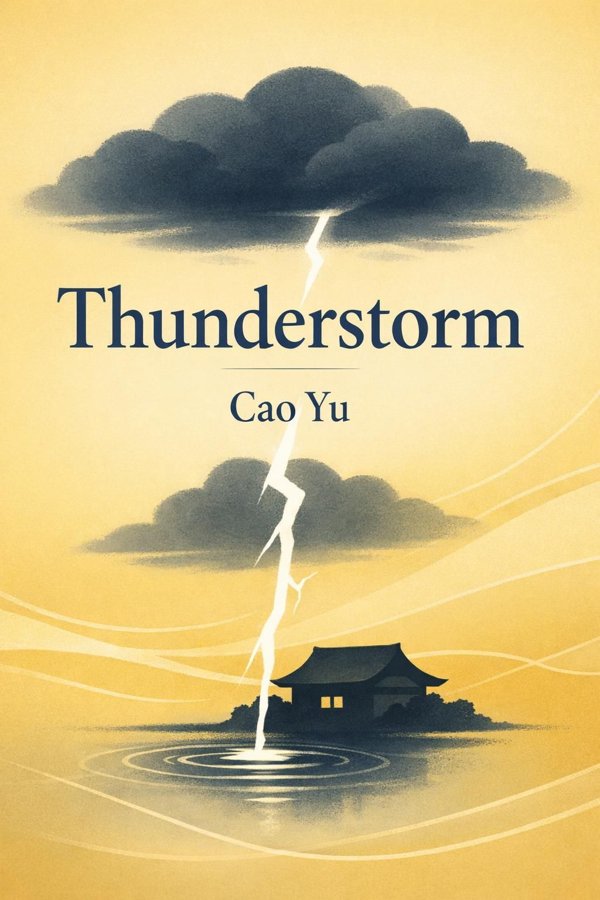
Thunderstorm: Summary & Key Insights
by Cao Yu
 10 min8 chaptersAudio available
Key Takeaways from Thunderstorm
The most dangerous storms often begin long before anyone hears thunder.
Authority without self-knowledge becomes a form of violence.
Human beings suffer when social roles leave no room for honest feeling.
Tragedy becomes especially cruel when some people have the power to define whose pain counts.
The stage can reveal truths that polite society works hard to conceal.
What Is Thunderstorm About?
Thunderstorm by Cao Yu is a performing_arts book. What begins as a family drama in Thunderstorm quickly deepens into one of modern Chinese literature’s most devastating portraits of power, secrecy, and moral collapse. Written by Cao Yu in 1933, this landmark play unfolds inside a wealthy household whose polished surface hides years of emotional cruelty, class oppression, and buried guilt. As old relationships resurface and hidden histories collide, the play builds toward a tragic reckoning that feels at once intimate and socially sweeping. Thunderstorm matters because it is far more than a melodrama: it is a fierce examination of patriarchy, hypocrisy, and the destructive consequences of a rigid social order. Cao Yu, widely regarded as one of the founding masters of modern Chinese drama, brought psychological depth and theatrical precision to the Chinese stage at a moment of major cultural change. His command of dialogue, character conflict, and dramatic structure makes Thunderstorm both a gripping performance text and a lasting work of social criticism. For readers, students, and theater lovers, it remains an essential play for understanding how private wounds and public systems can destroy lives together.
This FizzRead summary covers all 8 key chapters of Thunderstorm in approximately 10 minutes, distilling the most important ideas, arguments, and takeaways from Cao Yu's work. Also available as an audio summary and Key Quotes Podcast.
Thunderstorm
What begins as a family drama in Thunderstorm quickly deepens into one of modern Chinese literature’s most devastating portraits of power, secrecy, and moral collapse. Written by Cao Yu in 1933, this landmark play unfolds inside a wealthy household whose polished surface hides years of emotional cruelty, class oppression, and buried guilt. As old relationships resurface and hidden histories collide, the play builds toward a tragic reckoning that feels at once intimate and socially sweeping. Thunderstorm matters because it is far more than a melodrama: it is a fierce examination of patriarchy, hypocrisy, and the destructive consequences of a rigid social order. Cao Yu, widely regarded as one of the founding masters of modern Chinese drama, brought psychological depth and theatrical precision to the Chinese stage at a moment of major cultural change. His command of dialogue, character conflict, and dramatic structure makes Thunderstorm both a gripping performance text and a lasting work of social criticism. For readers, students, and theater lovers, it remains an essential play for understanding how private wounds and public systems can destroy lives together.
Who Should Read Thunderstorm?
This book is perfect for anyone interested in performing_arts and looking to gain actionable insights in a short read. Whether you're a student, professional, or lifelong learner, the key ideas from Thunderstorm by Cao Yu will help you think differently.
- ✓Readers who enjoy performing_arts and want practical takeaways
- ✓Professionals looking to apply new ideas to their work and life
- ✓Anyone who wants the core insights of Thunderstorm in just 10 minutes
Want the full summary?
Get instant access to this book summary and 100K+ more with Fizz Moment.
Get Free SummaryAvailable on App Store • Free to download
Key Chapters
The most dangerous storms often begin long before anyone hears thunder. In Thunderstorm, Cao Yu shows that tragedy does not arrive suddenly; it grows from secrets that have been hidden, normalized, and protected over many years. The Zhou household appears orderly and respectable, but beneath that image lies a history of exploitation, emotional violence, and concealed relationships. The plot’s power comes from the gradual revelation that what the family refuses to confront is exactly what will destroy it.
Cao Yu uses secrecy not merely as a dramatic device, but as a moral condition. Characters hide facts to protect status, avoid shame, preserve control, or escape accountability. Yet every secret distorts relationships. Parents cannot love honestly, children cannot understand themselves, and servants cannot speak freely. The household becomes a structure organized around silence. In such a world, misunderstanding is not accidental; it is built into the system.
This idea extends beyond the stage. Families, workplaces, and institutions often collapse not because of one isolated scandal, but because difficult truths were buried for too long. A company that hides harassment, a family that refuses to address abuse, or a community that protects appearance over honesty creates conditions for greater harm. Thunderstorm reminds us that silence can feel protective in the short term while becoming catastrophic in the long term.
As a reader or viewer, one practical way to engage with this theme is to notice how often conflict in real life intensifies when people defend reputation rather than truth. The play encourages hard but necessary reflection: what are people preserving when they say, "let us not talk about it"?
Actionable takeaway: Identify one unresolved silence in your own life or organization and ask what damage its continued concealment may be causing.
Authority without self-knowledge becomes a form of violence. At the center of Thunderstorm stands the patriarchal figure whose wealth and social dominance shape the emotional climate of the entire household. His power reaches beyond rules and commands; it determines what can be said, who can desire, who must obey, and whose suffering is dismissed. Cao Yu presents patriarchy not as abstract ideology but as daily practice: control over women, class hierarchy, moral double standards, and emotional coldness dressed up as order.
What makes the play so compelling is that patriarchal authority damages everyone, not only those most visibly oppressed. Women are constrained, judged, and used. Younger men inherit confusion, resentment, and moral weakness. Servants become vulnerable to exploitation. Even the patriarch himself is trapped inside a model of dominance that prevents remorse, intimacy, and honesty. The result is not stability, but decay.
This is one reason Thunderstorm still feels contemporary. Many modern institutions continue to reward domination while calling it leadership. In families, workplaces, and politics, a single controlling figure can create fear-based loyalty that suppresses truth. People around such authority figures often become skilled at compliance rather than integrity. The play reveals how systems built on obedience can look efficient while being morally rotten.
A useful application is to examine how power operates in ordinary settings. Who gets interrupted? Who must absorb blame? Who is expected to remain silent for the sake of harmony? Thunderstorm shows that unequal power is never only structural; it is emotional and psychological.
Actionable takeaway: In any group you belong to, pay attention to whether authority invites truth or merely demands compliance, and challenge systems that confuse control with care.
Human beings suffer when social roles leave no room for honest feeling. One of Thunderstorm’s deepest tensions lies in the clash between desire and duty. Characters long for love, recognition, freedom, and dignity, yet they are trapped by obligations imposed by family position, gender expectations, and social respectability. Cao Yu does not romanticize desire, but he does show that when people are denied the ability to express it truthfully, longing becomes distorted and dangerous.
The play’s emotional intensity comes from this pressure. People reach toward one another not in a healthy landscape of mutual understanding, but inside a world arranged by hierarchy and secrecy. Love is entangled with shame. Attraction is entangled with ignorance. Duty becomes less a moral commitment than a social prison. By placing personal yearning inside a rigid household structure, Cao Yu turns intimate emotion into a force that exposes the cruelty of the system itself.
This conflict has broad relevance. Many people still live between what they feel and what they are allowed to admit. Someone may stay in a lifeless career because family expectation demands it, remain silent in a harmful relationship to protect appearances, or suppress identity to avoid social punishment. Thunderstorm helps explain why such repression rarely produces peace. What is denied tends to return in more destructive forms: bitterness, impulsiveness, deception, or despair.
Readers can apply this insight by distinguishing between responsibility and performance. True duty should not require self-erasure. The play invites us to ask whether the roles we play are ethically meaningful or merely inherited scripts.
Actionable takeaway: Reflect on one area where you are performing obligation at the cost of emotional truth, and consider one honest conversation or decision that could reduce that gap.
Tragedy becomes especially cruel when some people have the power to define whose pain counts. In Thunderstorm, class is not just background; it is one of the engines of the plot. The wealthy household depends on the labor and subordination of servants and socially vulnerable people, and those unequal conditions shape every relationship. Cao Yu shows that intimacy across class lines is never innocent in such a world. Affection, pity, dependency, exploitation, and resentment become inseparable.
What makes the play powerful is its refusal to isolate private wrongdoing from social structure. The suffering of lower-status characters is not simply the result of personal bad luck. It is linked to a system in which wealth shields some people from consequences while leaving others exposed to humiliation, economic precarity, and coercion. Even acts that seem personal are conditioned by class hierarchy: who can leave, who must endure, who can speak openly, and who must swallow injustice.
This theme remains urgently relevant. In modern life, class differences still shape access to safety, privacy, legal protection, education, and dignity. A household worker with limited options, an employee dependent on a powerful boss, or a tenant facing an abusive landlord may experience constraints that wealthier people barely notice. Thunderstorm pushes readers to see that moral analysis is incomplete unless it includes material inequality.
A practical way to use this insight is to look at how class affects communication and choice in any environment. Are some people free to make mistakes while others pay permanently? Are emotional harms compounded by economic dependence? The play teaches that justice requires more than sympathy; it requires attention to structure.
Actionable takeaway: When evaluating any conflict, ask not only who acted wrongly, but also how power and economic dependence limited what each person could realistically choose.
No matter how carefully people manage appearances, unresolved history returns. A central insight of Thunderstorm is that the past is not over simply because it has been suppressed. Cao Yu constructs the play so that earlier actions continue shaping present relationships, often in ways characters do not fully understand until it is too late. Memory in the play is not nostalgic; it is active, dangerous, and morally demanding.
This gives the drama its sense of inevitability. Characters try to live forward while refusing to account for what happened before. But past choices have already organized the present: they determine loyalties, identities, resentments, and vulnerabilities. What looks like sudden catastrophe is, in fact, accumulated history surfacing all at once. The storm is tragic precisely because it was preventable, though no one chose prevention.
The idea applies far beyond literature. Personal trauma, family patterns, institutional wrongdoing, and historical injustice all tend to reappear when they are denied rather than addressed. A family that never discusses an old betrayal may unconsciously repeat its emotional habits across generations. A company that avoids accountability after misconduct often reproduces the same culture. A society that refuses historical reckoning may preserve old hierarchies under new language.
Thunderstorm encourages a disciplined way of reading events: ask what earlier conditions made the present crisis possible. This approach leads to deeper understanding and better judgment. It also invites humility, because current conflict is often rooted in causes that were normalized long before the visible breakdown.
Actionable takeaway: When facing a recurring problem in your life or work, trace it back at least one stage earlier and identify the unresolved past condition that keeps reproducing the present crisis.
Catastrophe is often the final expression of behaviors people have long considered normal. One of the most unsettling aspects of Thunderstorm is that its tragedy grows not only from extreme events, but from ordinary habits of domination, dismissal, silence, and emotional neglect. Cao Yu shows how everyday cruelty accumulates. A harsh word, a denied truth, a command issued without empathy, a person treated as disposable: these are not minor details. They are the atmosphere in which disaster becomes possible.
This is why the play feels so morally piercing. Its characters are not destroyed solely by fate in a mystical sense. They are destroyed by patterns that could have been interrupted earlier if anyone had chosen honesty, compassion, or accountability. Tragedy here is social and ethical before it is dramatic. The thunderstorm is spectacular, but the climate that produced it is painfully familiar.
In modern life, we often reserve moral concern for visibly dramatic wrongdoing while overlooking the small, repeated actions that make harm ordinary. A manager humiliates staff in meetings. A parent rules through fear. A family member is consistently scapegoated. A household worker is treated with cool contempt. Each act may seem manageable in isolation, yet together they create a system of injury.
The play’s practical lesson is to take daily conduct seriously. Culture is built from repetition. Respect is not measured in declarations but in patterns. If we wait for an obvious crisis before changing behavior, we are usually too late.
Actionable takeaway: Examine one routine interaction in your life where impatience or hierarchy has become normalized, and replace one damaging habit with a more truthful and humane practice this week.
The more rooted a story is in a specific world, the more powerfully it can speak across cultures. Thunderstorm is deeply shaped by early twentieth-century Chinese society, yet its emotional and ethical force extends far beyond that setting. Readers across time recognize its central concerns: family conflict, social shame, misuse of authority, longing for freedom, and the devastating cost of concealed truth. Cao Yu achieves universality not by being vague, but by being precise.
This precision is one reason the play continues to be read, taught, translated, and performed. Audiences do not need to share the exact historical circumstances to understand the dread of living in a household ruled by fear, the confusion created by hidden histories, or the pain of relationships damaged by power imbalance. The play offers both cultural specificity and human recognition.
For students of literature and theater, this provides an important lesson. Great works endure when they connect structural critique with emotional depth. Thunderstorm is not memorable simply because it addresses social issues; it is memorable because those issues are embodied in living, contradictory characters whose desires and failures feel real. That combination gives the play its longevity.
A practical application for readers is to approach classics not as museum objects but as active conversations. Ask what in the work still feels current, what feels historically specific, and how the two illuminate each other. Thunderstorm rewards that kind of reading especially well.
Actionable takeaway: When reading a classic, identify one conflict that belongs to its original era and one that still exists today, then use that comparison to deepen your understanding of both history and the present.
All Chapters in Thunderstorm
About the Author
Cao Yu (1910-1996) was one of the most influential playwrights in modern Chinese literature and a foundational figure in the development of spoken drama in China. Born Wan Jiabao, he studied at Tsinghua University and emerged in the 1930s as a major literary voice during a period of intense cultural and political change. His breakthrough play, Thunderstorm, established his reputation through its blend of psychological realism, social criticism, and strong theatrical craft. He later wrote other important plays, including Sunrise and The Wilderness. Cao Yu’s work helped modernize Chinese theater by bringing contemporary themes, layered characterization, and dramatic structure to the stage. He remains widely studied for his enduring impact on modern drama and literary history.
Get This Summary in Your Preferred Format
Read or listen to the Thunderstorm summary by Cao Yu anytime, anywhere. FizzRead offers multiple formats so you can learn on your terms — all free.
Available formats: App · Audio · PDF · EPUB — All included free with FizzRead
Download Thunderstorm PDF and EPUB Summary
Key Quotes from Thunderstorm
“The most dangerous storms often begin long before anyone hears thunder.”
“Authority without self-knowledge becomes a form of violence.”
“Human beings suffer when social roles leave no room for honest feeling.”
“Tragedy becomes especially cruel when some people have the power to define whose pain counts.”
“The stage can reveal truths that polite society works hard to conceal.”
Frequently Asked Questions about Thunderstorm
Thunderstorm by Cao Yu is a performing_arts book that explores key ideas across 8 chapters. What begins as a family drama in Thunderstorm quickly deepens into one of modern Chinese literature’s most devastating portraits of power, secrecy, and moral collapse. Written by Cao Yu in 1933, this landmark play unfolds inside a wealthy household whose polished surface hides years of emotional cruelty, class oppression, and buried guilt. As old relationships resurface and hidden histories collide, the play builds toward a tragic reckoning that feels at once intimate and socially sweeping. Thunderstorm matters because it is far more than a melodrama: it is a fierce examination of patriarchy, hypocrisy, and the destructive consequences of a rigid social order. Cao Yu, widely regarded as one of the founding masters of modern Chinese drama, brought psychological depth and theatrical precision to the Chinese stage at a moment of major cultural change. His command of dialogue, character conflict, and dramatic structure makes Thunderstorm both a gripping performance text and a lasting work of social criticism. For readers, students, and theater lovers, it remains an essential play for understanding how private wounds and public systems can destroy lives together.
You Might Also Like
Harriet Tubman: Live in Concert
Bob the Drag Queen
10 min
The Art of Stagecraft
Robert Edmond Jones
10 min
The Art of Stop-Motion Animation
Ken A. Priebe
10 min
Acting In Film: An Actor's Take on Movie Making
Michael Caine
10 min
Character Animation Crash Course!
Eric Goldberg
10 min
Dance as Medicine: The Story of Healing Dance
Anna Halprin
10 minBrowse by Category
Ready to read Thunderstorm?
Get the full summary and 100K+ more books with Fizz Moment.