
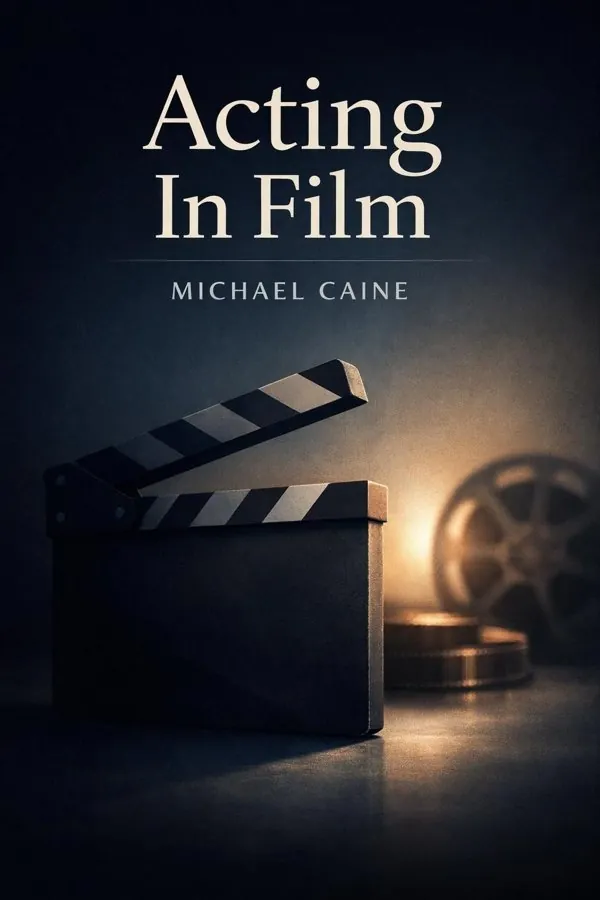
Acting In Film: An Actor's Take on Movie Making: Summary & Key Insights
 10 min11 chaptersAudio available
What Is Acting In Film: An Actor's Take on Movie Making About?
Acting In Film: An Actor's Take on Movie Making by Michael Caine is a performing_arts book spanning 11 pages. In this concise and insightful guide, Michael Caine shares his professional wisdom on the craft of acting for the camera. Drawing from decades of experience in film, he offers practical advice on preparation, performance, and the subtle techniques that distinguish screen acting from stage work. The book is valued for its clarity, humor, and directness, making it a classic resource for aspiring and professional actors alike.
This FizzRead summary covers all 11 key chapters of Acting In Film: An Actor's Take on Movie Making in approximately 10 minutes, distilling the most important ideas, arguments, and takeaways from Michael Caine's work. Also available as an audio summary and Key Quotes Podcast.
Acting In Film: An Actor's Take on Movie Making
In this concise and insightful guide, Michael Caine shares his professional wisdom on the craft of acting for the camera. Drawing from decades of experience in film, he offers practical advice on preparation, performance, and the subtle techniques that distinguish screen acting from stage work. The book is valued for its clarity, humor, and directness, making it a classic resource for aspiring and professional actors alike.
Who Should Read Acting In Film: An Actor's Take on Movie Making?
This book is perfect for anyone interested in performing_arts and looking to gain actionable insights in a short read. Whether you're a student, professional, or lifelong learner, the key ideas from Acting In Film: An Actor's Take on Movie Making by Michael Caine will help you think differently.
- ✓Readers who enjoy performing_arts and want practical takeaways
- ✓Professionals looking to apply new ideas to their work and life
- ✓Anyone who wants the core insights of Acting In Film: An Actor's Take on Movie Making in just 10 minutes
Want the full summary?
Get instant access to this book summary and 100K+ more with Fizz Moment.
Get Free SummaryAvailable on App Store • Free to download
Key Chapters
The first thing I tell any actor crossing from stage to screen is this: forget everything you’ve learned about size. On stage, you act for people fifty feet away; on screen, you act for someone two inches away. The lens magnifies your smallest movement, so what feels natural in a theater becomes exaggerated and false on camera. In film, sincerity hides in restraint. It’s not that emotions are smaller—it’s that their expression must be finer.
On stage, projection matters. You use your voice and body to fill space, but in film, the microphone and camera do that for you. Your job is not to push but to release. The camera picks up what you *think* before you even speak, so your inner life becomes the performance. I always tell actors: when you stop performing and start *being*, the camera loves you.
There’s another key difference—the continuity of story. Theater unfolds in sequence; the actor grows with the role. Film is fragmented. You may shoot the ending before the beginning, the tears before the laughter. That means you must know your character’s emotional map. Create that internal thread so you can match your truth across time and cuts. Film acting demands imagination and memory in equal measure.
It’s also less solitary. A film actor works with dozens of technicians, each shaping the image differently. The lighting, the frame, the editing—all affect the mood. The performance lives not in your complete control but in collaboration. This, too, is freeing once you embrace it. The intimacy of screen acting invites you to surrender to realism—to trust that less really is more. A single glance, honestly felt, can reach millions.
Preparation is the invisible backbone of any performance. It’s where truth begins. Before I walk onto a set, I’ve already built a private world for my character. I read the script not as text to memorize but as a guide to understanding why each moment exists. I ask questions constantly: What does my character want? What stops him from getting it? What’s he afraid of? These questions give life to the silences and pauses that film relies on.
Rehearsal, in film, doesn’t mean running scenes endlessly—it’s about subtle experimentation. It’s finding what works naturally with the camera and the other actors. Film rehearsals are usually brief, but they can be deep if you come prepared. The less you rely on mechanics while shooting, the more you can listen and react truthfully.
Every director has a rhythm. Part of your preparation is adapting to that rhythm. Some want precision; others crave spontaneity. I learned early on that my job was to serve the director’s vision without losing my own instincts. That means understanding the story as a whole—knowing how your scene fits into the larger emotional chain.
Most of all, preparation builds confidence. When nerves strike—which they always do—you fall back on your work. You don’t have to panic because you’ve already done the deep thinking. Spontaneity grows best from structured roots. The moment you begin shooting, you let the homework disappear and trust that it lives inside you. True readiness in film is invisible.
+ 9 more chapters — available in the FizzRead app
All Chapters in Acting In Film: An Actor's Take on Movie Making
About the Author
Michael Caine is an acclaimed British actor known for his distinctive voice and versatile performances across film genres. Born in London in 1933, he has appeared in over one hundred films and received multiple Academy Awards. His career spans from early British cinema to major Hollywood productions, establishing him as one of the most respected figures in international film.
Get This Summary in Your Preferred Format
Read or listen to the Acting In Film: An Actor's Take on Movie Making summary by Michael Caine anytime, anywhere. FizzRead offers multiple formats so you can learn on your terms — all free.
Available formats: App · Audio · PDF · EPUB — All included free with FizzRead
Download Acting In Film: An Actor's Take on Movie Making PDF and EPUB Summary
Key Quotes from Acting In Film: An Actor's Take on Movie Making
“The first thing I tell any actor crossing from stage to screen is this: forget everything you’ve learned about size.”
“Preparation is the invisible backbone of any performance.”
Frequently Asked Questions about Acting In Film: An Actor's Take on Movie Making
Acting In Film: An Actor's Take on Movie Making by Michael Caine is a performing_arts book that explores key ideas across 11 chapters. In this concise and insightful guide, Michael Caine shares his professional wisdom on the craft of acting for the camera. Drawing from decades of experience in film, he offers practical advice on preparation, performance, and the subtle techniques that distinguish screen acting from stage work. The book is valued for its clarity, humor, and directness, making it a classic resource for aspiring and professional actors alike.
You Might Also Like

Harriet Tubman: Live in Concert
Bob the Drag Queen
10 min
The Art of Stagecraft
Robert Edmond Jones
10 min
The Art of Stop-Motion Animation
Ken A. Priebe
10 min
Thunderstorm
Cao Yu
10 min
Character Animation Crash Course!
Eric Goldberg
10 min
Dance as Medicine: The Story of Healing Dance
Anna Halprin
10 minBrowse by Category
Ready to read Acting In Film: An Actor's Take on Movie Making?
Get the full summary and 100K+ more books with Fizz Moment.