
Paul Carter Books
Paul Carter is a stage technician and designer known for his contributions to technical theater education. He compiled The Backstage Handbook to provide a practical, illustrated reference for professionals and students in stagecraft and production design.
Known for: The Backstage Handbook: An Illustrated Almanac of Technical Information
Books by Paul Carter
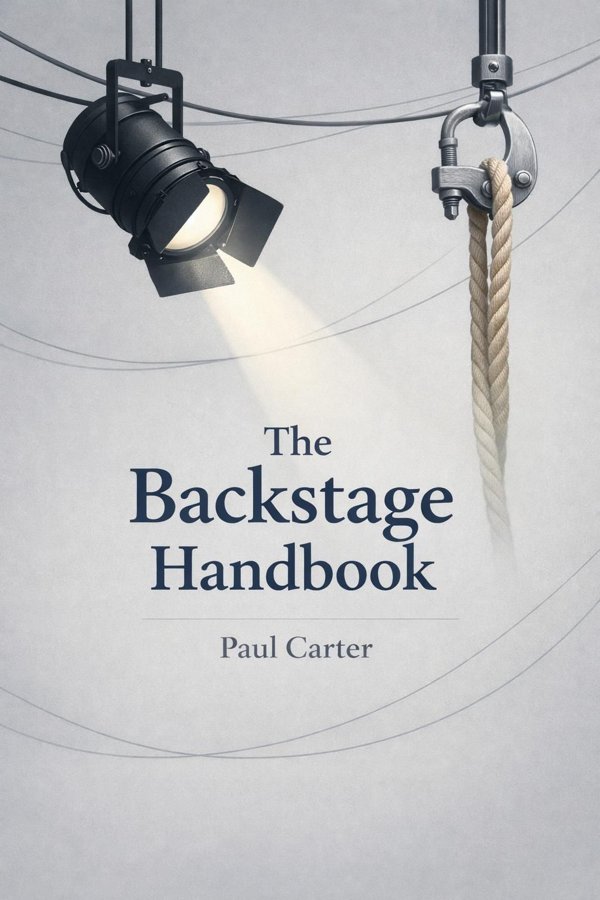
The Backstage Handbook: An Illustrated Almanac of Technical Information
Some books teach artistic vision; this one teaches how to make that vision stand up, hang safely, light correctly, and survive opening night. The Backstage Handbook: An Illustrated Almanac of Technical Information by Paul Carter is one of the most practical reference works ever created for technical theater. Rather than offering abstract theory, it gathers the measurements, formulas, drafting symbols, hardware diagrams, rigging conventions, material specifications, and backstage standards that working professionals rely on every day. It is the kind of book people keep within arm’s reach in a scene shop, lighting booth, prop room, or production office because it answers the questions that stop a build, delay a cue, or create risk. What makes the book matter is its extraordinary usefulness. Theater production depends on precision hidden beneath illusion: platform heights, lumber dimensions, cable data, counterweight calculations, stage geometry, electrical information, and safe working practices. Carter, a respected technician and designer, understood that backstage work runs on accumulated craft knowledge that is rarely organized in one place. His handbook turns that scattered expertise into a portable technical memory. For students, it is an education in professional standards. For experienced crews, it is a fast, trusted problem-solving tool. For anyone behind the scenes, it is less a book than an indispensable working companion.
Read SummaryKey Insights from Paul Carter
Tools Turn Ideas Into Workable Reality
A production rarely fails because of a lack of creativity; it fails when creative ideas cannot be executed accurately, efficiently, and on time. That is why The Backstage Handbook begins, in spirit, with tools. For Paul Carter, tools are not accessories to stagecraft but the basic vocabulary of tech...
From The Backstage Handbook: An Illustrated Almanac of Technical Information
Materials And Hardware Shape Stage Possibilities
Every scenic illusion begins as a decision about material behavior. The audience may see a Victorian staircase, a brick alley, or a futuristic control room, but backstage professionals see plywood thickness, framing stock, fasteners, hinges, casters, and load limits. One of the handbook’s greatest s...
From The Backstage Handbook: An Illustrated Almanac of Technical Information
Mechanical Systems Make Scenery Behave Predictably
The magic of stage movement depends on mechanics that are anything but magical. Sliding wagons, turntables, hinges, pivots, jacks, brakes, tracks, pulleys, and leverage systems all create motion, but only when their physical principles are understood. The Backstage Handbook treats mechanical systems...
From The Backstage Handbook: An Illustrated Almanac of Technical Information
Rigging Demands Precision, Not Assumptions
Few backstage disciplines punish guesswork more quickly than rigging. Whenever scenery, curtains, lighting equipment, or effects are suspended overhead, the stakes rise dramatically. The Backstage Handbook is especially valued for its rigging and stage machinery information because it translates a h...
From The Backstage Handbook: An Illustrated Almanac of Technical Information
Lighting Starts With Physics And Planning
Good stage lighting feels emotional, but it begins with numbers, angles, circuitry, and optics. The Backstage Handbook grounds lighting practice in the technical fundamentals that make artistic choices possible. Rather than treating light as a purely creative medium, Carter shows it as a controlled ...
From The Backstage Handbook: An Illustrated Almanac of Technical Information
Sound, Acoustics, And Power Must Cooperate
Audiences notice sound most when it fails. A mic cuts out, a speaker hums, a cue distorts, or spoken text disappears into the room. Carter’s handbook recognizes that sound is not separate from the physical environment or the electrical infrastructure that supports it. The sections on sound, acoustic...
From The Backstage Handbook: An Illustrated Almanac of Technical Information
About Paul Carter
Paul Carter is a stage technician and designer known for his contributions to technical theater education. He compiled The Backstage Handbook to provide a practical, illustrated reference for professionals and students in stagecraft and production design.
Frequently Asked Questions
Paul Carter is a stage technician and designer known for his contributions to technical theater education. He compiled The Backstage Handbook to provide a practical, illustrated reference for professionals and students in stagecraft and production design.
Read Paul Carter's books in 15 minutes
Get AI-powered summaries with key insights from 1 book by Paul Carter.