
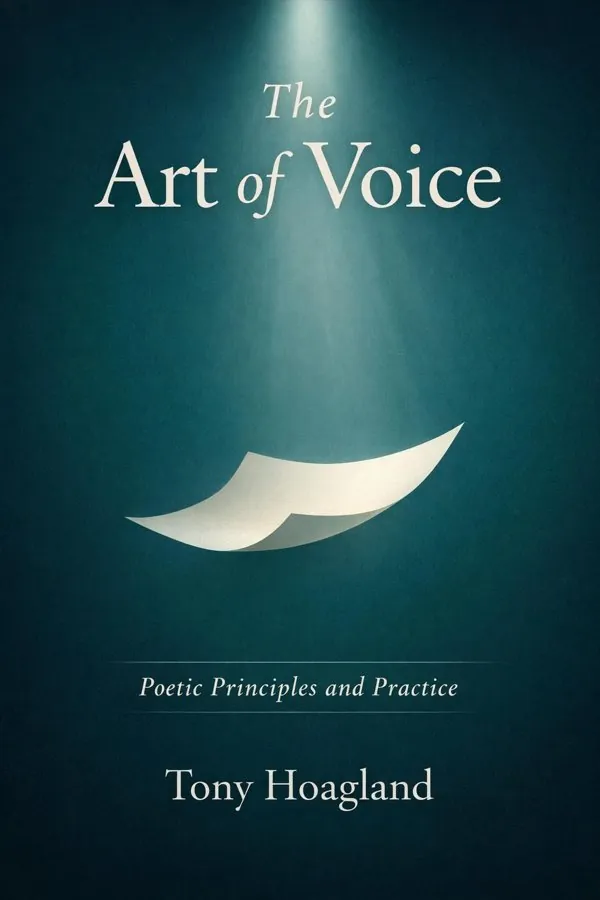
The Art of Voice: Poetic Principles and Practice: Summary & Key Insights
 10 min10 chaptersAudio available
Key Takeaways from The Art of Voice: Poetic Principles and Practice
Many weak poems fail not because they lack intelligence, but because they are trying too hard to sound like poetry.
A commanding tone does not automatically create authority; in poetry, authority is felt when tone, diction, and emotion align.
Voice becomes persuasive when it has something to touch.
One of Hoagland’s most useful ideas is that voice is relational: every poem implies a speaker, a listener, and a situation between them.
One of the myths that traps developing writers is the belief that authenticity requires a single consistent sound.
What Is The Art of Voice: Poetic Principles and Practice About?
The Art of Voice: Poetic Principles and Practice by Tony Hoagland is a writing book spanning 10 pages. What makes a poem feel alive is rarely just its subject or imagery. More often, it is the presence behind the words: the sense that an actual mind, temperament, and consciousness are speaking. In The Art of Voice: Poetic Principles and Practice, poet and teacher Tony Hoagland takes up this notoriously difficult subject and makes it concrete, teachable, and deeply engaging. Across a series of compact but rich reflections, he explores how poetic voice emerges through diction, rhythm, attitude, emotional honesty, and the writer’s relationship to experience. Hoagland’s great strength is that he never treats voice as mystical vapor. Instead, he shows how it is built through choices: whether a poet leans into vernacular speech, how authority is established, how irony is managed, and how revision sharpens tone. The result is both a practical craft guide and a philosophical meditation on what it means to sound like oneself on the page. Because Hoagland was an acclaimed poet, essayist, and beloved teacher known for his wit and clarity, he writes with rare authority. This is a valuable book for poets, students, teachers, and any reader interested in how language becomes personal, memorable, and unmistakably human.
This FizzRead summary covers all 10 key chapters of The Art of Voice: Poetic Principles and Practice in approximately 10 minutes, distilling the most important ideas, arguments, and takeaways from Tony Hoagland's work. Also available as an audio summary and Key Quotes Podcast.
The Art of Voice: Poetic Principles and Practice
What makes a poem feel alive is rarely just its subject or imagery. More often, it is the presence behind the words: the sense that an actual mind, temperament, and consciousness are speaking. In The Art of Voice: Poetic Principles and Practice, poet and teacher Tony Hoagland takes up this notoriously difficult subject and makes it concrete, teachable, and deeply engaging. Across a series of compact but rich reflections, he explores how poetic voice emerges through diction, rhythm, attitude, emotional honesty, and the writer’s relationship to experience.
Hoagland’s great strength is that he never treats voice as mystical vapor. Instead, he shows how it is built through choices: whether a poet leans into vernacular speech, how authority is established, how irony is managed, and how revision sharpens tone. The result is both a practical craft guide and a philosophical meditation on what it means to sound like oneself on the page.
Because Hoagland was an acclaimed poet, essayist, and beloved teacher known for his wit and clarity, he writes with rare authority. This is a valuable book for poets, students, teachers, and any reader interested in how language becomes personal, memorable, and unmistakably human.
Who Should Read The Art of Voice: Poetic Principles and Practice?
This book is perfect for anyone interested in writing and looking to gain actionable insights in a short read. Whether you're a student, professional, or lifelong learner, the key ideas from The Art of Voice: Poetic Principles and Practice by Tony Hoagland will help you think differently.
- ✓Readers who enjoy writing and want practical takeaways
- ✓Professionals looking to apply new ideas to their work and life
- ✓Anyone who wants the core insights of The Art of Voice: Poetic Principles and Practice in just 10 minutes
Want the full summary?
Get instant access to this book summary and 100K+ more with Fizz Moment.
Get Free SummaryAvailable on App Store • Free to download
Key Chapters
Many weak poems fail not because they lack intelligence, but because they are trying too hard to sound like poetry. Hoagland begins from a liberating premise: the more a poet reaches for an idealized “poetic” voice, the further that poet may drift from authentic speech. Readers respond not only to beauty, but to credibility. A poem becomes memorable when it sounds inhabited rather than decorated.
By vernacular language, Hoagland does not mean sloppy or uncrafted speech. He means language that carries the textures of actual human thought: surprise, hesitation, humor, bluntness, and the music of everyday syntax. A poet who allows common speech patterns into a poem often gains freshness, intimacy, and immediacy. Instead of announcing significance with inflated diction, the poem earns significance by sounding true.
This principle can be applied in revision. If a line feels overly literary, ask how you would say the same thing to a trusted friend. If an abstract phrase such as “the ineffable sorrow of existence” appears, try translating it into lived speech: “I woke up and everything felt heavier than it should.” The second version may not be final, but it gets closer to a voice that lives in the body.
Hoagland’s point is not that poetry should abandon artfulness, but that artfulness should emerge from lived language rather than imposed grandeur. The strongest voice often comes from daring to sound recognizably human.
Actionable takeaway: revise one poem by underlining every overly elevated phrase and replacing at least half of them with language closer to how you actually think and speak.
Voice becomes persuasive when it has something to touch. Hoagland emphasizes the importance of what he calls material imagination: the capacity to think and feel through objects, sensory details, and the physical world. Poets often begin with themes such as loneliness, memory, shame, or desire, but those experiences become vivid only when embodied in things we can see, hear, taste, or handle.
Material imagination does more than decorate a poem with imagery. It reveals the nature of the speaker’s mind. Two poets might write about envy, but one imagines envy as a polished car passing by at dusk, while another imagines it as a fork tapping a plate in a silent room. Those choices are not neutral. They create tonal atmosphere, psychological texture, and distinct voice.
Hoagland’s insight is especially useful for writers who tend toward abstraction. If a poem says, “I felt disconnected from my life,” the statement may be emotionally sincere but still thin. If instead the poem says, “I stood in my own kitchen turning a spoon in my hand as if it belonged to someone else,” the emotional reality becomes both clearer and more haunting. Voice grows stronger because thought is moving through matter.
A practical way to build material imagination is to list the objects, settings, and bodily sensations associated with an emotion before writing. Ask: what in the world carries this feeling? Which details are generic, and which belong uniquely to this speaker?
Actionable takeaway: choose one abstract line from a poem and rewrite it using three concrete sensory details, then keep the version that best reveals both the feeling and the speaker’s character.
No poem speaks into a vacuum. One of Hoagland’s most useful ideas is that voice is relational: every poem implies a speaker, a listener, and a situation between them. Even when a poem appears solitary, it is still directed toward someone—an intimate, a stranger, the self, the dead, God, society, or an imagined reader. The nature of that relationship shapes the voice.
This means voice is not just a personal essence but a social stance. A poet sounds different when confessing, arguing, teaching, seducing, mocking, or witnessing. The same writer may have several valid voices because each emerges from a different relationship. The important question is not “What is my one true voice?” but “Who am I speaking to, and from what position?”
For example, a poem addressed to a mother may carry restraint, longing, and coded history. A poem addressed to a corrupt politician may become sharper and more public. A poem addressed to one’s younger self may blend tenderness with irony. In each case, diction, pacing, and emotional openness change because the relationship changes.
This is powerful for revision. If a poem feels vague, identify the listener. If the listener remains blurry, the voice often does too. Sometimes simply changing the addressee clarifies the whole poem. A meditation can become a direct apostrophe; a complaint can become a confession; a private note can become a dramatic monologue.
Actionable takeaway: write the same short poem twice—once to a close friend and once to a stranger—and compare how the relationship alters tone, openness, and word choice.
One of the myths that traps developing writers is the belief that authenticity requires a single consistent sound. Hoagland pushes against this simplification. A mature poet often contains multiple voices: comic and solemn, intimate and performative, meditative and argumentative. Variety does not weaken identity; it can reveal the range of the self.
Voice, in this sense, is not a fixed mask but a repertoire. The challenge is not to limit oneself to one register, but to learn which voice serves which poem. Some subjects require looseness and improvisation. Others need restraint or clarity. Some poems thrive on high rhetoric; others on awkward candor. The writer’s job is to recognize available tonal resources and use them intentionally.
This insight also relieves creative pressure. A poet may love the conversational wit of one poem and the lyrical seriousness of another without betraying authenticity. What matters is whether each poem’s voice feels coherent within itself. Readers can accept range when the tonal contract of each poem is clear.
Exercises in persona, imitation, and formal experimentation can expand this repertoire. Writing in different modes helps the poet discover hidden capacities rather than exposing fraudulence. Over time, a larger signature may emerge: not one note, but a recognizable intelligence moving among several notes.
Actionable takeaway: draft three brief poems on the same subject in different tonal modes—comic, elegiac, and conversational—and study which aspects of your sensibility appear in all three.
Every voice comes from somewhere. Hoagland recognizes that biography, class, region, gender, race, education, and temperament all influence how a poem sounds. The vocabulary we inherit, the speech rhythms we hear growing up, and the cultural positions we occupy leave marks on syntax, humor, confidence, restraint, and subject matter. Voice is never detached from identity.
At the same time, Hoagland resists reducing voice to identity alone. A poem is not merely a demographic signal. Writers transform inheritance through craft. They can heighten, complicate, disguise, challenge, or hybridize the languages available to them. A poet shaped by rural speech may mix that cadence with literary allusion. A poet shaped by urban argument may write with devotional tenderness. Identity provides pressure and material, but not a cage.
This balance matters because some writers fear sounding “too much like themselves,” while others fear they have no right to experiment beyond familiar speech. Hoagland’s approach suggests a middle path: know the languages that formed you, but do not mistake them for your only possibilities. Voice deepens when a poet understands origin and agency together.
Practically, writers can examine which phrases feel inherited, which feel acquired, and which feel aspirational. Noticing those layers often clarifies why a poem sounds flat or conflicted. Sometimes a poem fails because its language belongs to an imagined literary class rather than the speaker’s actual inner weather.
Actionable takeaway: make three lists—words from your upbringing, words from your education, and words you use only in writing—then combine them deliberately in a poem to discover where your real tonal energy lives.
Voice is not carried by diction alone; it also lives in how sentences move. Hoagland pays careful attention to rhythm and syntax because they reveal attitude, temperament, and thought patterns. Long winding sentences can suggest rumination, accumulation, defensiveness, or exuberance. Short clipped lines may imply certainty, tension, exhaustion, or emotional recoil. The architecture of language is part of the voice.
Many poets focus on word choice while overlooking sentence behavior. Yet readers often identify a distinctive voice through pacing before they consciously register content. A speaker who interrupts themselves, doubles back, qualifies statements, or piles clause upon clause creates a very different presence from one who speaks in clean declarative bursts.
Imagine two versions of the same idea. One says, “I miss my father.” Another says, “Some days, crossing a parking lot with groceries, I feel him beside me so suddenly I have to stop.” The second is more than an image; its syntax enacts the mind being overtaken by memory. Rhythm becomes psychology.
Reading poems aloud is essential here. Hoagland treats the ear as a diagnostic tool. If a line stumbles, drones, or stiffens, the voice may be off. Revision should include not just semantic sharpening but rhythmic listening. Where does the poem speed up? Where should it hesitate? Which sentence structures belong to this speaker’s consciousness?
Actionable takeaway: read a draft aloud and mark every place your breath, emphasis, or natural speaking rhythm conflicts with the line; then revise syntax so the poem’s movement reflects the speaker’s mind rather than inherited poetic habits.
Irony can make a poem intelligent, agile, and contemporary, but it can also become a shield. Hoagland, whose own work often employs wit and tonal complexity, understands both its power and its danger. A voice shaped by irony may expose hypocrisy, prevent sentimentality, and capture the fractured consciousness of modern life. But when irony becomes habitual, it can keep the poem from risking sincerity.
The question is not whether irony is good or bad, but whether it enlarges the poem’s humanity. Effective irony creates tension between what is said and what is felt, allowing multiple layers of awareness. It can produce humor, critique, and emotional complexity at once. Weak irony, by contrast, performs detachment. It tells the reader that the poet is too clever to be vulnerable.
Consider a poem about heartbreak. A few self-mocking observations may make the grief more believable, because real feeling is often mixed with embarrassment and absurdity. But if every potentially tender moment is undercut by sarcasm, the poem may never arrive anywhere emotionally. The reader senses evasion.
Hoagland’s larger lesson is that voice gains authority when it can include both intelligence and exposure. The poet need not choose between sharpness and sincerity. The most compelling voices often oscillate between them, letting irony sharpen perception without canceling genuine feeling.
Actionable takeaway: in a draft that uses humor or sarcasm, circle every ironic turn and ask whether each one deepens the emotional truth or merely protects the speaker from it; cut or soften the defensive ones.
Original voice is rarely born in isolation. Hoagland treats imitation not as artistic failure but as part of apprenticeship. Poets learn by absorbing the tonal habits of writers they admire: a cadence, a sentence structure, a way of pivoting from image to reflection, a manner of humor or gravity. Influence is often the workshop where individuality is formed.
This can be difficult for emerging writers to accept because imitation seems opposed to authenticity. Yet no writer develops in a vacuum. By trying on other voices, poets discover what fits, what resists, and what awakens latent aspects of their own sensibility. The process resembles musicians learning standards before improvising.
Useful imitation is active, not submissive. Rather than copying a poet’s surface style, the writer studies underlying decisions. How does this poet move from observation to insight? How is authority established? How is humor balanced with tenderness? These structural lessons can be adapted without becoming derivative.
For example, a writer influenced by Frank O’Hara may borrow casual immediacy and urban momentum, while a writer influenced by Elizabeth Bishop may learn precision and restraint. Over time, the friction among influences helps generate something distinct. Originality often arises from synthesis, not purity.
To practice this, write a poem “after” a poet you admire, then rewrite it without looking at the model. Keep the discovered energy, but change the subject, imagery, and emotional priorities. What remains may be closer to your own voice than either pure imitation or self-conscious originality.
Actionable takeaway: imitate one admired poet for a page, then rewrite the piece from memory in your own diction and circumstances to identify which borrowed elements genuinely belong in your developing voice.
The first draft often reveals impulse; revision reveals voice. Hoagland sees revision not merely as correction but as an act of listening. A poem may begin with genuine feeling, but until the writer hears what the poem actually wants to sound like, the language may remain blurred by habit, vanity, or haste. Revision is where the ear catches false notes.
Listening occurs on multiple levels. The poet listens for tonal inconsistency: does one line belong to a different poem? The poet listens for pressure: where does the language feel alive, and where is it coasting? The poet listens for pretension, vagueness, overstatement, and the places where the poem becomes emotionally evasive. Good revision is less about adding ornament than about aligning the poem with its deepest intention.
One practical strategy is to separate drafting from evaluation. In early drafts, let the poem speak messily. Later, return as a listener rather than a performer. Read aloud. Print the poem and mark where attention drops. Notice clichés not only of language but of posture: familiar bitterness, familiar lyric uplift, familiar irony. Voice becomes clearer when default gestures are questioned.
Revision can also involve subtraction. Sometimes the strongest voice appears after cutting the explanatory line that mistrusts the reader or the flourish that mistrusts plain speech. What remains is often leaner, truer, and more resonant.
Actionable takeaway: after finishing a draft, leave it for a day, then read it aloud with a pencil in hand and cut any line that feels generic, showy, or tonally out of place, even if it is individually beautiful.
All Chapters in The Art of Voice: Poetic Principles and Practice
About the Author
Tony Hoagland (1953–2018) was an American poet, essayist, and influential teacher of creative writing. He was known for poems that combined humor, emotional directness, cultural critique, and conversational energy, making his work both intellectually alert and widely accessible. Over his career, he published several respected collections, including What Narcissism Means to Me and Application for Release from the Dream, as well as essays on poetry and craft that are valued for their clarity and insight. Hoagland taught at institutions including the University of Houston and became admired not only for his own writing but for his ability to articulate how poems work. His reflections on voice, tone, and poetic consciousness remain especially useful to students and practicing poets seeking a more vivid, honest, and flexible command of language.
Get This Summary in Your Preferred Format
Read or listen to the The Art of Voice: Poetic Principles and Practice summary by Tony Hoagland anytime, anywhere. FizzRead offers multiple formats so you can learn on your terms — all free.
Available formats: App · Audio · PDF · EPUB — All included free with FizzRead
Download The Art of Voice: Poetic Principles and Practice PDF and EPUB Summary
Key Quotes from The Art of Voice: Poetic Principles and Practice
“Many weak poems fail not because they lack intelligence, but because they are trying too hard to sound like poetry.”
“A commanding tone does not automatically create authority; in poetry, authority is felt when tone, diction, and emotion align.”
“Voice becomes persuasive when it has something to touch.”
“One of Hoagland’s most useful ideas is that voice is relational: every poem implies a speaker, a listener, and a situation between them.”
“One of the myths that traps developing writers is the belief that authenticity requires a single consistent sound.”
Frequently Asked Questions about The Art of Voice: Poetic Principles and Practice
The Art of Voice: Poetic Principles and Practice by Tony Hoagland is a writing book that explores key ideas across 10 chapters. What makes a poem feel alive is rarely just its subject or imagery. More often, it is the presence behind the words: the sense that an actual mind, temperament, and consciousness are speaking. In The Art of Voice: Poetic Principles and Practice, poet and teacher Tony Hoagland takes up this notoriously difficult subject and makes it concrete, teachable, and deeply engaging. Across a series of compact but rich reflections, he explores how poetic voice emerges through diction, rhythm, attitude, emotional honesty, and the writer’s relationship to experience. Hoagland’s great strength is that he never treats voice as mystical vapor. Instead, he shows how it is built through choices: whether a poet leans into vernacular speech, how authority is established, how irony is managed, and how revision sharpens tone. The result is both a practical craft guide and a philosophical meditation on what it means to sound like oneself on the page. Because Hoagland was an acclaimed poet, essayist, and beloved teacher known for his wit and clarity, he writes with rare authority. This is a valuable book for poets, students, teachers, and any reader interested in how language becomes personal, memorable, and unmistakably human.
You Might Also Like
The Art of Perspective
Christopher Castellani
10 min
Making a Point: The Persnickety Story of English Punctuation
David Crystal
10 min
The Elements Of Eloquence: How To Turn The Perfect English Phrase
Mark Forsyth
10 min
The Pocket Muse: Ideas and Inspirations for Writing
Monica Wood
10 min
A Little Book on Form: An Exploration into the Formal Imagination of Poetry
Robert Hass
10 min
Adventures In The Screen Trade: A Personal View Of Hollywood And Screenwriting
William Goldman
10 minBrowse by Category
Ready to read The Art of Voice: Poetic Principles and Practice?
Get the full summary and 100K+ more books with Fizz Moment.