
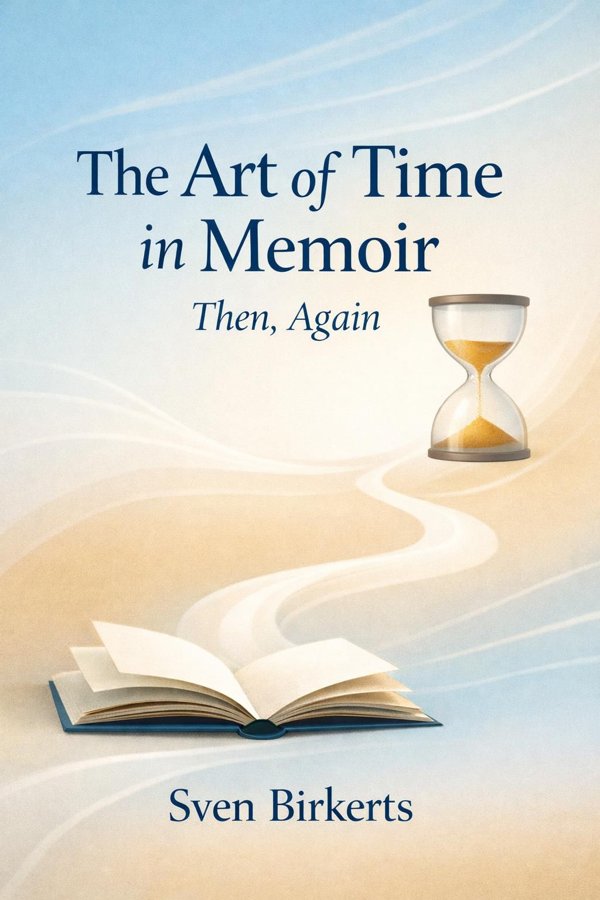
The Art of Time in Memoir: Then, Again: Summary & Key Insights
 10 min10 chaptersAudio available
Key Takeaways from The Art of Time in Memoir: Then, Again
A life becomes interesting on the page not when everything is included, but when the right things are.
We like to imagine memory as storage, but in memoir it behaves more like weather.
Every memoir contains at least two selves: the one who lived and the one who writes.
In Birkerts’s reading, Vladimir Nabokov exemplifies how memoir can transform recollection into intricate temporal art.
Some memoirists reveal time not through brilliance of pattern alone, but through the sense that one phase of life quietly prepares another.
What Is The Art of Time in Memoir: Then, Again About?
The Art of Time in Memoir: Then, Again by Sven Birkerts is a writing book spanning 10 pages. Sven Birkerts’s The Art of Time in Memoir: Then, Again is a compact but deeply illuminating meditation on what memoir really does. Rather than treating memoir as a simple record of what happened, Birkerts argues that its true subject is time: the gap between the self who once lived an experience and the self who now tries to understand it. In that gap, memory, reflection, voice, and narrative design all become essential tools. The memoirist is not merely recovering the past but shaping it into meaning. What makes this book especially valuable is Birkerts’s combination of literary sensitivity and practical insight. Drawing on close readings of writers such as Vladimir Nabokov, Frank Conroy, and Mary Karr, he shows how great memoirs move fluidly between remembered scenes and present consciousness. The result is not chronology for its own sake, but emotional and philosophical depth. For writers, readers, and anyone interested in how lived experience becomes art, this book offers a powerful framework. Birkerts writes not only as a critic, but as a seasoned essayist and teacher who understands that the hardest part of memoir is not remembering events—it is discovering the temporal shape that makes those events matter.
This FizzRead summary covers all 10 key chapters of The Art of Time in Memoir: Then, Again in approximately 10 minutes, distilling the most important ideas, arguments, and takeaways from Sven Birkerts's work. Also available as an audio summary and Key Quotes Podcast.
The Art of Time in Memoir: Then, Again
Sven Birkerts’s The Art of Time in Memoir: Then, Again is a compact but deeply illuminating meditation on what memoir really does. Rather than treating memoir as a simple record of what happened, Birkerts argues that its true subject is time: the gap between the self who once lived an experience and the self who now tries to understand it. In that gap, memory, reflection, voice, and narrative design all become essential tools. The memoirist is not merely recovering the past but shaping it into meaning.
What makes this book especially valuable is Birkerts’s combination of literary sensitivity and practical insight. Drawing on close readings of writers such as Vladimir Nabokov, Frank Conroy, and Mary Karr, he shows how great memoirs move fluidly between remembered scenes and present consciousness. The result is not chronology for its own sake, but emotional and philosophical depth. For writers, readers, and anyone interested in how lived experience becomes art, this book offers a powerful framework. Birkerts writes not only as a critic, but as a seasoned essayist and teacher who understands that the hardest part of memoir is not remembering events—it is discovering the temporal shape that makes those events matter.
Who Should Read The Art of Time in Memoir: Then, Again?
This book is perfect for anyone interested in writing and looking to gain actionable insights in a short read. Whether you're a student, professional, or lifelong learner, the key ideas from The Art of Time in Memoir: Then, Again by Sven Birkerts will help you think differently.
- ✓Readers who enjoy writing and want practical takeaways
- ✓Professionals looking to apply new ideas to their work and life
- ✓Anyone who wants the core insights of The Art of Time in Memoir: Then, Again in just 10 minutes
Want the full summary?
Get instant access to this book summary and 100K+ more with Fizz Moment.
Get Free SummaryAvailable on App Store • Free to download
Key Chapters
A life becomes interesting on the page not when everything is included, but when the right things are. One of Birkerts’s foundational distinctions is between autobiography and memoir. Autobiography tends to pursue comprehensiveness, moving in orderly fashion through a life as though facts alone could produce understanding. Memoir, by contrast, is selective. It does not attempt to tell everything. It gathers around a pressure point: a relationship, a crisis, an identity struggle, a period of becoming. The memoirist’s task is not to inventory the past, but to shape a meaningful encounter with it.
This distinction matters because many beginning writers assume they must start at birth and proceed forward. Birkerts suggests otherwise. A memoir may begin in adulthood and flash backward. It may revolve around a summer, a loss, a family secret, or a spiritual crisis. What matters is not sequence but significance. Selection creates intensity. Omission is not a failure of truth; it is often the means by which truth becomes visible.
Consider practical examples. A person writing about addiction does not need to recount every childhood year in equal detail. Instead, they might focus on a handful of scenes that illuminate patterns of shame, desire, and transformation. A writer exploring grief may circle around one funeral, one photograph, one unfinished conversation, letting those moments radiate outward.
For readers, this idea explains why powerful memoirs often feel more revealing than longer life stories. They are built around emotional necessity. For writers, it offers relief: you do not need your whole life to write a memoir; you need a center of gravity.
Actionable takeaway: Before drafting, write one sentence beginning with, “This memoir is really about…” and let that sentence guide what stays in and what can be left out.
We like to imagine memory as storage, but in memoir it behaves more like weather. Birkerts emphasizes that memory is not a stable recording of the past waiting to be replayed. It is active, interpretive, and constantly reshaped by present feeling. Every act of remembering is also an act of re-seeing. This does not make memoir false; it makes memoir human.
The memoirist therefore works with unstable material. A remembered childhood room may feel enormous in one recollection and cramped in another. A parent once seen as frightening may, years later, appear wounded, fragile, or tragically limited. The facts may remain similar, but their emotional resonance changes. Time alters perspective, and perspective alters narrative.
This insight has practical implications. Writers do not need to pretend certainty where none exists. A memoir can admit doubt: “I may have been six,” “I remember the kitchen as darker than it probably was,” or “What I know for sure is the feeling.” These admissions often deepen credibility because they acknowledge the reality of recollection. Readers trust a narrator who understands memory’s limits.
Birkerts is especially interested in how meaning emerges not from perfect recall but from the interplay between fragments. A smell, a sentence, a gesture, a seasonal light—such details can unlock emotional truth even when chronology is incomplete. The memoirist learns to follow these charged fragments rather than force artificial precision.
In everyday terms, anyone writing personal narrative can benefit from distinguishing literal certainty from emotional truth. The goal is not courtroom testimony; it is faithful representation of lived experience as honestly apprehended.
Actionable takeaway: Make two lists for an important memory—what you know happened, and what you strongly feel about it. Use both lists to build scenes that are honest about fact and revealing about meaning.
Every memoir contains at least two selves: the one who lived and the one who writes. Birkerts calls attention to this crucial “double perspective.” The younger self acts inside scenes without full understanding, while the older self narrates with hindsight, interpretation, and language the earlier self did not possess. Memoir becomes compelling when these two levels remain in productive tension.
If a writer relies only on the younger self, the work may feel immersive but shallow, lacking reflection. If the writer relies only on the older self, the memoir may become essayistic and distant, flattening lived immediacy. The art lies in balancing experience and interpretation. We need the child’s terror in the dark hallway and the adult’s understanding of what made that house so emotionally charged.
This double perspective is one reason memoir can produce such depth. It allows a narrative to reveal not just what happened, but how consciousness changes over time. A humiliating school incident, for example, may be rendered first in the raw terms of the child who feels annihilated, then later reconsidered by the adult who sees class dynamics, parental pressures, or the origins of a lifelong insecurity. The past is not overwritten; it is layered.
For writers, the challenge is technical as well as emotional. Voice must move smoothly between scene and reflection. The reflective passages should illuminate rather than explain away the lived moment. Readers want the shock of original experience and the intelligence of later understanding.
This idea also matters beyond literature. In life, maturity often means learning to hold our former selves with both honesty and compassion. Memoir formalizes that process.
Actionable takeaway: Revisit a key scene from your past and write it twice—first only from the consciousness you had then, and second from what you understand now. Then combine the strongest elements of both versions.
In Birkerts’s reading, Vladimir Nabokov exemplifies how memoir can transform recollection into intricate temporal art. Nabokov is not merely remembering events; he is arranging them through association, image, and recurrence so that the past feels both recovered and re-created. His memoiristic method shows that time on the page need not move in a straight line to feel coherent. Pattern can be stronger than chronology.
What makes Nabokov such a revealing case is his devotion to sensuous detail. A butterfly, a lamp, a path, a word in another language—these are not decorative extras. They are portals through which the past returns. Yet Birkerts suggests that Nabokov’s brilliance also demonstrates a larger truth: memory in memoir is aesthetic as well as documentary. The writer composes the past. Form is not separate from remembrance; it is the means by which remembrance becomes visible.
For practical purposes, this frees memoirists from the rigid timeline model. A chapter can begin with an object in the present and leap backward through association. A recurring image can bind separate decades together. A narrative can revisit one scene multiple times, each return adding new dimensions. This is not confusion if the writer maintains emotional clarity.
Imagine writing about a fractured family through the recurring image of the dinner table. One chapter shows childhood silence, another adolescent rebellion, another adult return after a parent’s death. The table becomes a temporal anchor. That is the kind of patterning Birkerts helps readers notice.
Nabokov’s example reminds us that memoir is an art of arrangement. The writer does not simply retrieve experience; the writer discovers its hidden shape.
Actionable takeaway: Identify one image, object, or motif from your past and trace how it appears at different moments in your life. Use it as a structural thread rather than forcing strict chronological order.
Some memoirists reveal time not through brilliance of pattern alone, but through the sense that one phase of life quietly prepares another. Birkerts’s attention to Frank Conroy highlights this subtler achievement. In Conroy’s work, episodes do not merely follow one another; they accumulate, creating a felt continuity between childhood circumstances and adult sensibility. The memoirist uncovers how a life becomes itself.
What matters here is not simple cause-and-effect. Great memoir avoids crude formulas such as “this happened, therefore I became that.” Instead, Conroy demonstrates how atmosphere, repeated conditions, and emotional climates shape identity over time. Loneliness, instability, yearning, improvisation—these qualities may surface in many scenes before the narrator can name them. The memoir gradually reveals their pattern.
For writers, this is a useful corrective. Not every chapter needs a dramatic revelation. Often the power of memoir lies in cumulative recognition. A difficult household, a series of moves, an absent parent, a talent discovered in isolation—each episode adds pressure until the reader senses the formation of character. The result is less flashy than confession and often more enduring.
A practical application might be writing a memoir of class mobility. Instead of reducing the story to one scholarship or one breakthrough moment, the writer can show the many small experiences that formed an inner split: the language used at home, embarrassment in affluent spaces, habits of thrift, coded gestures of belonging. Over time, these scenes make visible a consciousness shaped by transition.
Birkerts values memoir that lets time thicken meaning gradually. Understanding often arrives by accretion rather than epiphany.
Actionable takeaway: Review your major memories and ask not only, “What happened here?” but “What quality of mind or feeling keeps recurring?” Organize scenes around those recurring qualities to reveal continuity across time.
A memoir can be structurally sophisticated and still feel alive only if the voice carries risk. In turning to Mary Karr, Birkerts finds an example of how temporal complexity can coexist with candor, wit, and fierce self-scrutiny. Karr’s memoiristic power comes not just from what she remembers, but from the authority of a narrator willing to face the messiness of recollection without smoothing it into wisdom too quickly.
Her work demonstrates that reflection should not sanitize experience. The adult narrator may understand more, but that understanding remains emotionally costly. This is especially important when writing family, trauma, addiction, or class history. A polished retrospective stance can become evasive if it distances the writer from the volatility of lived experience. Karr shows how a memoirist can retain the sting of the past while still shaping it artistically.
Birkerts’s interest in her work underscores a central point: voice is one of the main instruments by which time is managed. Tone tells the reader when we are inside an old wound, when we are reinterpreting it, and when irony or tenderness has entered the frame. A strong voice allows these shifts without confusion.
For aspiring memoirists, Karr offers a practical lesson in honesty of stance. If your younger self was vain, cruel, needy, deluded, or absurd, the memoir becomes stronger when that is admitted. Reflection gains authority when it includes self-implication rather than merely judging others.
Outside writing, this principle speaks to personal growth. Real understanding rarely comes from making ourselves look better in retrospect. It comes from seeing ourselves clearly within time.
Actionable takeaway: Take a scene in which you are tempted to appear admirable and rewrite it with one uncomfortable truth included. Let voice carry both intelligence and vulnerability.
Experience alone does not make memoir; interpretation does. Birkerts stresses the role of reflection as the element that transforms anecdote into literature. A sequence of vivid scenes may be entertaining, but without some reflective intelligence, they remain episodes rather than meaning-bearing parts of a larger whole. Reflection is where the memoirist asks: Why does this memory matter now? What does it reveal that I could not see then?
This does not mean inserting moral lessons after every scene. Heavy-handed commentary can diminish a memoir’s force. The best reflection arises organically from narrative pressure. A remembered argument with a parent may lead to a meditation on inheritance. A childhood move may open into thoughts about belonging. Reflection widens the lens without abandoning the concrete event.
In practice, writers often struggle with where to place reflection. Too much at the beginning can stall momentum; too little leaves the reader unguided. Birkerts encourages a dynamic interplay. Scene creates immersion. Reflection creates depth. One animates the other. Think of memoir as a braid: action, memory, and thought interwoven.
For readers, this is part of what makes memoir distinct from gossip or diary. We are not just witnessing a life; we are watching consciousness work on experience. For writers, reflection offers the chance to connect private events to larger human questions—time, family, identity, shame, freedom, mortality.
An effective exercise is to ask after each major scene: what did I know then, what do I know now, and what remains unresolved? That final question is especially important. Reflection need not close uncertainty; sometimes it clarifies the shape of what cannot be settled.
Actionable takeaway: After drafting a scene, add a short reflective passage that links the event to a larger question in your life. Keep only the sentences that deepen, not explain away, the scene.
To write memoir is to use not only your own life, but lives entangled with yours. Birkerts addresses the ethical dimension of remembering: every act of personal narrative implicates other people, competing memories, and the problem of representation. Memoir is not fiction in disguise, yet neither is it objective history. The writer must navigate honesty, fairness, privacy, and loyalty without surrendering the work’s truth.
This ethical complexity begins with perspective. A memoirist can report what was seen, felt, and believed, but cannot claim total authority over another person’s interior life. Strong memoir often signals this limit. Instead of declaring, “My father felt nothing,” a writer might render behavior, silence, expression, and the child’s interpretation of it. Such writing remains forceful while acknowledging uncertainty.
There is also the issue of harm. Should every truth be told? Birkerts does not offer simplistic rules, but he makes clear that the memoirist must examine motives. Is a scene included because it is necessary to the story, or because it settles a score? Is another person rendered with human complexity, or reduced to a function in the narrator’s drama? Ethical memoir does not avoid difficulty; it avoids carelessness.
A practical application is especially important for writers dealing with family history. One useful method is to separate private drafting from public shaping. Write the most candid version first. Then revise with questions of accuracy, proportionality, and necessity in mind. Sometimes changing a detail protects privacy without altering truth. Sometimes the deeper revision is tonal: granting even painful figures some dimension.
The ethics of memoir are part of its artistry because fairness affects credibility.
Actionable takeaway: For every major person in your memoir, write a note answering three questions: What do I know? What am I assuming? What must I include to render this person as more than a villain or symbol?
One of Birkerts’s most valuable contributions is showing that time in memoir is not just subject matter; it is structure. Memoirists must decide how readers will experience movement between then and now. Chronology is only one option, and often not the most powerful one. Temporal design includes pacing, flashback, repetition, juxtaposition, framing, and the deliberate withholding or release of information.
Why does this matter? Because the arrangement of time creates meaning. If a writer begins with a present-day crisis and then spirals backward, the reader experiences the past as explanation. If the memoir unfolds in near-chronological order, the emphasis may fall on development and accumulation. If scenes from different periods are intercut, the result may highlight resemblance, unresolved conflict, or ironic contrast.
Think of a memoir about caregiving for an aging mother. A straightforward timeline might begin with diagnosis and proceed toward death. But a more resonant temporal design might alternate hospital scenes with childhood memories of the mother’s strength, discipline, or tenderness. The emotional force comes from the collision of those times. The present is haunted and illuminated by the past.
Birkerts encourages attention to rhythm as well as sequence. Some years may need a page; one afternoon may require a chapter. Time on the clock is not time in narrative. The memoirist expands what bears emotional weight and compresses what merely connects events.
This principle is useful for any writer stuck in chronological drag. Structure should arise from the book’s central emotional inquiry, not from habit.
Actionable takeaway: Sketch your memoir in three different time structures—strictly chronological, present-framed with flashbacks, and interwoven past-present chapters. Choose the design that best intensifies your central question.
No memoir is written from the past; it is always written from a present need. Birkerts highlights the importance of the present as frame—the condition, crisis, or consciousness from which the narrator turns back. This frame is not a decorative prologue. It is the source of urgency. We remember because something now compels remembering.
The present frame can take many forms: a parent’s death, a child reaching the writer’s old age, recovery from addiction, a return to a hometown, a divorce, an illness, or simply the pressure of midlife reevaluation. Whatever its form, the present establishes why this story is being told now. Without that pressure, memoir can feel merely retrospective. With it, the narrative gains necessity.
The present also shapes interpretation. A writer looking back after becoming a parent may understand their own childhood differently. A person writing after political disillusionment may revisit youthful idealism with new complexity. The present self is not outside the story; it is the lens through which the past comes into focus.
For writers, this is a powerful organizing tool. If you identify the present situation that initiates remembrance, you can create coherence across fragmented memories. The reader returns again and again to the now from which the then is being examined. This rhythm helps manage temporal shifts and builds thematic depth.
On a human level, Birkerts’s point is profound: we do not remember in a vacuum. We remember because life keeps changing the meaning of what has already happened.
Actionable takeaway: Write a paragraph beginning, “I am telling this story now because…” Use that statement as the framing pressure that anchors your memoir’s movement between past and present.
All Chapters in The Art of Time in Memoir: Then, Again
About the Author
Sven Birkerts is an American essayist, literary critic, editor, and teacher whose work has long focused on reading, memory, literature, and the inner life. He is best known for The Gutenberg Elegies, an influential meditation on how electronic culture affects reading and human consciousness. Birkerts has also written extensively on memoir, fiction, and literary experience, bringing a reflective, intellectually serious style to both criticism and personal prose. Over the course of his career, he has taught at universities and writing programs, helping shape generations of readers and writers. He has also served as editor of AGNI, a respected literary journal known for publishing innovative contemporary work. His authority as a guide to memoir comes from this rare combination of critical insight, literary sensitivity, and practical engagement with the craft of writing.
Get This Summary in Your Preferred Format
Read or listen to the The Art of Time in Memoir: Then, Again summary by Sven Birkerts anytime, anywhere. FizzRead offers multiple formats so you can learn on your terms — all free.
Available formats: App · Audio · PDF · EPUB — All included free with FizzRead
Download The Art of Time in Memoir: Then, Again PDF and EPUB Summary
Key Quotes from The Art of Time in Memoir: Then, Again
“A life becomes interesting on the page not when everything is included, but when the right things are.”
“We like to imagine memory as storage, but in memoir it behaves more like weather.”
“Every memoir contains at least two selves: the one who lived and the one who writes.”
“In Birkerts’s reading, Vladimir Nabokov exemplifies how memoir can transform recollection into intricate temporal art.”
“Some memoirists reveal time not through brilliance of pattern alone, but through the sense that one phase of life quietly prepares another.”
Frequently Asked Questions about The Art of Time in Memoir: Then, Again
The Art of Time in Memoir: Then, Again by Sven Birkerts is a writing book that explores key ideas across 10 chapters. Sven Birkerts’s The Art of Time in Memoir: Then, Again is a compact but deeply illuminating meditation on what memoir really does. Rather than treating memoir as a simple record of what happened, Birkerts argues that its true subject is time: the gap between the self who once lived an experience and the self who now tries to understand it. In that gap, memory, reflection, voice, and narrative design all become essential tools. The memoirist is not merely recovering the past but shaping it into meaning. What makes this book especially valuable is Birkerts’s combination of literary sensitivity and practical insight. Drawing on close readings of writers such as Vladimir Nabokov, Frank Conroy, and Mary Karr, he shows how great memoirs move fluidly between remembered scenes and present consciousness. The result is not chronology for its own sake, but emotional and philosophical depth. For writers, readers, and anyone interested in how lived experience becomes art, this book offers a powerful framework. Birkerts writes not only as a critic, but as a seasoned essayist and teacher who understands that the hardest part of memoir is not remembering events—it is discovering the temporal shape that makes those events matter.
More by Sven Birkerts
You Might Also Like
The Art of Perspective
Christopher Castellani
10 min
Making a Point: The Persnickety Story of English Punctuation
David Crystal
10 min
The Elements Of Eloquence: How To Turn The Perfect English Phrase
Mark Forsyth
10 min
The Pocket Muse: Ideas and Inspirations for Writing
Monica Wood
10 min
A Little Book on Form: An Exploration into the Formal Imagination of Poetry
Robert Hass
10 min
Adventures In The Screen Trade: A Personal View Of Hollywood And Screenwriting
William Goldman
10 minBrowse by Category
Ready to read The Art of Time in Memoir: Then, Again?
Get the full summary and 100K+ more books with Fizz Moment.