
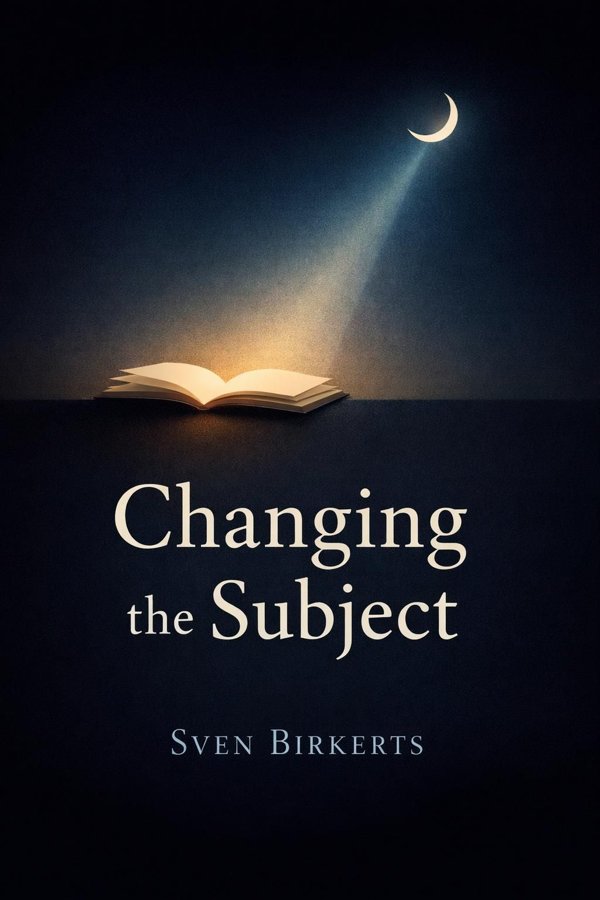
Changing the Subject: Art and Attention in Contemporary America: Summary & Key Insights
 10 min10 chaptersAudio available
What Is Changing the Subject: Art and Attention in Contemporary America About?
Changing the Subject: Art and Attention in Contemporary America by Sven Birkerts is a civilization book spanning 10 pages. In this collection of essays, Sven Birkerts explores the shifting landscape of American culture and the role of art and literature in an age increasingly dominated by technology and distraction. He reflects on how attention, meaning, and individuality are transformed in a world of constant connectivity, urging a return to deeper engagement with language and imagination.
This FizzRead summary covers all 10 key chapters of Changing the Subject: Art and Attention in Contemporary America in approximately 10 minutes, distilling the most important ideas, arguments, and takeaways from Sven Birkerts's work. Also available as an audio summary and Key Quotes Podcast.
Changing the Subject: Art and Attention in Contemporary America
In this collection of essays, Sven Birkerts explores the shifting landscape of American culture and the role of art and literature in an age increasingly dominated by technology and distraction. He reflects on how attention, meaning, and individuality are transformed in a world of constant connectivity, urging a return to deeper engagement with language and imagination.
Who Should Read Changing the Subject: Art and Attention in Contemporary America?
This book is perfect for anyone interested in civilization and looking to gain actionable insights in a short read. Whether you're a student, professional, or lifelong learner, the key ideas from Changing the Subject: Art and Attention in Contemporary America by Sven Birkerts will help you think differently.
- ✓Readers who enjoy civilization and want practical takeaways
- ✓Professionals looking to apply new ideas to their work and life
- ✓Anyone who wants the core insights of Changing the Subject: Art and Attention in Contemporary America in just 10 minutes
Want the full summary?
Get instant access to this book summary and 100K+ more with Fizz Moment.
Get Free SummaryAvailable on App Store • Free to download
Key Chapters
Art, at its core, is a practice of attention. The act of writing a poem, of reading a novel, of looking deeply into a painting — all these depend on a presence of mind that our culture increasingly makes difficult. Attention, for me, is not simply concentration; it is a moral engagement, a readiness to be changed by what we apprehend. When I open a page of Henry James or listen to a piece by Bach, I am not just receiving information — I am entering a dialogue between interior spaces. To pay attention is to say, ‘I am here; I am available to experience.’
In our era, however, attention itself has become fragmented. The world tugs at us from every direction, rewarding quickness over depth. Advertisements, newsfeeds, notifications — each a demand masquerading as importance — have turned our minds into switching stations. In art, such an ethos is fatal. The painting requires stillness; the poem asks for resonance. Without these, we skim over meanings that need time to bloom.
True attention gathers the scattered self. It allows a reader to touch the contours of language and to discover patterns of thought that lead beyond mere comprehension into insight. I have found that where attention thrives, empathy follows. To dwell long enough within another’s creation is to practice generosity — a slow surrender to otherness that expands our own humanity. In that sense, art becomes the antidote to the cultural acceleration that otherwise reduces our perception to flashes and fragments.
The digital revolution has altered not only how we process information but how we inhabit experience. When every image, idea, or sound can be summoned in seconds, the rhythms of interior life collapse. The continuity that once shaped reading — the gradual unfolding of meaning — is replaced by instantaneous retrieval and disposal.
I often describe our age as one of perpetual elsewhere. We are here, but our attentions constantly leap outward, mediated by screens. Time itself feels flattened; rather than extending toward memory or anticipation, it loops around the present, rewarding novelty over durability. Language, too, suffers under this compression. Its nuances, its silences, its deeper music resist digitization. In digital space, words are functional, transactional, stripped of mystery.
This shift transforms both perception and creative work. Many writers now feel pressured to adapt their craft to the shortened attention span of the digital reader. Yet something essential is lost when literature competes with velocity. Art’s power lies in immersion, in asking us to inhabit complexity. The act of reading — once a journey of duration — becomes scanning, a form of superficial recognition.
As I viewed this change unfold, I could not help but reflect on the earlier transformations brought about by the printing press, which once deepened individual interiority through solitary reading. Our current technological leap seems to reverse that inward turn, dissolving solitude in favor of connectivity. Yet connectivity, if unchecked, erodes depth. A culture cannot thrive on surface transactions alone. We must reclaim the time and silence that digital media constantly threatens to erase.
+ 8 more chapters — available in the FizzRead app
All Chapters in Changing the Subject: Art and Attention in Contemporary America
About the Author
Sven Birkerts is an American essayist and literary critic known for his reflections on reading, technology, and culture. He is the author of several influential works, including 'The Gutenberg Elegies', and has served as editor of the literary journal 'AGNI'.
Get This Summary in Your Preferred Format
Read or listen to the Changing the Subject: Art and Attention in Contemporary America summary by Sven Birkerts anytime, anywhere. FizzRead offers multiple formats so you can learn on your terms — all free.
Available formats: App · Audio · PDF · EPUB — All included free with FizzRead
Download Changing the Subject: Art and Attention in Contemporary America PDF and EPUB Summary
Key Quotes from Changing the Subject: Art and Attention in Contemporary America
“Art, at its core, is a practice of attention.”
“The digital revolution has altered not only how we process information but how we inhabit experience.”
Frequently Asked Questions about Changing the Subject: Art and Attention in Contemporary America
Changing the Subject: Art and Attention in Contemporary America by Sven Birkerts is a civilization book that explores key ideas across 10 chapters. In this collection of essays, Sven Birkerts explores the shifting landscape of American culture and the role of art and literature in an age increasingly dominated by technology and distraction. He reflects on how attention, meaning, and individuality are transformed in a world of constant connectivity, urging a return to deeper engagement with language and imagination.
More by Sven Birkerts
You Might Also Like
The Structure of Scientific Revolutions
Thomas S. Kuhn
10 min
Genius
Harold Bloom
10 min
A Cultural History of the Medieval Age
Various Editors
10 min
A History of God: The 4,000-Year Quest of Judaism, Christianity and Islam
Karen Armstrong
10 min
A History of the World in 10½ Chapters
Julian Barnes
10 min
A Short History of Progress
Ronald Wright
10 minBrowse by Category
Ready to read Changing the Subject: Art and Attention in Contemporary America?
Get the full summary and 100K+ more books with Fizz Moment.