
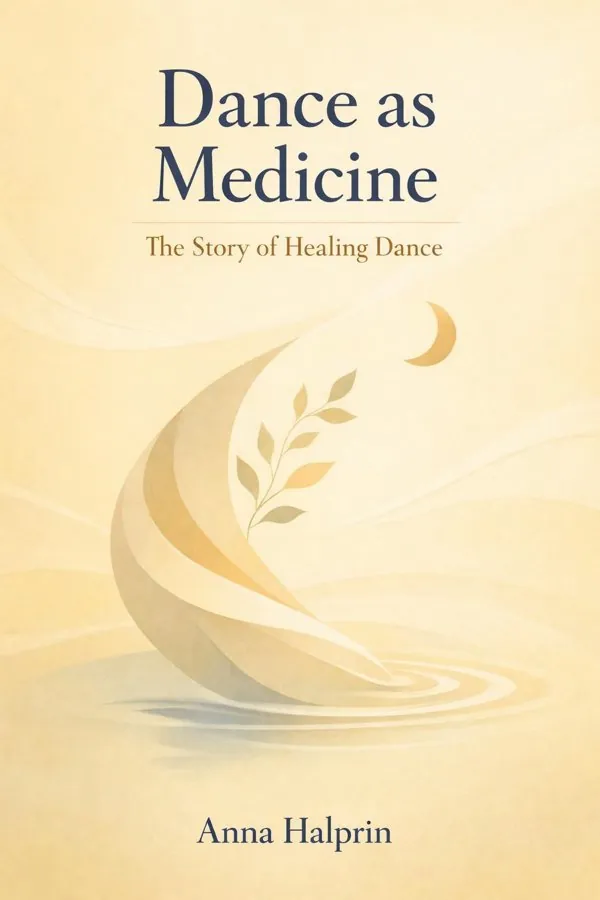
Dance as Medicine: The Story of Healing Dance: Summary & Key Insights
by Anna Halprin
 10 min9 chaptersAudio available
Key Takeaways from Dance as Medicine: The Story of Healing Dance
Before dance became a performance to watch, it was a practice people used to survive, connect, and heal.
Healing begins when we stop treating the body as an object to control and start experiencing it as a source of truth.
Art becomes healing when it helps us give form to lived experience.
We often believe healing must follow a medical script, yet Halprin shows that transformation can begin when a person is finally able to move what has been frozen.
Healing deepens when the body remembers that it belongs to the larger rhythms of the natural world.
What Is Dance as Medicine: The Story of Healing Dance About?
Dance as Medicine: The Story of Healing Dance by Anna Halprin is a performing_arts book spanning 9 pages. What if movement were more than exercise, performance, or entertainment? In Dance as Medicine: The Story of Healing Dance, Anna Halprin argues that dance is one of humanity’s oldest healing technologies—a way to process grief, restore vitality, reconnect with the body, and transform suffering into expression. Drawing from decades of work as a choreographer, teacher, and pioneer of expressive arts healing, Halprin shows how movement can become a practical path toward physical, emotional, and communal renewal. The book matters because it challenges the modern tendency to separate art from health, body from feeling, and personal healing from community life. Halprin writes from lived authority: she was not only a groundbreaking figure in postmodern dance, but also someone who turned to movement during illness, loss, and limitation. Her methods emerged from experience, experimentation, and work with diverse groups seeking recovery and meaning. More than a memoir or dance theory text, this book is a compassionate invitation to listen to the body as a source of wisdom. It speaks to artists, therapists, caregivers, and anyone curious about how creative movement can help us heal, adapt, and live more fully.
This FizzRead summary covers all 9 key chapters of Dance as Medicine: The Story of Healing Dance in approximately 10 minutes, distilling the most important ideas, arguments, and takeaways from Anna Halprin's work. Also available as an audio summary and Key Quotes Podcast.
Dance as Medicine: The Story of Healing Dance
What if movement were more than exercise, performance, or entertainment? In Dance as Medicine: The Story of Healing Dance, Anna Halprin argues that dance is one of humanity’s oldest healing technologies—a way to process grief, restore vitality, reconnect with the body, and transform suffering into expression. Drawing from decades of work as a choreographer, teacher, and pioneer of expressive arts healing, Halprin shows how movement can become a practical path toward physical, emotional, and communal renewal.
The book matters because it challenges the modern tendency to separate art from health, body from feeling, and personal healing from community life. Halprin writes from lived authority: she was not only a groundbreaking figure in postmodern dance, but also someone who turned to movement during illness, loss, and limitation. Her methods emerged from experience, experimentation, and work with diverse groups seeking recovery and meaning.
More than a memoir or dance theory text, this book is a compassionate invitation to listen to the body as a source of wisdom. It speaks to artists, therapists, caregivers, and anyone curious about how creative movement can help us heal, adapt, and live more fully.
Who Should Read Dance as Medicine: The Story of Healing Dance?
This book is perfect for anyone interested in performing_arts and looking to gain actionable insights in a short read. Whether you're a student, professional, or lifelong learner, the key ideas from Dance as Medicine: The Story of Healing Dance by Anna Halprin will help you think differently.
- ✓Readers who enjoy performing_arts and want practical takeaways
- ✓Professionals looking to apply new ideas to their work and life
- ✓Anyone who wants the core insights of Dance as Medicine: The Story of Healing Dance in just 10 minutes
Want the full summary?
Get instant access to this book summary and 100K+ more with Fizz Moment.
Get Free SummaryAvailable on App Store • Free to download
Key Chapters
Before dance became a performance to watch, it was a practice people used to survive, connect, and heal. One of Anna Halprin’s foundational insights is that movement has always carried medicinal and spiritual meaning. In many ancient and indigenous cultures, dance marked birth, death, harvest, illness, initiation, mourning, and renewal. It was not something reserved for trained specialists on a stage. It belonged to the whole community and helped people restore harmony with themselves, each other, and the natural world.
Halprin draws attention to this history to show that healing dance is not a modern invention. Rather, it is a recovery of something deeply human. Ritual movement gave form to emotions that words could not contain. A circle dance could hold grief. Repetitive rhythm could regulate fear. Communal gesture could reinforce belonging after trauma or loss. By moving together, people transformed private suffering into shared experience.
This perspective also challenges the modern split between art and life. In Halprin’s view, dance loses much of its power when reduced to technical display. Healing movement does not begin with aesthetic perfection. It begins with presence, sensation, and intention. A simple step, breath, or gesture can become meaningful when it is tied to need: release, remembrance, celebration, or repair.
In practical terms, this means anyone can reclaim dance as a healing ritual. You do not need formal training. You can create a personal movement for transition, such as walking slowly before a difficult conversation, swaying while grieving, or gathering friends for an intentional movement circle after a loss. The actionable takeaway: treat movement not only as exercise or art, but as a ritual tool for processing life’s major changes.
Healing begins when we stop treating the body as an object to control and start experiencing it as a source of truth. Halprin’s philosophy grew from confronting her own vulnerability, including illness and physical limitation. Rather than forcing the body to meet an ideal, she learned to listen to what it was expressing through tension, fatigue, pain, breath, impulse, and sensation. This shift from performance to awareness became central to her work.
For Halprin, body awareness is not passive self-observation. It is an active dialogue with the body’s intelligence. The body remembers experiences that the mind may ignore or suppress. Fear can show up as contraction in the chest. Unspoken grief may live in collapsed posture. Joy can appear as spontaneous expansion. When we pay close attention, movement becomes a way to read these signals and respond with care instead of judgment.
This principle is especially powerful because it makes healing dance accessible. You do not need to know choreography to practice awareness. A session can begin by noticing the feet on the floor, the rhythm of breathing, or the places in the body that feel numb, restless, or alive. From there, movement emerges organically: stretching toward openness, curling inward for protection, shaking off anxiety, or tracing the shape of a feeling with the hands.
In everyday life, this approach can help people make better decisions and regulate stress. Someone overwhelmed at work might pause and notice jaw tension, then use slow neck rolls and deeper breathing to interrupt the stress cycle. Someone recovering from illness might use gentle walking and arm gestures to rebuild trust in the body. The actionable takeaway: begin any healing movement practice by asking, “What is my body telling me right now?” and let the answer guide your next movement.
Art becomes healing when it helps us give form to lived experience. One of Halprin’s most influential contributions is the Life/Art Process, a method that links movement, drawing, writing, and reflection to personal transformation. The core idea is simple but profound: when experience is expressed through art, it becomes more visible, more workable, and less overwhelming. What is vague inside us can be moved, seen, named, and reshaped.
The Life/Art Process does not separate creativity from emotional inquiry. A person might begin with a bodily sensation, translate it into movement, then draw the pattern or image that emerged, and finally write about what it reveals. This sequence allows unconscious material to surface gently. Rather than analyzing feelings from a distance, the person engages them through multiple channels. The process often leads to insight because the body, imagination, and intellect are all involved.
Halprin used this method in workshops, therapeutic settings, and creative practice. It helped participants explore grief, fear, identity, sexuality, illness, aging, and change. The emphasis was not on producing polished art. It was on discovering authentic expression. A scribbled image, repeated movement phrase, or fragment of writing could become a doorway into deeper understanding.
This integrated process has practical applications far beyond dance studios. Teachers can use movement and drawing to help students process emotion. Therapists can incorporate embodied expression into talk-based work. Individuals can use it at home during periods of confusion or transition. For example, if you feel emotionally stuck, try moving for five minutes without judgment, then draw the shapes of that movement, then write one page beginning with “What this movement knows is...” The actionable takeaway: when words alone fail, use movement and art together to make inner experience tangible and transformable.
We often believe healing must follow a medical script, yet Halprin shows that transformation can begin when a person is finally able to move what has been frozen. Throughout her work, stories of healing demonstrate that dance is not an abstract theory but a lived practice with concrete emotional and physical effects. Participants dealing with illness, trauma, grief, shame, or isolation found in movement a way to reconnect with vitality and meaning.
These stories matter because they show that healing is not always about curing disease. Sometimes it means reclaiming agency, expressing what was silenced, or finding a new relationship to pain. Halprin’s own experiences, including her use of movement and ritual during serious illness, illustrate this shift. She did not present dance as magical denial of suffering. Instead, she showed how movement can help people face reality more fully, with creativity and courage.
In group settings, participants often discovered that gestures they thought were deeply private were also widely shared. One person’s trembling arms might mirror another’s fear. One person’s grounded stepping might inspire another’s sense of strength. These exchanges created recognition and reduced loneliness. The body became a storyteller, and the group became a witness.
Practical applications are especially powerful in times of stress or transition. A person coping with diagnosis might create a movement ritual for fear and resilience. Someone grieving a loved one might alternate gestures of reaching and releasing to embody loss and continuation. A support group might use guided movement to express emotions before discussion begins. The actionable takeaway: use personal movement stories not to escape difficulty, but to witness your experience honestly and discover where energy, resilience, and possibility still remain.
Healing deepens when the body remembers that it belongs to the larger rhythms of the natural world. Halprin consistently emphasizes the relationship between movement and nature, seeing the outdoors not as a backdrop but as an active partner in renewal. Wind, trees, water, rocks, changing light, and seasonal cycles all offer models for how bodies can move, rest, adapt, and transform.
This connection matters because modern life often disconnects people from sensory experience. Indoors, under pressure, we can become abstracted from our bodies and from time itself. Nature restores scale and presence. A person watching waves may rediscover fluidity. Standing barefoot on uneven ground can awaken balance and responsiveness. Moving with the rhythm of breath beside trees can soften the nervous system and widen attention.
For Halprin, nature-based movement is not about imitation in a superficial sense. It is about relationship. If you move with the quality of a branch bending in wind, you may discover flexibility without collapse. If you walk with the steadiness of a mountain image, you may embody support. If you observe decay and renewal in seasons, you may find a more compassionate understanding of aging, illness, and recovery.
This insight has practical value for everyday healing. A stressed person might leave the gym for a walk in a park and let the pace emerge from birdsong or sunlight. A group might create a shoreline ritual for grief or gratitude. Someone feeling emotionally rigid might explore spiraling, swaying, or grounded crouching outdoors to reconnect with organic movement patterns. The actionable takeaway: take your healing movement practice outside whenever possible, and let one element of nature guide how you move, breathe, and pay attention.
Some pain cannot be healed alone because it was created, intensified, or carried within relationship. Halprin understood that dance becomes especially powerful when it is shared in community ritual. Group movement can hold emotions that feel too heavy for one person to bear. It can turn isolation into belonging and private pain into collective witnessing. In this sense, healing dance is not only personal medicine but social medicine.
Ritual differs from casual activity because it gives intentional structure to experience. A community dance for mourning, forgiveness, transition, or celebration helps participants step out of ordinary roles and into a shared field of meaning. The ritual frame says: this moment matters, your body matters, and what we are experiencing together deserves form. This can be deeply reparative in cultures where many people feel unseen, fragmented, or emotionally unsupported.
Halprin’s group work often invited participants to move in circles, mirror each other, improvise around themes, or create symbolic gestures that expressed common needs. Such practices help people feel less alone in fear, grief, or vulnerability. They also create empathy, because people witness others’ humanity through movement rather than argument or explanation.
Today, this idea has broad application. Schools can use movement rituals to mark transitions or build trust. Healthcare teams can use reflective movement to process stress and prevent burnout. Families can create simple embodied rituals during times of change, such as illness, relocation, or bereavement. Communities recovering from crisis can gather for movement-based remembrance and renewal. The actionable takeaway: when facing a difficult life event, do not ask only, “How can I heal?” Ask also, “What movement ritual could help us heal together?”
Not all wisdom comes in words. Halprin teaches that the body communicates through sensation, image, impulse, gesture, and rhythm. When we learn to read this language, the body becomes more than a vehicle we inhabit; it becomes an intelligent messenger. Many emotional truths emerge physically before they become conscious thoughts. Tightness may signal fear. Heaviness may suggest grief. An urge to reach, push, curl, or stamp may reveal needs that the mind has not yet articulated.
This way of understanding the body has important implications for healing. Rather than dismissing bodily responses as irrational or inconvenient, Halprin invites us to approach them with curiosity. A repeated movement pattern may carry symbolic meaning. For example, circling could express searching, pacing might indicate agitation, and opening the arms may represent readiness or surrender. By moving these patterns consciously, people can explore what their bodies are trying to say.
This approach also validates nonverbal forms of knowledge. Some experiences are too early, too painful, or too complex to fit easily into language. For children, trauma survivors, people with illness, or anyone emotionally overwhelmed, movement can offer a safer and more immediate mode of communication. A facilitator can ask, “Show me how this feeling moves,” instead of “Explain exactly what is wrong.”
In daily life, anyone can practice bodily listening. During conflict, notice whether your body wants to brace, retreat, or reach. During decision-making, compare how different options feel in posture and breath. During creative work, follow the movement impulse that feels most alive. The actionable takeaway: treat recurring sensations and spontaneous gestures as meaningful information, and ask what message they may be carrying before trying to suppress them.
Art heals most deeply when performance is not just display but revelation. Halprin reimagines performance as a therapeutic and communal act, one that can make hidden realities visible and give people a structured way to witness transformation. In her work, performance did not serve vanity or polish alone. It became a container for truth, vulnerability, and healing intention.
This idea expands the meaning of both art and therapy. In conventional settings, therapy is private and performance is public. Halprin blurs that boundary carefully. When people shape lived experience into movement and share it with others, they often gain perspective, dignity, and release. The audience, in turn, is not just entertained but invited into empathy and reflection. A performed ritual around illness, aging, loss, or social pain can validate experiences many people carry silently.
Importantly, medicinal performance does not require professional virtuosity. What matters is authenticity, clarity of intention, and a respectful framework. A community group might create a movement piece about caregiving. Cancer survivors might perform gestures of fear, resilience, and hope. Elders might share embodied memories through walking patterns, touch, and voice. Such performances can reduce stigma and build bridges between personal struggle and public understanding.
This concept also applies on a smaller scale. Presenting a movement created during a difficult life chapter to a trusted friend, support group, or class can be healing because it transforms private experience into witnessed form. It says: this happened, this matters, and I can stand inside it. The actionable takeaway: consider shaping a meaningful life experience into a simple movement score or ritual performance and sharing it in a safe, intentional setting.
The future of care may depend on reconnecting what modern systems have split apart. Halprin’s broader vision is that dance can bridge art, health, education, and community life. She argues that healing is not solely the domain of medicine in the narrow clinical sense. Human well-being also depends on expression, connection, embodiment, imagination, and participation. Dance addresses these dimensions directly.
This makes her work especially relevant today. Many people live with chronic stress, trauma, loneliness, and conditions that are influenced by nervous system regulation, social support, and meaning-making as much as by medication or diagnosis. Healing dance does not replace medical treatment, but it can complement it by helping people restore agency and reconnect with their own capacities. It offers practices for resilience that are low-cost, adaptable, and accessible across ages and backgrounds.
Halprin’s legacy also points toward institutional change. Schools can integrate movement for emotional literacy. Hospitals can include expressive arts in patient support programs. Mental health settings can combine verbal therapy with embodied exploration. Community centers can offer intergenerational rituals and movement-based healing spaces. Public health can take seriously the role of creativity and belonging in recovery.
At the individual level, this vision invites a more integrated life. You do not have to choose between artistry and practicality, emotional depth and physical care, self-expression and community service. A movement practice can hold all of these at once. The actionable takeaway: look for one way to integrate healing movement into an existing area of life—healthcare, teaching, caregiving, leadership, or personal well-being—and treat embodiment as an essential part of long-term health.
All Chapters in Dance as Medicine: The Story of Healing Dance
About the Author
Anna Halprin (1920–2021) was an American dancer, choreographer, and visionary teacher whose work transformed the field of modern and postmodern dance. Rather than treating dance as a purely theatrical art, she explored movement as a way of engaging everyday life, nature, ritual, and healing. Over decades of innovation, Halprin developed practices that integrated improvisation, body awareness, drawing, performance, and community participation. Her experiences with illness and recovery deepened her commitment to using movement as a tool for emotional and physical transformation. Along with her daughter Daria Halprin, she co-founded the Tamalpa Institute, which became an influential center for expressive arts education and healing arts training. Halprin’s legacy continues to shape dancers, therapists, educators, and wellness practitioners around the world.
Get This Summary in Your Preferred Format
Read or listen to the Dance as Medicine: The Story of Healing Dance summary by Anna Halprin anytime, anywhere. FizzRead offers multiple formats so you can learn on your terms — all free.
Available formats: App · Audio · PDF · EPUB — All included free with FizzRead
Download Dance as Medicine: The Story of Healing Dance PDF and EPUB Summary
Key Quotes from Dance as Medicine: The Story of Healing Dance
“Before dance became a performance to watch, it was a practice people used to survive, connect, and heal.”
“Healing begins when we stop treating the body as an object to control and start experiencing it as a source of truth.”
“Art becomes healing when it helps us give form to lived experience.”
“We often believe healing must follow a medical script, yet Halprin shows that transformation can begin when a person is finally able to move what has been frozen.”
“Healing deepens when the body remembers that it belongs to the larger rhythms of the natural world.”
Frequently Asked Questions about Dance as Medicine: The Story of Healing Dance
Dance as Medicine: The Story of Healing Dance by Anna Halprin is a performing_arts book that explores key ideas across 9 chapters. What if movement were more than exercise, performance, or entertainment? In Dance as Medicine: The Story of Healing Dance, Anna Halprin argues that dance is one of humanity’s oldest healing technologies—a way to process grief, restore vitality, reconnect with the body, and transform suffering into expression. Drawing from decades of work as a choreographer, teacher, and pioneer of expressive arts healing, Halprin shows how movement can become a practical path toward physical, emotional, and communal renewal. The book matters because it challenges the modern tendency to separate art from health, body from feeling, and personal healing from community life. Halprin writes from lived authority: she was not only a groundbreaking figure in postmodern dance, but also someone who turned to movement during illness, loss, and limitation. Her methods emerged from experience, experimentation, and work with diverse groups seeking recovery and meaning. More than a memoir or dance theory text, this book is a compassionate invitation to listen to the body as a source of wisdom. It speaks to artists, therapists, caregivers, and anyone curious about how creative movement can help us heal, adapt, and live more fully.
You Might Also Like

Harriet Tubman: Live in Concert
Bob the Drag Queen
10 min
The Art of Stagecraft
Robert Edmond Jones
10 min
The Art of Stop-Motion Animation
Ken A. Priebe
10 min
Thunderstorm
Cao Yu
10 min
Acting In Film: An Actor's Take on Movie Making
Michael Caine
10 min
Character Animation Crash Course!
Eric Goldberg
10 minBrowse by Category
Ready to read Dance as Medicine: The Story of Healing Dance?
Get the full summary and 100K+ more books with Fizz Moment.