
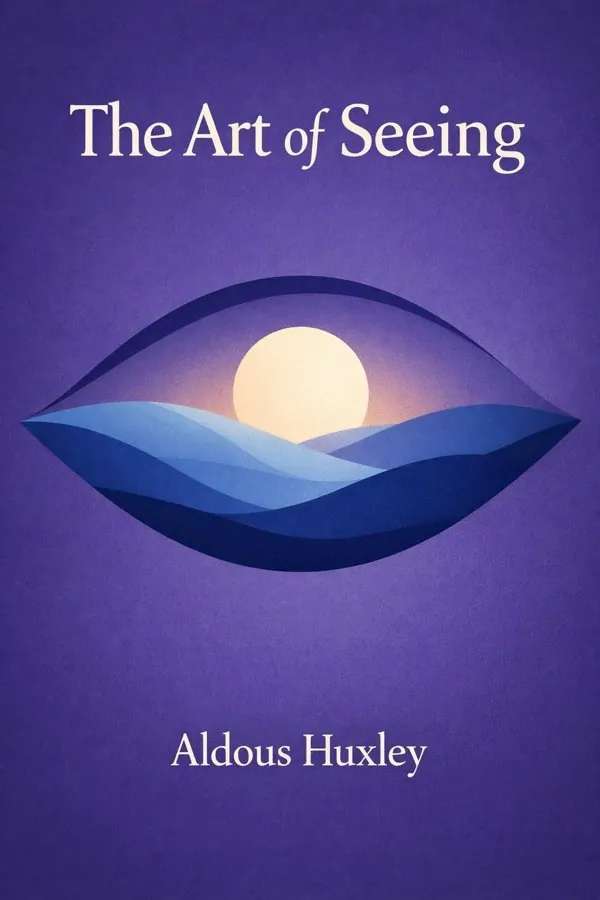
The Art of Seeing: Summary & Key Insights
 10 min8 chaptersAudio available
Key Takeaways from The Art of Seeing
One of Huxley’s boldest claims is that vision cannot be fully understood if we treat the eye like a camera.
Huxley places mental strain at the center of defective seeing.
Huxley presents the Bates Method not as a miracle cure but as a form of reeducation.
Huxley’s discussion of sight gradually expands into a philosophy of perception.
A recurring theme in Huxley’s account is that healthy seeing is dynamic.
What Is The Art of Seeing About?
The Art of Seeing by Aldous Huxley is a popular_sci book spanning 6 pages. The Art of Seeing is Aldous Huxley’s deeply personal and provocative exploration of vision, perception, and the possibility of improving eyesight through habit, attention, and relaxation. Written after Huxley’s own struggle with severe visual impairment, the book introduces readers to the Bates Method, a controversial approach that argues many common vision problems are worsened by mental tension and harmful patterns of seeing. Rather than treating the eye as a mere machine, Huxley invites us to consider vision as a whole-body, whole-mind activity shaped by psychology, posture, expectation, and awareness. What makes the book enduringly compelling is its combination of memoir, popular science, and philosophy. Huxley does not simply repeat a medical theory; he tests it against lived experience, asking how we might recover a more natural, less strained way of looking at the world. Even where readers remain skeptical of some claims, the book raises fascinating questions about attention, stress, embodiment, and the limits of orthodox expertise. Huxley’s authority comes not from professional ophthalmology but from his rare blend of intellectual rigor, self-observation, and firsthand necessity.
This FizzRead summary covers all 8 key chapters of The Art of Seeing in approximately 10 minutes, distilling the most important ideas, arguments, and takeaways from Aldous Huxley's work. Also available as an audio summary and Key Quotes Podcast.
The Art of Seeing
The Art of Seeing is Aldous Huxley’s deeply personal and provocative exploration of vision, perception, and the possibility of improving eyesight through habit, attention, and relaxation. Written after Huxley’s own struggle with severe visual impairment, the book introduces readers to the Bates Method, a controversial approach that argues many common vision problems are worsened by mental tension and harmful patterns of seeing. Rather than treating the eye as a mere machine, Huxley invites us to consider vision as a whole-body, whole-mind activity shaped by psychology, posture, expectation, and awareness.
What makes the book enduringly compelling is its combination of memoir, popular science, and philosophy. Huxley does not simply repeat a medical theory; he tests it against lived experience, asking how we might recover a more natural, less strained way of looking at the world. Even where readers remain skeptical of some claims, the book raises fascinating questions about attention, stress, embodiment, and the limits of orthodox expertise. Huxley’s authority comes not from professional ophthalmology but from his rare blend of intellectual rigor, self-observation, and firsthand necessity.
Who Should Read The Art of Seeing?
This book is perfect for anyone interested in popular_sci and looking to gain actionable insights in a short read. Whether you're a student, professional, or lifelong learner, the key ideas from The Art of Seeing by Aldous Huxley will help you think differently.
- ✓Readers who enjoy popular_sci and want practical takeaways
- ✓Professionals looking to apply new ideas to their work and life
- ✓Anyone who wants the core insights of The Art of Seeing in just 10 minutes
Want the full summary?
Get instant access to this book summary and 100K+ more with Fizz Moment.
Get Free SummaryAvailable on App Store • Free to download
Key Chapters
One of Huxley’s boldest claims is that vision cannot be fully understood if we treat the eye like a camera. In conventional eye science of his time, sight was often described as a mechanical process: light enters the eye, the lens focuses, the retina receives an image, and the brain interprets the result. Huxley believed this model was too narrow. It explained optical structures, but not the living act of seeing.
For Huxley, vision is influenced by emotion, habit, attention, and muscular tension. Two people may have similar eyes anatomically yet use them very differently. A person under stress may squint, stare, or hold the body rigid, making perception less fluid and less accurate. Another person may look with ease, allowing the eyes to shift naturally and perceive detail more comfortably. This means that some visual difficulty may come not only from physical defects but from learned patterns of strain.
This idea matters because it challenges passive dependence on correction alone. Huxley does not deny that physical impairments exist, nor does he suggest that every eye condition can be reversed. Instead, he argues that many people worsen their own seeing through unconscious effort. We often try too hard to see, especially when reading small print, working at screens, or staring into the distance.
A simple example is what happens when you struggle to read a sign far away. Many people freeze their face, tighten the forehead, and force their gaze. The result is often poorer clarity, not better. Huxley’s insight is that seeing improves when effort becomes intelligent rather than intense.
Actionable takeaway: Notice how you look during visually demanding tasks. If you catch yourself staring or tensing your face, pause, blink, and let your gaze move more naturally before trying again.
Huxley places mental strain at the center of defective seeing. Drawing on the work of Dr. William H. Bates, he argues that blurred vision is often linked to a state of inner effortfulness. When the mind is anxious, hurried, or overconcentrated, the eyes do not remain innocent observers; they participate in the tension. Muscles tighten, blinking decreases, and visual attention becomes rigid.
This theory may sound surprising, but it resonates with everyday experience. Most people know that fatigue, worry, or pressure can make reading harder and distant vision less reliable. Huxley extends that observation into a broader principle: strain is not a minor side effect but a major contributor to poor seeing. According to this view, relaxation is not a luxury added after vision happens; it is one of the conditions that makes clear vision possible.
The practical significance is immense. If strain contributes to visual problems, then training the mind and body to release effort may improve how we use our eyes. Huxley discusses methods such as rest, rhythmic blinking, and shifting attention lightly rather than fixing it in one place. These are meant to interrupt the habit of visual forcing.
Consider someone reading email for hours. As attention narrows, the person may lean in, stop blinking, and feel the eyes burning. Vision seems to dull, so they try harder. But the harder they try, the more strained they become. Huxley’s point is that the cycle must be broken through ease, not added effort.
His broader message also applies beyond eyesight. Many human functions worsen when overcontrolled. Sleep, memory, speech, and athletic movement all deteriorate when forced. Seeing, Huxley suggests, belongs in the same category.
Actionable takeaway: When your vision feels tired or blurred, do not immediately force focus. First relax the jaw, shoulders, and forehead, blink several times, and let your attention soften before resuming the task.
Huxley presents the Bates Method not as a miracle cure but as a form of reeducation. The central idea is that many people have learned dysfunctional visual habits and can, at least to some degree, learn better ones. Instead of assuming that the eye’s condition is fixed and that glasses are the only answer, Bates proposed training in more natural seeing: movement instead of staring, relaxation instead of effort, and awareness instead of unconscious misuse.
This educational framing is crucial. Huxley does not describe vision improvement as something done to a passive patient. It requires participation. A person must observe how they use their eyes, notice when strain appears, and practice alternative habits consistently. The exercises often sound simple, but their simplicity is deceptive. Relearning a deeply ingrained pattern can be difficult precisely because it is automatic.
Among the best-known practices are shifting, central fixation, and palming. Shifting means allowing the eyes to move from point to point instead of trying to grasp an entire field at once. Central fixation refers to the idea that we see best where we are directly looking, so clarity improves when we let attention travel rather than attempt uniform sharpness everywhere. Palming involves resting the closed eyes under the palms to encourage mental and visual relaxation.
Even for readers who do not accept every element of Bates’s theory, the educational approach remains valuable. People can learn better screen ergonomics, blink more often, avoid prolonged staring, and introduce visual breaks into concentrated work. These are forms of reeducation too.
Huxley’s larger contribution is to restore agency. He suggests that eyesight is not always a sealed fate handed down by diagnosis. Sometimes it is also a practice, a skill, and a relationship between body and consciousness.
Actionable takeaway: Treat vision as a trainable habit. Experiment daily with brief periods of relaxed eye movement, frequent blinking, and short visual rests instead of relying only on willpower to push through fatigue.
Huxley’s discussion of sight gradually expands into a philosophy of perception. We do not merely receive visual data; we attend, select, interpret, and organize it. In that sense, seeing is not just optical but psychological. What we notice depends on our mental state, expectations, interests, and habits of awareness.
This is one reason Huxley believed better vision involved more than the eyeball itself. A distracted or frightened person may fail to see what is plainly present. A calm and observant person may detect subtle distinctions others miss. This is true in everyday life: a skilled painter notices color relationships, a birder spots movement in trees, and a proofreader catches errors invisible to hurried readers. Their eyes are not necessarily superior in structure; they are trained in attention.
Huxley therefore links visual improvement with heightened consciousness. To see better is partly to become more present. Instead of staring blankly or grasping anxiously, one learns to observe lightly and steadily. This has ethical and philosophical dimensions. Much human misunderstanding, he implies, comes from poor seeing in the broadest sense: we look without attention, or we interpret before we truly perceive.
The idea can be applied well beyond eyesight. In conversation, we often fail to notice facial expressions because we are preparing our reply. In work, we overlook mistakes because we scan too quickly. In nature, we pass through rich environments while mentally elsewhere. Better seeing begins when awareness slows enough to receive reality rather than impose tension on it.
This makes The Art of Seeing more than a manual of eye exercises. It becomes a meditation on presence. Huxley invites readers to experience perception as a living dialogue between world and mind.
Actionable takeaway: Practice one minute of deliberate observation each day. Look at a familiar object without rushing, and notice shape, texture, light, and color. Train attention, not just eyesight.
A recurring theme in Huxley’s account is that healthy seeing is dynamic. The eyes are made to move, adapt, and respond to changing light. Problems arise when we immobilize them through prolonged staring, artificial work patterns, or excessive close focus. Good vision, in Huxley’s view, involves rhythm: the eyes shift, the focus changes, blinking refreshes the surface, and the body remains relatively at ease.
He also emphasizes the role of light. Modern readers may take lighting for granted, but visual comfort is heavily shaped by it. Harsh glare, dim environments, and long periods under unnatural illumination can encourage strain. Huxley suggests that people often ignore such conditions and then blame the eyes alone for the resulting discomfort. Better visual habits include respecting how strongly environment affects perception.
A practical example is digital life. Many people spend hours in static visual conditions, focusing at one distance with limited movement and reduced blinking. This creates fatigue even in people with otherwise healthy eyes. Huxley’s framework helps explain why: vision is being used unnaturally, not because technology is evil, but because the pattern is narrow and rigid.
Movement matters at a small scale too. Instead of trying to lock onto words or objects with fixed intensity, Huxley recommends allowing attention to travel gently across details. This can make reading less effortful and scene perception more comfortable. The point is not restlessness but natural mobility.
His larger insight is ecological: eyesight cannot be separated from the conditions in which it functions. Light, distance, posture, and pacing all shape visual performance.
Actionable takeaway: Create a more natural visual rhythm. During concentrated work, look away every few minutes, let your eyes travel to different distances, and adjust lighting to reduce glare and unnecessary strain.
Huxley’s own story gives the book much of its force. After serious visual impairment and discouraging medical predictions, he pursued methods of retraining and reported meaningful improvement. Whether readers accept every detail of his interpretation or not, the story highlights a powerful principle: change in perception is gradual, uneven, and dependent on disciplined practice.
Huxley does not portray recovery as instantaneous. He describes setbacks, experimentation, and the need to undo deeply rooted habits. This is important because many people approach self-improvement with hidden impatience. If results are not dramatic and immediate, they conclude the effort is useless. Huxley instead presents vision work as comparable to learning an instrument or rebuilding physical coordination after injury. Progress may be real without being linear.
He also uses case studies and observations from others to argue that improvement is possible across a range of visual difficulties. Again, the key idea is not that every condition is equally reversible, but that functional use of the eyes can often be improved. Even modest gains in comfort, endurance, or clarity can matter enormously in daily life.
This perspective has broad relevance. In health, people often underestimate the power of repeated small adjustments and overestimate the value of single interventions. Better sleep, movement, posture, breathing, and attention frequently work this way. Vision, Huxley argues, is no exception.
For modern readers, the takeaway is encouraging but realistic. Eye comfort may improve through habit changes, but only if those changes are practiced consistently. A single relaxation exercise will not erase years of strain. Lasting change comes from repetition and self-observation.
Actionable takeaway: Set a modest, repeatable vision habit for two weeks, such as three daily visual breaks or one minute of relaxed eye movement, and track whether comfort and clarity improve over time.
Huxley is sharply critical of any authority that mistakes its current methods for final truth. In The Art of Seeing, he challenges orthodox vision science not because he rejects science itself, but because he believes institutions often become too confident in partial explanations. If the eye is treated only as an optical instrument, then solutions will be limited to optical corrections or surgical thinking. What gets ignored are psychological variables, behavioral habits, and the possibility of functional retraining.
This critique remains relevant today. In many fields, experts work within frameworks that illuminate some truths while obscuring others. The danger comes when a dominant model dismisses anomalies rather than investigating them. Huxley saw this happening in ophthalmology, where reports of improved sight through relaxation and retraining were often rejected outright because they did not fit prevailing assumptions.
At the same time, Huxley does not advocate gullibility. He is not asking readers to believe every unconventional claim. His argument is for disciplined open-mindedness. A good investigator should examine evidence, attend to lived outcomes, and remain willing to revise theory when experience demands it.
This balance is valuable beyond medicine. In education, work, nutrition, and psychology, people often oscillate between blind trust in authority and reckless rejection of it. Huxley offers a third path: respect expertise, but do not surrender observation. If something helps in repeatable ways, it deserves attention. If a theory cannot explain real experience, the theory may need expansion.
The deeper lesson is intellectual humility. Human knowledge advances when certainty loosens enough for inquiry to continue.
Actionable takeaway: When dealing with health or performance problems, seek qualified advice but also observe your own patterns carefully. Let evidence include both professional guidance and honest personal experience.
For Huxley, improved vision is not merely a medical convenience; it changes one’s relationship to reality. To see more clearly is to participate more fully in the world. Reading becomes easier, movement becomes more confident, and the surrounding environment regains richness. But Huxley’s claim goes further: the cultivation of better seeing can also foster patience, calm, and attentiveness in everyday life.
This is because the habits that support vision—relaxation, sensitivity, mobility of attention, and reduced forcing—are also habits of wiser living. A person who learns not to strain visually may discover parallels in thought and action. They may speak less compulsively, work with better pacing, and approach problems with more observation and less panic. In this sense, visual training becomes a small school for consciousness.
The idea may seem lofty, yet it has simple daily expressions. A person who stops repeatedly to rest their eyes may also interrupt cycles of stress. Someone who learns to notice tension in the forehead may become more aware of emotional pressure throughout the body. Someone who practices looking closely at ordinary objects may recover wonder that routine has dulled.
Huxley’s philosophy suggests that modern life often trains us in the opposite direction. We rush, skim, stare, and overexert. We consume visual information without really seeing. The art of seeing therefore becomes a corrective to modern distraction as much as a method of visual care.
In the end, the book asks a subtle question: what if clearer sight is part of a clearer life? Huxley does not promise perfection, but he does insist that perception deserves cultivation.
Actionable takeaway: Use visual care as a gateway to broader self-awareness. Each time you relax your eyes, also check your breathing, posture, and mental pace.
All Chapters in The Art of Seeing
About the Author
Aldous Huxley (1894–1963) was an English novelist, essayist, and intellectual whose work ranged across literature, science, religion, psychology, and philosophy. He is best known for Brave New World, but his nonfiction is equally notable for its curiosity and breadth. Huxley came from a prominent intellectual family and was educated at Eton and Oxford. A serious eye illness in youth left him with lasting visual impairment, an experience that shaped his interest in perception and eventually led to The Art of Seeing. Throughout his career, he explored themes of human potential, consciousness, social control, and spiritual development. Other major works include The Doors of Perception and Island. Huxley remains influential for his rare ability to combine literary elegance with searching inquiry into how human beings think, perceive, and live.
Get This Summary in Your Preferred Format
Read or listen to the The Art of Seeing summary by Aldous Huxley anytime, anywhere. FizzRead offers multiple formats so you can learn on your terms — all free.
Available formats: App · Audio · PDF · EPUB — All included free with FizzRead
Download The Art of Seeing PDF and EPUB Summary
Key Quotes from The Art of Seeing
“One of Huxley’s boldest claims is that vision cannot be fully understood if we treat the eye like a camera.”
“Huxley places mental strain at the center of defective seeing.”
“Huxley presents the Bates Method not as a miracle cure but as a form of reeducation.”
“Huxley’s discussion of sight gradually expands into a philosophy of perception.”
“A recurring theme in Huxley’s account is that healthy seeing is dynamic.”
Frequently Asked Questions about The Art of Seeing
The Art of Seeing by Aldous Huxley is a popular_sci book that explores key ideas across 8 chapters. The Art of Seeing is Aldous Huxley’s deeply personal and provocative exploration of vision, perception, and the possibility of improving eyesight through habit, attention, and relaxation. Written after Huxley’s own struggle with severe visual impairment, the book introduces readers to the Bates Method, a controversial approach that argues many common vision problems are worsened by mental tension and harmful patterns of seeing. Rather than treating the eye as a mere machine, Huxley invites us to consider vision as a whole-body, whole-mind activity shaped by psychology, posture, expectation, and awareness. What makes the book enduringly compelling is its combination of memoir, popular science, and philosophy. Huxley does not simply repeat a medical theory; he tests it against lived experience, asking how we might recover a more natural, less strained way of looking at the world. Even where readers remain skeptical of some claims, the book raises fascinating questions about attention, stress, embodiment, and the limits of orthodox expertise. Huxley’s authority comes not from professional ophthalmology but from his rare blend of intellectual rigor, self-observation, and firsthand necessity.
More by Aldous Huxley

You Might Also Like
Structures: Or Why Things Don"t Fall Down
J.E. Gordon
10 min
The Road to Wigan Pier
George Orwell
10 min
Bonk: The Curious Coupling of Science and Sex
Mary Roach
10 min
First Bite: How We Learn to Eat
Bee Wilson
10 min
In Pursuit Of The Unknown: 17 Equations That Changed The World
Ian Stewart
10 min
Napoleon's Buttons: 17 Molecules That Changed History
Penny Le Couteur and Jay Burreson
10 minBrowse by Category
Ready to read The Art of Seeing?
Get the full summary and 100K+ more books with Fizz Moment.