
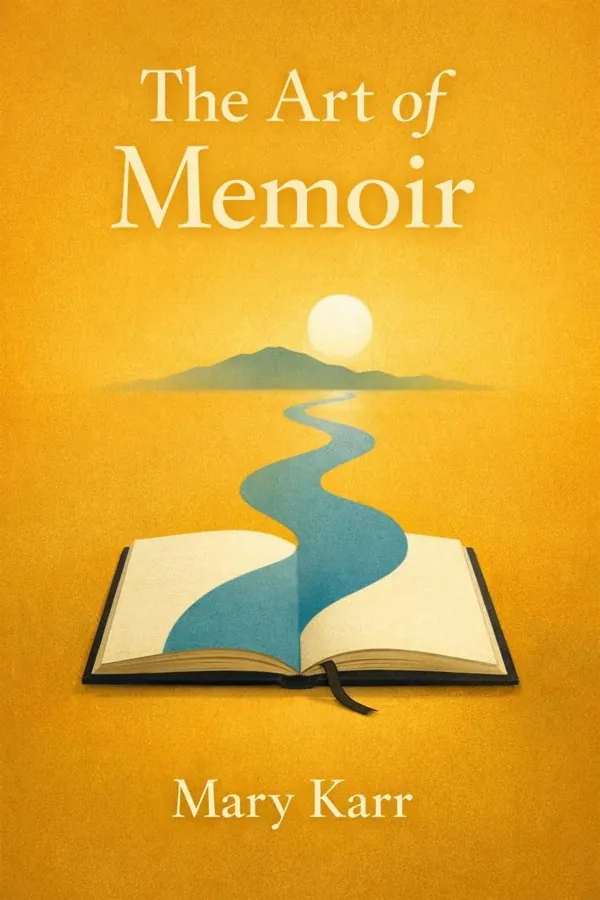
The Art of Memoir: Summary & Key Insights
by Mary Karr
 10 min12 chaptersAudio available
What Is The Art of Memoir About?
The Art of Memoir by Mary Karr is a writing book spanning 12 pages. In this masterclass on the craft of memoir, Mary Karr—acclaimed author of The Liars’ Club, Cherry, and Lit—shares her insights into the art of transforming personal experience into compelling narrative. Drawing on her own writing journey and decades of teaching, Karr explores truth-telling, memory, voice, and structure, offering practical advice and candid reflections that illuminate how to turn life into literature.
This FizzRead summary covers all 12 key chapters of The Art of Memoir in approximately 10 minutes, distilling the most important ideas, arguments, and takeaways from Mary Karr's work. Also available as an audio summary and Key Quotes Podcast.
The Art of Memoir
In this masterclass on the craft of memoir, Mary Karr—acclaimed author of The Liars’ Club, Cherry, and Lit—shares her insights into the art of transforming personal experience into compelling narrative. Drawing on her own writing journey and decades of teaching, Karr explores truth-telling, memory, voice, and structure, offering practical advice and candid reflections that illuminate how to turn life into literature.
Who Should Read The Art of Memoir?
This book is perfect for anyone interested in writing and looking to gain actionable insights in a short read. Whether you're a student, professional, or lifelong learner, the key ideas from The Art of Memoir by Mary Karr will help you think differently.
- ✓Readers who enjoy writing and want practical takeaways
- ✓Professionals looking to apply new ideas to their work and life
- ✓Anyone who wants the core insights of The Art of Memoir in just 10 minutes
Want the full summary?
Get instant access to this book summary and 100K+ more with Fizz Moment.
Get Free SummaryAvailable on App Store • Free to download
Key Chapters
Memory is both the memoirist’s quarry and her trickster. It resists capture, reshaping itself every time we glance back at the past. In *The Art of Memoir*, I insist that the writer must hold dual awareness: a deep faith in what was lived, and a keen suspicion toward what’s recalled. “Memory,” as I tell my students, “is a pinball machine where the self ricochets off experience.” What matters, then, isn’t reconstructing the past exactly, but tracing how its echoes continue to sound within you.
I describe moments from my own writing to illustrate the paradox: recalling the trauma of my mother’s breakdown or the roughness of my East Texas childhood, I could never be sure whether I remembered my mother’s perfume or only the story I’d told myself a hundred times about it. Yet that doubt was not a flaw — it was the story. The memoirist’s job is not to ossify memory into certainty but to explore its workings, to ask: What do I believe happened, and why do I need to believe it that way? Through that inquiry, the past reveals its emotional architecture.
In the classroom, I’ve seen students cling to “getting it right.” But the reader doesn’t come to you for police-report truth; she comes for the felt truth. We must confess not only what happened, but how flawed our remembering of it is. By foregrounding uncertainty, you honor the reader’s trust and your own fallibility. Great memoirs—like Tobias Wolff’s *This Boy’s Life*—show how self-deception crumbles under scrutiny, and the writer’s vulnerability becomes a form of moral precision.
Memoir lives or dies by the writer’s moral courage. To write truthfully about one’s life requires not just recollection, but excavation of motive, shame, and contradiction. In *The Art of Memoir*, I define truth not as a static ledger of facts but as the ongoing struggle to see oneself without flattery. This is why lying — even small lies — poisons the work. When a writer manipulates memory for self-justification, the reader senses it instantly; our animal nose detects the fake grief, the skewed blame, the missing texture.
Telling the truth often means implicating oneself. I learned this the hard way while writing *Lit*, when I had to admit the cruelties I inflicted on those I loved. Honesty doesn’t mean cruelty toward others, but it does demand humility. You can omit details to spare someone’s privacy, but never to varnish your own image. Truth-telling is an aesthetic necessity because the reader must feel she’s in the company of a mind that refuses illusion. The paradox is that memoir, though shaped by art, must feel truer than fact — because it speaks from the depths of human reckoning.
+ 10 more chapters — available in the FizzRead app
All Chapters in The Art of Memoir
About the Author
Mary Karr is an American poet, essayist, and memoirist best known for her bestselling memoirs The Liars’ Club, Cherry, and Lit. Born in 1955 in Groves, Texas, she is a professor of literature at Syracuse University and a member of the American Academy of Arts and Letters. Her work is celebrated for its honesty, humor, and lyrical prose.
Get This Summary in Your Preferred Format
Read or listen to the The Art of Memoir summary by Mary Karr anytime, anywhere. FizzRead offers multiple formats so you can learn on your terms — all free.
Available formats: App · Audio · PDF · EPUB — All included free with FizzRead
Download The Art of Memoir PDF and EPUB Summary
Key Quotes from The Art of Memoir
“Memory is both the memoirist’s quarry and her trickster.”
“Memoir lives or dies by the writer’s moral courage.”
Frequently Asked Questions about The Art of Memoir
The Art of Memoir by Mary Karr is a writing book that explores key ideas across 12 chapters. In this masterclass on the craft of memoir, Mary Karr—acclaimed author of The Liars’ Club, Cherry, and Lit—shares her insights into the art of transforming personal experience into compelling narrative. Drawing on her own writing journey and decades of teaching, Karr explores truth-telling, memory, voice, and structure, offering practical advice and candid reflections that illuminate how to turn life into literature.
More by Mary Karr
You Might Also Like
The Art of Perspective
Christopher Castellani
10 min
Making a Point: The Persnickety Story of English Punctuation
David Crystal
10 min
The Elements Of Eloquence: How To Turn The Perfect English Phrase
Mark Forsyth
10 min
The Pocket Muse: Ideas and Inspirations for Writing
Monica Wood
10 min
A Little Book on Form: An Exploration into the Formal Imagination of Poetry
Robert Hass
10 min
Adventures In The Screen Trade: A Personal View Of Hollywood And Screenwriting
William Goldman
10 minBrowse by Category
Ready to read The Art of Memoir?
Get the full summary and 100K+ more books with Fizz Moment.