
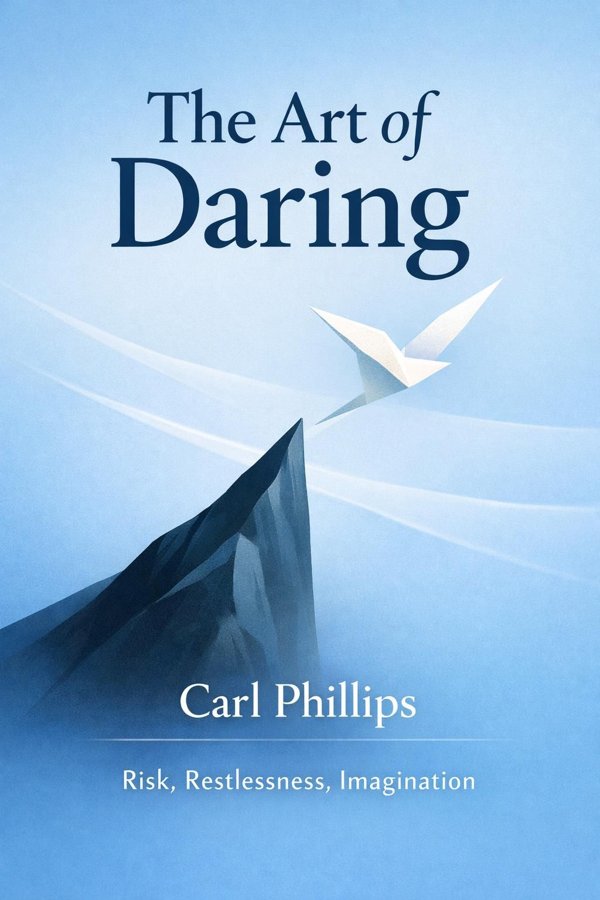
The Art of Daring: Risk, Restlessness, Imagination: Summary & Key Insights
 10 min9 chaptersAudio available
Key Takeaways from The Art of Daring: Risk, Restlessness, Imagination
The strongest art often comes from a paradox: the more seriously we engage limits, the more meaningful our freedom becomes.
Imagination is most necessary precisely when we do not know what comes next.
What readers often recognize as honesty in art is usually a form of risk.
Not all risk is equal, and Phillips is careful to distinguish meaningful daring from empty provocation.
Creative restlessness is often treated as a problem, but Phillips sees it as a sign of life.
What Is The Art of Daring: Risk, Restlessness, Imagination About?
The Art of Daring: Risk, Restlessness, Imagination by Carl Phillips is a writing book spanning 8 pages. In The Art of Daring: Risk, Restlessness, Imagination, acclaimed poet Carl Phillips reflects on what it means to create honestly in a world that often rewards certainty, polish, and control. Across a series of elegant, probing essays, he examines the inner conditions that make art possible: vulnerability, discipline, uncertainty, desire, and the willingness to keep questioning one’s own habits. For Phillips, daring is not spectacle or rebellion for its own sake. It is the quiet courage to remain open to what we do not yet understand, and to let that openness reshape language, form, and self. What makes this book especially valuable is that Phillips writes not only as a gifted thinker, but as a practicing poet and teacher who has spent decades wrestling with the demands of craft. He understands that artistic risk must be balanced by rigor, and that imagination thrives not in chaos alone but in tension with restraint. The result is a book about writing that also speaks to anyone trying to live more truthfully. It shows that restlessness, far from being a flaw, can become a force for renewal, discovery, and deeper creative integrity.
This FizzRead summary covers all 9 key chapters of The Art of Daring: Risk, Restlessness, Imagination in approximately 10 minutes, distilling the most important ideas, arguments, and takeaways from Carl Phillips's work. Also available as an audio summary and Key Quotes Podcast.
The Art of Daring: Risk, Restlessness, Imagination
In The Art of Daring: Risk, Restlessness, Imagination, acclaimed poet Carl Phillips reflects on what it means to create honestly in a world that often rewards certainty, polish, and control. Across a series of elegant, probing essays, he examines the inner conditions that make art possible: vulnerability, discipline, uncertainty, desire, and the willingness to keep questioning one’s own habits. For Phillips, daring is not spectacle or rebellion for its own sake. It is the quiet courage to remain open to what we do not yet understand, and to let that openness reshape language, form, and self.
What makes this book especially valuable is that Phillips writes not only as a gifted thinker, but as a practicing poet and teacher who has spent decades wrestling with the demands of craft. He understands that artistic risk must be balanced by rigor, and that imagination thrives not in chaos alone but in tension with restraint. The result is a book about writing that also speaks to anyone trying to live more truthfully. It shows that restlessness, far from being a flaw, can become a force for renewal, discovery, and deeper creative integrity.
Who Should Read The Art of Daring: Risk, Restlessness, Imagination?
This book is perfect for anyone interested in writing and looking to gain actionable insights in a short read. Whether you're a student, professional, or lifelong learner, the key ideas from The Art of Daring: Risk, Restlessness, Imagination by Carl Phillips will help you think differently.
- ✓Readers who enjoy writing and want practical takeaways
- ✓Professionals looking to apply new ideas to their work and life
- ✓Anyone who wants the core insights of The Art of Daring: Risk, Restlessness, Imagination in just 10 minutes
Want the full summary?
Get instant access to this book summary and 100K+ more with Fizz Moment.
Get Free SummaryAvailable on App Store • Free to download
Key Chapters
The strongest art often comes from a paradox: the more seriously we engage limits, the more meaningful our freedom becomes. Phillips argues that creativity is not a choice between wild expression and strict control. Instead, art happens in the tension between the urge to say everything and the discipline to shape what is said. Freedom gives a work vitality, surprise, and emotional reach. Restraint gives it form, clarity, and power.
This insight matters because many writers misunderstand daring. They assume risk means abandoning structure, rejecting tradition, or exposing every feeling without filtration. Phillips suggests the opposite. True daring is often the decision to hold back, to choose precision over overflow, and to let silence or ambiguity carry part of the meaning. A poem, essay, or story becomes stronger not when it says more, but when it says exactly enough.
In practice, this means learning to revise with both courage and care. A poet might cut a beautiful line because it weakens the whole. A novelist might resist overexplaining a character’s motives, trusting the reader to feel the tension. Even outside writing, the principle applies: in conversation, leadership, or teaching, thoughtful restraint can create more impact than constant assertion.
Phillips’s broader point is that freedom without shape becomes noise, while restraint without openness becomes lifeless. The artist’s task is not to solve this tension once and for all, but to keep working inside it. That ongoing negotiation is part of what keeps art alive.
Actionable takeaway: In your next piece of writing, identify one place where you can be bolder and one place where you can cut back, then revise until both freedom and control feel equally present.
Imagination is most necessary precisely when we do not know what comes next. Phillips treats imagination not as decoration or fantasy, but as a serious mode of inquiry. It allows artists to move beyond what is obvious, inherited, or already verified. To imagine is to risk entering a space without guarantees. That is why imagination is inseparable from daring.
For Phillips, the creative act starts when we allow possibility to matter more than certainty. A writer may begin with an image, a rhythm, or a question rather than a clear message. Instead of forcing the work toward a predetermined conclusion, the artist follows what emerges. This requires trust, patience, and a tolerance for confusion. It also requires humility, because imagination often leads us away from what we thought we understood.
This idea has practical value for anyone who creates. If you only write what you can fully explain in advance, your work may remain competent but predictable. Imagination asks you to explore emotional or intellectual territory that feels slightly beyond reach. A memoirist might question her own memory instead of presenting it as fixed truth. A poet might pursue an image whose meaning remains unclear until late in revision. A teacher might design an assignment that invites discovery rather than mere performance.
Phillips reminds us that imagination is not the opposite of discipline. It needs conditions in which to work: attentiveness, reading, revision, and the willingness to be surprised. To imagine well is to make room for the unseen without surrendering craft.
Actionable takeaway: Start your next writing session with a question instead of a thesis, and follow the most unexpected image, memory, or idea for at least one full page before judging it.
What readers often recognize as honesty in art is usually a form of risk. Phillips shows that vulnerability is not simply self-disclosure or confession. It is the willingness to approach what feels emotionally unstable, morally complicated, or personally unresolved without rushing to make it neat. In this sense, vulnerability is a strength because it permits depth.
Many creators protect themselves by relying on polish, irony, abstraction, or technical mastery alone. These tools are useful, but they can also become defenses. Phillips invites artists to ask where they are hiding. Are they using language to reveal, or to avoid? Are they making work that risks being misunderstood, or only work that appears controlled? Vulnerability enters when a writer allows uncertainty, contradiction, and feeling to remain visible on the page.
That does not mean art must be autobiographical or emotionally raw in an obvious way. A carefully crafted sonnet can be deeply vulnerable if it approaches a truth the writer fears. A critical essay can be vulnerable if it admits doubt. A fictional character can carry emotional exposure on behalf of the author. The point is not nakedness for its own sake. The point is contact with what matters.
This applies beyond literature. In any serious creative or intellectual life, growth depends on allowing oneself to be changed by what one encounters. Vulnerability is the condition under which that change becomes possible. Without it, the work may be clever, but it will rarely feel necessary.
Phillips suggests that the artist’s challenge is not to eliminate fear, but to write through it. When we stop demanding invulnerability from ourselves, we make room for a more complex and humane kind of truth.
Actionable takeaway: Identify one subject, memory, or question you tend to avoid in your work, and approach it indirectly through a scene, image, or form that gives you enough safety to be honest.
Not all risk is equal, and Phillips is careful to distinguish meaningful daring from empty provocation. The artist’s job is not simply to break rules, shock audiences, or pursue novelty at any cost. Risk matters because it can deepen truth, enlarge perception, and challenge dead habits of feeling or thought. That gives creative daring an ethical dimension.
Phillips’s point is subtle but important. Art exists in relation to others: readers, traditions, communities, histories, and language itself. So when an artist takes risks, the question is not only, “Is this new?” but also, “What does this risk serve?” A formal experiment that clarifies experience may be worthwhile. A controversial statement designed only to attract attention may not be. Daring becomes ethically serious when it emerges from genuine inquiry rather than performance.
This is especially relevant in an age of visibility and branding, where creators can feel pressure to appear bold rather than actually pursue difficult truth. Phillips reminds us that artistic integrity involves responsibility. If you write about pain, desire, race, violence, intimacy, or power, your work should not merely exploit charged material. It should engage complexity with care.
In practical terms, this means asking harder questions during revision. Am I challenging the reader because the subject demands it, or because I want to seem brave? Am I using ambiguity to deepen meaning, or to avoid accountability? Am I treating experience, especially others’ experience, with enough seriousness?
The ethics of risk do not eliminate experimentation; they make it more meaningful. Art is most daring when it enlarges what can be felt or thought without abandoning rigor or responsibility.
Actionable takeaway: Before finalizing a bold creative choice, write a brief note answering one question: what deeper truth, tension, or human reality does this risk help the work reveal?
Creative restlessness is often treated as a problem, but Phillips sees it as a sign of life. The artist who remains dissatisfied is not necessarily failing; he may be responding to the fact that no single form, style, or solution can fully contain experience. Restlessness, in this sense, is what keeps a writer moving, searching, and growing.
Phillips does not romanticize constant instability. Restlessness can be uncomfortable. It can create doubt, self-revision, and the sense that one has not yet arrived. But that discomfort may be essential to artistic development. Once a writer becomes too comfortable with a method, voice, or reputation, the work can harden into mannerism. Restlessness interrupts that hardening. It insists that previous achievements are not final answers.
This insight is liberating for writers who feel impatient with their own progress. Instead of interpreting dissatisfaction as evidence of incompetence, Phillips suggests seeing it as evidence of attention. The crucial question is what we do with restlessness. Do we let it scatter us into aimless novelty, or do we use it to push deeper into craft and inquiry?
A poet might experiment with longer lines after years of compression. An essayist might shift from argument-driven prose to a more meditative form. A teacher might rethink assignments that once worked well but now feel stale. In each case, restlessness becomes a catalyst rather than a threat.
Phillips’s larger lesson is that artistic identity should remain porous. The goal is not to become fixed, but to stay responsive. Growth depends on preserving some dissatisfaction with what one already knows how to do.
Actionable takeaway: Review your recent work and name one habit that has become too comfortable; in your next piece, deliberately replace it with a different formal or emotional approach.
Tradition is often misunderstood as something that restricts originality, but Phillips treats it as both inheritance and provocation. Writers do not create in isolation. They enter ongoing conversations with earlier voices, forms, assumptions, and possibilities. Tradition can feel constraining because it reminds us that others have already said much before us. Yet that is also what makes it fertile. It gives us materials to resist, revise, inhabit, and transform.
Phillips’s view avoids two extremes. On one side is submissive reverence, where writers imitate established models so closely that their own urgency disappears. On the other is shallow rebellion, where artists reject tradition simply to appear independent. Neither response produces strong work. More interesting is the artist who reads tradition deeply enough to argue with it.
In practical terms, this might mean using a classical form to hold modern emotional tension, or drawing from a literary influence while changing its values or assumptions. A poet can write in meter without sounding antique. A contemporary essayist can borrow from older rhetorical structures while addressing current anxieties. Even a writer working in experimental modes is shaped by prior traditions, whether acknowledged or not.
Phillips suggests that tradition becomes meaningful when it sharpens rather than softens the artist’s awareness. It gives us standards, pressures, and companions. It also helps us see that originality is rarely invention from nothing. More often, it is the discovery of a distinct relation to what has already been made.
This idea encourages humility without passivity. To engage tradition seriously is to recognize one’s place within a longer history while still insisting on one’s own necessary deviation.
Actionable takeaway: Choose one writer or form you admire, study what it enables, then write a new piece that borrows one element from it while consciously changing another.
Phillips refuses the easy separation between art and life. He suggests that the ways we write are connected to the ways we live: how we tolerate uncertainty, how we approach desire, how we respond to fear, and how honestly we face contradiction. Art does not merely reflect life after the fact; it is one of the places where a life gets examined, tested, and transformed.
This does not mean every personal experience should become material, or that good writing automatically produces a better self. Rather, Phillips shows that artistic practice trains certain capacities that matter beyond the page: attention, patience, receptivity, ethical discernment, and the ability to remain inside complexity without fleeing too quickly toward certainty. These are also life skills.
The exchange works in both directions. A writer’s emotional history, relationships, losses, loyalties, and forms of longing shape what becomes imaginable in the work. Likewise, artistic habits can alter one’s relation to the world. Someone who learns to notice tonal nuance in poems may become more attentive in conversation. Someone who revises rigorously may become more aware of the stories they tell themselves about identity or failure.
This makes daring a human practice, not just an aesthetic one. The risk of confronting difficult material in art often parallels the risk of honesty in life. To write with integrity may require living with greater openness, and to live openly may enlarge what one can make.
Phillips’s insight is especially useful for readers who do not identify primarily as writers. The book offers a philosophy of inward seriousness: a reminder that imagination and courage are not limited to literature but belong to any thoughtful life.
Actionable takeaway: After finishing a piece of writing, ask not only what the work says, but what it reveals about your habits of attention, avoidance, and desire.
Daring in art does not live only in subject matter; it also lives in the sentence, the line break, the structure, the rhythm. Phillips emphasizes that language and form are not containers for meaning but active participants in it. The way a piece moves can embody uncertainty, restraint, exposure, or discovery as much as its explicit themes do.
This matters because writers often think of form as secondary, something applied after the real content has been found. Phillips suggests the reverse: form is one of the places where thought happens. A fragmented structure may enact a mind struggling toward coherence. A tightly patterned poem may intensify emotional pressure. A long, flowing sentence may create the sensation of desire, hesitation, or refusal to stop. In such cases, form is not decoration. It is the body of the work’s risk.
For creators, this means paying attention to how technical choices affect emotional and intellectual force. If a poem about uncertainty is written in overly resolved language, the form may betray the subject. If an essay about vulnerability is organized so neatly that nothing destabilizes the reader, it may remain conceptually sound but emotionally thin.
Practical experimentation can help. Rewrite the same passage in short sentences, then in long ones. Turn a prose paragraph into broken lines. Remove explanatory transitions and see what tension appears. Such exercises reveal that meaning changes when form changes.
Phillips’s larger point is that daring often requires trusting technique as a site of discovery. The writer does not merely express risk through content; the writer builds risk into the work’s very movement.
Actionable takeaway: Take one finished passage and rewrite it in a dramatically different form, then compare which version more fully embodies the emotional tension you want the reader to experience.
Many people come to writing hoping it will help them resolve confusion. Phillips offers a more demanding idea: art may not eliminate uncertainty, but teach us how to remain productively inside it. This is one of the book’s deepest lessons. Uncertainty is not only a temporary obstacle before clarity arrives. It can be a generative condition in which richer forms of perception become possible.
Phillips suggests that the urge to resolve too quickly often weakens art. We tidy contradiction, explain mystery, and close emotional tensions before they have done their full work. Yet some truths can only emerge when we resist immediate closure. A poem may need to end in suspension. An essay may need to keep two conflicting insights in play. A writer may need to admit not knowing exactly what a piece means while still trusting its necessity.
This does not mean celebrating vagueness. Productive uncertainty is disciplined. It depends on precision, attentiveness, and a willingness to distinguish complexity from confusion. The writer’s task is not to be obscure, but to remain faithful to realities that do not simplify easily.
In practical terms, this can change revision habits. Instead of asking only, “How can I make this clearer?” also ask, “Where is ambiguity actually serving the work?” In life, the lesson is equally useful. Relationships, identity, grief, faith, and desire rarely submit to final answers. Phillips offers a model of seriousness that does not panic in the face of incompletion.
By treating uncertainty as a practice rather than a failure, he opens a more spacious understanding of both writing and being. The artist does not always conquer doubt. Sometimes the artist learns how to think with it.
Actionable takeaway: During revision, preserve one unresolved tension in your work on purpose, then refine the language around it so the uncertainty feels intentional rather than accidental.
All Chapters in The Art of Daring: Risk, Restlessness, Imagination
About the Author
Carl Phillips is an American poet, essayist, and professor widely recognized for his lyrical intensity and philosophical depth. Born in 1959, he has built a distinguished literary career through numerous poetry collections that explore desire, morality, intimacy, and the complexities of selfhood. His work has earned major honors, including the Pulitzer Prize for Poetry and the Kingsley Tufts Poetry Award, confirming his place among the most important contemporary American poets. In addition to writing, Phillips has been an influential teacher of poetry and literature, including at Washington University in St. Louis. His essays draw on both his artistic practice and his classroom experience, giving him unusual authority on questions of craft, form, and creative risk. Across genres, he is admired for combining emotional honesty with intellectual rigor.
Get This Summary in Your Preferred Format
Read or listen to the The Art of Daring: Risk, Restlessness, Imagination summary by Carl Phillips anytime, anywhere. FizzRead offers multiple formats so you can learn on your terms — all free.
Available formats: App · Audio · PDF · EPUB — All included free with FizzRead
Download The Art of Daring: Risk, Restlessness, Imagination PDF and EPUB Summary
Key Quotes from The Art of Daring: Risk, Restlessness, Imagination
“The strongest art often comes from a paradox: the more seriously we engage limits, the more meaningful our freedom becomes.”
“Imagination is most necessary precisely when we do not know what comes next.”
“What readers often recognize as honesty in art is usually a form of risk.”
“Not all risk is equal, and Phillips is careful to distinguish meaningful daring from empty provocation.”
“Creative restlessness is often treated as a problem, but Phillips sees it as a sign of life.”
Frequently Asked Questions about The Art of Daring: Risk, Restlessness, Imagination
The Art of Daring: Risk, Restlessness, Imagination by Carl Phillips is a writing book that explores key ideas across 9 chapters. In The Art of Daring: Risk, Restlessness, Imagination, acclaimed poet Carl Phillips reflects on what it means to create honestly in a world that often rewards certainty, polish, and control. Across a series of elegant, probing essays, he examines the inner conditions that make art possible: vulnerability, discipline, uncertainty, desire, and the willingness to keep questioning one’s own habits. For Phillips, daring is not spectacle or rebellion for its own sake. It is the quiet courage to remain open to what we do not yet understand, and to let that openness reshape language, form, and self. What makes this book especially valuable is that Phillips writes not only as a gifted thinker, but as a practicing poet and teacher who has spent decades wrestling with the demands of craft. He understands that artistic risk must be balanced by rigor, and that imagination thrives not in chaos alone but in tension with restraint. The result is a book about writing that also speaks to anyone trying to live more truthfully. It shows that restlessness, far from being a flaw, can become a force for renewal, discovery, and deeper creative integrity.
You Might Also Like
The Art of Perspective
Christopher Castellani
10 min
Making a Point: The Persnickety Story of English Punctuation
David Crystal
10 min
The Elements Of Eloquence: How To Turn The Perfect English Phrase
Mark Forsyth
10 min
The Pocket Muse: Ideas and Inspirations for Writing
Monica Wood
10 min
A Little Book on Form: An Exploration into the Formal Imagination of Poetry
Robert Hass
10 min
Adventures In The Screen Trade: A Personal View Of Hollywood And Screenwriting
William Goldman
10 minBrowse by Category
Ready to read The Art of Daring: Risk, Restlessness, Imagination?
Get the full summary and 100K+ more books with Fizz Moment.