
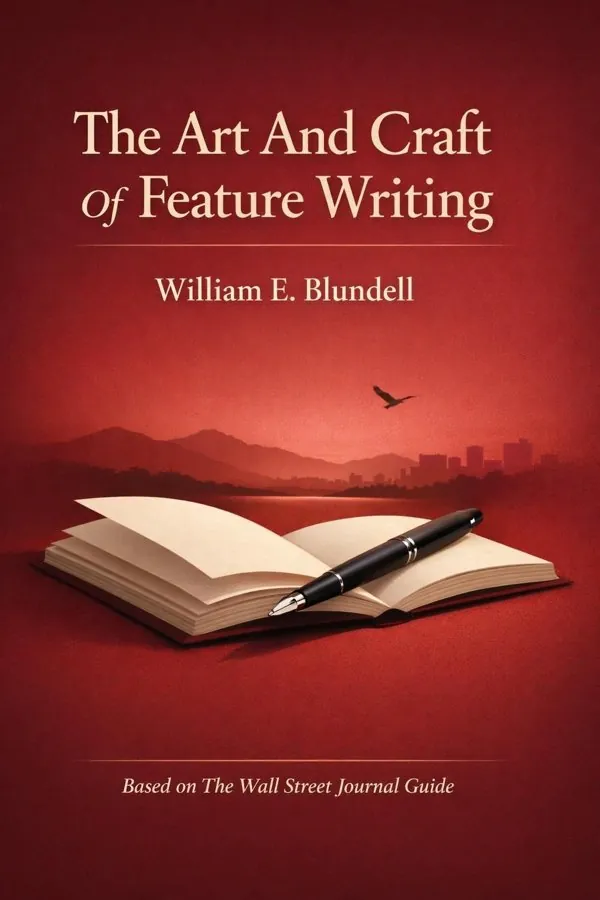
The Art And Craft Of Feature Writing: Based on The Wall Street Journal Guide: Summary & Key Insights
 10 min9 chaptersAudio available
Key Takeaways from The Art And Craft Of Feature Writing: Based on The Wall Street Journal Guide
Most weak features do not fail in the writing stage; they fail at the idea stage.
A good writer is not just someone who sees possibilities; it is someone who knows which possibilities deserve pursuit.
Feature writing is won in reporting long before it is polished in prose.
A feature often begins as a mountain of notes and fragments, but readers should experience it as a controlled journey.
The lead is a promise, and weak promises lose readers quickly.
What Is The Art And Craft Of Feature Writing: Based on The Wall Street Journal Guide About?
The Art And Craft Of Feature Writing: Based on The Wall Street Journal Guide by William E. Blundell is a writing book spanning 13 pages. The Art And Craft Of Feature Writing is a practical masterclass in turning reported facts into stories that people actually want to read. Drawing on his experience at The Wall Street Journal, William E. Blundell explains how strong feature writing goes beyond delivering information: it reveals meaning, emotion, conflict, and character. This is not a book about decorative prose or clever tricks. It is a disciplined guide to finding worthwhile ideas, reporting deeply, choosing the right structure, writing irresistible leads, and shaping scenes so readers feel they are inside the story rather than standing outside it. What makes the book enduring is its balance between journalistic rigor and narrative craft. Blundell shows that great features are built from careful observation, clear judgment, and relentless revision. He treats writing as both an art and a system, giving readers concrete tools they can apply whether they are profiling a person, exploring a trend, or illuminating a social issue. For journalists, nonfiction writers, content creators, and anyone who wants to write with more humanity and precision, this book remains one of the most authoritative and useful guides ever written.
This FizzRead summary covers all 9 key chapters of The Art And Craft Of Feature Writing: Based on The Wall Street Journal Guide in approximately 10 minutes, distilling the most important ideas, arguments, and takeaways from William E. Blundell's work. Also available as an audio summary and Key Quotes Podcast.
The Art And Craft Of Feature Writing: Based on The Wall Street Journal Guide
The Art And Craft Of Feature Writing is a practical masterclass in turning reported facts into stories that people actually want to read. Drawing on his experience at The Wall Street Journal, William E. Blundell explains how strong feature writing goes beyond delivering information: it reveals meaning, emotion, conflict, and character. This is not a book about decorative prose or clever tricks. It is a disciplined guide to finding worthwhile ideas, reporting deeply, choosing the right structure, writing irresistible leads, and shaping scenes so readers feel they are inside the story rather than standing outside it.
What makes the book enduring is its balance between journalistic rigor and narrative craft. Blundell shows that great features are built from careful observation, clear judgment, and relentless revision. He treats writing as both an art and a system, giving readers concrete tools they can apply whether they are profiling a person, exploring a trend, or illuminating a social issue. For journalists, nonfiction writers, content creators, and anyone who wants to write with more humanity and precision, this book remains one of the most authoritative and useful guides ever written.
Who Should Read The Art And Craft Of Feature Writing: Based on The Wall Street Journal Guide?
This book is perfect for anyone interested in writing and looking to gain actionable insights in a short read. Whether you're a student, professional, or lifelong learner, the key ideas from The Art And Craft Of Feature Writing: Based on The Wall Street Journal Guide by William E. Blundell will help you think differently.
- ✓Readers who enjoy writing and want practical takeaways
- ✓Professionals looking to apply new ideas to their work and life
- ✓Anyone who wants the core insights of The Art And Craft Of Feature Writing: Based on The Wall Street Journal Guide in just 10 minutes
Want the full summary?
Get instant access to this book summary and 100K+ more with Fizz Moment.
Get Free SummaryAvailable on App Store • Free to download
Key Chapters
Most weak features do not fail in the writing stage; they fail at the idea stage. Blundell argues that feature writers cannot wait for inspiration or breaking events to hand them perfect material. They must develop the habit of noticing what other people overlook: contradictions, hidden struggles, unusual routines, cultural shifts, private costs behind public success, and the human implications of larger trends. A feature idea becomes promising when it contains movement, tension, surprise, or a revealing angle on ordinary life.
This means writers should train themselves to ask better questions. What is changing here? Who is affected in an interesting way? What small situation reflects a bigger truth? A local diner closing may not seem important as news, but it becomes a feature if it reveals the slow disappearance of a town’s shared gathering places. A high-performing student may not be enough for a profile, but a student balancing excellence with family caregiving and night work offers a richer human story.
Blundell treats curiosity as a professional discipline. He suggests gathering ideas constantly from conversations, observations, trade publications, neighborhoods, workplaces, and recurring patterns in daily life. The writer’s notebook is not a luxury; it is a working tool for capturing fragments before they disappear. Over time, these fragments become a reservoir of possible stories.
A practical approach is to keep an “idea file” organized by themes such as work, family, money, education, identity, technology, and community. Revisit it weekly and ask which ideas contain both specificity and broader significance.
Actionable takeaway: stop hunting only for dramatic events and start collecting tensions, anomalies, and human consequences; the best feature ideas often begin as small observations with large meaning.
A good writer is not just someone who sees possibilities; it is someone who knows which possibilities deserve pursuit. Blundell emphasizes that not every interesting subject can support a satisfying feature. Time, access, reader interest, and narrative depth all matter. Before reporting heavily, a writer should test whether the idea has enough freshness, emotional pull, focus, and reporting potential to sustain the piece.
He encourages writers to think like both reporter and reader. Is the angle genuinely new, or only new to you? Does it touch something recognizable in human experience, such as ambition, fear, belonging, loss, pride, or resilience? Can you find scenes, voices, and details that will allow the story to be shown rather than merely explained? If the subject is too abstract, too familiar, or too dependent on unsupported opinion, it may collapse under the weight of feature expectations.
For example, “remote work is changing business” is too broad and overused. But “a manager trying to maintain team trust across three countries while caring for a newborn at home” offers conflict, scene, and specificity. Likewise, “housing is expensive” is not enough; “a schoolteacher living in a motel while teaching a class on civic responsibility” creates a more vivid entry point into the larger issue.
Blundell’s deeper lesson is that feature value lies in the union of the particular and the universal. The story must be specific enough to feel real and broad enough to matter. This evaluation stage saves writers from wasting weeks on ideas that cannot support strong narrative development.
Actionable takeaway: before committing, write a one-sentence story promise that names the angle, the human stake, and the broader meaning; if you cannot do that clearly, the idea probably needs refinement.
Feature writing is won in reporting long before it is polished in prose. Blundell insists that the writer’s job is not merely to gather quotes but to collect the raw materials of experience: scenes, chronology, behavior, contradictions, physical settings, emotional undercurrents, and facts that can withstand scrutiny. Thin reporting produces generic writing. Deep reporting produces authority, texture, and surprise.
He encourages an almost obsessive attention to observation. What does the office smell like? What objects sit on the desk? How does a source pause before answering a sensitive question? What happens before and after the “official” moment? Such details are not decoration. They are evidence that helps readers inhabit the story. At the same time, Blundell never lets style outrun accuracy. Every description should be verifiable, every anecdote checked, every interpretation supported.
Practical reporting also means interviewing broadly and strategically. Speak not only to the main subject, but to colleagues, critics, relatives, competitors, and experts who can provide context or challenge the obvious narrative. If you are writing about a celebrated chef, talk to suppliers, former staff, and regular customers. If you are covering a neighborhood transformation, interview longtime residents, business owners, planners, and those pushed to the margins.
Another major point is chronology. Writers often fail because they do not know what happened when. Building a timeline can expose hidden causation and reveal the best dramatic arc. It may also show where reporting holes remain.
Actionable takeaway: during reporting, collect five categories deliberately for every story: hard facts, chronology, scenes, revealing details, and conflicting perspectives; this gives you both narrative richness and factual strength.
A feature often begins as a mountain of notes and fragments, but readers should experience it as a controlled journey. Blundell teaches that organization is not a cosmetic step done after reporting; it is the act of discovering what the story is truly about. Without focus, even excellent material feels shapeless. With focus, the writer can decide what belongs, what can be cut, and what deserves emphasis.
The core question is simple but demanding: what is this story really saying? Not just what happened, but what the reader should understand by the end. That central idea becomes the filter for structure. Once the writer identifies it, material can be grouped into purposeful sections: a narrative sequence, a thematic progression, a problem-to-meaning structure, a profile built around a decisive conflict, or a trend story anchored by recurring scenes.
For instance, if you are writing about a young doctor in a collapsing rural hospital, the story could become many things: a profile of personal sacrifice, an investigation of healthcare inequality, or a portrait of institutional decline. Each choice leads to a different structure. The mistake is trying to write all three at once without hierarchy.
Blundell also values transitions and pacing. Readers need orientation, relief, and forward motion. Dense exposition should be balanced with scenes or vivid examples. A structural map or outline helps reveal where momentum drops or repetition creeps in.
Good organization creates confidence. It tells the reader that the writer knows where the story is going and why the journey matters.
Actionable takeaway: before drafting fully, write a brief structural plan with your central theme, opening scene, major sections, and ending note; if a section does not support the core focus, cut or reposition it.
The lead is a promise, and weak promises lose readers quickly. Blundell sees the opening as one of the most strategic parts of feature writing because it determines tone, stakes, and curiosity. Unlike a hard-news lead that frontloads essential facts, a feature lead often works by creating interest first and delivering context with control. It should invite the reader into a situation, a voice, a question, or an image that makes continuing irresistible.
A strong feature lead does not simply delay information for theatrical effect. It selects the most compelling doorway into the story. This might be a revealing moment, an unusual detail, a sharply drawn scene, a paradox, or a line that captures the central tension. A profile of a bankruptcy lawyer might begin with him rehearsing calm before calling a family about losing a business. A story about climate anxiety might open with a child moving prized possessions above a flood line in her bedroom. These openings create emotional and conceptual traction.
Blundell warns against several common problems: overly clever leads that confuse rather than attract, throat-clearing introductions that waste space, and generic statements that could fit any story. The opening must be specific, earned, and tied to the story’s deeper purpose. It should also set expectations honestly. If the story is intimate, the lead should feel intimate. If it is sweeping and analytical, the lead should still ground that scope in something concrete.
The lead’s ultimate job is not only to catch attention but to establish momentum. It should naturally pull the reader toward the next paragraph and then the next.
Actionable takeaway: draft at least three different leads for every feature, then choose the one that creates the most curiosity while best reflecting the story’s central tension.
Readers remember people in motion more than they remember abstractions. Blundell shows that the body of a feature gains power when it is built from scenes, behavior, and character rather than from a flat procession of explanations. Information matters, but information lands more deeply when attached to lived experience. A feature comes alive when readers can see who is involved, what they want, what stands in their way, and how the environment shapes their choices.
Character in feature writing is not fictional invention; it is disciplined portraiture. The writer reveals personality through action, speech, habit, relationships, and contradiction. A principal who says she values calm but keeps three phones buzzing on her desk tells us something before any direct statement does. Scene works similarly. Instead of summarizing that a workplace is understaffed, show the nurse skipping lunch for the third time while monitors beep and a family waits in the hallway.
Blundell’s method is especially useful when handling complex topics. A feature about automation becomes more compelling when centered on a veteran machinist training the software that may replace him. A story about immigration policy becomes more accessible when organized around one family’s repeated appointments, paperwork, and uncertainty.
Still, he cautions against letting anecdote replace significance. Scenes and characters must illuminate the larger subject, not distract from it. The body should alternate between narrative movement and context so the reader both feels and understands.
Actionable takeaway: as you draft, test every major section by asking, “Do I have a person, a moment, or a concrete example carrying this point?” If not, report more or rewrite for specificity.
Stylish writing without purpose quickly becomes self-display. Blundell’s central lesson about voice and style is that they must serve the story’s meaning, not the writer’s ego. Theme gives the piece coherence; voice gives it personality; style gives it readability and force. When all three align, a feature feels inevitable rather than manufactured.
Theme is the underlying idea that connects the details. It might be the hidden cost of ambition, the loneliness inside expertise, the fragility of institutions, or the resilience embedded in ordinary routines. Once the writer identifies this theme, diction, pacing, examples, and emphasis can reinforce it. Voice, meanwhile, reflects stance and temperament. It may be restrained, intimate, ironic, compassionate, or brisk, but it should fit the material. A story about grief requires a different tonal discipline than a quirky social trend piece.
Blundell values clarity above ornament. Strong sentences are precise, active, and economical. Metaphors should illuminate, not call attention to themselves. Quotations should carry energy or insight, not merely fill space. Even rhythm matters: a long explanatory paragraph may need to be followed by a short, hard sentence that resets the reader’s attention.
Revision is where style is made trustworthy. Writers discover whether they are repeating themselves, overexplaining, sentimentalizing, or leaning on cliché. They also discover whether the ending resonates with the theme instead of merely stopping.
Actionable takeaway: after drafting, underline the sentence that best expresses your story’s deeper meaning, then revise surrounding paragraphs so tone, detail choice, and pacing all support that thematic center.
Feature writing can be vivid without becoming careless. Blundell makes clear that the more artful the storytelling, the greater the obligation to remain accurate, fair, and transparent. Revision is not just about making prose smoother; it is about testing whether the story is honest. Have you exaggerated conflict? Have you omitted context that changes interpretation? Have you shaped scenes in a way the reporting cannot support? Ethical lapses often begin not with malice but with the temptation to make a story cleaner than reality.
Good revision works on several levels. At the macro level, the writer checks structure, focus, and proportion. At the paragraph level, the writer examines transitions, redundancy, and clarity. At the sentence level, every claim, date, quote, and description is tested. Blundell encourages the discipline of reading with suspicion: if something feels too perfect, verify it again.
Ethics also includes how subjects are treated. Writers hold asymmetrical power. A feature can dignify a person’s experience or exploit it. That means representing vulnerability carefully, avoiding cheap emotional manipulation, and distinguishing observation from inference. If a subject appears evasive or distressed, describe what is observable rather than assigning motives you cannot prove.
These principles are highly practical in modern writing environments, where speed and attention pressure can reward shortcuts. Whether writing for newspapers, magazines, newsletters, or branded editorial platforms, credibility remains the foundation of lasting impact.
Actionable takeaway: create a final pre-publication checklist covering factual verification, fairness of characterization, source balance, and unsupported interpretation; elegant writing is only valuable when the reader can trust it.
Great feature writing does more than hold attention for a few pages; it leaves readers with a sharpened way of seeing. Blundell’s advanced techniques revolve around control of emphasis, surprise, pacing, and ending. Once a writer can report thoroughly and structure clearly, the next challenge is creating resonance. That means deciding where to zoom in, where to step back, and how to make the final impression feel both satisfying and earned.
One important technique is strategic contrast. A story grows stronger when opposing realities are placed near each other: public confidence versus private doubt, economic growth versus personal instability, ritual normalcy versus looming change. These contrasts deepen complexity without requiring heavy explanation. Another technique is delayed revelation, used carefully. If a crucial fact becomes most powerful later in the story, the structure can withhold it until the reader has enough context to feel its weight.
Blundell also values the ending as a place of meaning rather than summary. A feature should not simply run out of material. The close might return to an opening image with new significance, land on a revealing quote, or leave the reader with a concrete moment that embodies the theme. For example, a story about labor precarity might end not with a statistic but with a worker setting two alarms for different jobs and sleeping in uniform.
These techniques apply beyond journalism. Essayists, profile writers, podcasters, and long-form content creators all benefit from learning how narrative emphasis shapes memory.
Actionable takeaway: in your final revision, identify your story’s three most powerful moments and make sure they are spaced and framed deliberately so the reader experiences escalation, not monotony.
All Chapters in The Art And Craft Of Feature Writing: Based on The Wall Street Journal Guide
About the Author
William E. Blundell was a respected journalist and editor best known for his work at The Wall Street Journal and for his influence on the craft of feature writing. He developed a reputation for showing reporters how to combine rigorous factual reporting with the narrative qualities that make stories vivid and memorable. Rather than treating journalism as mere information delivery, Blundell emphasized structure, character, scene, theme, and revision as essential tools of serious nonfiction. His teaching has had lasting impact on reporters, editors, and aspiring writers who want to turn complex material into engaging, trustworthy stories. Through his guidance, he helped define a practical approach to feature writing that remains relevant across newspapers, magazines, and modern long-form nonfiction.
Get This Summary in Your Preferred Format
Read or listen to the The Art And Craft Of Feature Writing: Based on The Wall Street Journal Guide summary by William E. Blundell anytime, anywhere. FizzRead offers multiple formats so you can learn on your terms — all free.
Available formats: App · Audio · PDF · EPUB — All included free with FizzRead
Download The Art And Craft Of Feature Writing: Based on The Wall Street Journal Guide PDF and EPUB Summary
Key Quotes from The Art And Craft Of Feature Writing: Based on The Wall Street Journal Guide
“Most weak features do not fail in the writing stage; they fail at the idea stage.”
“A good writer is not just someone who sees possibilities; it is someone who knows which possibilities deserve pursuit.”
“Feature writing is won in reporting long before it is polished in prose.”
“A feature often begins as a mountain of notes and fragments, but readers should experience it as a controlled journey.”
“The lead is a promise, and weak promises lose readers quickly.”
Frequently Asked Questions about The Art And Craft Of Feature Writing: Based on The Wall Street Journal Guide
The Art And Craft Of Feature Writing: Based on The Wall Street Journal Guide by William E. Blundell is a writing book that explores key ideas across 9 chapters. The Art And Craft Of Feature Writing is a practical masterclass in turning reported facts into stories that people actually want to read. Drawing on his experience at The Wall Street Journal, William E. Blundell explains how strong feature writing goes beyond delivering information: it reveals meaning, emotion, conflict, and character. This is not a book about decorative prose or clever tricks. It is a disciplined guide to finding worthwhile ideas, reporting deeply, choosing the right structure, writing irresistible leads, and shaping scenes so readers feel they are inside the story rather than standing outside it. What makes the book enduring is its balance between journalistic rigor and narrative craft. Blundell shows that great features are built from careful observation, clear judgment, and relentless revision. He treats writing as both an art and a system, giving readers concrete tools they can apply whether they are profiling a person, exploring a trend, or illuminating a social issue. For journalists, nonfiction writers, content creators, and anyone who wants to write with more humanity and precision, this book remains one of the most authoritative and useful guides ever written.
You Might Also Like
The Art of Perspective
Christopher Castellani
10 min
Making a Point: The Persnickety Story of English Punctuation
David Crystal
10 min
The Elements Of Eloquence: How To Turn The Perfect English Phrase
Mark Forsyth
10 min
The Pocket Muse: Ideas and Inspirations for Writing
Monica Wood
10 min
A Little Book on Form: An Exploration into the Formal Imagination of Poetry
Robert Hass
10 min
Adventures In The Screen Trade: A Personal View Of Hollywood And Screenwriting
William Goldman
10 minBrowse by Category
Ready to read The Art And Craft Of Feature Writing: Based on The Wall Street Journal Guide?
Get the full summary and 100K+ more books with Fizz Moment.