
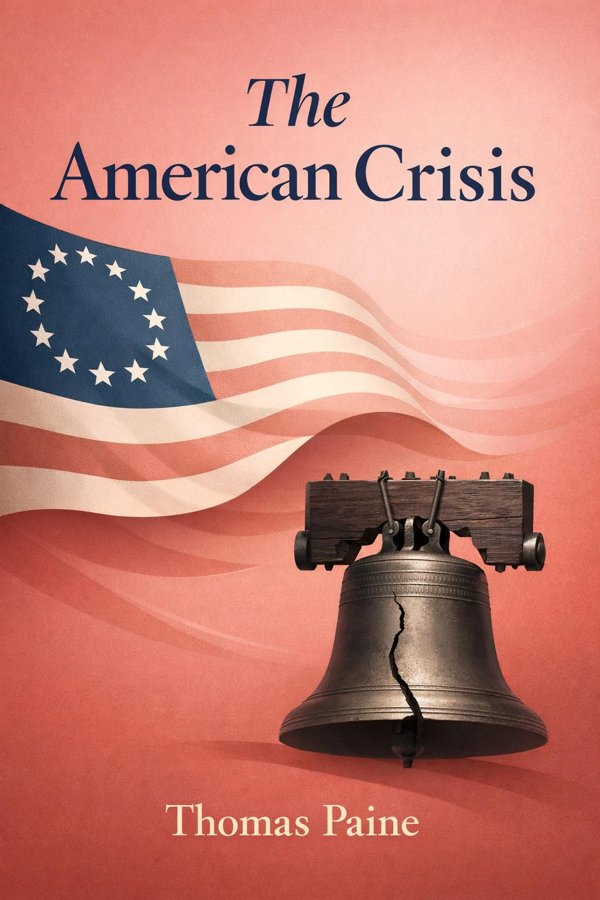
The American Crisis: Summary & Key Insights
by Thomas Paine
 10 min8 chaptersAudio available
What Is The American Crisis About?
The American Crisis by Thomas Paine is a world_history book spanning 8 pages. The American Crisis is a series of pamphlets written by Thomas Paine between 1776 and 1783 during the American Revolution. The work was intended to inspire the colonists to persevere in their struggle for independence, famously beginning with the line 'These are the times that try men's souls.' Paine’s essays were published serially in Philadelphia and other American cities, addressing the hardships of war and the moral duty of citizens to defend liberty.
This FizzRead summary covers all 8 key chapters of The American Crisis in approximately 10 minutes, distilling the most important ideas, arguments, and takeaways from Thomas Paine's work. Also available as an audio summary and Key Quotes Podcast.
The American Crisis
The American Crisis is a series of pamphlets written by Thomas Paine between 1776 and 1783 during the American Revolution. The work was intended to inspire the colonists to persevere in their struggle for independence, famously beginning with the line 'These are the times that try men's souls.' Paine’s essays were published serially in Philadelphia and other American cities, addressing the hardships of war and the moral duty of citizens to defend liberty.
Who Should Read The American Crisis?
This book is perfect for anyone interested in world_history and looking to gain actionable insights in a short read. Whether you're a student, professional, or lifelong learner, the key ideas from The American Crisis by Thomas Paine will help you think differently.
- ✓Readers who enjoy world_history and want practical takeaways
- ✓Professionals looking to apply new ideas to their work and life
- ✓Anyone who wants the core insights of The American Crisis in just 10 minutes
Want the full summary?
Get instant access to this book summary and 100K+ more with Fizz Moment.
Get Free SummaryAvailable on App Store • Free to download
Key Chapters
When I look upon those who profess loyalty to the British crown, I see not steadfast citizens, but weak souls recoiling from the duties of conscience. The Loyalist may persuade himself that submission is prudence, that obedience preserves peace—but I tell him it is the peace of the grave. To cling to the authority of Britain, after its insults, plunder, and bloodshed, is to confess moral cowardice. One cannot love liberty and, at the same time, venerate the instruments of its destruction. The struggle for independence has unmasked every man’s principles: those who shrink away when danger looms merely show that their hearts were never truly free.
I have often encountered the man who, in the tavern or the market, proclaims that the king will protect him—that rebellion only brings ruin. To such men I say: your protection is a myth purchased at the price of your children’s chains. You would rather be safe than be virtuous, but you will find neither safety nor respect in your servitude. History will remember you not for your caution, but for your compliance. And when this nation, through perseverance, secures its freedom, your descendants will blush at the memory of your obedience.
True loyalty is owed not to kings but to the principles that dignify humanity. Those who betray this truth by clinging to tyrants choose the comfort of the moment over the righteousness of eternity. I condemn not their persons but their corruption of spirit—for they have bartered away what no man can rightfully sell: the liberty of their own souls.
Ours is a cause that transcends politics. We fight not for empire, not for conquest, but for that sacred right by which every man may live unchained. When I wrote of these trials, I did not speak as an orator addressing a crowd but as a man convinced that freedom is the natural condition of humanity. Tyranny, wherever it exists, is a crime against reason. Thus, this war, cruel as it may be, is a struggle to preserve the very essence of moral responsibility.
We must understand that liberty is not granted—it is earned through vigilance and sacrifice. If Heaven intended man to be governed by the caprice of kings, it would not have endowed him with reason and will. Hence, our resistance is not only lawful but divinely sanctioned. I urge every reader to see beyond the battlefield, beyond the politics of the day, and recognize that we are participating in a universal drama of good against evil, justice against cruelty.
Each hardship we endure is a proof of our commitment. The blood spilt at Trenton, the hunger of Valley Forge, the tears of widows—all these are not mere sufferings but sacred offerings to the future of mankind. To abandon the cause because the path is bitter would be to dishonor the very principle that made us human. Therefore I say, let no man despair, for every act of perseverance is a blow struck for the liberty of the world.
+ 6 more chapters — available in the FizzRead app
All Chapters in The American Crisis
About the Author
Thomas Paine (1737–1809) was an English-born American political philosopher and writer. He was a key figure in the American Revolution, best known for his influential works 'Common Sense' and 'The American Crisis,' which helped galvanize public support for independence. Paine later contributed to revolutionary thought in France and wrote 'The Rights of Man' and 'The Age of Reason.'
Get This Summary in Your Preferred Format
Read or listen to the The American Crisis summary by Thomas Paine anytime, anywhere. FizzRead offers multiple formats so you can learn on your terms — all free.
Available formats: App · Audio · PDF · EPUB — All included free with FizzRead
Download The American Crisis PDF and EPUB Summary
Key Quotes from The American Crisis
“When I look upon those who profess loyalty to the British crown, I see not steadfast citizens, but weak souls recoiling from the duties of conscience.”
“Ours is a cause that transcends politics.”
Frequently Asked Questions about The American Crisis
The American Crisis by Thomas Paine is a world_history book that explores key ideas across 8 chapters. The American Crisis is a series of pamphlets written by Thomas Paine between 1776 and 1783 during the American Revolution. The work was intended to inspire the colonists to persevere in their struggle for independence, famously beginning with the line 'These are the times that try men's souls.' Paine’s essays were published serially in Philadelphia and other American cities, addressing the hardships of war and the moral duty of citizens to defend liberty.
More by Thomas Paine

You Might Also Like
The Age of Capital
Eric Hobsbawm
10 min
The Gulag Archipelago
Aleksandr Solzhenitsyn
10 min
Jerusalem: The Biography
Simon Sebag Montefiore
10 min
The Anglo-Saxons
James Campbell
10 min
The Boer War
Thomas Pakenham
10 min
The Industrial Revolutionaries: The Making of the Modern World 1776–1914
Gavin Weightman
10 minBrowse by Category
Ready to read The American Crisis?
Get the full summary and 100K+ more books with Fizz Moment.