
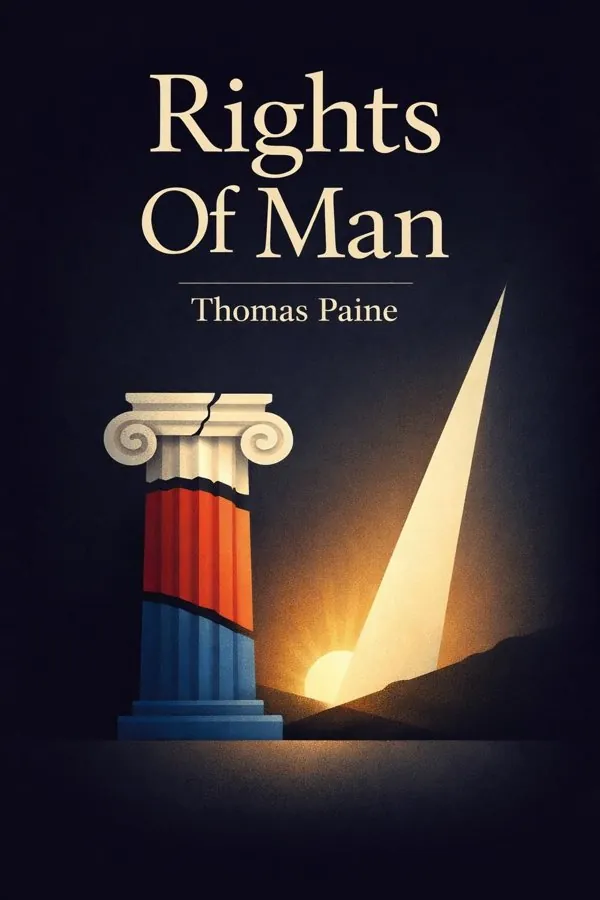
Rights Of Man: Summary & Key Insights
by Thomas Paine
 10 min8 chaptersAudio available
What Is Rights Of Man About?
Rights Of Man by Thomas Paine is a politics book spanning 8 pages. Rights of Man is a political treatise written by Thomas Paine in 1791–1792 as a defense of the French Revolution and a call for natural rights and democratic government. It argues that hereditary government is unjust and that people have the right to overthrow oppressive systems. The work was published in two parts and became a foundational text for modern liberal and democratic thought.
This FizzRead summary covers all 8 key chapters of Rights Of Man in approximately 10 minutes, distilling the most important ideas, arguments, and takeaways from Thomas Paine's work. Also available as an audio summary and Key Quotes Podcast.
Rights Of Man
Rights of Man is a political treatise written by Thomas Paine in 1791–1792 as a defense of the French Revolution and a call for natural rights and democratic government. It argues that hereditary government is unjust and that people have the right to overthrow oppressive systems. The work was published in two parts and became a foundational text for modern liberal and democratic thought.
Who Should Read Rights Of Man?
This book is perfect for anyone interested in politics and looking to gain actionable insights in a short read. Whether you're a student, professional, or lifelong learner, the key ideas from Rights Of Man by Thomas Paine will help you think differently.
- ✓Readers who enjoy politics and want practical takeaways
- ✓Professionals looking to apply new ideas to their work and life
- ✓Anyone who wants the core insights of Rights Of Man in just 10 minutes
Want the full summary?
Get instant access to this book summary and 100K+ more with Fizz Moment.
Get Free SummaryAvailable on App Store • Free to download
Key Chapters
Let us begin where all political reflection must—at the distinction between society and government. Society is born of our wants; government is born of our wickedness. The first unites the affections, the second restrains our vices. Left to our own devices, the natural inclination of man is toward companionship, exchange, and fellowship. We gather not to enslave one another but to assist, to preserve, and to improve. Society is, therefore, a blessing. Government, however, is a necessary evil at best, instituted not to create virtue but to prevent harm.
In tracing this origin, I invite the reader to see that government does not draw its legitimacy from antiquity or inheritance but from the consent of the governed. Power is a trust, not a gift of lineage. Its sole justification lies in the protection of rights which existed before it—the rights of life, liberty, property, and security. To break this trust is to convert government into tyranny, to change its form from guardian to oppressor.
When I wrote that government should only exist for the preservation of natural rights, I meant to strip away the mystique of antiquity that surrounded kings and parliaments. The purpose of all political institutions must be reduced to one principle: the happiness and safety of the people. All else—pomp, privilege, ceremony—is a corruption of that sacred duty.
Among the errors which time has sanctified, none is more absurd than the belief that wisdom or virtue may be transmitted by blood. To suppose that the child of a king is thereby qualified to govern millions is as irrational as believing that a man born blind is fit to judge colors. Hereditary monarchy is not merely unjust; it is a fraud upon reason itself.
When I examined the British constitution, I found that it was no constitution at all. A constitution presupposes the consent of the people; it draws its authority from their collective will. But a hereditary monarchy, no matter how gilded by ceremony, rests upon usurpation. It neither represents the people nor protects them; it exists to perpetuate privilege.
In my mind, monarchy is the last relic of political superstition—the belief that power is divine, not human, and that subjection is a duty, not a misfortune. The king, surrounded by courtiers who thrive upon flattery, becomes a symbol of separation between rulers and the ruled. The people are taught to revere what oppresses them, to cheer their own servitude. But I write against this deception: no generation has the right to bind another. Authority must forever return to its source—the living people.
+ 6 more chapters — available in the FizzRead app
All Chapters in Rights Of Man
About the Author
Thomas Paine (1737–1809) was an English-born American political activist, philosopher, and revolutionary. He is best known for his influential pamphlets such as Common Sense and The Rights of Man, which inspired democratic movements in both America and Europe. Paine’s writings championed liberty, equality, and human rights.
Get This Summary in Your Preferred Format
Read or listen to the Rights Of Man summary by Thomas Paine anytime, anywhere. FizzRead offers multiple formats so you can learn on your terms — all free.
Available formats: App · Audio · PDF · EPUB — All included free with FizzRead
Download Rights Of Man PDF and EPUB Summary
Key Quotes from Rights Of Man
“Let us begin where all political reflection must—at the distinction between society and government.”
“Among the errors which time has sanctified, none is more absurd than the belief that wisdom or virtue may be transmitted by blood.”
Frequently Asked Questions about Rights Of Man
Rights Of Man by Thomas Paine is a politics book that explores key ideas across 8 chapters. Rights of Man is a political treatise written by Thomas Paine in 1791–1792 as a defense of the French Revolution and a call for natural rights and democratic government. It argues that hereditary government is unjust and that people have the right to overthrow oppressive systems. The work was published in two parts and became a foundational text for modern liberal and democratic thought.
More by Thomas Paine


You Might Also Like
Antifa: The Anti-Fascist Handbook
Mark Bray
10 min
Attack from Within: How Disinformation Is Sabotaging America
Barbara McQuade
10 min
Coercion, Capital, and European States, AD 990–1992
Charles Tilly
10 min
Digital Democracy: Concepts, Methodologies, Tools, and Applications
Various Authors
10 min
Fascism
Stanley G. Payne
10 min
Fire And Fury: Inside The Trump White House
Michael Wolff
10 minBrowse by Category
Ready to read Rights Of Man?
Get the full summary and 100K+ more books with Fizz Moment.