
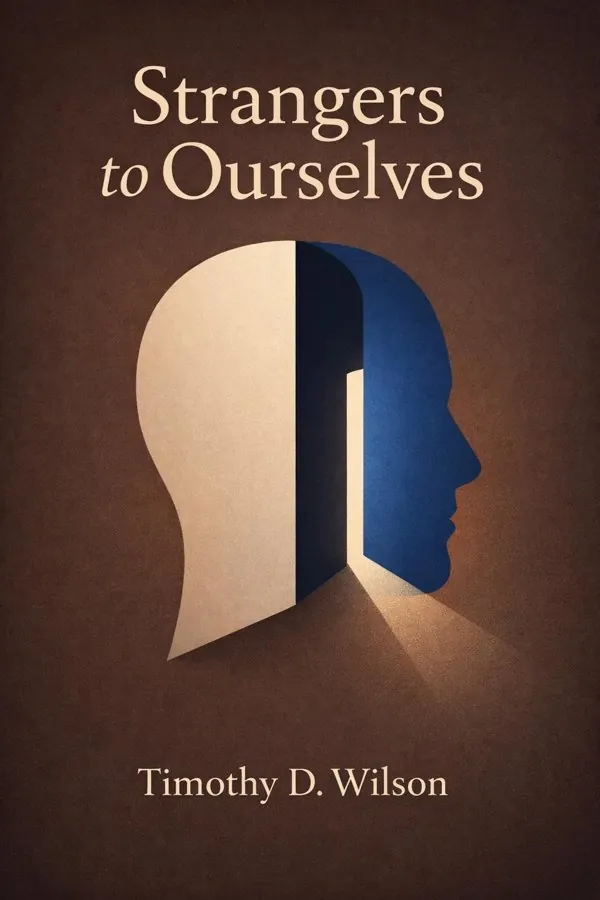
Strangers to Ourselves: Discovering the Adaptive Unconscious: Summary & Key Insights
 10 min9 chaptersAudio available
Key Takeaways from Strangers to Ourselves: Discovering the Adaptive Unconscious
One of the book’s most important insights is that the unconscious is not just a dark basement of forbidden wishes; it is also an intelligent operating system.
A striking truth runs through Wilson’s argument: people can be sincere, articulate, and completely wrong about why they did something.
A powerful and unsettling idea in the book is that we can hold attitudes we do not consciously endorse.
Human beings are natural storytellers, and one of Wilson’s most revealing arguments is that the self is partly a narrative construction.
People are surprisingly poor prophets of their own emotional future.
What Is Strangers to Ourselves: Discovering the Adaptive Unconscious About?
Strangers to Ourselves: Discovering the Adaptive Unconscious by Timothy D. Wilson is a cognition book spanning 8 pages. Why do people so often misunderstand their own motives, make poor predictions about what will make them happy, or confidently explain choices that were shaped by forces they never noticed? In Strangers to Ourselves, social psychologist Timothy D. Wilson argues that much of mental life happens outside conscious awareness—and that this hidden activity is not merely irrational noise, but an efficient, adaptive system that helps us navigate the world. The book challenges the comforting belief that looking inward is the best path to self-knowledge. Instead, Wilson shows that introspection is often incomplete, biased, or simply blind to the real causes of our behavior. Drawing on decades of research in social psychology, cognition, emotion, and judgment, he explains how unconscious processes shape attitudes, decisions, relationships, and moral reactions. Wilson’s authority comes from both scholarship and clarity: he translates complex psychological findings into practical insight without oversimplifying them. The result is a deeply illuminating book about why we are partly opaque to ourselves—and how scientific thinking can help us become a little less so.
This FizzRead summary covers all 9 key chapters of Strangers to Ourselves: Discovering the Adaptive Unconscious in approximately 10 minutes, distilling the most important ideas, arguments, and takeaways from Timothy D. Wilson's work. Also available as an audio summary and Key Quotes Podcast.
Strangers to Ourselves: Discovering the Adaptive Unconscious
Why do people so often misunderstand their own motives, make poor predictions about what will make them happy, or confidently explain choices that were shaped by forces they never noticed? In Strangers to Ourselves, social psychologist Timothy D. Wilson argues that much of mental life happens outside conscious awareness—and that this hidden activity is not merely irrational noise, but an efficient, adaptive system that helps us navigate the world. The book challenges the comforting belief that looking inward is the best path to self-knowledge. Instead, Wilson shows that introspection is often incomplete, biased, or simply blind to the real causes of our behavior. Drawing on decades of research in social psychology, cognition, emotion, and judgment, he explains how unconscious processes shape attitudes, decisions, relationships, and moral reactions. Wilson’s authority comes from both scholarship and clarity: he translates complex psychological findings into practical insight without oversimplifying them. The result is a deeply illuminating book about why we are partly opaque to ourselves—and how scientific thinking can help us become a little less so.
Who Should Read Strangers to Ourselves: Discovering the Adaptive Unconscious?
This book is perfect for anyone interested in cognition and looking to gain actionable insights in a short read. Whether you're a student, professional, or lifelong learner, the key ideas from Strangers to Ourselves: Discovering the Adaptive Unconscious by Timothy D. Wilson will help you think differently.
- ✓Readers who enjoy cognition and want practical takeaways
- ✓Professionals looking to apply new ideas to their work and life
- ✓Anyone who wants the core insights of Strangers to Ourselves: Discovering the Adaptive Unconscious in just 10 minutes
Want the full summary?
Get instant access to this book summary and 100K+ more with Fizz Moment.
Get Free SummaryAvailable on App Store • Free to download
Key Chapters
One of the book’s most important insights is that the unconscious is not just a dark basement of forbidden wishes; it is also an intelligent operating system. Wilson distinguishes the adaptive unconscious from older, purely Freudian views of the unconscious by showing that much of mental life outside awareness is fast, efficient, and necessary for survival. We constantly interpret faces, assess danger, form impressions, regulate behavior, and make sense of social cues without deliberate thought. If consciousness had to handle every detail, daily functioning would become impossibly slow.
This hidden system is “adaptive” because it helps us respond to a complex environment with extraordinary speed. You do not consciously calculate how to read another person’s tone of voice, when to brake in traffic, or why someone feels subtly threatening or trustworthy. Your mind does a great deal of this work automatically. Yet because these judgments arise effortlessly, we often assume we consciously produced them and fully understand them.
Wilson’s point is not that consciousness is useless. Conscious reasoning matters for planning, reflection, and self-control. But conscious thought is only one layer of mind, and often not the layer doing the initial heavy lifting. Recognizing this changes how we think about self-knowledge. If important mental processes are inaccessible to introspection, then understanding ourselves requires more than simply “looking within.”
In practice, this means taking your first impressions and reactions seriously, but not treating your explanations for them as automatically accurate. Notice patterns in your behavior, especially repeated ones, and ask what they reveal that your conscious story may be missing. Actionable takeaway: assume that some of your most important judgments happen before conscious thought catches up, and use observation—not just introspection—to understand them.
A striking truth runs through Wilson’s argument: people can be sincere, articulate, and completely wrong about why they did something. Introspection feels trustworthy because our thoughts are close to us, but access to our mental processes is far more limited than we imagine. We often know the outcome of our thinking—what we prefer, fear, or decide—without knowing the actual steps that produced it.
Psychological experiments repeatedly show that when asked to explain their choices, people frequently invent plausible reasons rather than retrieve real causes. This does not mean they are lying. It means the mind is skilled at producing narratives that sound coherent and socially acceptable. Someone may say they chose a product for its quality when packaging or placement had more influence. A person might claim a romantic relationship failed for one reason when deeper emotional habits played a stronger role.
Wilson emphasizes that introspection can even distort experience. When people are asked to analyze preferences that normally operate intuitively, they may make worse decisions. For example, carefully verbalizing why you like one painting, friend, or option over another can shift attention toward reasons that are easy to express rather than reasons that genuinely matter. The result is not greater insight, but a more polished misunderstanding.
This has practical consequences in work, relationships, and personal development. If you always demand immediate explanations from yourself, you may become overconfident in stories that were created after the fact. Better self-understanding often comes from tracking behavior over time, listening to feedback, and studying circumstances instead of relying on momentary self-analysis.
Actionable takeaway: when you explain your own behavior, treat your first explanation as a hypothesis, not a verdict, and look for evidence in your actions, habits, and outcomes.
Human beings are natural storytellers, and one of Wilson’s most revealing arguments is that the self is partly a narrative construction. We do not simply discover who we are; we continuously assemble explanations that make our past and present feel coherent. These stories give life meaning, help us maintain identity, and allow us to communicate ourselves to others. But they also create blind spots. A story can feel emotionally true while still omitting crucial causes.
Wilson shows that people often build personal narratives from limited evidence, cultural templates, and hindsight. We look backward from outcomes and arrange events into clean plots: I succeeded because I was determined, I fell in love because of shared values, I changed careers because I finally found my purpose. Sometimes those explanations are partly right. But often they simplify a messier reality involving chance, context, unconscious preferences, and social influence.
This matters because the narratives we adopt shape future behavior. If you tell yourself you are “bad at relationships,” “not creative,” or “the kind of person who always sabotages opportunities,” that story can become self-reinforcing. On the other hand, a constructive narrative can support resilience and growth. The goal is not to eliminate self-storytelling; that would be impossible and undesirable. The goal is to make our stories more flexible, evidence-based, and open to revision.
A practical example is journaling after major events, not just to express feelings but to compare your immediate interpretation with what later evidence suggests. You may discover that your first story was too dramatic, too flattering, or too harsh. That gap is a source of learning.
Actionable takeaway: examine the recurring story you tell about yourself and ask, “What facts does this story highlight, and what does it consistently leave out?”
People are surprisingly poor prophets of their own emotional future. Wilson discusses affective forecasting—the attempt to predict how future events will make us feel—and shows that these predictions are often wrong in both intensity and duration. We imagine promotions, breakups, successes, failures, and purchases will transform our happiness far more permanently than they usually do. The future self becomes a stage for exaggerated emotional expectations.
Why does this happen? One reason is focalism: when imagining an event, we zoom in on it and ignore everything else that will also affect our mood. A person awaiting a job offer may imagine that getting it will produce lasting fulfillment, forgetting that daily hassles, changing goals, commute stress, and adaptation will soon become part of the picture. Another reason is our failure to appreciate psychological immune systems—the mind’s natural tendency to reinterpret setbacks, rationalize losses, and recover.
This forecasting error affects major life decisions. People may overvalue income, status, appearance, or prestige because they overestimate the emotional payoff. They may avoid risk because they overestimate how devastating failure will feel. They may stay in dissatisfying situations because they exaggerate the pain of change.
Wilson’s insight can make decision-making wiser and calmer. Instead of asking only, “How happy will this make me?” ask, “What will everyday life actually be like after the novelty fades?” It also helps to study people who are already living the future you are imagining, rather than trusting fantasy. Real-world examples often reveal trade-offs hidden by idealized projections.
Actionable takeaway: before a major decision, picture not the peak emotional moment but the ordinary Tuesday three months later; that is often the truer guide to future well-being.
We like to think moral judgment is the result of careful reasoning, but Wilson shows that many social and moral responses begin automatically. We react first and justify later. An action can strike us as admirable, disgusting, generous, suspicious, or wrong before we can explain why. Conscious reasoning often behaves less like a judge delivering an original verdict and more like a lawyer defending an intuitive one.
This does not mean moral thought is meaningless. Reflection can refine, correct, and challenge instinctive reactions. But the initial spark frequently comes from rapid unconscious processing shaped by emotion, social norms, and prior learning. This is why people sometimes feel certain about a moral judgment yet struggle to produce a compelling explanation. Their certainty is real, but its source is not fully available to awareness.
In everyday life, this helps explain snap judgments in parenting, leadership, politics, and friendships. We may immediately trust one person and distrust another. We may condemn behavior that violates an unspoken norm without understanding the emotional trigger. We may believe our moral position emerged from principle when group identity or intuitive disgust had already set the direction.
Wilson’s contribution is to make these processes visible enough that we can handle them more responsibly. When stakes are high, immediate moral confidence should be followed by deliberate examination. Ask what cue triggered the reaction. Consider whether your response would be the same if the group, context, or framing changed. Moral growth requires respect for intuition and willingness to interrogate it.
Actionable takeaway: when a moral reaction feels instant and absolute, pause long enough to separate the feeling of certainty from the quality of the reasons supporting it.
If introspection is limited, then how can we know ourselves better? Wilson’s answer is refreshing: use the same spirit of evidence and experimentation that good science uses. Self-knowledge improves when we stop assuming that inward access is enough and start gathering information from behavior, context, feedback, and patterns. In other words, become a careful observer of your own life.
This means paying attention to what you repeatedly do, not just what you say you value. If you claim family matters most but consistently prioritize work, your schedule may reveal motives more accurately than your self-description. If you believe certain environments bring out your best, test that belief by comparing your mood, productivity, and behavior across settings. If several people give similar feedback about how you affect them, treat that pattern as data.
Wilson also points to indirect methods for uncovering hidden tendencies. Instead of asking, “Why am I unhappy?” ask, “When am I less unhappy?” Instead of analyzing endlessly whether a career suits you, observe your energy, curiosity, and persistence while doing the work. Small behavioral experiments often reveal more than abstract rumination. Try a new habit, alter your environment, spend time with different people, and see what changes.
This is especially important because conscious explanations can become traps. We cling to an identity story and then seek evidence to confirm it. Scientific self-observation breaks that cycle by inviting falsification: what would prove my assumption wrong? That question opens the door to genuine learning.
Actionable takeaway: choose one area of life—work, relationships, health, or mood—and track your actual behavior for two weeks; let the pattern challenge or confirm your self-image.
A major practical implication of Wilson’s work is that change often succeeds not through heroic insight, but through smarter design of situations. Because the adaptive unconscious is highly sensitive to cues, routines, and context, altering the environment can shift behavior more effectively than relying on willpower alone. People often fail at change because they target conscious intentions while leaving automatic triggers untouched.
Consider habits like overeating, procrastination, snapping at loved ones, or doom-scrolling late at night. You may fully understand that the behavior is unhelpful, yet continue doing it because the environment repeatedly activates the same automatic response. The phone is beside the bed. The snacks are visible. The stressful meeting happens before lunch. The email inbox is always open. In such cases, insight without redesign has limited power.
Wilson’s framework suggests practical interventions: reduce exposure to triggers, create friction around unwanted behavior, increase cues for desired behavior, and build routines that support nonconscious momentum. Want to exercise more? Lay out clothes in advance and pair the habit with a stable cue. Want better conversations? Remove distractions and change the setting. Want less impulsive spending? Delay purchases and avoid browsing contexts that trigger desire.
This idea also applies socially. The people around us shape norms, attention, and expectations. If your environment normalizes cynicism, excess, or passivity, your adaptive unconscious absorbs those cues. Change becomes easier when your surroundings support the identity you want to grow into.
Actionable takeaway: instead of asking only how to become more disciplined, ask what concrete environmental cue is repeatedly producing the behavior you want to change—and redesign that cue first.
Perhaps the deepest lesson of Strangers to Ourselves is not simply that the mind is hidden from itself, but that intellectual humility is a psychological strength. Wilson asks readers to accept a difficult truth: self-certainty is often overestimated. We feel we know why we act, what will satisfy us, and what drives others, yet many of those beliefs rest on partial evidence and post hoc storytelling. This recognition can be unsettling, but it is also liberating.
Humility does not mean chronic self-doubt or indecision. It means holding your self-explanations lightly enough to revise them when new evidence appears. It means recognizing that confidence is not proof of accuracy. It means understanding that other people may also be acting from motives they cannot fully articulate. This softens harsh judgment and improves empathy.
In relationships, humility encourages curiosity over accusation. Instead of insisting, “I know exactly why you did that,” you ask better questions. In leadership, it supports better systems because you assume decision-makers are vulnerable to bias. In personal development, it keeps you from mistaking a neat story for genuine insight. You become more experimental, more observant, and less attached to defending your current self-concept.
Wilson’s broader contribution is to replace the fantasy of total self-transparency with a more realistic and useful model of personhood. We are not fully knowable through introspection alone. But by combining reflection with evidence, feedback, and context, we can become less blind to ourselves.
Actionable takeaway: practice saying, “That is my current explanation, but I may be missing something,” and let that sentence guide difficult decisions and conversations.
All Chapters in Strangers to Ourselves: Discovering the Adaptive Unconscious
About the Author
Timothy D. Wilson is an American social psychologist and acclaimed writer known for making complex psychological research accessible to general readers. A longtime professor at the University of Virginia, his work has focused on self-knowledge, unconscious mental processes, affective forecasting, and the ways people misunderstand the causes of their own behavior. Wilson has published influential scholarly articles as well as widely read books that connect social psychology to everyday life. His writing is respected for combining scientific rigor with clarity, practicality, and humane insight. In Strangers to Ourselves, he draws on decades of research to examine how the adaptive unconscious shapes judgment, emotion, and identity. His broader contribution lies in helping readers see that understanding themselves requires not just introspection, but evidence, observation, and intellectual humility.
Get This Summary in Your Preferred Format
Read or listen to the Strangers to Ourselves: Discovering the Adaptive Unconscious summary by Timothy D. Wilson anytime, anywhere. FizzRead offers multiple formats so you can learn on your terms — all free.
Available formats: App · Audio · PDF · EPUB — All included free with FizzRead
Download Strangers to Ourselves: Discovering the Adaptive Unconscious PDF and EPUB Summary
Key Quotes from Strangers to Ourselves: Discovering the Adaptive Unconscious
“One of the book’s most important insights is that the unconscious is not just a dark basement of forbidden wishes; it is also an intelligent operating system.”
“A striking truth runs through Wilson’s argument: people can be sincere, articulate, and completely wrong about why they did something.”
“A powerful and unsettling idea in the book is that we can hold attitudes we do not consciously endorse.”
“Human beings are natural storytellers, and one of Wilson’s most revealing arguments is that the self is partly a narrative construction.”
“People are surprisingly poor prophets of their own emotional future.”
Frequently Asked Questions about Strangers to Ourselves: Discovering the Adaptive Unconscious
Strangers to Ourselves: Discovering the Adaptive Unconscious by Timothy D. Wilson is a cognition book that explores key ideas across 9 chapters. Why do people so often misunderstand their own motives, make poor predictions about what will make them happy, or confidently explain choices that were shaped by forces they never noticed? In Strangers to Ourselves, social psychologist Timothy D. Wilson argues that much of mental life happens outside conscious awareness—and that this hidden activity is not merely irrational noise, but an efficient, adaptive system that helps us navigate the world. The book challenges the comforting belief that looking inward is the best path to self-knowledge. Instead, Wilson shows that introspection is often incomplete, biased, or simply blind to the real causes of our behavior. Drawing on decades of research in social psychology, cognition, emotion, and judgment, he explains how unconscious processes shape attitudes, decisions, relationships, and moral reactions. Wilson’s authority comes from both scholarship and clarity: he translates complex psychological findings into practical insight without oversimplifying them. The result is a deeply illuminating book about why we are partly opaque to ourselves—and how scientific thinking can help us become a little less so.
More by Timothy D. Wilson
You Might Also Like
A Field Guide to Lies: Critical Thinking in the Information Age
Daniel J. Levitin
10 min
A Theory of Cognitive Dissonance
Leon Festinger
10 min
Black-And-White Thinking: The Burden of a Binary Brain in a Complex World
Kevin Dutton
10 min
Born Liars: Why We Can’t Live Without Deceit
Ian Leslie
10 min
Collective Illusions: Conformity, Complicity, and the Science of Why We Make Bad Decisions
Todd Rose
10 min
Concrete Mathematics: A Foundation for Computer Science
Ronald L. Graham, Donald E. Knuth, Oren Patashnik
10 minBrowse by Category
Ready to read Strangers to Ourselves: Discovering the Adaptive Unconscious?
Get the full summary and 100K+ more books with Fizz Moment.