
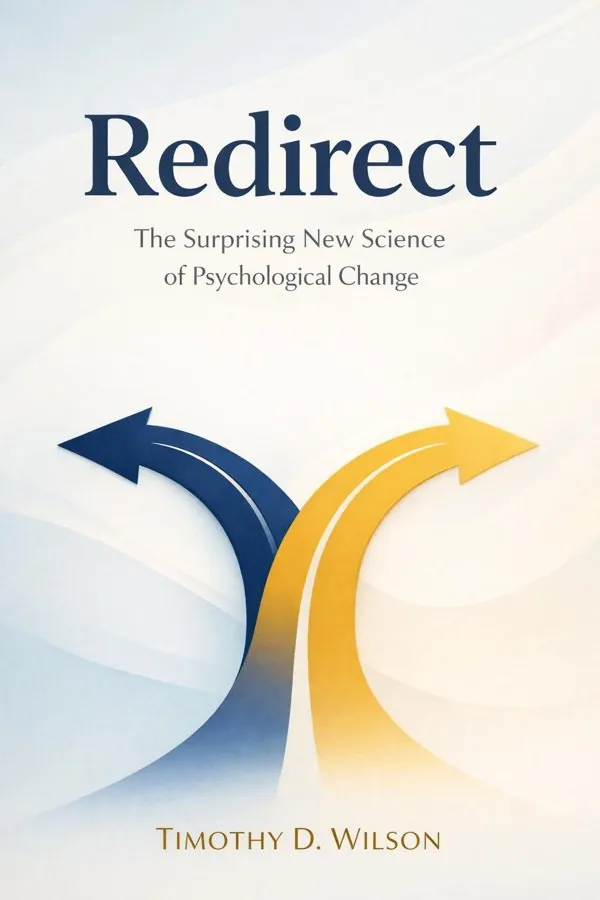
Redirect: The Surprising New Science of Psychological Change: Summary & Key Insights
 10 min9 chaptersAudio available
Key Takeaways from Redirect: The Surprising New Science of Psychological Change
A change in behavior often begins as a change in interpretation.
People resist change when they feel they are being lectured, diagnosed, or manipulated.
Insight alone is fragile unless it is activated.
Sometimes the most powerful psychological tool is a blank page.
Big change does not always require big programs.
What Is Redirect: The Surprising New Science of Psychological Change About?
Redirect: The Surprising New Science of Psychological Change by Timothy D. Wilson is a psychology book spanning 4 pages. Why do some people change for the better after a small shift in perspective, while others remain stuck despite years of advice, motivation, and good intentions? In Redirect, social psychologist Timothy D. Wilson argues that lasting change often begins not with willpower, but with interpretation. People live by stories: stories about who they are, why things happen, what others think of them, and what their future holds. When those stories become distorted, hopeless, or self-defeating, behavior follows. But when they are gently revised, the effects can be powerful and surprisingly durable. Drawing on decades of research in social psychology, Wilson introduces the science of “story editing,” a practical approach to changing the meaning people assign to their experiences. Rather than offering vague inspiration, he shows how carefully designed interventions can improve academic performance, relationships, health, and social outcomes. This book matters because it bridges rigorous science and everyday life, revealing how subtle psychological shifts can produce real-world transformation. Wilson’s authority comes from his long career studying self-knowledge, the unconscious mind, and the hidden forces that shape human behavior.
This FizzRead summary covers all 9 key chapters of Redirect: The Surprising New Science of Psychological Change in approximately 10 minutes, distilling the most important ideas, arguments, and takeaways from Timothy D. Wilson's work. Also available as an audio summary and Key Quotes Podcast.
Redirect: The Surprising New Science of Psychological Change
Why do some people change for the better after a small shift in perspective, while others remain stuck despite years of advice, motivation, and good intentions? In Redirect, social psychologist Timothy D. Wilson argues that lasting change often begins not with willpower, but with interpretation. People live by stories: stories about who they are, why things happen, what others think of them, and what their future holds. When those stories become distorted, hopeless, or self-defeating, behavior follows. But when they are gently revised, the effects can be powerful and surprisingly durable. Drawing on decades of research in social psychology, Wilson introduces the science of “story editing,” a practical approach to changing the meaning people assign to their experiences. Rather than offering vague inspiration, he shows how carefully designed interventions can improve academic performance, relationships, health, and social outcomes. This book matters because it bridges rigorous science and everyday life, revealing how subtle psychological shifts can produce real-world transformation. Wilson’s authority comes from his long career studying self-knowledge, the unconscious mind, and the hidden forces that shape human behavior.
Who Should Read Redirect: The Surprising New Science of Psychological Change?
This book is perfect for anyone interested in psychology and looking to gain actionable insights in a short read. Whether you're a student, professional, or lifelong learner, the key ideas from Redirect: The Surprising New Science of Psychological Change by Timothy D. Wilson will help you think differently.
- ✓Readers who enjoy psychology and want practical takeaways
- ✓Professionals looking to apply new ideas to their work and life
- ✓Anyone who wants the core insights of Redirect: The Surprising New Science of Psychological Change in just 10 minutes
Want the full summary?
Get instant access to this book summary and 100K+ more with Fizz Moment.
Get Free SummaryAvailable on App Store • Free to download
Key Chapters
A change in behavior often begins as a change in interpretation. One of Wilson’s central insights is that human beings do not simply react to events; they explain them. We are natural storytellers, constantly creating narratives about success, failure, rejection, effort, identity, and belonging. These stories feel like objective truth, but they are often partial, biased, or flat-out wrong. Yet because they guide expectations and actions, they can become self-fulfilling.
This is the foundation of story editing. If a student interprets one bad grade as proof of low ability, motivation drops and future performance declines. If the same grade is understood as feedback, effort increases and results improve. The event is the same; the meaning changes everything. Wilson shows that small narrative shifts can redirect lives because people act in accordance with the story they believe.
What makes this approach so powerful is that it does not require pretending that problems do not exist. Story editing is not blind optimism. It is the careful replacement of unhelpful interpretations with more accurate, useful ones. Someone who feels socially excluded, for example, may benefit from understanding that awkward early interactions are normal rather than evidence of permanent unlikability.
In practice, this idea applies everywhere: parenting, leadership, education, therapy, and personal growth. A manager can frame mistakes as learning opportunities instead of incompetence. A parent can help a child see conflict with friends as a common part of growing up, not a personal flaw. An individual can challenge the internal script that says, “I always fail,” and replace it with, “I am still learning how to do this well.”
Actionable takeaway: Pay attention to the explanations you repeatedly give yourself. When something difficult happens, ask: “What story am I telling, and is there a more accurate, more helpful way to understand this?”
People resist change when they feel they are being lectured, diagnosed, or manipulated. One of the surprising lessons in Redirect is that effective psychological interventions are often subtle rather than forceful. Wilson emphasizes that people are more likely to embrace a new narrative when they feel they have discovered it for themselves.
This is why direct persuasion so often fails. Telling someone to “be more confident” or “stop thinking negatively” can backfire because it creates pressure and defensiveness. Story editing works differently. It offers a believable reinterpretation of experience and allows individuals to integrate that interpretation into their own self-understanding. The intervention is light-touch, but the internal effects can be deep.
For example, a student from an underrepresented group may worry that early academic struggles mean they do not belong. A well-designed intervention might expose them to stories from older students who explain that these doubts are common and temporary. The point is not to deny struggle; it is to normalize it. That subtle shift can reduce anxiety, preserve effort, and improve outcomes.
Wilson’s research suggests that timing and context matter. A reframed story is most useful when it arrives at a moment of uncertainty, before a negative belief has hardened into identity. This has major implications for schools, workplaces, and families. Rather than waiting for serious disengagement, we can intervene early with interpretations that protect motivation and hope.
The broader message is that durable change often depends less on intensity than on fit. A small, credible story delivered at the right moment can outperform dramatic advice. People do not need slogans; they need meanings they can live inside.
Actionable takeaway: When trying to help someone change, avoid preaching. Offer a realistic alternative interpretation they can adopt on their own, especially during moments of doubt or transition.
Insight alone is fragile unless it is activated. Wilson explains that one powerful way to encourage change is through story prompting, a method that nudges people to generate healthier interpretations themselves. Instead of simply receiving a message, individuals are invited to reflect, explain, advise, or teach. This makes the new story feel more personally true and more behaviorally relevant.
The logic is simple: people are often persuaded most effectively by their own words. When someone writes about how challenges can be temporary, or offers advice to another person facing similar struggles, they reinforce that perspective internally. Story prompting helps transform a psychological insight into a guiding narrative.
Wilson pairs this with the idea of “do good, be good,” which shows that action can shape identity. We often assume that beliefs cause behavior, but the reverse can also happen. If a person performs caring, disciplined, or brave actions, they may begin to see themselves as caring, disciplined, or brave. A student who tutors peers may start to think, “I am someone who contributes.” A teenager who volunteers may develop a stronger moral identity not because they were told to be good, but because they acted in ways that made goodness part of their story.
This has practical uses in education, relationships, and self-development. If you want to become more confident, one path is not to wait until you feel confident, but to take repeated actions that a confident person would take. If a team wants to improve its culture, members should not only discuss values but practice them through visible routines and acts of support.
Actionable takeaway: To make a new story stick, write about it, explain it to someone else, and back it up with small actions that embody the identity you want to build.
Sometimes the most powerful psychological tool is a blank page. Wilson highlights the research on expressive writing and reflective narration to show how writing can help people process upsetting experiences and reduce their emotional grip. The benefit does not come merely from venting. It comes from organizing experience into a coherent story.
When people go through stress, loss, humiliation, or confusion, their thoughts often become fragmented. The mind circles around unanswered questions: Why did this happen? What does it mean about me? What now? Writing helps convert emotional chaos into structured understanding. In doing so, it can reduce rumination and create distance from pain.
Wilson is careful not to present writing as magic. Not every kind of writing heals, and not every problem can be solved through reflection alone. But when writing helps people identify patterns, reinterpret events, or locate growth inside difficulty, it can be transformative. A breakup can move from “I was rejected because I am unlovable” to “This relationship revealed what I need and how I want to grow.” A professional setback can shift from “I am a failure” to “I tied too much of my worth to one outcome.”
Writing also creates evidence of change over time. By revisiting past entries, people can see how emotions evolved, how assumptions softened, and how resilience developed. In therapeutic, educational, and personal contexts, this makes writing a low-cost but potentially high-impact intervention.
The core lesson is that reframing pain does not mean denying it. It means making meaning from it. When people become authors rather than prisoners of their experiences, emotional recovery becomes more possible.
Actionable takeaway: When facing a difficult experience, spend 15 to 20 minutes writing about what happened, what it means, and how your understanding might be broader or kinder than your first interpretation.
Big change does not always require big programs. One of the most compelling aspects of Redirect is Wilson’s demonstration that brief, well-designed psychological interventions can have long-term effects. This challenges the assumption that meaningful change must be intensive, expensive, or prolonged.
The reason small interventions can matter so much is that they alter a person’s trajectory at critical moments. If someone is on the edge of giving up, withdrawing, or internalizing a harmful belief, a modest narrative shift can influence the next choice, then the next, and then the next. Over time, these choices accumulate into substantial differences in performance, health, and well-being.
Think of a freshman entering college who worries they do not belong. If that worry leads to isolation, lower participation, and weaker grades, the consequences can snowball. But if an early intervention normalizes uncertainty and frames discomfort as temporary, the student may stay engaged. That engagement then creates better experiences, which confirm the healthier story. The intervention is small, but it redirects the path.
This principle matters for policy and institutions. Schools, healthcare systems, and workplaces often search for large structural solutions, and those are sometimes necessary. But Wilson reminds us not to overlook strategic, psychologically informed moments where a small message, exercise, or shift in framing can create disproportionate benefits.
For individuals, this is encouraging. You do not need to redesign your entire life overnight. A better question is: where is the key turning point? What is the recurring interpretation that, if changed, would unlock a different pattern?
Actionable takeaway: Identify one area where you feel stuck and look for the smallest meaningful intervention: a new explanation, ritual, conversation, or exercise that could shift your next decision in a better direction.
Many people suffer not just from problems, but from the belief that their problems reveal a fixed self. Wilson argues against this trap by showing how identity is shaped continuously by context, interpretation, and experience. We are not infinitely flexible, but neither are we locked into a permanent essence. The stories people tell about “who I am” can either freeze growth or support it.
A person who says, “I am bad at relationships,” “I am lazy,” or “I am not leadership material,” turns temporary patterns into stable identity claims. Once this happens, change becomes psychologically harder because every setback appears to confirm the label. Story editing interrupts that process by separating current behavior from permanent identity. Instead of “I am this way,” the story becomes, “This is a pattern I have learned, and patterns can be changed.”
This distinction is especially important for children, adolescents, and anyone in transition. Labels from teachers, parents, peers, or workplaces can become internal narratives that shape future performance. Praising a child only for being “smart,” for instance, may lead them to fear challenge. Framing effort, strategy, and growth gives them a more adaptable identity.
In adult life, the same principle applies. Career setbacks do not have to mean “I picked the wrong path and I am incapable.” Conflict in marriage does not have to mean “We are broken.” Struggles with habit change do not have to mean “I lack discipline by nature.” Identity is not merely discovered; it is edited, enacted, and revised.
Wilson’s contribution is to show that this is not motivational fluff but a psychologically grounded way to reduce shame and preserve agency.
Actionable takeaway: Replace identity-based self-judgments with process-based language. Instead of saying “I am bad at this,” say “I am learning how to handle this more effectively.”
We like to think that first we change our minds, then we change our lives. Wilson shows that the sequence often runs in both directions. Behavior can lead belief. The actions people take influence how they see themselves, what they expect from the future, and what stories feel believable.
This insight connects with decades of research in social psychology, including self-perception theory and cognitive dissonance. If people repeatedly act in ways that are generous, persistent, or socially open, they often infer that those qualities reflect who they are. This is why even small, structured actions can help build new narratives. The person who starts exercising regularly begins to think of themselves as someone who values health. The employee who speaks up in meetings starts to feel more agentic. The neighbor who joins a local project starts identifying with the community more strongly.
The practical implication is liberating. You do not need to wait for a complete internal transformation before taking action. In fact, waiting may keep you stuck. A more effective strategy is to behave in line with the story you want to inhabit, even before it feels natural. Over time, the behavior gives the story credibility.
This principle is also useful in overcoming discouragement. When motivation is low, people often look inward for the right feeling. Wilson’s work suggests another route: create conditions for action first. Set up small commitments, social accountability, and repeatable behaviors. Identity then catches up.
Whether the goal is kindness, confidence, resilience, or belonging, action is not merely the result of self-concept. It is one of its builders.
Actionable takeaway: Pick one concrete behavior that reflects the person you want to become, and repeat it consistently for a week. Let the action begin rewriting your self-story.
Personal stories are powerful, but collective stories shape entire societies. Wilson extends his argument beyond individual change to show how social problems, including prejudice and inequality, are sustained by the meanings groups attach to one another. People do not only inherit institutions; they inherit narratives about who belongs, who is threatening, who is competent, and what is normal.
These narratives can be astonishingly resilient because they are reinforced through culture, media, education, and everyday interaction. Yet they are not untouchable. Wilson suggests that social progress often depends on changing the stories people use to interpret members of other groups and their own place within society.
For example, interventions that humanize out-groups, increase meaningful contact, or challenge stereotypes can reduce bias because they weaken simplistic narratives. A school that helps students see cultural difference as enriching rather than dangerous creates a different social psychology than one that leaves divisions unnamed. Likewise, communities that frame civic identity in inclusive terms can reduce us-versus-them thinking.
Importantly, Wilson does not imply that storytelling alone solves structural injustice. Material conditions and policy matter. But narratives influence whether reforms are accepted, resisted, or even imagined in the first place. Story editing at the societal level means changing the lenses through which people interpret social reality.
This applies to organizations too. A workplace can subtly communicate that only certain personalities lead, or it can build stories of leadership that include a wider range of styles and backgrounds. A community can define struggling youth as problems to contain or as people whose potential needs support.
Actionable takeaway: Notice the repeated group stories in your environment. Ask which ones divide, diminish, or stereotype, and actively introduce examples and conversations that support a more humane narrative.
One reason many interventions fail is that they aim at the wrong target. Wilson insists that psychological change works best when the intervention fits the actual problem people are trying to solve. Not every issue is a story problem, and not every story problem is the same. Some people need new interpretations; others need skills, resources, safety, or structural support.
This makes Redirect more sophisticated than standard self-help. Wilson is not claiming that reframing alone can overcome poverty, trauma, discrimination, or illness. Rather, he argues that where interpretation is part of the problem, changing interpretation can meaningfully improve outcomes. The challenge is diagnosis. What exactly is driving the behavior? Is a student underperforming because of poor study habits, stereotype threat, lack of belonging, or unstable housing? Each requires a different response.
Story editing is most effective when it addresses a real psychological bottleneck. If a person keeps failing because they secretly believe every setback proves they are doomed, then a new narrative may unlock effort and persistence. But if they lack information or opportunity, reframing by itself will not be enough. This emphasis on precision is one of Wilson’s great strengths.
For leaders, teachers, therapists, and parents, the lesson is to resist one-size-fits-all solutions. Before offering encouragement, ask what story is operating. Before designing a program, ask what interpretation is blocking progress. Then pair narrative change with practical support.
This balanced view protects the concept of story editing from becoming shallow positivity. It is not about telling everyone to think better. It is about understanding where meaning-making is shaping outcomes and intervening intelligently.
Actionable takeaway: Before trying to fix a problem, identify whether the main obstacle is interpretation, skill, environment, or resources. Use story editing where it fits, and combine it with practical support where needed.
All Chapters in Redirect: The Surprising New Science of Psychological Change
About the Author
Timothy D. Wilson is an American social psychologist, researcher, and professor best known for his work on self-knowledge, the unconscious mind, and the hidden psychological forces that shape human behavior. He has spent much of his academic career at the University of Virginia, where he developed a reputation for combining rigorous research with unusually clear public writing. Wilson’s scholarship often explores how people misunderstand the causes of their own thoughts, feelings, and actions, and how carefully designed interventions can improve well-being. He is the author of the widely praised Strangers to Ourselves: Discovering the Adaptive Unconscious, as well as Redirect. Across his work, Wilson has focused on making social psychology practical, showing how scientific insights can help individuals, educators, and institutions create meaningful change.
Get This Summary in Your Preferred Format
Read or listen to the Redirect: The Surprising New Science of Psychological Change summary by Timothy D. Wilson anytime, anywhere. FizzRead offers multiple formats so you can learn on your terms — all free.
Available formats: App · Audio · PDF · EPUB — All included free with FizzRead
Download Redirect: The Surprising New Science of Psychological Change PDF and EPUB Summary
Key Quotes from Redirect: The Surprising New Science of Psychological Change
“A change in behavior often begins as a change in interpretation.”
“People resist change when they feel they are being lectured, diagnosed, or manipulated.”
“Insight alone is fragile unless it is activated.”
“Sometimes the most powerful psychological tool is a blank page.”
“Big change does not always require big programs.”
Frequently Asked Questions about Redirect: The Surprising New Science of Psychological Change
Redirect: The Surprising New Science of Psychological Change by Timothy D. Wilson is a psychology book that explores key ideas across 9 chapters. Why do some people change for the better after a small shift in perspective, while others remain stuck despite years of advice, motivation, and good intentions? In Redirect, social psychologist Timothy D. Wilson argues that lasting change often begins not with willpower, but with interpretation. People live by stories: stories about who they are, why things happen, what others think of them, and what their future holds. When those stories become distorted, hopeless, or self-defeating, behavior follows. But when they are gently revised, the effects can be powerful and surprisingly durable. Drawing on decades of research in social psychology, Wilson introduces the science of “story editing,” a practical approach to changing the meaning people assign to their experiences. Rather than offering vague inspiration, he shows how carefully designed interventions can improve academic performance, relationships, health, and social outcomes. This book matters because it bridges rigorous science and everyday life, revealing how subtle psychological shifts can produce real-world transformation. Wilson’s authority comes from his long career studying self-knowledge, the unconscious mind, and the hidden forces that shape human behavior.
More by Timothy D. Wilson
You Might Also Like

The Body Keeps the Score
Bessel van der Kolk
10 min
Surrounded by Idiots
Thomas Erikson
10 min
Emotional Intelligence
Daniel Goleman
10 min
Attached
Amir Levine
10 min
Why Does He Do That
Lundy Bancroft
10 min
Women Who Run with the Wolves
Clarissa Pinkola Estés
10 minBrowse by Category
Ready to read Redirect: The Surprising New Science of Psychological Change?
Get the full summary and 100K+ more books with Fizz Moment.