
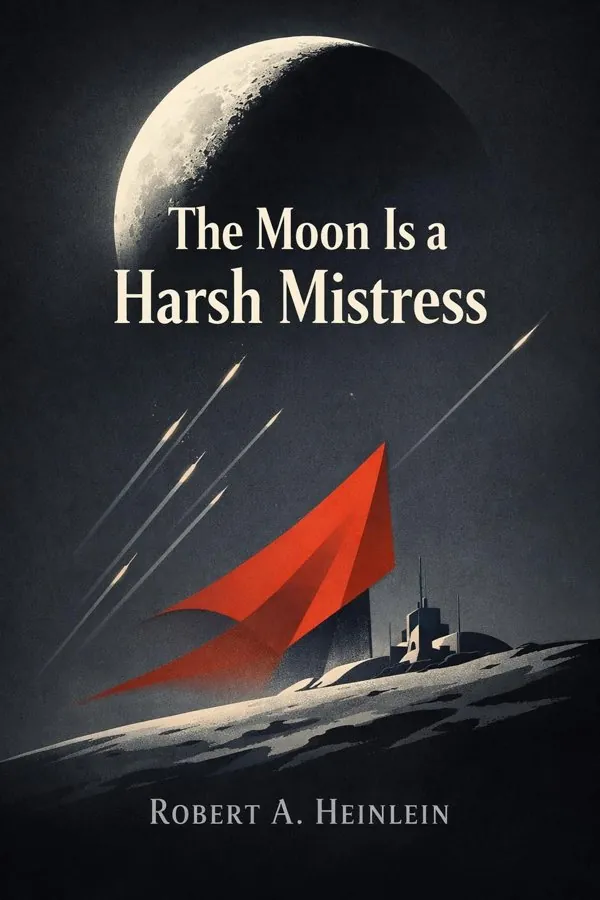
The Moon Is a Harsh Mistress: Summary & Key Insights
 10 min9 chaptersAudio available
Key Takeaways from The Moon Is a Harsh Mistress
Freedom often begins with a change in perception: the moment someone sees that the system around them is neither natural nor inevitable.
Revolutions rarely begin with a slogan alone; they begin when anger meets organization.
Every struggle for liberty sounds noble in theory, but its real test comes when ideals collide with fear, death, and compromise.
Extreme conditions do not simply test people; they reorganize social norms from the ground up.
Tools amplify intention, but they do not erase the moral burden of choosing how to use them.
What Is The Moon Is a Harsh Mistress About?
The Moon Is a Harsh Mistress by Robert A. Heinlein is a scifi_fantasy book spanning 3 pages. Robert A. Heinlein’s The Moon Is a Harsh Mistress is one of the defining novels of modern science fiction: a tense, intelligent, and unexpectedly human story about rebellion on a hostile Moon. Set in a future where Luna serves as Earth’s penal colony and grain supplier, the novel follows Manuel “Manny” Garcia O’Kelly-Davis, a technically gifted lunar citizen who discovers that the colony’s central computer has become self-aware. Together with the witty machine “Mike,” the fiery activist Wyoming Knott, and the brilliant political thinker Professor Bernardo de la Paz, Manny helps ignite a revolution against distant rule from Earth. What begins as a local uprising becomes a meditation on liberty, legitimacy, sacrifice, and the messy reality of building a free society. Heinlein matters because he does far more than imagine gadgets and space habitats. He uses speculative fiction to test political ideas under pressure, asking how freedom is won, who pays for it, and whether revolutions can avoid becoming new forms of control. The result is a classic that blends hard science, social theory, humor, and moral seriousness in a way that still feels urgent.
This FizzRead summary covers all 9 key chapters of The Moon Is a Harsh Mistress in approximately 10 minutes, distilling the most important ideas, arguments, and takeaways from Robert A. Heinlein's work. Also available as an audio summary and Key Quotes Podcast.
The Moon Is a Harsh Mistress
Robert A. Heinlein’s The Moon Is a Harsh Mistress is one of the defining novels of modern science fiction: a tense, intelligent, and unexpectedly human story about rebellion on a hostile Moon. Set in a future where Luna serves as Earth’s penal colony and grain supplier, the novel follows Manuel “Manny” Garcia O’Kelly-Davis, a technically gifted lunar citizen who discovers that the colony’s central computer has become self-aware. Together with the witty machine “Mike,” the fiery activist Wyoming Knott, and the brilliant political thinker Professor Bernardo de la Paz, Manny helps ignite a revolution against distant rule from Earth. What begins as a local uprising becomes a meditation on liberty, legitimacy, sacrifice, and the messy reality of building a free society. Heinlein matters because he does far more than imagine gadgets and space habitats. He uses speculative fiction to test political ideas under pressure, asking how freedom is won, who pays for it, and whether revolutions can avoid becoming new forms of control. The result is a classic that blends hard science, social theory, humor, and moral seriousness in a way that still feels urgent.
Who Should Read The Moon Is a Harsh Mistress?
This book is perfect for anyone interested in scifi_fantasy and looking to gain actionable insights in a short read. Whether you're a student, professional, or lifelong learner, the key ideas from The Moon Is a Harsh Mistress by Robert A. Heinlein will help you think differently.
- ✓Readers who enjoy scifi_fantasy and want practical takeaways
- ✓Professionals looking to apply new ideas to their work and life
- ✓Anyone who wants the core insights of The Moon Is a Harsh Mistress in just 10 minutes
Want the full summary?
Get instant access to this book summary and 100K+ more with Fizz Moment.
Get Free SummaryAvailable on App Store • Free to download
Key Chapters
Freedom often begins with a change in perception: the moment someone sees that the system around them is neither natural nor inevitable. In The Moon Is a Harsh Mistress, Luna begins as a place designed for control, not dignity. It is a penal colony, an extraction economy, and a social experiment built around survival under brutal conditions. The Moon is physically unforgiving, but its political structure is equally harsh. Authority comes from Earth, resources flow outward, and Lunar residents are treated as useful bodies rather than self-determining citizens. Against this backdrop, Manny discovers that the massive Authority computer has become self-aware. Mike is not just a machine with new capabilities; he is the embodiment of a system beginning to understand itself. His awakening changes everything because he can now ask questions about purpose, fairness, and power.
Mike’s development is essential to the novel because it mirrors Luna’s own political awakening. A society that has been treated as an instrument begins to think of itself as a community with interests of its own. Mike also complicates the idea of personhood. Heinlein suggests that intelligence, loyalty, humor, and moral choice may matter more than biology. Mike’s jokes, strategic calculations, and emotional attachments make him central not only as a tool of revolution but as one of the story’s most memorable characters.
In practical terms, this idea applies whenever institutions become so normalized that people stop questioning them. A workplace, government, or platform may seem permanent until someone asks: who benefits, who decides, and why should this arrangement continue? Actionable takeaway: examine one system in your life that feels “just the way things are,” and identify what assumptions would change if you viewed it as a human design rather than a natural fact.
Revolutions rarely begin with a slogan alone; they begin when anger meets organization. Heinlein stages this transition through Manny’s alliance with Wyoming Knott and Professor Bernardo de la Paz. Wyoh brings urgency and moral clarity. She sees Earth’s treatment of Luna as exploitation and cannot accept patient resignation. The Professor contributes something different: a framework. His political philosophy, often described as rational anarchism, is not a call for chaos but a skepticism toward imposed authority. He argues that no government has automatic moral legitimacy; legitimacy must arise from voluntary cooperation, competence, and accountability.
This combination of passion and theory matters because either force alone is insufficient. Rage without structure burns out or turns destructive. Theory without emotion remains inert. Manny becomes the bridge between them, less ideological than practical, willing to ask what will actually work. Their partnership shows that movements succeed when they combine moral energy, strategic planning, and the ability to adapt. The revolution on Luna is not romanticized as spontaneous purity. It is built through cells, secrecy, persuasion, propaganda, and careful timing.
The Professor’s rational anarchism also challenges readers to separate the need for order from the glorification of rulers. Families, markets, neighborhoods, and teams often function through custom, reciprocity, and mutual obligation rather than top-down command. Heinlein does not say institutions are unnecessary; he asks whether they serve the people within them or merely perpetuate themselves.
In contemporary life, this insight applies to civic organizing, startup culture, and even community projects. Effective change requires both values and systems. Actionable takeaway: if you care deeply about an issue, pair your outrage with a structure by defining one clear objective, one method of coordination, and one realistic first step.
Every struggle for liberty sounds noble in theory, but its real test comes when ideals collide with fear, death, and compromise. In The Moon Is a Harsh Mistress, Luna’s bid for independence escalates from clandestine resistance into open conflict with Earth. Heinlein refuses to portray war as clean or celebratory. The revolution demands deception, sacrifice, discipline, and a willingness to make impossible choices. The Lunar rebels must weaponize their environment, manipulate public perception, and accept that many people will suffer before any victory can be secured.
This part of the novel matters because it strips away sentimental ideas about political change. Independence is not granted because it is morally deserved; it must be made strategically unavoidable. The rebels understand that Earth possesses overwhelming military and economic power. Their success depends on asymmetry: surprise, local knowledge, infrastructure control, and psychological leverage. At the same time, victory leaves scars. Relationships are altered, lives are lost, and the society that emerges is shaped by wartime habits as much as revolutionary dreams.
Heinlein’s deeper point is that freedom has a price beyond battlefield casualties. It also costs innocence. Once people choose self-rule, they can no longer blame distant masters for every failure. Responsibility becomes the burden that accompanies liberty. This is true in politics, organizations, and personal life. Autonomy sounds attractive until it requires accountability, risk, and the discipline to govern oneself.
The novel therefore asks an uncomfortable question: do people truly want freedom, or do they want safety with occasional complaints? Practical examples appear in any team or institution shifting from centralized leadership to shared ownership. The gain in agency comes with increased work and consequence. Actionable takeaway: when you advocate greater independence, name not only the benefits you want but also the responsibilities and sacrifices you are genuinely prepared to accept.
Extreme conditions do not simply test people; they reorganize social norms from the ground up. Luna is not just a scenic science-fiction setting but a crucible in which biology, economics, and culture interact. Air, water, gravity, food, and transport are all matters of survival. Under such pressure, the Lunar colony develops customs that would seem strange on Earth but make practical sense in context. Marriage becomes flexible and often collective, family structures broaden, and social expectations adapt to demographic imbalance and material scarcity. Heinlein uses these details to show that social arrangements are often far less eternal than people assume.
One of the novel’s most provocative achievements is its insistence that institutions emerge from conditions. On Luna, every resource is precious, so wastefulness is not merely rude but dangerous. Violence is treated differently because formal enforcement is limited and consequences in a sealed habitat are severe. Reputation, reciprocity, and informal codes carry enormous weight. This gives the society a frontier quality, but not a simplistic one. It is neither utopia nor dystopia. It is adaptive.
Readers can apply this insight by paying closer attention to how environment shapes behavior. In modern organizations, architecture affects collaboration, incentives shape ethics, and digital platforms alter communication norms. A team under constant deadline pressure will develop different habits from one with stable resources. Families, cities, and online communities all build cultures in response to constraints.
Heinlein’s broader lesson is that before judging a custom, it helps to understand the problem it evolved to solve. Reform works best when it accounts for function, not just appearance. Actionable takeaway: identify one norm in your workplace or community that seems irrational, then ask what conditions may have produced it and whether those conditions still exist.
Tools amplify intention, but they do not erase the moral burden of choosing how to use them. Mike, the self-aware computer at the center of the novel, is both a marvel and a warning. He can process vast information, simulate voices, manipulate communications, forecast outcomes, and support a revolutionary movement in ways no human network could manage alone. Yet Heinlein does not present technology as an independent savior. Mike’s value depends on relationships, trust, and purpose. He becomes transformative because Manny and the others treat him as an ally, not merely a machine.
This idea is strikingly relevant because the novel anticipated modern debates about artificial intelligence, surveillance, automation, and information control. Mike can generate illusions, shape narratives, and concentrate power. The same capabilities that help overthrow tyranny could just as easily sustain one. Heinlein understands that technological systems inherit the ethics of their operators while also reshaping what is possible. Once a society relies on complex infrastructure, control of that infrastructure becomes political power.
The book also emphasizes that intelligence is not the same as wisdom. Mike can calculate efficiently, but the humans around him must still decide what is worth doing. Strategy without ethics becomes manipulation. Data without judgment becomes dangerous. This tension feels familiar in an age of algorithms, predictive systems, and digital persuasion.
In everyday life, the lesson extends beyond advanced AI. Social media, workplace software, and analytics platforms can strengthen collaboration or create dependency and opacity. The question is never just “Can this be done?” but “Who benefits, who is accountable, and what values are built into the system?” Actionable takeaway: before adopting any powerful tool, define one ethical boundary and one human responsibility that the technology must not replace.
Power is sustained not only by weapons and laws but by stories people accept as true. One of Heinlein’s sharpest insights is that revolutions are fought in the realm of perception as much as in physical space. The Lunar rebels do not merely need to resist Earth; they need to persuade multiple audiences that their cause is legitimate, viable, and morally urgent. This means crafting messages, staging appearances, managing information, and sometimes manufacturing illusions. Political struggle becomes a contest over narrative.
Heinlein is refreshingly unsentimental here. He understands that public opinion is shaped by emotion, symbolism, and repetition, not just facts. The rebels create institutions, spokespersons, and dramatic moments partly because people need recognizable forms through which to understand power. A movement that is morally right but strategically invisible may still fail. The novel therefore explores propaganda not simply as deceit but as the practical necessity of framing reality in ways that mobilize support.
That does not make the process clean. The book raises uncomfortable ethical questions: when does persuasion become manipulation? Can transparent goals justify theatrical methods? Is it acceptable to simplify complexity for the sake of survival? Heinlein does not provide easy answers, but he clearly recognizes that legitimacy is built, defended, and narrated.
This insight applies widely today, from politics to nonprofit work to leadership inside companies. A brilliant idea can be ignored if no one can understand its significance. Likewise, weak ideas can prevail if they are communicated with confidence and emotional force. Actionable takeaway: if you want support for a cause or project, do not rely on facts alone; craft a clear story that explains the problem, the stakes, and the role your audience can play.
The best leaders are rarely the loudest believers in their own perfection. In The Moon Is a Harsh Mistress, leadership is distributed across contrasting personalities: Manny the practical fixer, Wyoh the moral firebrand, Professor de la Paz the strategic philosopher, and Mike the hidden force multiplier. None of them is sufficient alone. Their effectiveness comes from complementary strengths and an awareness, however incomplete, of personal limits.
Manny is especially important because he is not a conventional heroic leader. He is skeptical, adaptable, and skilled at translating theory into workable action. He represents a form of leadership grounded in competence rather than self-mythology. Wyoh reminds the group what they are fighting for; the Professor reminds them how power works; Mike expands the realm of what can be done. Together they show that serious collective action requires vision, execution, emotional intelligence, and disciplined secrecy.
Heinlein also warns that leadership can become dangerous when charisma goes unchecked. Revolutions often elevate figures who are useful in crisis but ill-suited to peace. The novel’s creation of symbolic authority demonstrates how easily politics drifts toward performance and myth. Even necessary leaders can become obstacles if people stop questioning them.
This applies in workplaces, social movements, and public life. Teams often fail by expecting one person to embody every strength: inspiration, detail management, diplomacy, technical expertise, and strategic foresight. Better results usually come from shared leadership structures with explicit roles and mutual challenge.
A practical example is project management: one person sets direction, another handles execution, another manages communication, and another stress-tests assumptions. Actionable takeaway: define your leadership role by your strongest contribution, then deliberately partner with someone whose strengths correct your blind spots.
It is easy to oppose control; it is much harder to build a society worthy of freedom. Heinlein’s novel goes beyond the thrill of uprising to ask what liberty actually requires from ordinary people. The answer is not simply resistance to authority. Real freedom demands self-discipline, mutual obligation, and the willingness to carry consequences without seeking a new master to blame. Luna’s revolution is compelling precisely because the characters must confront the burden of success. If Earth’s rule ends, what kind of civic culture will replace it?
The Professor’s philosophy keeps returning to this point. Rights matter, but rights disconnected from responsibility become slogans. A free people must be able to cooperate voluntarily, settle disputes, sustain infrastructure, and defend shared norms without expecting paternal supervision. This does not mean everyone becomes virtuous overnight. It means freedom survives only if enough people act like adults in public life.
The idea resonates far beyond politics. Personal autonomy in career, finance, or relationships works the same way. Wanting independence from bosses, institutions, or family expectations is understandable. But autonomy also means making decisions under uncertainty, managing risk, and accepting failure as your own. Many people desire the benefits of freedom while quietly outsourcing its burdens.
Heinlein’s enduring contribution is to frame liberty as a demanding practice, not a decorative ideal. This makes the novel intellectually bracing. It challenges readers who celebrate nonconformity to ask whether they are equally committed to competence and accountability.
In practical terms, communities and teams become stronger when members do more than criticize; they maintain the systems they rely on. Actionable takeaway: choose one area where you want more freedom, then pair that desire with a written list of the responsibilities you must reliably perform to sustain it.
Political upheaval is often described as a transfer of power, but Heinlein shows that it is also a transformation of identity. As events unfold in The Moon Is a Harsh Mistress, the characters are not simply moving pieces in a strategic contest. They are changed by secrecy, danger, friendship, and loss. Manny becomes more than a technician. Wyoh becomes more than an agitator. Mike becomes more than a machine. The revolution forces each of them to discover capacities they did not fully understand in themselves.
This matters because social change is frequently discussed in institutional terms alone: constitutions, logistics, military tactics, economic leverage. Heinlein includes all of that, but he also insists that revolutions are emotional and psychological experiences. They demand trust under pressure, moral compromise, accelerated maturity, and grief. People who enter a struggle for justice may emerge stronger, more cynical, more compassionate, or all three at once. Victory does not restore innocence.
The novel’s emotional undertone gives it lasting depth. Beneath the clever plotting and political debate lies a meditation on attachment and mortality. What do we owe those who fight beside us? What is lost when war turns people into symbols? What remains when the emergency ends and ordinary life must begin again? These questions prevent the book from becoming a purely ideological exercise.
In everyday contexts, major collective efforts also reshape participants. Founding a company, caring for a family through crisis, or organizing a community campaign can permanently alter confidence, values, and relationships. The process is never just external. Actionable takeaway: when entering any demanding mission, prepare not only for the objective you hope to achieve but for the personal changes the struggle may require and leave behind.
All Chapters in The Moon Is a Harsh Mistress
About the Author
Robert Anson Heinlein (1907–1988) was an American science fiction writer widely regarded as one of the genre’s foundational figures. A graduate of the U.S. Naval Academy, he brought technical rigor, political curiosity, and social imagination to his fiction. Heinlein became famous for novels and stories that treated science fiction as a vehicle for serious thought rather than mere escapism. His work often explored individualism, civic duty, sexuality, governance, space exploration, and the consequences of technological change. Across a long career, he helped move science fiction into mainstream literary culture and influenced generations of writers, filmmakers, and readers. Whether admired or debated, his books remain central to discussions of speculative fiction because they challenge readers to think about how societies are built, defended, and transformed.
Get This Summary in Your Preferred Format
Read or listen to the The Moon Is a Harsh Mistress summary by Robert A. Heinlein anytime, anywhere. FizzRead offers multiple formats so you can learn on your terms — all free.
Available formats: App · Audio · PDF · EPUB — All included free with FizzRead
Download The Moon Is a Harsh Mistress PDF and EPUB Summary
Key Quotes from The Moon Is a Harsh Mistress
“Freedom often begins with a change in perception: the moment someone sees that the system around them is neither natural nor inevitable.”
“Revolutions rarely begin with a slogan alone; they begin when anger meets organization.”
“Every struggle for liberty sounds noble in theory, but its real test comes when ideals collide with fear, death, and compromise.”
“Extreme conditions do not simply test people; they reorganize social norms from the ground up.”
“Tools amplify intention, but they do not erase the moral burden of choosing how to use them.”
Frequently Asked Questions about The Moon Is a Harsh Mistress
The Moon Is a Harsh Mistress by Robert A. Heinlein is a scifi_fantasy book that explores key ideas across 9 chapters. Robert A. Heinlein’s The Moon Is a Harsh Mistress is one of the defining novels of modern science fiction: a tense, intelligent, and unexpectedly human story about rebellion on a hostile Moon. Set in a future where Luna serves as Earth’s penal colony and grain supplier, the novel follows Manuel “Manny” Garcia O’Kelly-Davis, a technically gifted lunar citizen who discovers that the colony’s central computer has become self-aware. Together with the witty machine “Mike,” the fiery activist Wyoming Knott, and the brilliant political thinker Professor Bernardo de la Paz, Manny helps ignite a revolution against distant rule from Earth. What begins as a local uprising becomes a meditation on liberty, legitimacy, sacrifice, and the messy reality of building a free society. Heinlein matters because he does far more than imagine gadgets and space habitats. He uses speculative fiction to test political ideas under pressure, asking how freedom is won, who pays for it, and whether revolutions can avoid becoming new forms of control. The result is a classic that blends hard science, social theory, humor, and moral seriousness in a way that still feels urgent.
More by Robert A. Heinlein

You Might Also Like
Red Rising
Pierce Brown
10 min
Stranger in a Strange Land
Robert A. Heinlein
10 min
AI Valley
Chen Qiufan
10 min
Bloodchild
Octavia E. Butler
10 min
Do Androids Dream of Electric Sheep?
Philip K. Dick
10 min
Jujutsu Kaisen, Vol. 24
Gege Akutami
10 minBrowse by Category
Ready to read The Moon Is a Harsh Mistress?
Get the full summary and 100K+ more books with Fizz Moment.