
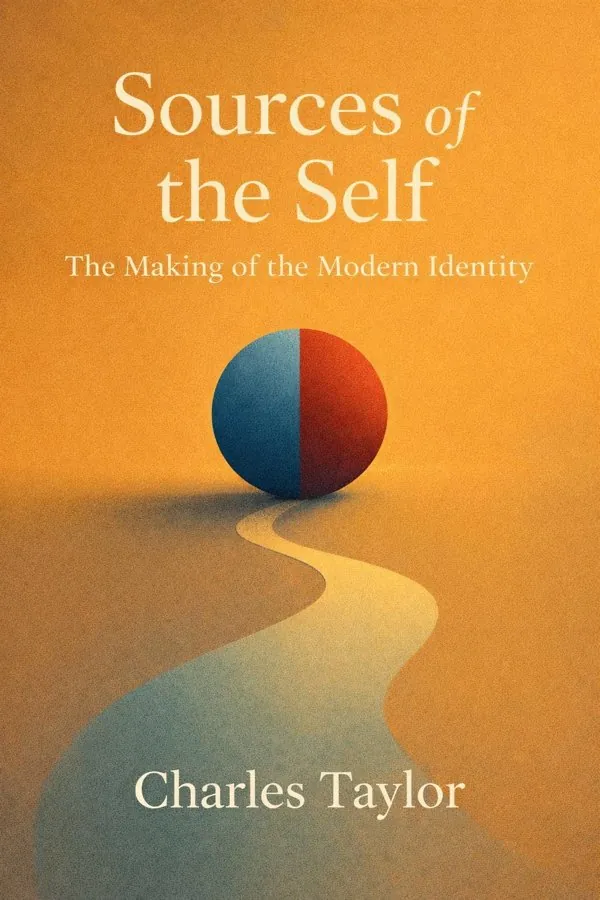
Sources of the Self: The Making of the Modern Identity: Summary & Key Insights
 10 min9 chaptersAudio available
Key Takeaways from Sources of the Self: The Making of the Modern Identity
A self is never formed in a vacuum; it first appears within a world already charged with meaning.
One of the most revolutionary changes in Western identity came when moral life moved inward.
Modern identity often feels natural because we are so accustomed to living from the inside out.
Few modern ideals are more powerful than the belief that reason should free us from illusion.
One of modernity’s most cherished beliefs is that each person has a unique way of being human.
What Is Sources of the Self: The Making of the Modern Identity About?
Sources of the Self: The Making of the Modern Identity by Charles Taylor is a western_phil book spanning 9 pages. What does it mean to be a modern self? Why do ideas like authenticity, inner depth, personal freedom, and moral autonomy feel so natural to us today? In Sources of the Self, Charles Taylor answers these questions through a sweeping intellectual history of Western identity. Rather than treating the self as timeless, Taylor shows that our most familiar assumptions about personhood were historically formed through changing moral, religious, and philosophical frameworks. From Plato and Augustine to Descartes, Rousseau, and Nietzsche, he traces how the modern individual emerged from ancient notions of cosmic order, Christian inwardness, Enlightenment rationality, and Romantic self-expression. The book matters because it reveals that identity is never morally neutral: every way of understanding the self depends on deeper visions of the good. Taylor’s great contribution is to uncover those hidden “moral sources” that still guide modern life, even when we pretend to live beyond tradition. A leading Canadian philosopher and one of the most influential interpreters of modernity, Taylor brings rare historical breadth and philosophical depth to a question that touches everyone: who are we, and how did we come to see ourselves this way?
This FizzRead summary covers all 9 key chapters of Sources of the Self: The Making of the Modern Identity in approximately 10 minutes, distilling the most important ideas, arguments, and takeaways from Charles Taylor's work. Also available as an audio summary and Key Quotes Podcast.
Sources of the Self: The Making of the Modern Identity
What does it mean to be a modern self? Why do ideas like authenticity, inner depth, personal freedom, and moral autonomy feel so natural to us today? In Sources of the Self, Charles Taylor answers these questions through a sweeping intellectual history of Western identity. Rather than treating the self as timeless, Taylor shows that our most familiar assumptions about personhood were historically formed through changing moral, religious, and philosophical frameworks. From Plato and Augustine to Descartes, Rousseau, and Nietzsche, he traces how the modern individual emerged from ancient notions of cosmic order, Christian inwardness, Enlightenment rationality, and Romantic self-expression. The book matters because it reveals that identity is never morally neutral: every way of understanding the self depends on deeper visions of the good. Taylor’s great contribution is to uncover those hidden “moral sources” that still guide modern life, even when we pretend to live beyond tradition. A leading Canadian philosopher and one of the most influential interpreters of modernity, Taylor brings rare historical breadth and philosophical depth to a question that touches everyone: who are we, and how did we come to see ourselves this way?
Who Should Read Sources of the Self: The Making of the Modern Identity?
This book is perfect for anyone interested in western_phil and looking to gain actionable insights in a short read. Whether you're a student, professional, or lifelong learner, the key ideas from Sources of the Self: The Making of the Modern Identity by Charles Taylor will help you think differently.
- ✓Readers who enjoy western_phil and want practical takeaways
- ✓Professionals looking to apply new ideas to their work and life
- ✓Anyone who wants the core insights of Sources of the Self: The Making of the Modern Identity in just 10 minutes
Want the full summary?
Get instant access to this book summary and 100K+ more with Fizz Moment.
Get Free SummaryAvailable on App Store • Free to download
Key Chapters
A self is never formed in a vacuum; it first appears within a world already charged with meaning. Taylor begins in the ancient Greek and classical tradition, where thinkers such as Plato and Aristotle understood human beings as situated within a larger moral and cosmic order. To know who you were was not mainly to discover private feelings or personal preferences. It was to understand your place in a structured reality in which reason, virtue, and purpose were woven into the nature of the world itself. The good life meant aligning oneself with that order.
This ancient framework matters because it reminds us that identity was once inseparable from orientation toward the good. Plato emphasized the harmony of the soul under the rule of reason, while Aristotle saw flourishing as the cultivation of virtue through practice, character, and participation in community. The self was not imagined as radically independent. It was formed by education, habit, political life, and an objective moral hierarchy.
A practical application of this idea appears whenever we ask not just what we want, but what kind of person we should become. For example, someone choosing between a lucrative career and a meaningful but less prestigious vocation is still, in a sense, asking an ancient question about human flourishing. The language has changed, but the moral challenge remains.
Taylor uses this world to show that modern identity did not begin with individual choice alone. It emerged out of older traditions in which the self was defined by its orientation toward excellence, order, and shared ideals. Actionable takeaway: when reflecting on your identity, ask not only what feels right to you, but what vision of human flourishing your choices are serving.
One of the most revolutionary changes in Western identity came when moral life moved inward. Taylor argues that Christianity transformed the ancient picture of the self by making interiority central. In classical thought, moral order was largely read off the cosmos. In Christian thought, especially in Augustine, the decisive moral drama increasingly takes place within the soul. The path to truth is no longer only outward, through rational contemplation of the order of being, but inward, through conscience, self-examination, and relation to God.
Augustine becomes a pivotal figure because he teaches that God is found in the depths of inwardness. This does not mean the self becomes isolated or self-sufficient. On the contrary, the inward turn is a way of discovering dependence on divine grace. The human agent becomes a being who must search the heart, confess disorder, and reorient desire. Identity is now tied to sincerity, repentance, and the inner life.
This Christian development remains visible in modern habits that seem secular. Think of journaling, therapy, self-reflection, or the expectation that a person should be true not only in action but in intention. Even when God is absent from the picture, we still assume that inner motives matter profoundly. We judge hypocrisy more harshly than mere error because inwardness has become morally weighty.
Taylor’s point is that modern interiority did not suddenly arise with psychology or individualism. It has deep spiritual roots. The modern concern with conscience, authenticity, and inner truth owes much to this Christian reshaping of the moral self. Actionable takeaway: strengthen your self-understanding by examining not just what you do, but the deeper loves, loyalties, and motives organizing your inner life.
Modern identity often feels natural because we are so accustomed to living from the inside out. Taylor shows that this inwardness was historically constructed. Over time, the self came to be understood less as a node in a fixed cosmic order and more as an interior space of reflection, conviction, and experience. This shift was not a single event but a long development involving religion, philosophy, and changing forms of social life.
In the early modern era, inwardness becomes more disciplined and self-conscious. Individuals are increasingly expected to monitor themselves, regulate desire, and define their own commitments. The self gains depth. It becomes something one can explore, narrate, and shape. This is the background for later ideas of personality, authenticity, and psychological identity.
We can see this in everyday expectations. Employers value self-awareness. Friends encourage emotional honesty. Education often aims to help students “find their voice.” Social media, for all its distortions, assumes that identity should be expressed from within. These practices make sense only in a culture that treats the inner life as a privileged source of truth.
But Taylor also warns that inwardness has a cost. The more identity is centered internally, the easier it becomes to forget the larger moral horizons that give inner life significance. Feelings alone cannot provide a full moral map. Without frameworks of worth, inwardness can collapse into confusion or narcissism.
Taylor’s history helps us see both the achievement and fragility of modern interiority. It gives dignity to the inner life while reminding us that inwardness still depends on standards we do not invent from nothing. Actionable takeaway: cultivate self-reflection, but always test your inner convictions against enduring moral commitments, relationships, and responsibilities.
Few modern ideals are more powerful than the belief that reason should free us from illusion. Taylor argues that the Enlightenment gave this impulse a new shape by elevating the image of the self as rational, autonomous, and capable of disengagement. Thinkers such as Descartes and Locke helped define a subject who can step back from custom, passion, and inherited authority in order to examine the world clearly and govern life through methodical reason.
This was a major achievement. The disengaged self made possible scientific inquiry, legal equality, political criticism, and the ideal of individual rights. If people can reason independently, they need not simply submit to tradition. Modern institutions from constitutional government to evidence-based medicine owe much to this moral image of rational agency.
Yet Taylor insists that the Enlightenment picture is not merely a neutral description of how minds work. It is also a moral ideal. It praises self-control, objectivity, discipline, and mastery. The danger comes when we forget that this model is partial. Human beings are not only calculating intellects. We are embodied, emotional, historical, and socially formed.
A practical example appears in contemporary workplaces that prize efficiency, productivity, and measurable outcomes. These values can improve performance, but when they become absolute, they reduce people to functions and overlook meaning, loyalty, and dignity. The same happens in personal life when every decision is treated as a technical problem rather than a moral one.
Taylor does not reject Enlightenment reason; he places it in context. Rational autonomy is valuable, but it cannot replace deeper sources of value. Actionable takeaway: use reason rigorously, but resist the temptation to treat human life as if it were only a matter of calculation, control, and efficiency.
One of modernity’s most cherished beliefs is that each person has a unique way of being human. Taylor traces this ideal to Romantic expressivism, especially in figures like Rousseau and later expressive traditions that celebrate feeling, imagination, and originality. Against overly rigid models of reason and social conformity, Romanticism insists that moral life involves discovering and articulating one’s own voice. Authenticity becomes a central value.
This development transformed how people think about identity. The good life is no longer only about obeying universal reason or fulfilling inherited roles. It is also about fidelity to one’s inner calling. Artistic creativity becomes morally important. So do individuality, emotional depth, and resistance to flattening social norms. To betray oneself by living according to external scripts starts to look like a profound moral failure.
Today this ideal is everywhere. People seek careers that reflect their passions, relationships that affirm who they “really are,” and lifestyles that feel personally meaningful rather than socially prescribed. Even consumer culture borrows the language of authenticity, encouraging people to express their true selves through taste and choice.
Taylor appreciates the dignity in this ideal but also exposes its vulnerabilities. Authenticity becomes distorted when it is cut loose from dialogue, community, and standards of worth. A self cannot define itself meaningfully in total isolation. If being true to yourself means only doing whatever feels immediate or private, authenticity becomes shallow. Genuine self-expression requires engagement with what is significant beyond the self.
Taylor’s insight is that authenticity is a moral achievement, not a permission slip for self-indulgence. Actionable takeaway: pursue a life that feels genuinely your own, but define authenticity through disciplined self-knowledge, dialogue with others, and commitment to goods larger than personal preference.
The deepest claim in Taylor’s book is that human identity is always connected to what he calls moral sources. These are the visions, beliefs, and frameworks that empower us to make sense of dignity, obligation, fulfillment, and the good life. Even when modern people imagine themselves as independent choosers, their choices still draw meaning from background assumptions about what is noble, admirable, sacred, or worth pursuing.
Taylor challenges the idea that morality can be reduced to isolated preferences or procedural rules. We do not merely rank options arbitrarily. We live through what he calls “strong evaluations,” judging some desires as higher, more worthwhile, or more worthy of us than others. A person may want comfort yet still feel called to courage, loyalty, truth, or compassion. Such judgments reveal that identity is shaped by qualitative distinctions, not just by desire satisfaction.
This helps explain why purely relativistic accounts of the self feel thin. In practice, people still appeal to fairness, authenticity, justice, love, or human dignity. A doctor working long hours, a parent sacrificing for a child, or an activist enduring risk for a cause all act from moral sources that reach beyond convenience.
Taylor’s contribution is to make these background sources visible again. Secular modernity often lives off inherited moral capital while denying its depth. The result can be confusion: we continue to affirm human rights, equality, and authenticity, but struggle to explain why they should matter.
Understanding your moral sources clarifies your identity. It reveals what truly animates your commitments and where your deepest loyalties lie. Actionable takeaway: identify the values or beliefs you treat as non-negotiable, and ask what larger moral vision gives them their authority in your life.
Modern freedom has expanded our options, but it has also fractured our shared moral world. Taylor argues that contemporary identity develops under conditions of plurality, contestation, and loss of common horizons. Ancient and medieval societies often assumed broad agreement about the structure of reality and the highest good. Modern societies do not. Individuals now navigate competing frameworks: religious faith, scientific naturalism, liberal rights, artistic authenticity, consumer aspiration, therapeutic self-care, and political ideology.
This fragmentation creates both possibility and instability. On one hand, people can critically examine inherited authorities and pursue lives of genuine conviction. On the other hand, it becomes harder to sustain confidence in any single moral language. Many people oscillate between incompatible ideals: autonomy and belonging, efficiency and meaning, self-expression and duty. The modern self can feel rich in options yet poor in orientation.
A clear example is the pressure many people experience in ordinary life. They may believe they should pursue meaningful work, maintain financial security, remain true to themselves, care for family, contribute to society, and optimize personal wellness all at once. These goods are not always harmonious. Without a hierarchy of values, identity becomes stretched and anxious.
Taylor does not romanticize old certainties, but he insists that fragmentation has moral consequences. When no framework appears authoritative, cynicism and shallowness become temptations. People may retreat into lifestyle branding, procedural neutrality, or private satisfaction while losing touch with deeper moral purpose.
His diagnosis encourages humility and seriousness. The challenge is not to eliminate plurality but to live within it without surrendering the search for higher goods. Actionable takeaway: when you feel pulled in too many directions, consciously rank your values and articulate the moral horizon that should guide your major life decisions.
A society can become highly efficient while growing morally disoriented. Taylor criticizes the dominance of instrumental reason, the mindset that treats rationality mainly as the calculation of the most effective means to a given end. Instrumental reason is indispensable in technology, economics, administration, and planning. The problem begins when this mode of thought expands beyond its proper limits and becomes the default way of understanding human life itself.
When instrumental reason dominates, people ask how to maximize output, reduce friction, improve systems, and optimize behavior. These are useful questions, but they do not tell us which ends are worthy. A hospital may become efficient while losing compassion. Education may become measurable while neglecting wisdom. A person may optimize productivity while forgetting friendship, contemplation, or moral courage.
Taylor’s concern is especially relevant today. Data-driven systems increasingly shape work, relationships, and politics. We quantify attention, health, learning, and even emotional life. Yet what matters most often resists easy measurement: trust, loyalty, reverence, beauty, and dignity. Once everything is translated into utility, the moral texture of life thins out.
This critique is not anti-science or anti-technology. Taylor does not deny the power of practical reason. He warns against allowing it to become sovereign. Human beings need qualitative distinctions between better and worse ways of living, not just more efficient methods. Without such distinctions, freedom itself becomes empty, because we become excellent at pursuing ends we have never examined.
Actionable takeaway: the next time you plan a major decision, ask two questions instead of one: not only “What works best?” but also “What is genuinely worth pursuing, and why?”
The modern self becomes more intelligible when we recover the language of moral depth. Taylor argues that people do not merely have desires; they evaluate those desires in light of higher standards. This capacity for “strong evaluation” is essential to identity. You are not just the sum of your impulses, preferences, or passing moods. You are also the being who can judge some motives as base, others as noble, some actions as degrading, others as worthy.
This idea offers a path beyond both rigid traditionalism and shallow subjectivism. It allows us to acknowledge freedom while retaining moral seriousness. A person can reject inherited norms and still make profound distinctions between courage and cowardice, love and manipulation, truthfulness and self-deception. Identity is formed through these qualitative judgments.
In practical terms, strong evaluation appears whenever someone says, “I could do this, but it would make me less of the person I want to be.” A student tempted to cheat, an executive pressured to deceive clients, or a friend deciding whether to keep a difficult promise all confront not just choices but questions of worth. They are evaluating what is worthy of admiration, shame, integrity, or respect.
Taylor believes modern culture often lacks confidence in speaking this way, yet our lives continue to depend on it. We hunger for meaning because we cannot live well without orienting ourselves toward goods that command our respect. Recovering moral language does not mean returning to dogmatism. It means becoming honest about the evaluative structure already present in human agency.
Actionable takeaway: when making a difficult choice, name the higher and lower goods involved, then decide in a way that strengthens the kind of character you most deeply respect.
All Chapters in Sources of the Self: The Making of the Modern Identity
About the Author
Charles Taylor is a Canadian philosopher celebrated for his work on ethics, political theory, secularism, and the history of ideas. Born in 1931, he studied at McGill University and the University of Oxford, where he was influenced by both analytic and continental traditions. He later taught for decades at McGill and became one of the most important interpreters of modern identity and moral life. Taylor’s writing is known for combining philosophical rigor with historical breadth, especially in his studies of modernity, authenticity, religion, and multiculturalism. Among his best-known books are Sources of the Self, The Ethics of Authenticity, and A Secular Age. His work has had wide influence across philosophy, politics, theology, and cultural criticism.
Get This Summary in Your Preferred Format
Read or listen to the Sources of the Self: The Making of the Modern Identity summary by Charles Taylor anytime, anywhere. FizzRead offers multiple formats so you can learn on your terms — all free.
Available formats: App · Audio · PDF · EPUB — All included free with FizzRead
Download Sources of the Self: The Making of the Modern Identity PDF and EPUB Summary
Key Quotes from Sources of the Self: The Making of the Modern Identity
“A self is never formed in a vacuum; it first appears within a world already charged with meaning.”
“One of the most revolutionary changes in Western identity came when moral life moved inward.”
“Modern identity often feels natural because we are so accustomed to living from the inside out.”
“Few modern ideals are more powerful than the belief that reason should free us from illusion.”
“One of modernity’s most cherished beliefs is that each person has a unique way of being human.”
Frequently Asked Questions about Sources of the Self: The Making of the Modern Identity
Sources of the Self: The Making of the Modern Identity by Charles Taylor is a western_phil book that explores key ideas across 9 chapters. What does it mean to be a modern self? Why do ideas like authenticity, inner depth, personal freedom, and moral autonomy feel so natural to us today? In Sources of the Self, Charles Taylor answers these questions through a sweeping intellectual history of Western identity. Rather than treating the self as timeless, Taylor shows that our most familiar assumptions about personhood were historically formed through changing moral, religious, and philosophical frameworks. From Plato and Augustine to Descartes, Rousseau, and Nietzsche, he traces how the modern individual emerged from ancient notions of cosmic order, Christian inwardness, Enlightenment rationality, and Romantic self-expression. The book matters because it reveals that identity is never morally neutral: every way of understanding the self depends on deeper visions of the good. Taylor’s great contribution is to uncover those hidden “moral sources” that still guide modern life, even when we pretend to live beyond tradition. A leading Canadian philosopher and one of the most influential interpreters of modernity, Taylor brings rare historical breadth and philosophical depth to a question that touches everyone: who are we, and how did we come to see ourselves this way?
More by Charles Taylor
You Might Also Like
A Little History of Philosophy
Nigel Warburton
10 min
Areopagitica
John Milton
10 min
How To Think Like A Philosopher: Essential Principles For Clear Thinking
Peter Cave
10 min
Language, Truth and Logic
A. J. Ayer
10 min
The Age of Reason
Thomas Paine
10 min
The Essays
Michel De Montaigne
10 minBrowse by Category
Ready to read Sources of the Self: The Making of the Modern Identity?
Get the full summary and 100K+ more books with Fizz Moment.